
Tasting texture
Why Ripe Pu-erh Often Feels Thicker Than Other Dark Teas
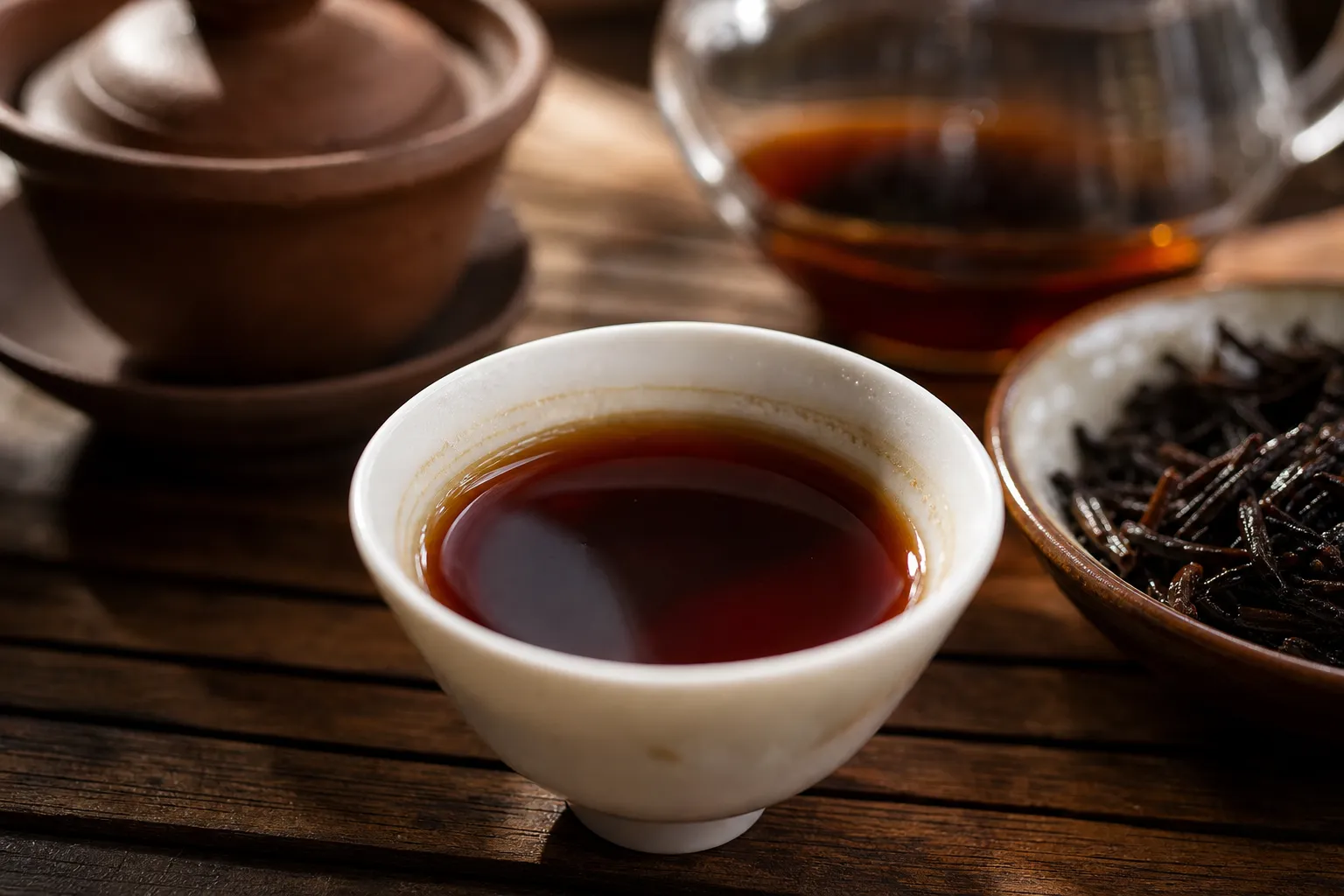
Ripe pu-erh often feels thicker because pile fermentation changes the leaf before it reaches your teapot. In many cups, that process softens sharper bitterness and astringency while building a rounder infusion with more body. That is the practical reason why ripe pu-erh tastes thick: it can feel smooth at the front, full in the middle, and lightly coating after the swallow.
This is not a rule that every shu pu-erh will feel heavier than every other dark tea. Leaf material, storage, compression, broken leaf, water temperature, steep time, and your own texture preference all matter. But ripe pu-erh has a processing path that often makes a mellow, full body easier to notice.
upward
Start with the broader guide
Use the broader guide first if you need the full scope before this page.
Thick does not simply mean strong
A strong brew and a thick brew can overlap, but they are not the same.
More leaf, a smaller vessel, hotter water, or a longer steep can make almost any dark tea stronger. The liquor may look darker, taste more concentrated, or feel heavier. That is extraction strength.
The thick ripe pu-erh mouthfeel is more specific. It often shows up as:
- A rounded entrance instead of a sharp first bite
- A smooth, low-friction feel across the tongue
- A fuller middle of the sip
- A coating or slightly sticky aftertaste
- Less obvious bitterness or drying edge
- Earthy, woody, sweet, or mellow notes that sit low in the cup
A tea can be strong but thin: dark in color, bitter around the edges, and quick to disappear. A ripe pu-erh can be only moderate in color and still feel full if the liquor has that rounded, coating body.
So do not judge texture by color alone. Ripe pu-erh often brews red-brown to dark brown, but darkness is only a clue. The better test is how the tea moves in the mouth and what remains after you swallow.
What pile fermentation changes
Ripe pu-erh, or shu pu-erh, is made through pile fermentation of sun-dried tea material. Heat, moisture, microorganisms, and enzymes reshape many taste-related compounds during that stage. For the drinker, the important part is not the lab detail; it is the change in the cup.
A 2022 sensory-directed study on ripe pu-erh described “mellow and thick” as a combined impression of mellow taste, smoothness, and sticky aftertaste. The study linked that sensation with larger or interacting materials in the infusion, including theabrownins, tea polysaccharides, soluble proteins, soluble sugars, transformed polyphenols, and related compounds. In separated tea fractions, the fraction holding more of these larger materials showed a stronger mellow and sticky character than the thinner fraction.
For everyday tasting, that gives a useful frame:
Theabrownins
Can contribute to the dark color and mellow character often associated with ripe pu-erh.
Polysaccharides, pectin-related materials, and soluble sugars
Can support a smoother, fuller, sometimes lightly sticky texture.
Protein and polysaccharide interactions
May help the liquor feel rounder rather than watery.
Transformed polyphenols and catechin changes
Can reduce the sharper astringent snap found in less-fermented material.
This does not make ripe pu-erh better by default. It only explains why many cups feel broad, soft, and coating rather than narrow and brisk.
Ripe versus raw pu-erh texture
One of the easiest comparisons is ripe pu-erh beside raw pu-erh.
Raw pu-erh, or sheng pu-erh, is not made through the same ripe pile-fermentation process. Young raw pu-erh often tastes brighter, more bitter, more astringent, and more active in the mouth. With age and storage, raw pu-erh can become rounder, but it follows a different path.
Ripe pu-erh is processed to develop a darker, mellower profile earlier. In the cup, the contrast often looks like this:
The comparison has limits. A lightly fermented ripe pu-erh may feel clean rather than heavy. An aged raw pu-erh may feel deep and rounded. A broken, low-grade ripe cake brewed hard may feel thick but coarse. Texture always comes from material, processing, storage, and brewing together.
Why other dark teas may feel thinner
Many dark teas are post-fermented, and many can be mellow. Fu brick tea, Liu Bao, Hunan dark tea, and other regional styles can all develop depth, aged aroma, and a soft cup. Ripe pu-erh does not own thickness.
The difference is that ripe pu-erh’s fermentation profile often emphasizes the cluster drinkers describe as mellow, smooth, earthy, and full-bodied. Some other dark teas may lean more toward woody clarity, mineral dryness, herbal depth, lighter sweetness, or a cleaner aged note. Those teas can be satisfying without feeling as dense across the tongue.
When comparing dark tea texture, name the kind of body you mean:
Dense body
Heavy, dark, coating, sometimes broth-like
Smooth body
Soft and low in bitterness, but not necessarily heavy
Oily body
Slick or polished, often noticed on the lips
Sticky aftertaste
Lingering coating after swallowing
Dry structure
Flavorful, but with a more tannic or mineral finish
Thin liquor
Aroma is present, but the middle of the sip feels hollow
Ripe pu-erh often stands out in dense body, smooth body, and sticky aftertaste. Other dark teas may stand out in different texture categories.
Brewing choices that change thickness
Even when the tea material is naturally full-bodied, brewing decides whether that body feels pleasant or dull. If your ripe pu-erh tastes muddy, flat, or too heavy, extraction may be the issue.
Leaf ratio
More leaf usually increases body. In a small gongfu-style vessel, a generous amount of ripe pu-erh can become dense quickly. In a mug or larger pot, the same tea may feel softer and more diluted.
If the cup feels thin, increase the leaf slightly before making the steep much longer. If it feels heavy and dull, reduce the leaf or shorten the early infusions.
Broken versus intact material
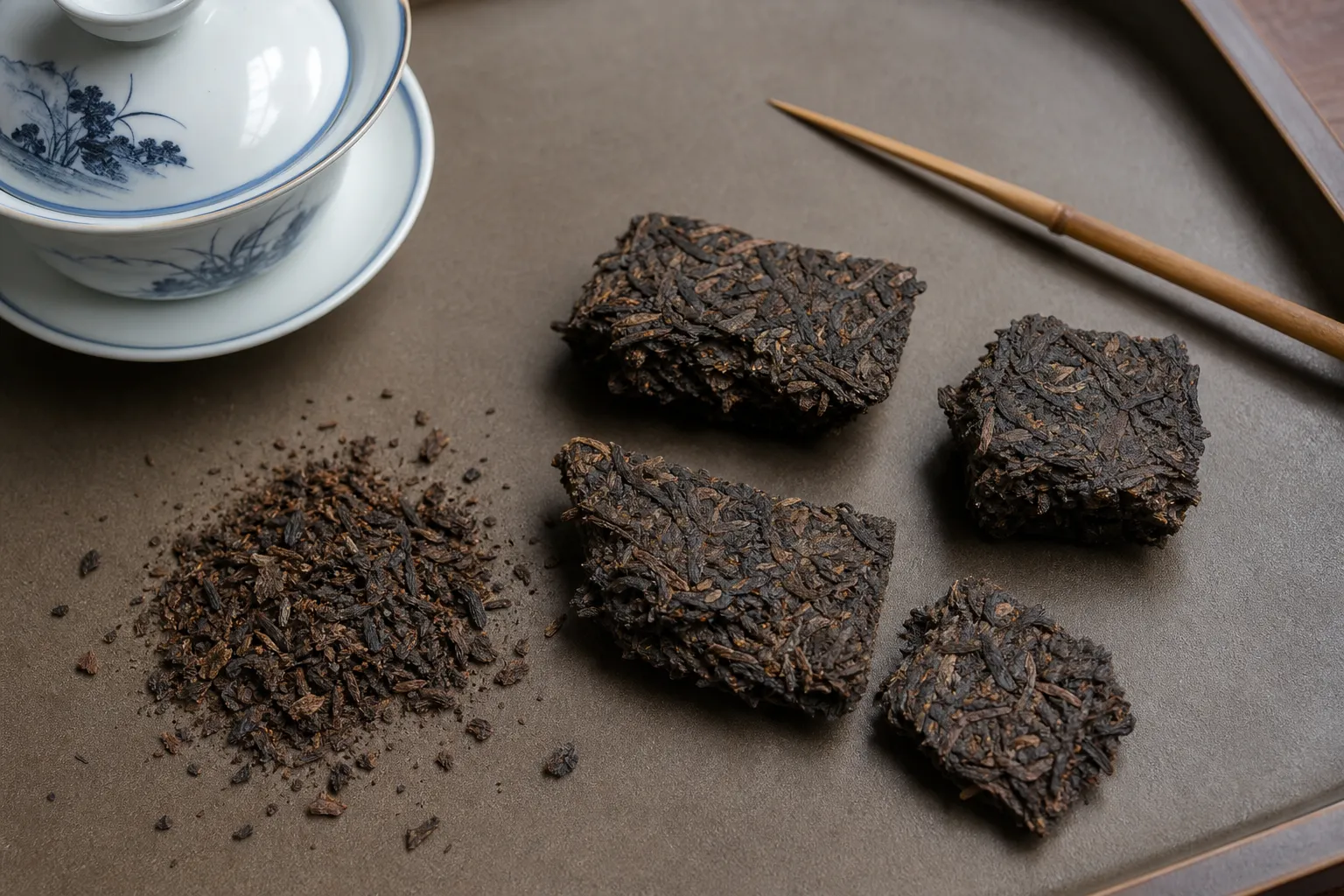
Broken leaf, crumbs from a cake, and small compressed fragments extract fast. They can give quick dark liquor and strong body, but they can also make the texture dusty, muddy, or rough.
Larger intact pieces open more slowly. They often give a cleaner progression: lighter first cup, fuller middle infusions, then a gentler finish.
If you are brewing a small broken piece of cake, use shorter early steeps. The tea may already be releasing plenty of material.
Water temperature
Ripe pu-erh is often brewed with very hot water, and many teas in this style handle heat well. Hotter water pulls body, color, and earthy depth more quickly. But if a tea already feels heavy, near-boiling water plus long steeps can flatten the cup.
If the tea tastes thick but clumsy, keep the water hot and shorten the steep. If it tastes thin and muted, hotter water may help wake up the leaf.
Steep length
Longer steeps increase extraction, but they do not always improve texture. A good mellow and thick ripe pu-erh has body with shape. An over-pushed cup may become dark and earthy without gaining clarity.
For repeated short infusions, watch the second through fourth brews. That is often where ripe pu-erh body becomes most obvious. If those cups feel too dense, cut time before changing everything else.
Rinse and early infusions
Many drinkers give compressed ripe pu-erh a brief rinse to loosen the leaf and clear the first surface extraction. This is not a rule for every tea. It is simply useful when a cake, brick, or tuo feels dusty, tight, or slow to open.
A short rinse can make the first drinkable infusion smoother. A long rinse may remove some of the early sweetness and body you wanted.
Storage can round the cup, but it can also confuse the signal
Storage affects aroma, smoothness, and how a tea presents its body. A ripe pu-erh kept in a stable, moderate environment may feel more settled over time. Harsh edges can soften, and earthy or woody notes may become more integrated.
But “older” does not automatically mean “thicker.” Temperature, humidity, airflow, packaging, compression, and original material all matter. A tea can be old and thin. A younger ripe pu-erh can be thick. A poorly stored tea can smell unpleasant even if the liquor looks dark.
This is where readers sometimes confuse earthy, musty, and moldy notes. Ripe pu-erh can have earthy or aged aromas as part of its normal profile. But thickness by itself does not prove clean storage, quality, or age. If the aroma is sharply unpleasant, visibly abnormal, or makes you hesitate, do not use body as reassurance. That is a separate storage question.
For texture tasting, separate the questions:
- Does the liquor feel full or thin?
- Is the fullness smooth, sticky, and rounded, or muddy and flat?
- Do the aromas seem clean to you, or distracting?
- Did the brewing choices make the cup heavier than intended?
That sequence keeps you from blaming fermentation for a brewing problem, or blaming brewing for a storage note.
Pleasant thickness versus over-brewing
A good thick ripe pu-erh does not have to be delicate, but it should still have shape. The cup may be earthy, dark, and full without feeling collapsed.
Pleasant ripe pu-erh body often feels
- Smooth at the front of the sip
- Rounded in the middle
- Lightly sweet, woody, earthy, or date-like depending on the tea
- Coating after the swallow
- Low in harsh drying sensation
- Full but still drinkable for several infusions
Over-extracted thickness often feels
- Muddy rather than rounded
- Heavy without sweetness
- Flat after the first impact
- Dusty or rough when much broken leaf is present
- So earthy that it covers other notes
- Tiring after a small cup
The fix is usually simple: shorten the next infusion, use slightly less leaf next time, keep broken dust out of the vessel, or brew in a larger cup if you want a softer daily drink.
A quick tasting check
To read the body of one ripe pu-erh, brew it in a way that lets texture change gradually.
Use a modest amount of leaf, very hot water, and short early infusions. Taste the first three cups for different cues:
Cup 1
Is it clean, dusty, light, or already heavy?
Cup 2
Does the body fill out, or does it only get darker?
Cup 3
Is the aftertaste smooth and coating, or flat and muddy?
If the tea becomes thicker without becoming rough, the body is likely coming from both the fermented material and balanced extraction. If it becomes dark but harsh, you may be pulling too much too quickly. If it stays thin across several infusions, the tea may be lighter in body, the leaf amount may be low, or the compressed piece may not have opened yet.
The practical answer
Ripe pu-erh often feels thicker than many other dark teas because pile fermentation can favor mellow body, smoothness, and a sticky afterfeel. Research on ripe pu-erh connects this “mellow and thick” impression with infusion materials such as theabrownins, polysaccharides, soluble proteins, sugars, and transformed polyphenols.
In the cup, that becomes a simple tasting pattern: less sharpness, more roundness, and more coating after the swallow.
Still, thickness is only one texture cue. It is not proof of quality, age, storage condition, or correct brewing. To read it well, taste beyond color, separate body from over-extraction, and adjust leaf ratio, broken material, water, and steep time until the cup feels full without becoming heavy.
Sources
Sources and further reading
Reference links are limited to sources considered suitable for public citation in this page.