
Is Ripe Pu-erh a Dark Tea or a Separate Tea Category
Yes. In many practical tea-category discussions, ripe Pu-erh is treated as a dark tea, or heicha, because ripe/shou Pu-erh goes through wet-pile post-fermentation. That is the direct answer to is ripe pu-erh a dark tea.
The useful detail is that Pu-erh is also a more specific tea identity, commonly tied to Yunnan material and Pu-erh processing conventions. Dark tea is the broader category. Ripe Pu-erh can sit under that broader umbrella, but “dark tea” is not simply another name for Pu-erh.
Raw Pu-erh is where the wording gets less tidy. Raw/sheng Pu-erh does not go through the same wet-pile ripening step, so its classification can depend on the system or context being used.
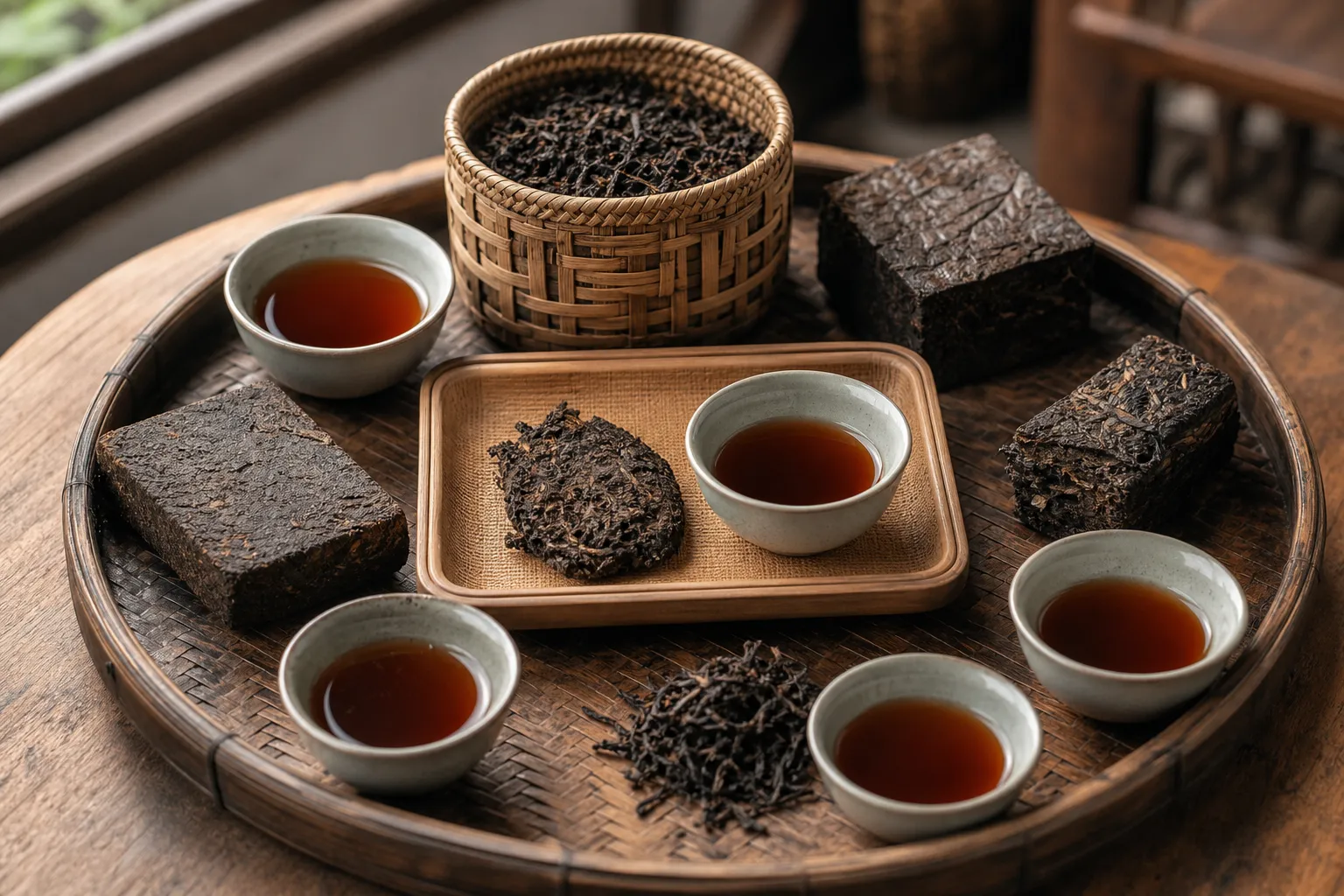
upward
Start with the broader guide
Use the broader guide first if you need the full scope before this page.
The cleanest way to say it
If you are sorting a tea shelf, writing tasting notes, or reading a product label, use this working distinction:
Tea on the label
Ripe Pu-erh, shou Pu-erh, shu Pu-erh, cooked Pu-erh
Practical category reading
Commonly grouped with dark tea/heicha
Why it matters
It undergoes wet-pile post-fermentation, often called wo dui.
Tea on the label
Raw Pu-erh, sheng Pu-erh
Practical category reading
More classification-dependent
Why it matters
It starts from sun-dried tea material and changes through storage rather than the same ripening step.
Tea on the label
Liu Bao, Anhua dark tea, Fu brick, Qing brick, other regional dark teas
Practical category reading
Dark tea, but not Pu-erh
Why it matters
They share the broader post-fermented dark tea frame, but come from different origins and processes.
Ripe/shou Pu-erh is a Pu-erh tea that is often grouped under dark tea because of its post-fermented processing.
That keeps the answer useful without pretending every tea category system uses exactly the same boundary.
Why ripe Pu-erh fits the dark tea idea
In the Chinese tea-category sense, dark tea is generally discussed through post-fermentation. The word “dark” is not only about liquor color or dry-leaf color. It points to what happens to the leaf after earlier processing steps: moisture, heat, microbes, time, and storage conditions continue to change the tea.
Ripe Pu-erh was developed around an added wet-piling process, often written as wo dui. In simple terms, tea material is moistened, piled, and managed so that microbial and heat-driven changes happen more quickly than they would through long storage alone. Tea-processing literature often separates raw and ripened Pu-erh by this pile-fermentation step, and also describes Chinese dark teas through post-fermentation.
That processing link is the main reason ripe Pu-erh is commonly placed with dark tea.
Cup cues that often support the same impression
- Red-brown to very dark liquor
- Dark brown or blackish leaf
- Earthy, woody, or damp-forest aroma
- Fuller body and a smoother mouthfeel than many young raw Pu-erhs
Those cues help, but they should not carry the whole classification. Storage, age, compression, leaf grade, brewing strength, and water can all change what you see in the cup. An old raw Pu-erh can darken. A heavily brewed tea can look deeper than expected. Start with process and label terms, then use the cup as supporting evidence.
Pu-erh and dark tea are related, not identical
The common misunderstanding is to treat “Pu-erh” and “dark tea” as exact synonyms. They are not.
Dark tea is the wider category. It can include several regional Chinese post-fermented teas. Pu-erh is one important member of that world, but not the whole world. Liu Bao from Guangxi and Anhua dark tea from Hunan are useful comparison points: they show that a tea can be dark tea without being Pu-erh.
Pu-erh also has its own identity. English tea materials often connect Pu-erh with Yunnan large-leaf material, sun-dried maocha, compressed forms such as cakes or tuo, and the raw-versus-ripe split. Those details make Pu-erh more specific than the broad term dark tea.
So the relationship is nested:
- Dark tea/heicha is the wider processing category.
- Ripe Pu-erh is commonly treated as a dark tea because of wet-pile post-fermentation.
- Pu-erh is a specific tea identity, not a synonym for every dark tea.
- Raw Pu-erh creates the most classification friction because it does not share the same ripening process.
This is why two tea sellers or books may seem to disagree. One may place all Pu-erh under a broad dark-tea heading for simplicity. Another may separate raw Pu-erh from dark tea and place only ripe Pu-erh there. Often, they are solving different naming problems.
Why raw Pu-erh makes the answer less settled
Raw Pu-erh is the reason “Pu-erh is dark tea” is too blunt.
Young raw/sheng Pu-erh is usually made without the wet-pile step used for ripe/shou Pu-erh. It may be pressed into a cake and stored for years, during which the leaf can slowly change. The dry leaf may darken. The liquor may move from pale gold toward orange, amber, or deeper tones. Aromas can become less grassy and more layered depending on storage.
That long change matters, but it is not the same as deliberate wet-pile ripening. Because of that, raw Pu-erh may be handled differently depending on whether a classification frame emphasizes origin, product family, aging potential, or the specific manufacturing step.
Ripe Pu-erh is the straightforward dark-tea case. Raw Pu-erh is more context-dependent.
That does not make raw Pu-erh less legitimate. It only means the category label needs more context.
How to read a Pu-erh label or cup
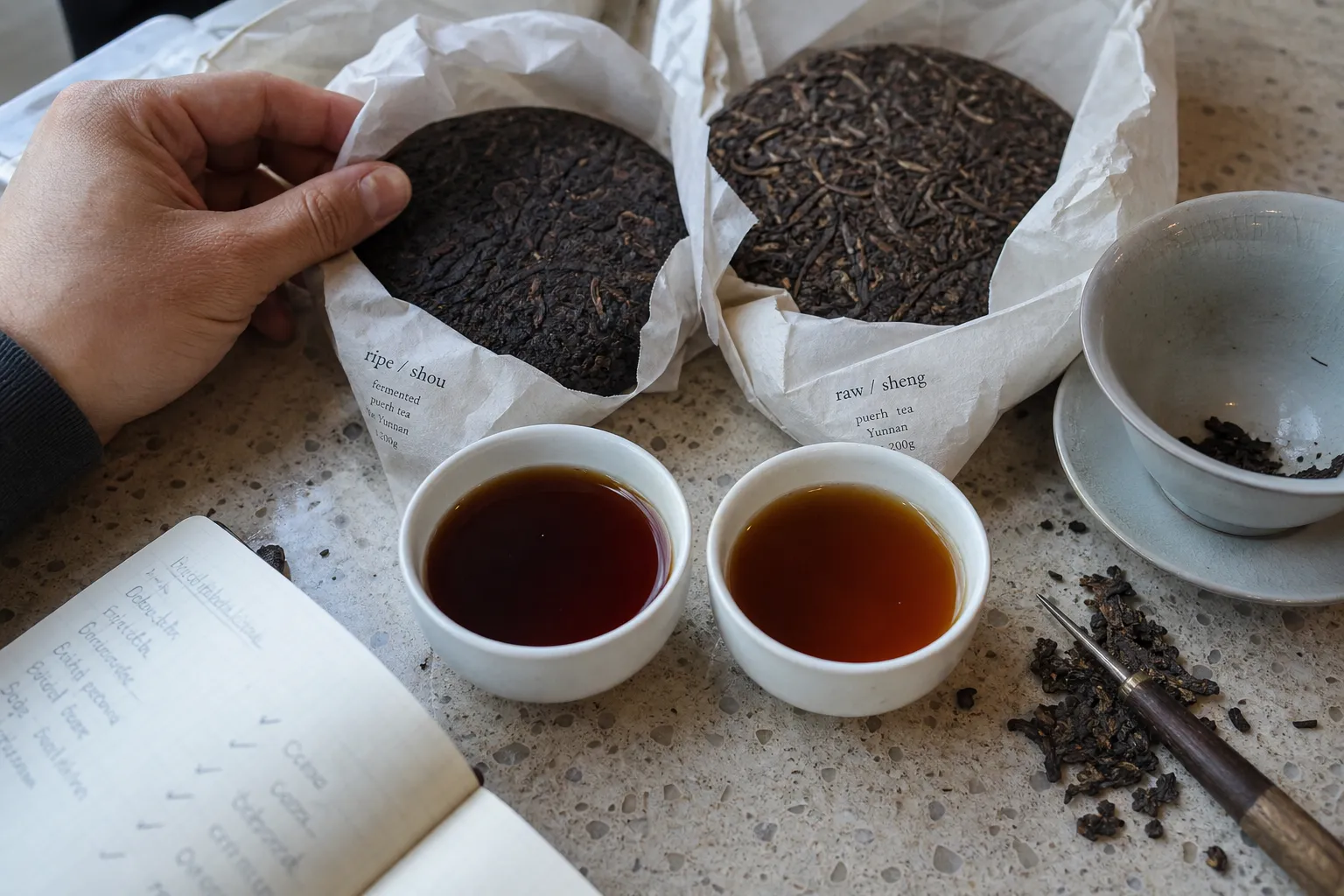
If you have a cake, brick, tuo, mini tuo, or loose tea labeled only “Pu-erh,” look for processing words before deciding what category language to use.
Terms that usually point toward ripe Pu-erh
- Ripe
- Shou
- Shu
- Cooked
- Ripened
- Wo dui
- Wet pile
- Pile fermentation
Terms that usually point toward raw Pu-erh
- Raw
- Sheng
- Green Pu-erh
- Qing
- Maocha, when used for unfinished raw material before pressing or further processing
The spellings “shou” and “shu” both appear in English tea contexts. They usually point to the ripe side of the Pu-erh split.
Cup clues can support the label reading. Ripe Pu-erh often has dark dry leaf, red-brown liquor, and a mellow earthy or woody aroma. Young raw Pu-erh often looks greener, gold, or silvery in the dry leaf and may brew golden to orange, with brighter bitterness, astringency, floral notes, or herbaceous edges.
Still, do not decide by color alone. A young ripe tea can show a damp pile note that softens with rest, while an aged raw tea can become visually dark enough to confuse a quick glance. If the label is unclear, brew lightly at first and note aroma, body, and aftertaste before forcing the tea into a category.
What changes the answer
The answer changes mostly because people use different classification frames.
Processing frame: ripe Pu-erh fits naturally with dark tea because wet-pile post-fermentation is central to its identity.
Named tea family frame: ripe and raw may be discussed together because both are Pu-erh, even though they are not processed the same way.
Retail frame: a shop may give Pu-erh its own section because buyers search for it directly. That is a navigation choice, not always a strict category statement.
Sensory frame: ripe Pu-erh may sit near other dark teas because of darker liquor, fuller body, and earthy or woody notes. Sensory similarity helps, but it is not enough on its own.
Formal terminology frame: use careful wording unless you have the exact classification text in front of you. “Commonly grouped with” is safer than making a stronger claim from a public summary alone.
Quick field answer for a tea you already own
Use this short check:
- Does the label say ripe, shou, shu, cooked, or ripened? It is reasonable to call it ripe Pu-erh and place it under dark tea in many practical tea-category discussions.
- Does the label say raw or sheng? Treat it as raw Pu-erh first. Be cautious about calling it dark tea without knowing the classification frame.
- Does the tea look dark but the label is vague? Do not decide by color alone. Old raw Pu-erh can darken, and brewing strength can deepen liquor color.
- Is it Liu Bao, Anhua, Fu brick, or another regional dark tea? It may be dark tea, but it is not Pu-erh unless it is specifically identified as Pu-erh.
- Are you writing a simple tasting note? “Ripe Pu-erh, commonly grouped with dark tea/heicha” is usually clearer than making Pu-erh and dark tea mean the same thing.
Bottom line
Ripe Pu-erh is best understood as a specific Pu-erh style that is commonly placed within the broader dark tea/heicha category because of wet-pile post-fermentation. Dark tea is broader than Pu-erh, and Pu-erh is more specific than dark tea.
So the practical answer is: yes, ripe/shou Pu-erh can be called a dark tea in many category discussions, but it is not a separate category that replaces dark tea, and dark tea is not just another name for Pu-erh. Raw/sheng Pu-erh is the part to label more carefully, because its processing and classification can be treated differently depending on the frame.
Sources
Sources and further reading
Reference links are limited to sources considered suitable for public citation in this page.