
Comparison guide
Ripe Pu-erh Compared With Other Dark Teas
If you are searching for ripe pu-erh vs dark tea, the useful question is usually not “which one is better?” It is: are you looking at the same tea under two names, or at one Pu-erh style beside a wider family of Chinese dark teas?
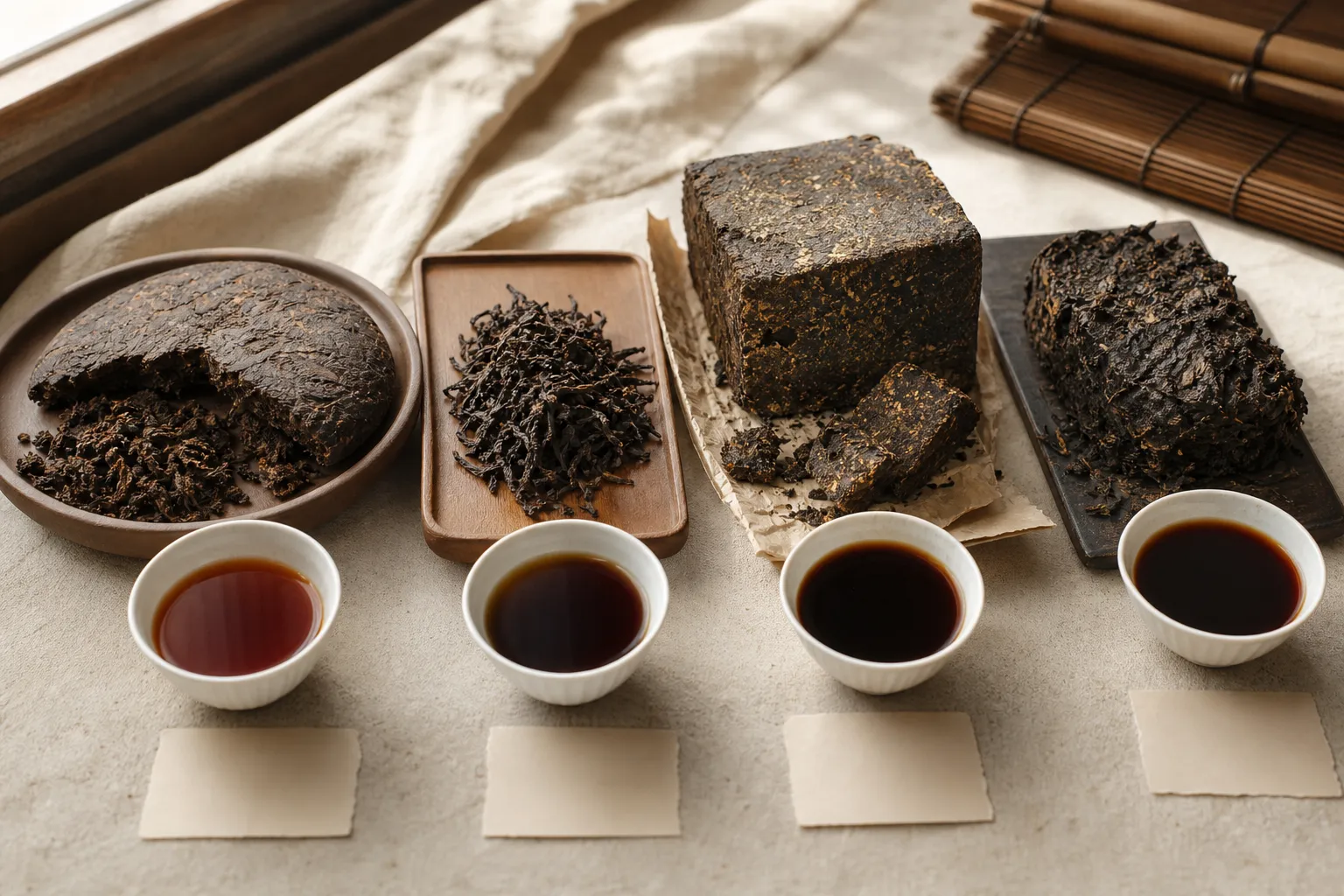
Ripe Pu-erh, also called shou or shu Pu-erh, sits close to the world of Chinese dark tea, or hei cha, because both belong to the broader conversation around post-fermented tea. But ripe Pu-erh is not a shortcut for understanding every dark tea. Liu Bao, Fu brick, Anhua dark tea, Hubei Qing brick, Sichuan dark tea, and other regional styles can differ in leaf material, processing sequence, compression, storage, aroma, and body.
The label gives you a starting map. The cup often tells you where the real difference is.
upward
Read the full overview first
Use the broader guide first if you need the full scope before this page.
Is Ripe Pu-erh a Dark Tea or a Separate Tea Category?
In everyday English tea conversation, ripe Pu-erh is often discussed alongside dark tea because it is a post-fermented tea. In Chinese tea naming, hei cha is commonly translated as “dark tea.” That translation creates two common mix-ups.
First, hei cha is not the same as Western “black tea.” In Chinese naming, what English speakers call black tea usually corresponds to hong cha, or “red tea,” because of the reddish liquor. Hei cha points to post-fermented dark teas, many of which are compressed, stored, or regionally transformed after the early tea-making steps.
Second, Pu-erh itself is not one processing path. Pu-erh is commonly divided into:
- Sheng Pu-erh, often called raw Pu-erh, which is not wet-piled during initial production and may change gradually in storage.
- Shou or shu Pu-erh, often called ripe Pu-erh, which undergoes managed wet piling, commonly called wo dui.
This page is about ripe Pu-erh. Sheng Pu-erh matters here only because many readers see “Pu-erh” on a label and assume all Pu-erh is dark, earthy, thick, and ready to brew like shu. That assumption can lead to a confusing cup.
A careful answer is: ripe Pu-erh overlaps strongly with the dark tea world, and many sources discuss it beside Chinese dark teas. Exact formal classification can depend on the standard, market context, or naming system being used. For drinking and buying, the practical distinction is clearer: ripe Pu-erh is a wet-piled Pu-erh style, while other dark teas may follow different regional post-fermentation routes.
Ripe Pu-erh vs Hei Cha: What Changes in Processing
Processing matters because it shapes what you smell in the dry leaf, how quickly the liquor darkens, and why one cup feels dense while another feels more open.
Ripe Pu-erh is closely associated with wet piling. In practical terms, tea material is gathered into piles, moistened, kept in warm and humid conditions, and managed through turning or other controls while microbial activity transforms the leaf. Factories and batches do not all work identically, but the drinker-facing point is simple: ripe Pu-erh is deliberately pushed through an accelerated post-fermentation stage before it reaches the cup.
Other dark teas can also be post-fermented, but not always in the same way. Some use different regional leaf material. Some are shaped into bricks, baskets, logs, or other compressed forms. Some develop through fermentation stages before compression; others continue changing during storage. Fu brick tea, for example, is often discussed in connection with “golden flowers,” a visible fungal growth associated with that style. Liu Bao is often compared with Pu-erh because both can show earthy, woody, and aged notes. Anhua dark teas may appear as Hei Zhuan, Hua Zhuan, Fu Zhuan, San Jian, or Qian Liang-style forms, each with its own handling and brewing implications.
Practical comparison points
Ripe Pu-erh
- Common center: wet-piled shou or shu Pu-erh.
- Key process idea: managed wo dui pile fermentation.
- Typical forms: loose, cake, brick, tuo, mini tuo.
- Cup tendency: often dark, smooth, earthy, thick.
- Main caution: not all Pu-erh is ripe.
Other Chinese dark teas
- Common center: broad hei cha styles from several regions.
- Key process idea: diverse regional post-fermentation paths.
- Typical forms: brick, basket, log, loose leaf, compressed pieces.
- Cup tendency: can be woody, grainy, herbal, floral, lighter, rustic, or thick.
- Main caution: not all dark tea tastes like Pu-erh.
The difference is not “fermented versus not fermented.” It is closer to “one recognizable wet-piled route beside a wider map of dark tea methods.”
Shu Pu-erh Beside Liu Bao, Fu Brick, and Anhua Dark Tea
The best comparison is not based on which tea is more traditional, refined, or authentic. Those words often hide the variables that actually change the cup. Look instead at material, processing, storage, compression, and brew behavior.
Shu Pu-erh vs Liu Bao tea
Liu Bao, from Guangxi, is one of the most common comparisons because it can share some of the same shop and tasting language: earthy, woody, mellow, aged, and sometimes betel-like. The feel in the cup, though, may not match ripe Pu-erh.
Ripe Pu-erh often leans toward a dense, dark, settled liquor when brewed strongly. Many examples show smooth body, low sharpness, and wet-leaf or forest-floor earthiness. Liu Bao can also be earthy, but some examples feel more woody, mineral, basket-aged, or betel-nut-like. Depending on the tea and storage, it may seem less creamy than ripe Pu-erh and more open in the aftertaste.
A useful test is to smell the wet leaves after the rinse. Ripe Pu-erh may give a warmer, heavier pile aroma, especially when young or strongly fermented. Liu Bao may show wood, old basket, camphor-like edges, betel, or a drier cellar note. Treat those as prompts, not promises.
Shu Pu-erh vs Fu brick tea
Fu brick, or Fu Zhuan, shows how broad dark tea can be. Some Fu brick teas are associated with visible golden-flower growth. That does not make Fu brick better or more advanced than ripe Pu-erh. It points to a different fermentation identity.
In the cup, Fu brick may seem lighter, grainier, more cereal-like, woody, or gently sweet compared with a heavy ripe Pu-erh. Some examples have a warm brick-tea aroma and a less opaque liquor. If ripe Pu-erh suggests dark polished wood and damp earth, Fu brick may feel more like dry grain, wood, and warm storage. The range is wide, especially across age, compression, and brewing strength.
Ripe Pu-erh vs Anhua dark tea
Anhua dark tea is not one single tea. The name may point to several Hunan dark tea forms, including brick teas and larger compressed styles. Compared with ripe Pu-erh, some Anhua-style teas can taste more rustic, woody, or grainy, with a clearer edge in the cup. Others may become rounded and sweet with time and careful storage.
If you are choosing between them, frame it as body versus structure. Ripe Pu-erh often suits drinkers who want depth, thickness, and a smooth dark liquor. Some Anhua dark teas may appeal when you want a cup that feels less heavy, more textured, or more obviously tied to compressed brick-tea character.
Why Ripe Pu-erh Often Feels Thicker
Ripe Pu-erh’s reputation for thickness is not only shop language. Research on ripe Pu-erh taste has connected its mellow, thick character with changes during pile fermentation and with larger soluble compounds such as tea polysaccharides, proteins, pectin-related material, and theabrownin-like pigments. For the drinker, that science translates into a simpler observation: the liquor can feel smooth, coating, and heavy even when bitterness is low.
That does not mean every ripe Pu-erh is thick. A lightly brewed mini tuo can taste thin. A poorly stored cake can taste flat, muddy, or dull. A very broken leaf grade can turn dark quickly and still lack sweetness or aftertaste. At the same time, some other dark teas brew with impressive body when the leaf is rich, the compression has opened well, or the steep is pushed.
In many everyday brewing setups, ripe Pu-erh often shows these clues:
- Darker liquor early: The cup may turn deep red-brown, brown-black, or nearly opaque faster than many other dark teas.
- Lower sharpness: It often feels less astringent than green tea, many oolongs, or young raw Pu-erh.
- Dense middle: The texture may sit in the center of the mouth instead of lifting quickly.
- Earthy aroma: Young or heavily fermented examples may show pile aroma, wet wood, damp leaves, or dark soil notes.
- Soft sweetness: Some cups suggest molasses, date, dark fruit, or brown sugar, especially when storage is clean and the tea is not over-steeped.
Other dark teas may be smoother, sweeter, or more aromatic in their own ways. Fu brick may give grain and wood. Liu Bao may show betel, basket, or old-wood notes. Qing brick or Sichuan dark tea may feel more straightforward, tannic, or herbal depending on the batch. Ripe Pu-erh’s thickness is a common comparison clue, not a universal rule.
Pile Aroma vs Musty Storage Notes
One of the most useful distinctions in any ripe Pu-erh comparison is the difference between processing aroma and storage aroma.
A young ripe Pu-erh may carry pile aroma from wet piling. This can show as damp wood, wet leaves, compost-like warmth, cellar, dark soil, or a humid smell. In some teas, that aroma settles with airing and time. In others, it remains central to the cup.
Storage aroma comes from the environment after the tea was made: humidity, airflow, light, nearby odors, packaging, and time. A less appealing storage note may show as stale cardboard, sour dampness, old closet, or a clinging odor that does not clear after a rinse.
Because these words overlap in ordinary tea talk, use the cup rather than the label:
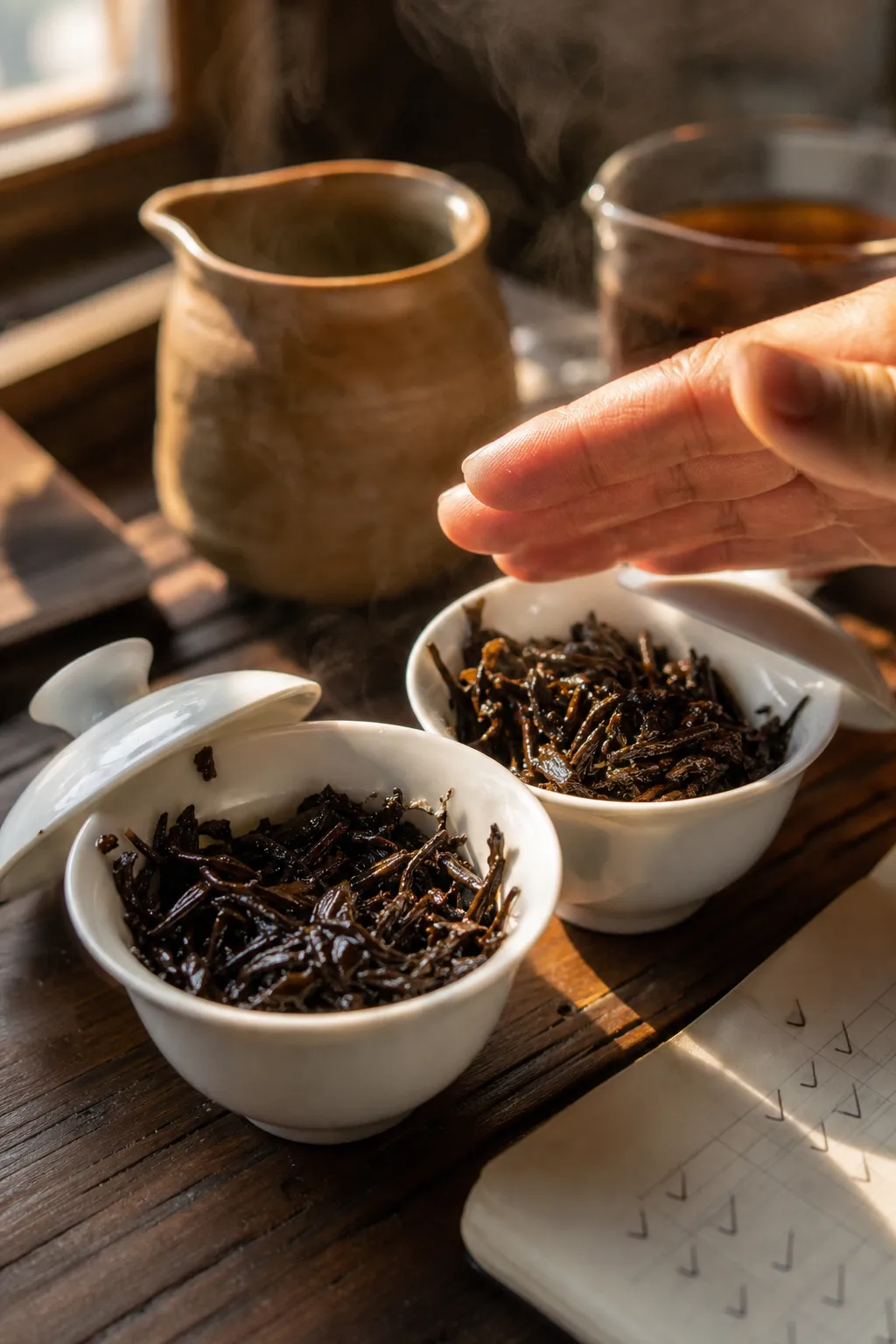
Aroma boundary checks
More likely processing-related
- Damp wood or wet leaf can appear in young ripe Pu-erh.
- Earthy base note is common in many ripe Pu-erh examples and is not a problem by itself.
- If an aroma clears after a rinse, it may be manageable, though later steeps still matter.
- If an aroma persists harshly through steeps, rough processing could be part of the issue.
More likely storage-related
- Damp wood or wet leaf can also appear if storage was humid.
- Sour, stale, or clinging odor is a reason to pause and compare another tea.
- If a note clears after a rinse, it is still worth judging through later steeps.
- If an aroma persists harshly through steeps, storage may be part of the issue.
This is not a formal quality test, and a rinse does not transform a questionable tea into a good one. It is a tasting boundary. If the aroma feels unpleasant, persistent, or distracting, compare another tea rather than calling it “aged character” by default.
Does Ripe Pu-erh Need a Different Rinse?
Often, yes, but the reason is practical rather than ceremonial.
Ripe Pu-erh is frequently compressed, wet-piled, stored, and handled in forms that benefit from a short first rinse. The rinse can loosen compressed leaves, carry off loose surface dust, and give you a chance to smell the wet leaf before the first drinking infusion. Other dark teas may also benefit from a rinse, especially bricks, baskets, older storage, or tightly packed pieces.
For a side-by-side comparison, start here:
- Use the same vessel type for both teas.
- Use the same leaf weight, such as 5 grams per 100–120 ml in a small gaiwan or pot.
- Use hot water close to a full boil.
- Rinse each tea briefly, around 5–10 seconds.
- Smell the wet leaves before brewing.
- Begin with short steeps, then lengthen gradually.
If a ripe Pu-erh is very dense or tightly compressed, it may need a second short rinse or a slightly longer first steep to open. If another dark tea is looser or lighter in body, too much rinsing can make the first cup feel thin. Look at the leaves: are they still locked together, or have they started to loosen?
For thermos brewing, ripe Pu-erh can become heavy quickly. Start with less leaf than you would use for short steeps. A practical starting range is 2–3 grams for a 300–500 ml thermos, then adjust. Some other dark teas tolerate long holding with a cleaner woody or grainy profile, while others become flat or too tannic. A thermos is not a neutral test; it favors forgiving teas and exposes rough ones.
How to Brew Ripe Pu-erh Beside Another Dark Tea
A fair comparison does not require laboratory precision. It only requires that you avoid giving one tea an obvious advantage.
1. Match the form as much as possible
Loose ripe Pu-erh opens faster than a tight Fu brick chunk. A small broken piece of Liu Bao brews differently from a large compressed Pu-erh cake flake. If possible, choose similarly sized pieces and let compressed teas rest after breaking so the leaf is not all powder and splinters.
2. Keep water and vessel steady
Use the same water, vessel size, and steeping rhythm. Hot water helps most dark teas show body and aroma. If one tea tastes harsh, do not immediately blame the category; shorten the infusion first.
3. Compare the same sensory points
Write down only a few observations:
- Dry leaf aroma
- Wet leaf aroma after rinse
- Liquor color in the first two drinking steeps
- Body: thin, medium, thick, coating
- Main aroma: earth, wood, grain, herb, fruit, basket, flower, smoke, mineral
- Sweetness or dryness after swallowing
- Whether the cup feels dense or open
“Ripe Pu-erh is smoother” is too broad. “This ripe Pu-erh is darker, thicker, and less drying than this Fu brick at the same steep time” is useful.
4. Watch what changes after the third steep
Ripe Pu-erh may give a strong first impression, then settle into dark sweetness or fade into flatness depending on quality and leaf condition. Other dark teas may start lighter but become more woody, grainy, or aromatic later. If you judge only the first cup, you may mistake extraction speed for depth.
Does Ripe Pu-erh Age Like Other Dark Teas?
Storage can change ripe Pu-erh and other dark teas, but it should not be treated as an automatic upgrade.
Ripe Pu-erh has already passed through wet piling, so storage often changes integration, aroma, smoothness, and the way pile notes settle. Some older ripe Pu-erh examples may show more woody, aged, or rounded qualities. Research on stored ripe Pu-erh and other dark teas also describes shifts in volatile compounds over time. For a drinker, the modest takeaway is enough: storage can change the cup, but the direction depends on the tea and the conditions.
Other dark teas also change in storage. A Fu brick, Liu Bao basket tea, Qing brick, or Anhua compressed tea may develop differently because of raw material, compression, microbial environment, humidity, airflow, and time. Clean storage may help a tea feel more integrated. Poor storage may make it dull, sour, or unpleasant.
When buying, do not let vague aging language make the decision for you. Ask simpler questions:
- Does the dry tea smell clean and appealing?
- Does the wet leaf aroma improve after a rinse?
- Does the cup have sweetness, structure, or aftertaste?
- Is the storage note part of the tea, or does it dominate the tea?
- Would you drink it now, not only hope it changes later?
That last question matters. A dark tea that tastes poor today should not be chosen only because the label suggests future transformation.
Choosing Ripe Pu-erh or Another Dark Tea for Daily Drinking
Choose ripe Pu-erh when you want a dark, smooth, low-sharpness cup that often feels thick and settled: dense liquor, wet wood, earth, soft sweetness, and a forgiving brew window. It is especially practical for short-steep sessions, office mugs, and cautious thermos brewing when you use modest leaf.
Choose another dark tea when you want regional variety rather than a Pu-erh-like profile. Liu Bao may be appealing if you want earthy and woody notes with possible basket, betel, or old-wood character. Fu brick may suit you if grain, warm brick aroma, and a less opaque cup sound attractive. Anhua dark tea, Hubei Qing brick, Sichuan dark tea, Ya’an Zang Cha, Lu An, San Jian, or Qian Liang-style teas may open a broader range of rustic, woody, herbal, floral, or compressed-tea textures.
The most useful comparison is not “ripe Pu-erh versus all dark tea.” It is “this shou cake beside this Liu Bao,” or “this ripe Pu-erh beside this Fu brick,” brewed with the same water, weight, and attention. Processing explains why the map makes sense. The cup decides what you actually want to drink again.
Sources
Sources and further reading
Reference links are limited to sources considered suitable for public citation in this page.