
Processing comparison
Ripe Pu-erh vs Hei Cha: What Actually Changes in Processing
Ripe Pu-erh vs Hei Cha processing is not a comparison between two matching recipes.
Ripe Pu-erh, also called shu or shou Pu-erh, is a specific Pu-erh style built around deliberate wet piling. The tea is moistened, heaped, kept warm and humid, and managed so microbial post-fermentation develops in a concentrated period.
Hei Cha, or Chinese dark tea, is wider than that. It names a broad group of post-fermented dark teas, and the processing can change by region, leaf material, compression style, pile treatment, storage practice, and microbial environment.
So the practical answer is simple: ripe Pu-erh makes wet piling the center of the tea’s identity; Hei Cha is an umbrella category, not one fixed processing method.
upward
Read the full overview first
Use the broader guide first if you need the full scope before this page.
The shortest useful distinction
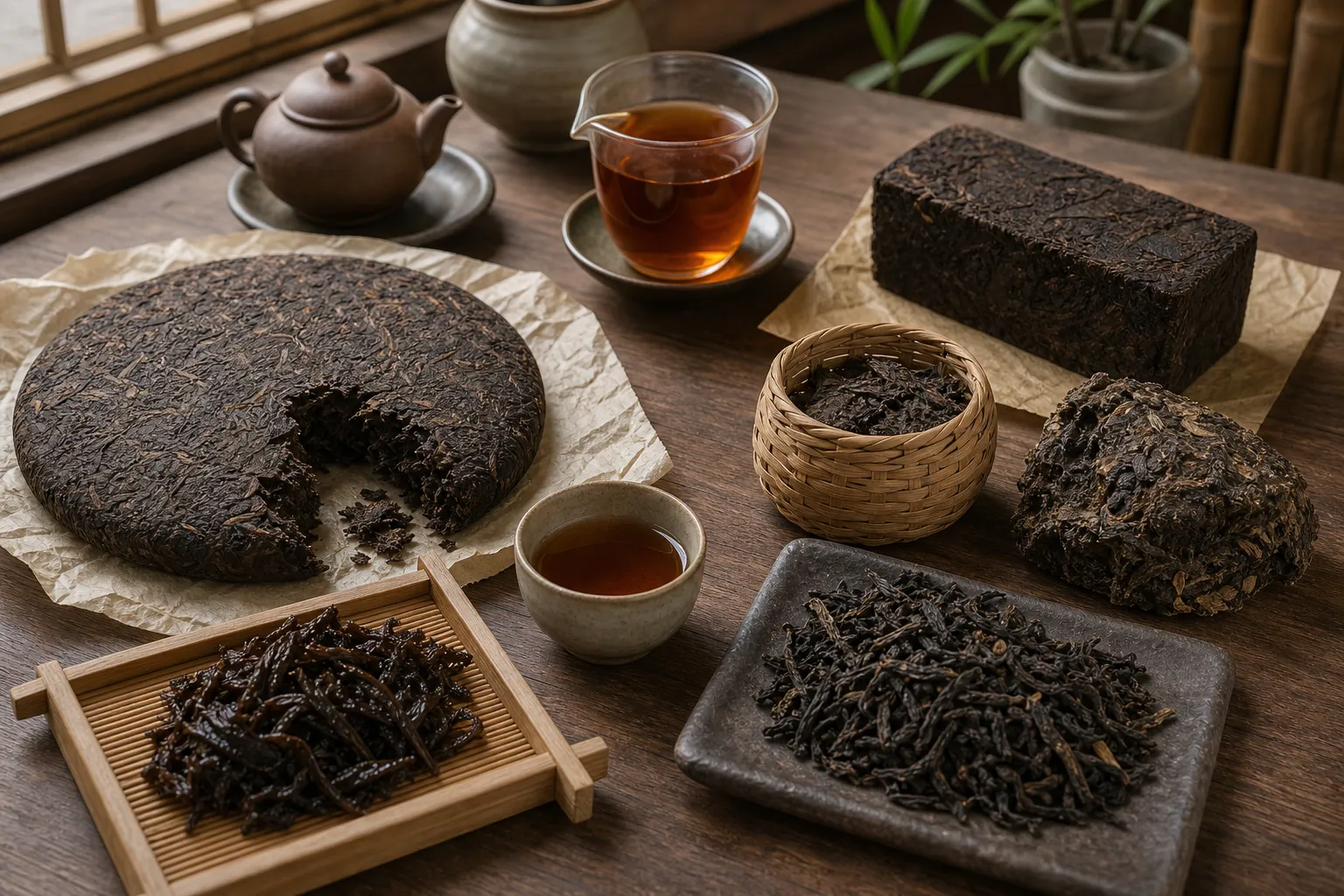
If you are holding a cake of ripe Pu-erh beside a brick, basket, or loose form of another Hei Cha, the main processing difference is usually how deliberately and intensively the post-fermentation was pushed before the tea reached you.
Ripe Pu-erh starts within the Pu-erh processing world, commonly associated with Yunnan sun-dried tea material, then undergoes wo dui wet piling. In plain tea-room language, moisture is added, leaves are piled, heat builds inside the mass, microbial activity changes the tea, and the pile is turned or otherwise managed so the transformation is more even. The aim is to produce the dark, mellow, lower-astringency profile many drinkers associate with shu Pu-erh without relying only on long, slow storage.
Hei Cha is less tidy as a category. It includes regional dark teas such as Liu Bao, Fu Zhuan, Qing Zhuan, Qian Liang, Liuan, Kangzhuan, and others. Many are post-fermented, and some use piling, but they are not simply “ripe Pu-erh made somewhere else.” Their processing may involve different leaf material, kill-green choices, rolling, moisture levels, compression formats, microbial conditions, and expectations for later storage.
That is why a precise comparison is usually “ripe Pu-erh vs Liu Bao” or “ripe Pu-erh vs Fu Zhuan,” not just “ripe Pu-erh vs Hei Cha.” The broader comparison is useful as a map, but it cannot describe every route.
What changes in the leaf, pile, and finished tea
The main differences are easiest to read through practical cues.
| Processing point | Ripe Pu-erh / shu Pu-erh | Hei Cha as a broader group |
|---|---|---|
| Category shape | A specific Pu-erh style centered on accelerated post-fermentation | A family of Chinese dark teas, not one recipe |
| Key process term | Wo dui wet piling | Post-fermentation methods vary by style |
| Moisture and warmth | Added moisture and pile heat are central | Moisture and piling may be used, but intensity and timing differ |
| Pile management | Turning or mixing helps manage the tea mass | Some styles are piled, compressed, stored, or transformed differently |
| Microbial role | Central to ripe Pu-erh fermentation | Also important, but communities and conditions vary |
| Cup tendency | Often darker, thicker, earthy, woody, mellow, or sweet | Can be woody, grainy, mineral, floral, dark, mellow, or earthy depending on style |
| Best comparison habit | Notice pile intensity and storage condition | Name the actual Hei Cha style before judging |
The important word is tendency. A heavily wet-piled ripe Pu-erh may brew very dark and thick, while a cleaner or lighter example can feel smoother and less earthy. A Liu Bao may show deep woody or betel-nut-like notes in some examples. A Fu Zhuan may draw attention to its brick form and visible fungal development. Liuan is not Liu Bao, even though the English names look similar. Qing Zhuan, Qian Liang, Kangzhuan, and other regional teas should not be flattened into one flavor or one method.
Processing creates the material, but brewing still changes what you notice. A small gaiwan, boiling water, and short steeps can make both teas feel intense. A larger pot, lower leaf ratio, or longer casual steep can make the same tea feel softer, thinner, sweeter, or more woody.
Wet piling is not the same as black-tea oxidation
A lot of confusion comes from the word “fermentation.” In English tea writing, it is often used loosely. For this comparison, the useful distinction is:
- Ripe Pu-erh fermentation means microbial post-fermentation during wet piling.
- Hei Cha post-fermentation also involves microbial transformation, but not always in the same way as ripe Pu-erh.
- English “black tea” processing is mainly enzymatic oxidation, not Hei Cha-style post-fermentation.
This is why “Hei Cha vs black tea” can confuse readers. In Chinese tea classification, Hei Cha means dark tea. What English speakers usually call black tea is closer to Hong Cha, often translated as red tea. Both may produce dark liquor, but the processing logic is different.
For ripe Pu-erh, wet piling uses moisture, warmth, microbial activity, and time in the pile. Research on Pu-erh and dark tea often describes changes in microbial communities and tea compounds during this kind of processing. For a drinker, the practical result is easier to observe in the cup: sharp greenness and bitterness often soften, the liquor can move toward reddish-brown or dark brown, and the aroma may lean woody, earthy, old-leaf-like, or sweet.
For black tea, fresh leaves are oxidized through leaf enzymes during processing. That can produce brisk, malty, fruity, or tannic profiles, but it is not the same path as wet piled tea.
Why Hei Cha cannot be treated as one method
The most useful caution in ripe pu-erh vs hei cha processing is this: Hei Cha is too broad for one processing sentence.
Some tea writing places Pu-erh inside the wider dark-tea world because both belong to post-fermented tea. Other writing separates Pu-erh because of its Yunnan association, material identity, market language, and the familiar sheng-versus-shu distinction. You do not need to resolve that taxonomy debate to taste more clearly. You only need to avoid assuming that every Hei Cha is processed like ripe Pu-erh.
A few examples show the problem:
- Fu Zhuan is often discussed in relation to its brick form and “golden flower” fungal development. That does not make it the same process as shu Pu-erh wet piling.
- Liu Bao can share dark, earthy, woody, or aged notes with ripe Pu-erh in some cups, but its regional handling and storage culture are not identical.
- Liuan is a separate tea from Liu Bao, despite the similar romanization.
- Qing Zhuan, Qian Liang, Kangzhuan, and Kangzhuan-style regional dark teas may differ in compression, raw material, pile treatment, and the way the tea continues to change after production.
A broad label can help you find the shelf. It cannot tell you the whole processing path.
What to notice when you taste them side by side
When comparing ripe Pu-erh with another Hei Cha, do not start with “which one is darker?” Start with the processing cues you can actually check.
First, look at the form. Is it a cake, brick, basket, loose tea, or tightly compressed piece? Compression affects how the tea opens in water and how aromas release. A dense brick may need a rinse or slightly longer early steeps. A loose ripe Pu-erh may give up color and body quickly.
Next, notice the dry leaf and rinse aroma. Ripe Pu-erh that has been strongly wet piled can show damp wood, dark earth, old leaves, cocoa-like sweetness, or warehouse-like notes. These are not automatic signs of quality or defect on their own. Context matters. If the aroma is clean, deep, and integrated, many drinkers enjoy it. If it is sharp, sour, flat, or unpleasantly musty, the issue may come from storage, processing, age, or the particular tea.
With non-Pu-erh Hei Cha, expect more variation. Some examples may feel grainy, woody, mineral, herbal, floral, or gently sweet. Others can be dark, thick, and earthy enough to overlap with ripe Pu-erh in casual tasting. That overlap is exactly why processing labels help, but do not fully predict the cup.
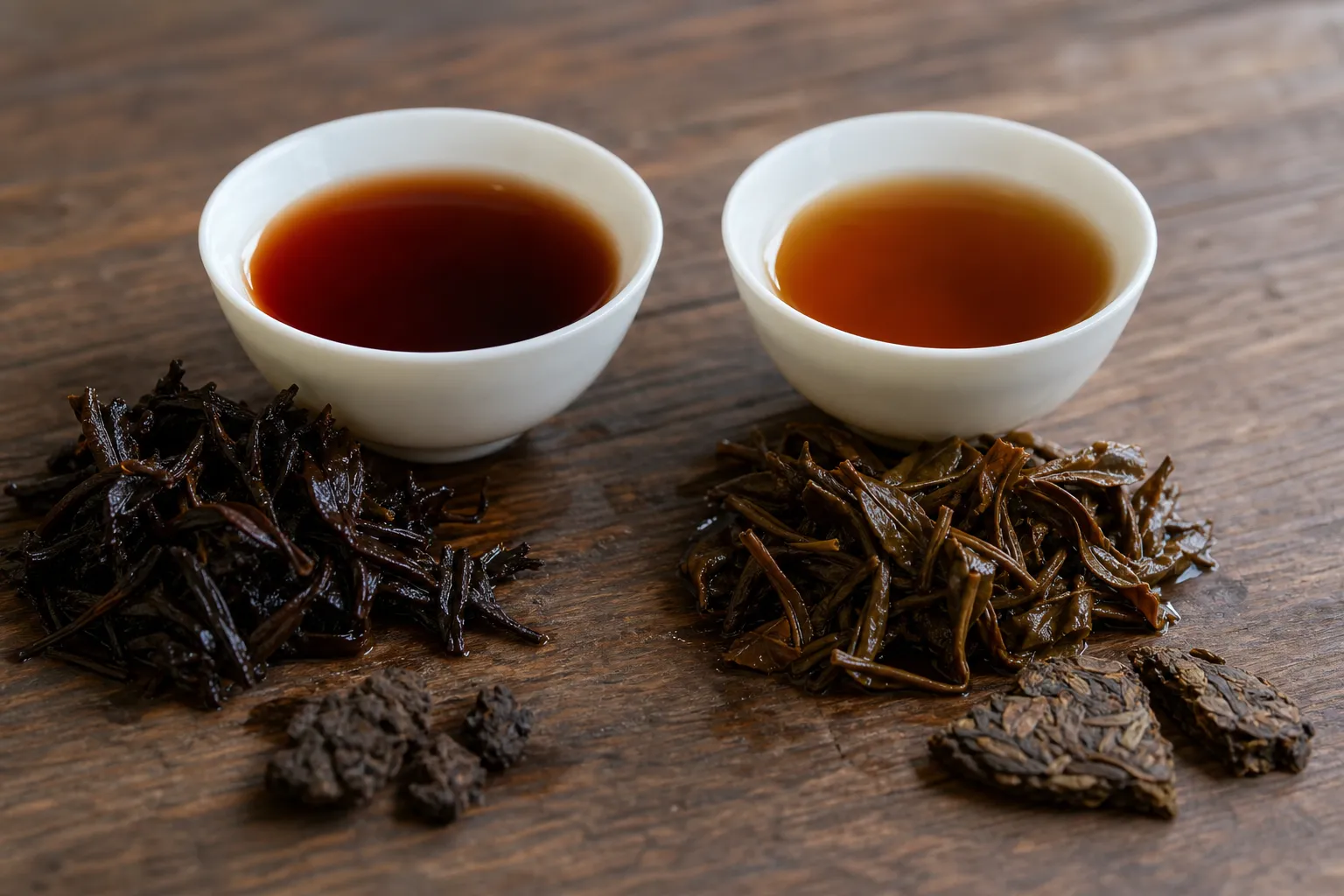
A simple comparison method
- Use the same vessel size and similar leaf weight for both teas.
- Rinse briefly if the tea is compressed or dusty.
- Start with short hot steeps instead of one long extraction.
- Compare liquor color, aroma, mouthfeel, and aftertaste separately.
- Ask whether the tea feels heavily pile-transformed, regionally woody, storage-aged, or still close to its original leaf character.
That last question is more useful than asking whether Hei Cha is “lighter” than Pu-erh. Some is. Some is not.
Where raw Pu-erh fits
Searches for ripe Pu-erh and Hei Cha often bring up raw Pu-erh too. It is related, but it is a different comparison.
Raw Pu-erh, or sheng Pu-erh, does not go through the same deliberate wet piling used for ripe Pu-erh. It may change over time through storage, and older sheng can become darker and smoother, but that is not the same processing path as shu Pu-erh fermentation. Ripe Pu-erh is built around a faster, managed pile process. Raw Pu-erh depends more on original material, early processing, age, and storage conditions.
So when a comparison says “Pu-erh tastes like this,” check whether it means sheng or shu. This page is about shu Pu-erh fermentation compared with the wider Hei Cha family.
Practical takeaway
If you are choosing between ripe Pu-erh and Hei Cha, do not ask which category is better. Ask what processing path you want to explore.
Choose ripe Pu-erh when you specifically want wet-piled Pu-erh character: dark liquor, rounded body, lower sharpness, and a profile that often leans earthy, woody, mellow, or sweet. Look for descriptions that tell you whether it is loose or compressed, young or aged, heavily or lightly fermented, and how clean the storage seems.
Choose a named Hei Cha when you want regional variation. Instead of buying “Hei Cha” as an abstract category, look for the actual style: Liu Bao, Fu Zhuan, Liuan, Qing Zhuan, Qian Liang, Kangzhuan, or another named tea. Then judge that tea by its own processing notes, compression, storage, and cup character.
The core processing difference remains: ripe Pu-erh is defined by a deliberate wet piling tea process, while Hei Cha names a broad post-fermented dark tea world with multiple regional methods. Once you keep that distinction in mind, the labels become less confusing, and the cup becomes easier to read.
Sources
Sources and further reading
Reference links are limited to sources considered suitable for public citation in this page.