
Root guide
Dark Tea Culture and Everyday Tea Practice
Dark tea culture is easiest to understand as a practical way of living with tea: choose a form, brew it with attention, notice what the cup is doing, adjust the next steep, and store the remaining tea so it stays worth returning to.
It is not one fixed ceremony, one flavor profile, or one rule for every cake, brick, loose leaf, or compressed piece. A dark tea may taste earthy, woody, sweet, mellow, heavy, mineral, smoky, flat, or rough depending on leaf material, compression, age, storage, water, vessel size, steeping time, and personal preference.
This root guide gives you the working map: how to look at the tea in front of you, set up a simple dark tea brewing session, read liquor color and aroma, adjust a thin or heavy cup, store tea with care, and find the next topic to explore.
Start with the tea in front of you
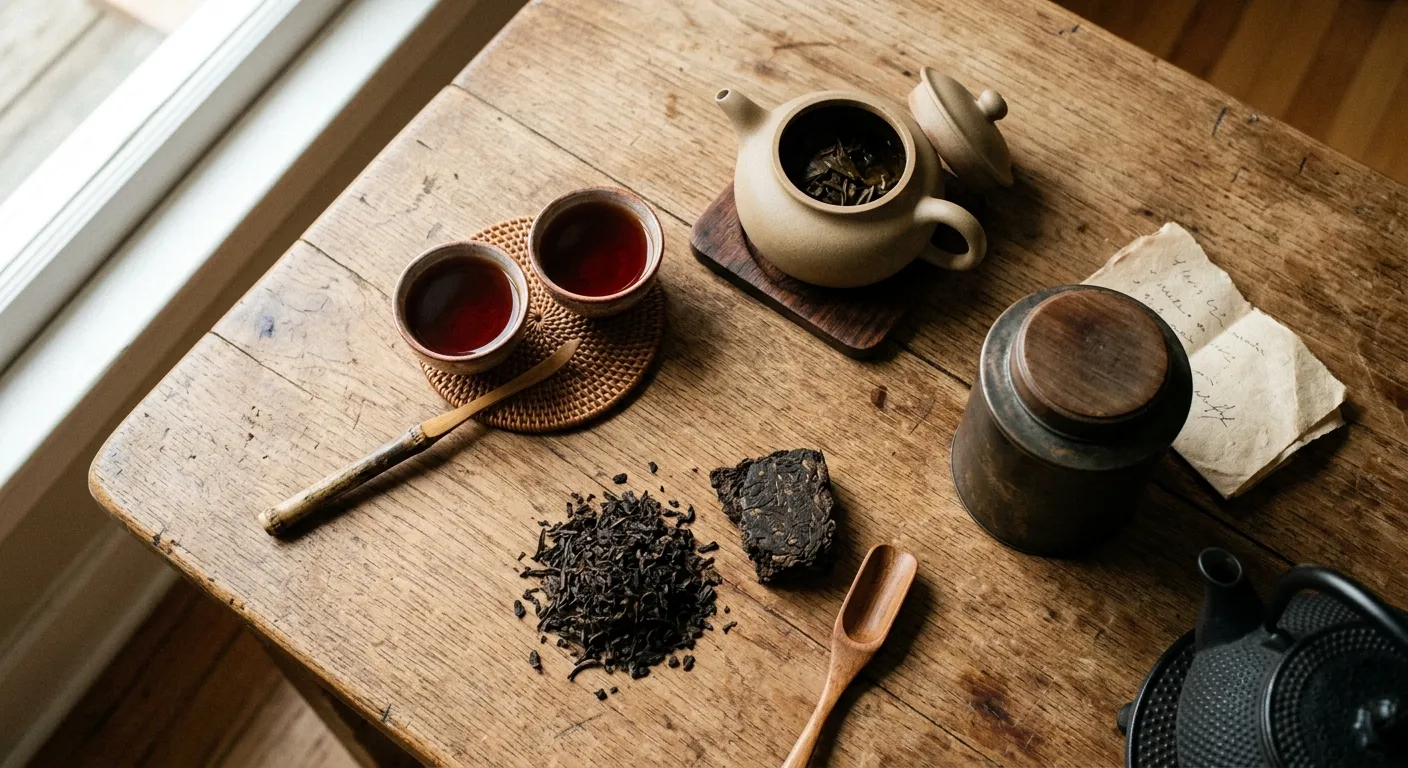
Before thinking about ritual, region, or tasting language, look at the material you are about to brew.
Ask:
- Is it loose or compressed?
- Are the leaves whole, chopped, dusty, stem-heavy, or tightly packed?
- Does the dry tea smell clean, woody, earthy, sweet, smoky, musty, herbal, or faint?
- Does it break apart easily, or does it need careful prying?
- Does the first wet aroma feel lively, muted, storage-forward, sharp, or sweet?
- Does the brewed liquor look amber, reddish brown, dark brown, nearly black, clear, or cloudy?
These cues do not tell the whole story, but they give you better first decisions than a label alone.
Loose and compressed dark tea behave differently
In everyday dark tea practice, form matters because it changes how the tea meets water.
Loose tea is usually easier to portion. It often opens quickly, so aroma and body may appear early in the session.
Compressed tea asks for one more step. A cake, brick, tuo, or dense chunk may release slowly at first, then become stronger as the inner leaves loosen. A thin flake can brew quickly; a hard nugget may hold its center through several infusions.
Neither form is automatically better. Loose tea is convenient. Compressed tea can be practical for storage and repeated sessions. The useful question is not which form is superior, but how this tea behaves in your cup today.
For a first session with compressed dark tea:
- Use a modest amount rather than filling the vessel heavily.
- Break the piece into thinner layers when possible.
- Let water reach as much surface area as you can without crushing the leaves into powder.
- Expect the first pour to be lighter, closed, or more storage-forward.
- Judge the tea across several steeps, not only by the first cup.
This is one reason a brief first pour can matter for some dark teas. It is not a rule for every tea, but it can help you read how the leaves are opening.
A simple framework for daily dark tea practice
A daily tea practice does not need rare tools or a formal room. It needs repeatable choices. Once your setup is steady, you can notice what changed: the tea amount, water, vessel, time, storage condition, or your own taste that day.
Tea amount
Control leaf weight, chunk size, and loose-leaf volume. Notice strength, thickness, bitterness, and heaviness.
Water
Control temperature, pour speed, and refill timing. Notice aroma release, clarity, body, and roughness.
Vessel
Control size, heat retention, and pour speed. Notice concentration, pacing, and comfort.
Time
Control rinse length, steep length, and pause between steeps. Notice thinness, depth, harshness, and sweetness.
Storage condition
Control aroma, dryness, container, and room setting. Notice clean scent, stale notes, storage aroma, and loss of liveliness.
The point is not precision for its own sake. The point is changing one thing at a time.
If the tea tastes too thin, you might add time, use a little more leaf, pour hotter water, or choose a smaller vessel. If the brew feels too heavy, you might shorten the next steep, use slightly less leaf, pour faster, or give more space between cups. If the cup turns harsh, check steep length, leaf amount, broken particles, and water heat before blaming the tea.
A basic home setup
For simple dark tea brewing, start with ordinary tools:
- A small teapot, gaiwan, or heat-safe brewing vessel
- A cup or sharing pitcher if you want even pours
- A kettle
- A tray, towel, or plate to catch spills
- A tea pick or careful knife only if you use compressed tea
- A dry, odor-aware storage place
You can brew dark tea in a casual mug, especially for daily drinking. A smaller vessel, however, makes short steeps easier and lets you watch the tea change across several cups. That is useful when the tea is compressed, strong, unfamiliar, or storage-forward.
A reliable first pattern:
- Warm the vessel if you want a steadier session.
- Add a modest amount of leaf.
- Smell the dry tea.
- Add hot water.
- Rinse briefly only if the tea seems to need it.
- Brew short at first.
- Taste, then adjust.
The first session is not a final judgment. It is a reading.
A useful ritual is repeatable, not theatrical
An everyday tea ritual is simply a repeatable way to pay attention. It may be quiet and slow, or it may be a morning routine beside breakfast. It may involve a tray and small cups, or a plain pot on a kitchen counter.
The steady parts matter more than the decorative parts:
- Use similar water and vessel conditions when comparing teas.
- Smell the dry leaf before brewing.
- Notice the wet aroma after the first pour.
- Watch the dark tea liquor color as it deepens or fades.
- Taste for body before chasing rare flavor words.
- Keep the session comfortable enough that you will repeat it.
A routine that makes you anxious about doing everything correctly is not useful for daily tea. A routine that helps you notice one thing better is enough.
How to read the cup
Dark tea tasting becomes clearer when you separate the cup into a few observable layers: color, aroma, mouthfeel, sweetness, earthiness, and finish.
Instead of beginning with “Is this good?”, ask:
- What color is the liquor?
- What does the steam smell like?
- Is the first sip light, round, heavy, rough, sweet, or drying?
- Does the flavor stay, fade, coat the mouth, or turn flat?
- Does the next steep improve, weaken, sharpen, or deepen?
These questions help you describe the tea without forcing it into a fixed profile.
Liquor color is a clue, not a verdict
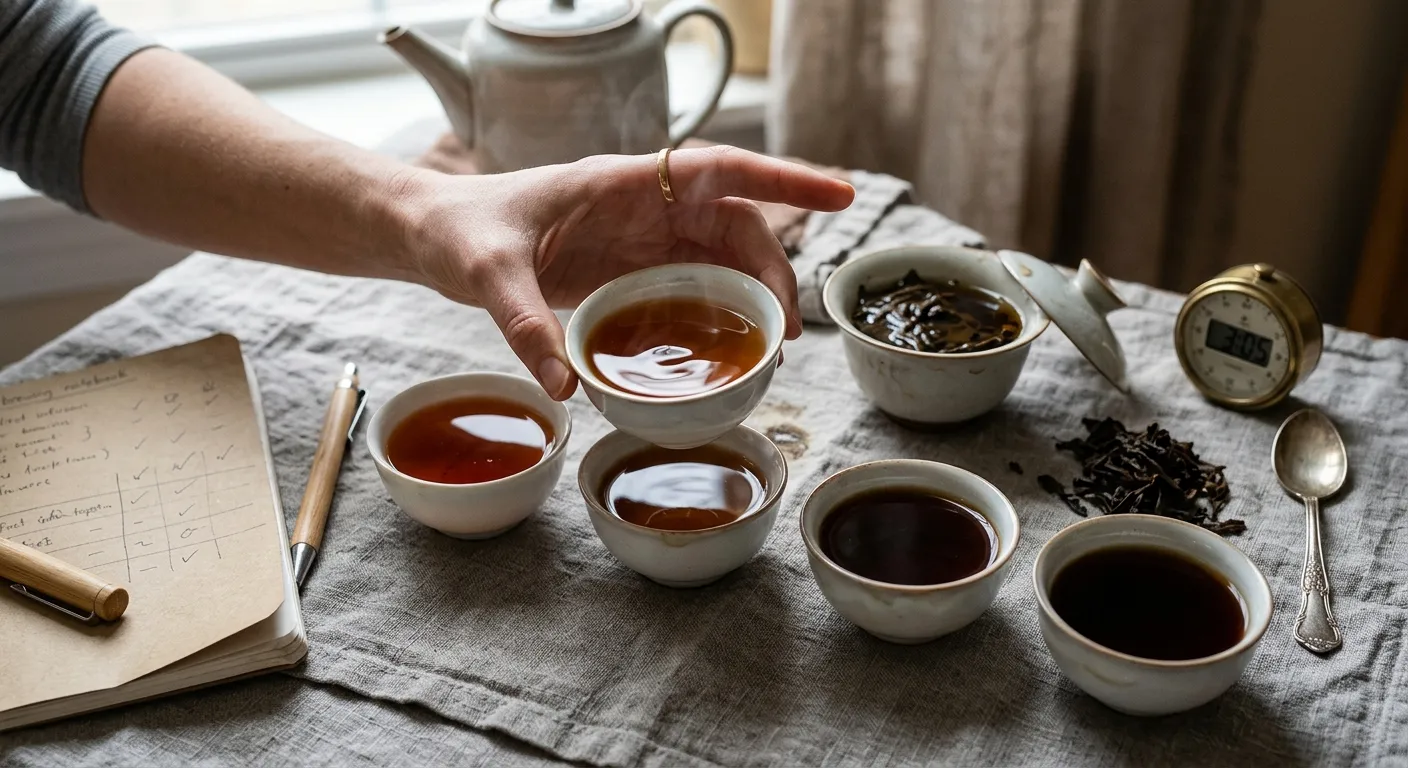
Dark tea liquor color can range from amber to reddish brown, walnut brown, coffee-dark brown, or nearly black. Color can be shaped by leaf amount, steep time, vessel size, compression, age, storage, and how much fine material enters the brew.
A darker cup is not automatically better. A pale cup is not automatically weak. A clear lighter infusion may carry good aroma and sweetness, while a very dark brew may feel heavy or over-extracted.
Very pale and thin
Possible signal: too little leaf, short time, or slow-opening compression. Try extending the steep or letting the leaves open.
Clear reddish brown
Possible signal: balanced extraction in many setups. Keep the timing and observe later steeps.
Very dark and heavy
Possible signal: strong leaf ratio, long steep, or many small particles. Shorten the next pour or use less leaf next time.
Cloudy or muddy
Possible signal: fine particles, broken tea, storage influence, or hard handling. Pour gently and avoid crushing compressed tea.
Use color as one cue beside aroma, body, and aftertaste.
Aroma often speaks before flavor
Dark tea aroma can be easier to read than flavor, especially when you are new to the category. Smell the dry tea, the warmed leaf, and the wet leaf after the first pour.
You might notice:
- Earthy or forest-floor-like notes
- Sweet wood or old furniture-like notes
- Dried fruit hints
- Grain, date, bark, nut, or mineral impressions
- Storage aroma that feels clean, closed, stale, sharp, or too dominant
These words are prompts, not requirements. Your tea does not need to match a list.
Aroma can also guide adjustment. If the wet leaf smells closed, a brief rest or slightly longer steep may help. If the aroma feels too heavy, shorten the next infusion. If it smells flat, try hotter water or a smaller vessel before deciding the tea itself is dull.
Mouthfeel tells you what brewing did
Dark tea mouthfeel is the physical side of the cup: thickness, smoothness, dryness, coating, weight, and finish.
- Thin but aromatic
- Thick but dull
- Sweet but flat
- Earthy but clean
- Heavy and tiring
- Light and refreshing
- Harsh at the edges
- Soft through the finish
Mouthfeel often tells you more about brewing than a flavor label does. If the tea tastes pleasant but feels watery, it may need more concentration. If the aroma is good but the mouth becomes rough, the tea may be over-brewed, over-broken, or too strong for the vessel.
Sweetness and earthiness need context
Dark tea sweetness is not always sugary. It may appear as a soft finish, a round aftertaste, a date-like impression, or a gentle easing of earthy notes.
Earthy dark tea taste can be appealing when it feels clean, grounded, and integrated. It becomes less pleasant when it turns muddy, stale, or too dominant.
Ask:
- Does the earthiness have shape, or is it only weight?
- Does sweetness appear after swallowing?
- Does the cup invite another sip?
- Does the aftertaste stay pleasant, fade quickly, or become rough?
A balanced cup does not need to be light. It should feel drinkable for the purpose of the session. A strong brew after a meal may be welcome; the same strength during a quiet morning may feel too heavy.
How to adjust the next steep
A good dark tea session is not one where every cup is perfect. It is one where you can respond. Adjusting dark tea steeping is the daily skill that connects culture, brewing, and tasting.
Use the cup as feedback.
If the cup feels thin
Too little leaf, short time, slow-opening compression, or low concentration may be happening. Try adding 5–15 seconds, using a smaller vessel, breaking compressed tea thinner, or letting the leaves rest after a rinse.
If the cup feels heavy
Too much leaf, long steep, many fine particles, or strong storage aroma may be happening. Try shortening steeps, using less leaf, pouring faster, using a slightly larger vessel, or giving more space between cups.
If the cup feels harsh
Over-extraction, crushed dust, too much leaf, or rough edges showing early may be happening. Try shortening the next infusion, avoiding dust, pouring gently, or letting the tea open before pushing it harder.
If the cup feels flat
Low aroma, weak body, muted finish, or possible storage dullness may be happening. Try hotter water, warming the vessel, increasing leaf slightly, shortening pauses, or checking storage aroma.
Do not overcorrect immediately. A compressed tea that starts thin may become stronger by the third or fourth infusion. A heavy tea may become cleaner after the first few pours. A rough tea may soften when you reduce concentration. If a problem remains after several adjustments, note it plainly. Some teas simply will not match your preference.
Storage is part of practice
Dark tea storage often attracts strong claims, but for everyday drinkers the first goal is simpler: keep tea stable, clean-smelling, and easy to revisit. Storage is not only about long-term change. It affects tomorrow’s cup.
Tea can absorb surrounding odors. Light, moisture conditions, airflow, handling, and container choice can all affect how a stored tea presents in the cup.
Before storing a tea, smell it carefully. You are not trying to write a professional note; you are creating a baseline.
Look for:
- Clean dry aroma
- Earthy or woody scent
- Sweetness or stale edges
- Damp, musty, smoky, perfumed, or kitchen-like odors
- Crumbling, excessive dust, or very tight compression
- Packaging that traps unwanted smells or exposes tea too much
If a tea already carries a strong dark tea storage aroma, keep it separate from more delicate teas. Strongly scented tea can influence nearby leaves, especially in enclosed spaces.
Aroma
Aim to keep tea away from strong smells. Avoid spice cabinets, scented rooms, cleaning products, and fragrant packaging.
Light
Aim to reduce direct exposure. Use boxes, wrappers, tins, cabinets, or shaded shelves.
Moisture conditions
Aim to avoid dampness and extremes. Do not store tea where condensation, steam, or kitchen humidity is common.
Airflow
Aim to avoid both stale enclosure and uncontrolled exposure. Let the container fit the tea and the room rather than sealing everything blindly.
Handling
Aim to keep pieces intact when possible. Break only what you need, and avoid turning compressed tea into dust.
Different homes have different climates. A habit that works in a dry apartment may not suit a humid kitchen. The practical test is the tea itself: does it smell clean when reopened, and does the cup still feel lively?
Separate teas when one is smoky, perfumed, very earthy, strongly storage-forward, newly opened, broken into many small pieces, or being compared against another tea. You do not need an elaborate system. Labeled wrappers, clean boxes, simple tins, or odor-neutral containers can be enough for daily use, depending on the tea and the room.
Culture shows up in handling, sharing, and attention
This page does not present a full history of Chinese dark tea or a complete classification system. Without reliable public references attached here, detailed historical and regional claims should be handled elsewhere with proper sourcing.
For this root guide, culture is treated through repeatable practices: compression, brewing, tasting, sharing, storing, and returning to the same tea over time.
That is a modest frame, but it is useful. It lets you participate with care while you continue learning the background.
A respectful approach to dark tea culture starts with a few loosened assumptions:
- Do not assume all dark tea tastes earthy.
- Do not assume age always makes a tea better.
- Do not assume one region, form, or ritual explains the whole category.
- Do not assume a seller’s poetic tasting note will match your water and vessel.
- Do not assume a darker cup is a better cup.
Respect does not require performance. It can show up in careful handling, clean storage, patient tasting, and serving others with attention.
Sharing dark tea with guests
When serving dark tea to others, the most useful custom is consideration. Keep the tea drinkable, explain only what helps, and watch the pace of the table.
Guest-friendly practice can include:
- Using smaller cups so people can taste changes without committing to a large mug
- Pouring evenly so one person does not receive only the strongest end of the brew
- Mentioning that the first infusion may be lighter, heavier, or more storage-forward
- Offering a simple description such as “this one may be earthy and sweet” rather than a long lecture
- Asking whether people prefer a lighter or stronger next cup
- Keeping water, hot vessels, and tea tools arranged calmly
How to share dark tea well is less about memorized rules and more about making the tea understandable.
The first pour: rinse, wake, or drink?
Some dark tea drinkers use a quick first pour to rinse or wake the leaves. Others drink the first infusion, especially if the tea is loose, clean-smelling, and already open.
The right choice depends on tea form, compression, storage aroma, dust, and your purpose for the session. A rinse is not a special guarantee. It is a practical tool.
A short first pour may help when:
- The tea is tightly compressed.
- The dry leaf smells closed or storage-forward.
- The chunk needs help opening.
- There is visible dust or broken material.
- You want the next infusion to show a more settled aroma.
- You are serving guests and want a gentler first shared cup.
After a rinse, smell the wet leaf. Is the aroma opening? Is it sweet, woody, earthy, sharp, stale, or lively? Has the compression loosened?
You may choose to drink the first infusion when:
- The tea is loose and opens quickly.
- The dry aroma is clean and inviting.
- You want to understand the full session from the beginning.
- The first pour tastes balanced.
- The tea is delicate enough that discarding the first infusion would lose something you enjoy.
Try both approaches with the same tea on different days. The comparison will teach you more than a fixed rule.
Wet-leaf aroma
It can show whether the tea is opening, closed, clean, or storage-forward. You may rest briefly, rinse once, or begin short steeps.
Leaf separation
It can show whether compression is loosening. You may extend slightly or break thinner next time.
Cup character
It can show whether the first infusion is thin, harsh, heavy, or balanced. You may adjust time, leaf ratio, or pour speed.
A first dark tea session you can repeat
If you want one simple session to begin with, use this as a baseline. Adjust it to your vessel and tea.
- Choose a small amount of tea. If it is compressed, break a thin piece rather than a hard lump when possible.
- Use a vessel that pours easily. A small teapot or gaiwan makes short steeps easier, but a simple heat-safe vessel can work.
- Smell the dry leaf. Notice whether it is sweet, earthy, woody, smoky, storage-forward, faint, or sharp.
- Add hot water. Use water hot enough to open the tea, while remembering that your exact water and vessel will change the result.
- Decide on the first pour. Rinse briefly if the tea is compressed, dusty, or closed. Drink the first infusion if it smells clean and tastes balanced.
- Brew short at first. Start lighter than you think you need. You can always lengthen the next steep.
- Taste in layers. Notice aroma first, then body, sweetness or earthiness, and aftertaste.
- Adjust one variable. Change time, leaf amount, water heat, or vessel concentration. Do not change everything at once.
- Store the rest with attention. Keep it away from strong odors, direct light, damp areas, and careless crushing.
A short note is enough
- Tea form: loose, cake, brick, chunk, flakes
- Amount: light, medium, heavy, or measured weight if you use one
- Vessel: mug, gaiwan, small pot, larger pot
- First pour: rinsed or drunk
- Liquor color: amber, red-brown, dark brown, cloudy, clear
- Aroma: earthy, woody, sweet, storage-forward, smoky, faint
- Mouthfeel: thin, smooth, thick, drying, rough, soft
- Adjustment: longer, shorter, more leaf, less leaf, hotter, gentler
- Storage note: clean, strong aroma, separate, needs checking
Over time, these notes teach you your own brewing habits. They also make comparison easier. If two teas taste different, you can ask whether the difference came from the leaf or from the session.
Common assumptions to loosen
Dark tea is easy to overstate. Everyday brewing improves faster when you work with smaller, observable truths.
There is one correct dark tea method.
Different methods serve different moments. A mug, small pot, gaiwan, or shared setup can all make sense. What changes is control.
Darker liquor means better tea.
Dark color may show strong extraction, long steeping, more leaf, broken material, or a naturally deep brew. Judge aroma, clarity, body, and finish too.
Earthy means the same thing every time.
Earthy can mean clean, sweet, damp, mineral, woody, stale, soft, or heavy. Add one more descriptor to make the note useful.
Older always means better.
Time alone does not promise a better cup. Judge aroma, clarity, mouthfeel, aftertaste, storage scent, and whether the session remains pleasant.
Culture requires performance.
Care can be quiet: careful handling, patient tasting, clean storage, and serving others with attention.
Reader paths for deeper practice
A root page should not answer every detailed question. It should help you choose the next useful path.
Chinese dark tea culture
Start here when you want cultural background without turning the topic into a broad history lesson. The practical focus is how fermentation language, compression, shared drinking, and repeated brewing shape daily use.
Everyday dark tea rituals
Use this path if your question is how to make dark tea part of a calm home routine with modest tools and flexible pacing.
Dark tea tools
Choose this when picks, trays, small pots, gaiwans, sharing pitchers, cups, wrappers, boxes, and storage containers feel confusing. The goal is to know what each object does and what can remain optional.
Sharing dark tea
Go here for portions, cup order, pacing, rinses, flavor explanation, and ways to keep a session welcoming rather than overly formal.
Rinsing and waking dark tea
Use this route when you are unsure whether to discard the first pour, drink it, or use it to open compressed leaves.
These paths all return to the same root skill: make one better decision in the next cup.
Boundary note
No public reference links were available for this page. For that reason, this guide stays with practical observation: leaf form, compression, water, steeping, liquor color, aroma, mouthfeel, aftertaste, and storage setting. It does not make detailed claims about regional history, production chronology, classification systems, named ritual traditions, quality schemes, or health outcomes.
If you are new to dark tea, begin with one tea and one repeatable setup. Brew it lightly, then more strongly. Try one session with a rinse and one without. Notice how the aroma changes after water touches the leaf. Watch whether the liquor becomes clearer, deeper, heavier, or softer across steeps. Store the remaining tea carefully and return to it another day.
If you already drink dark tea, use this page as a check on your habits. Are you judging too quickly by color? Using too much leaf because the first steep was thin? Letting storage aroma dominate nearby teas? Serving guests a brew that suits your taste but not theirs?
The heart of dark tea culture is not a perfect performance. It is the repeated act of paying attention: choosing a tea, preparing it with care, tasting what actually appears, changing the next pour, and keeping the remaining tea in good condition for another session.