
Dark tea field guide
Dark Tea Types, Forms, and Selection
Dark tea types are easier to understand when you separate three decisions: the tea family, the form, and how you plan to brew it.
For a first map, think in practical terms. Ripe pu-erh is often the familiar earthy reference point. Fu Brick is a mellow compressed tea often described through “Golden Flowers” language. Liu Bao tends to sit in an aged-wood, clean-earth, sometimes mineral direction. Anhua-style bricks can be sturdy, rustic, smoky, or grainy. Tibetan tea or Zang Cha is usually discussed as a robust dark tea suited to stronger preparation.
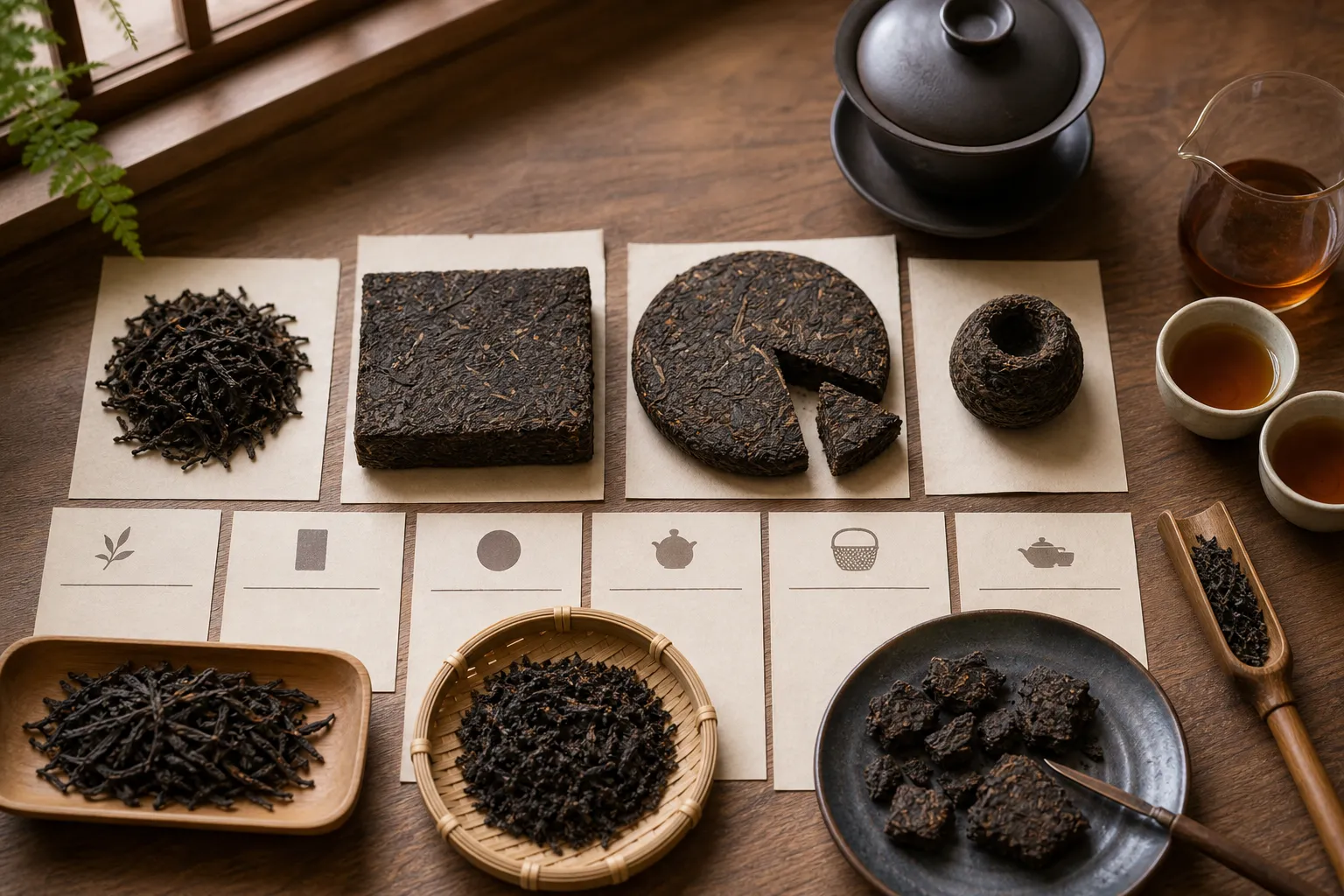
Then choose the form. Loose leaf dark tea is easiest to measure and compare. Compressed tea bricks, cakes, tuos, baskets, logs, and broken pieces ask for more handling: prying, loosening, rinsing, portioning, and storage. Neither form is automatically better. The better choice is the one you will brew often enough to learn from.
What “Dark Tea” Means in Practice
Dark tea is the English name often used for the Chinese tea category hei cha. It is not the same thing as English “black tea.”
In English-language tea buying, black tea usually means fully oxidized teas such as Assam, Ceylon, Keemun, or Dianhong. Dark tea usually refers to post-fermented tea: tea that has already gone through heat treatment during processing and then changes further through microbial activity, moisture, storage, compression, and time.
That distinction matters because dark tea often appears beside searches for “black tea types,” even though the cup behaves differently.
| Term you may see | What it usually means in tea buying | Practical cue |
|---|---|---|
| Black tea | Fully oxidized tea | Often brisk, malty, fruity, tannic, or bright |
| Dark tea / Hei Cha | Post-fermented tea category | Often earthy, woody, mellow, smoky, sweet, or robust depending on type |
| Ripe pu-erh | A Yunnan post-fermented tea style | Often dark red-brown in the cup, earthy, dense, and smooth |
| Fu Brick / Fu Zhuan | A compressed brick-style dark tea | Often mellow, thick, grainy, sweet, or woody |
| Liu Bao | A Guangxi dark tea family | Often aged-woody, clean-earthy, mineral, or sometimes betel-nut-like |
Research on dark tea commonly studies post-fermentation, volatile compounds, microbial succession, and manufacturing changes. For a drinker, the useful translation is modest: processing and storage can influence aroma, liquor color, texture, and taste. They do not make every dark tea taste alike, improve in the same way, or follow one simple quality rule.
When choosing, let the cup keep you honest. Look at the leaf form. Smell the warmed tea. Watch the liquor. Notice whether the body is thin, thick, harsh, mellow, clean, smoky, sweet, flat, or heavy.
Major Types of Dark Tea You Are Likely to Meet
There are many regional names, factory styles, and market labels. At root level, you do not need to memorize all of them. Start with the dark tea types most likely to appear in English-language shops, tasting notes, and comparison guides.
| Type or family | Common market language | Forms you may see | General flavor direction |
|---|---|---|---|
| Ripe pu-erh | Shou pu-erh, cooked pu-erh, wo dui | Cakes, bricks, tuos, loose leaf, samples | Earthy, woody, dense, smooth, sometimes date-like |
| Fu Brick | Fu Zhuan, Fuzhuan, Fu Brick Tea | Compressed bricks, broken brick pieces | Mellow, thick, grainy, sweet, sometimes honey-like or woody |
| Liu Bao | Liubao, Guangxi dark tea | Loose, basket-aged, compressed, broken pieces | Aged wood, clean earth, mineral, sometimes betel-nut-like |
| Anhua dark tea | Hei Zhuan, Hua Zhuan, Qianliang-style terms | Bricks, logs, slices, compressed pieces | Rustic, smoky, woody, sturdy, sometimes grainy |
| Qing Brick / Hubei dark tea | Qingzhuan | Bricks | Firm, woody, compact, often brewed for strength |
| Tibetan tea / Zang Cha | Ya’an tea, border-tea language | Bricks or compressed pieces | Robust, coarse-leaf, strong, suited to concentrated brewing |
These flavor directions are starting points, not promises. A cleanly stored ripe pu-erh can taste soft and sweet; a poorly stored one can feel muddy or stale. Fu Brick can be pleasantly mellow, but “Golden Flowers” on a label does not settle the question of whether you will like the tea. Liu Bao may be graceful and woody, or it may feel damp, smoky, or flat depending on production and storage. Anhua dark tea bricks can range from friendly daily brews to rougher, heavier cups that need careful steeping.
How to Place Each Type Without Overthinking It
Use the main dark tea families as reference points rather than fixed rankings.
- Ripe pu-erh is useful as a baseline because many drinkers meet dark tea through it first. Expect dark liquor, low sharpness, earthy aroma, and often a thick cup. It is widely sold as loose leaf, cakes, bricks, mini tuos, and samples. Use it as a comparison point, not as the standard for all dark tea.
- Fu Brick is one of the most recognizable compressed dark teas because labels often mention Golden Flowers. Fu Brick manufacturing has been studied for microbial succession and production changes, but the buying lesson is simpler: look at the brick, smell it, brew it, and decide whether the mellow, grainy, woody, or sweet profile fits your taste.
- Liu Bao dark tea often appears in an aged-wood and clean-earth direction. It may be loose, basket-aged, compressed, or sold as broken portions from larger stored lots. Compared with many ripe pu-erh teas, some Liu Bao can feel less dense and more aromatic, though examples vary widely.
- Anhua dark tea bricks are better treated as a broad family than a single flavor. Hei Zhuan, Hua Zhuan, and large-format compressed teas can be rustic, smoky, woody, grainy, or strong. Compression often affects brewing as much as the label does.
- Tibetan tea / Zang Cha is usually discussed as a robust dark tea connected with practical, stronger preparations. For selection, the important cue is strength: these teas may be less about delicate aroma and more about body, endurance, and compatibility with concentrated brewing.
If you dislike one type, do not write off the whole category. A drinker who finds ripe pu-erh too earthy may still enjoy Liu Bao or a lighter Fu Brick. Someone who finds Fu Brick too gentle may prefer a stronger Anhua-style brick or a dense ripe pu-erh.
Loose Leaf Dark Tea vs Compressed Tea Bricks
The most important beginner choice may not be type. It may be form.
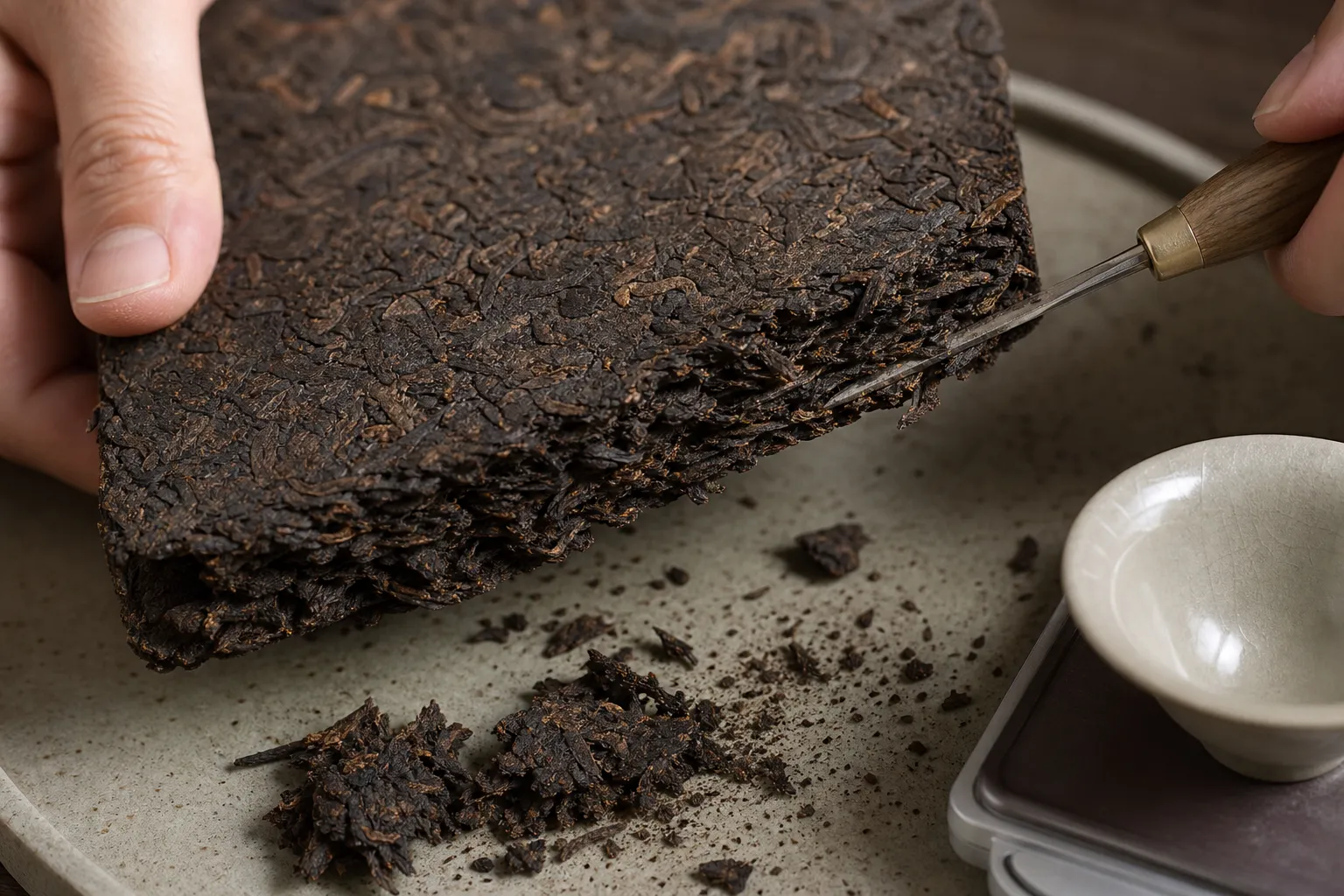
Loose leaf dark tea is easier to measure, easier to adjust, and easier to compare quickly. Compressed tea bricks, cakes, tuos, baskets, logs, and cut pieces can be rewarding, but they ask more from the brewer. You need to pry safely, loosen the material, manage dust and chunks, and store the remaining tea with care.
| Form | Best for | Tradeoff |
|---|---|---|
| Loose leaf dark tea | Daily brewing, beginners, fast comparison, office cups, small pots | Broken leaf can brew quickly; storage may be less compact |
| Compressed tea bricks | Compact storage, traditional forms, patient brewing | Requires prying; dense chunks may extract unevenly |
| Cakes | Pu-erh-style portioning and storage | Edge, center, and compression can brew differently |
| Tuos | Small compressed nests or bowls | Can be tight; easy to overuse if brewed whole |
| Basket-aged or basket-packed tea | Liu Bao and related aged-tea contexts | Aroma may depend strongly on storage history |
| Cut pieces from large formats | Sampling large compressed teas without buying the full piece | Broken surfaces may brew differently from intact inner material |
Loose leaf is often the better first teacher. If the cup is too heavy, use less leaf or shorten the steep. If it tastes thin, add leaf or extend time. You can smell the dry tea, warm it in the vessel, rinse if useful, and see how the leaf opens.
Compressed tea matters because it changes both handling and extraction. A tight brick may give a restrained first infusion, then open slowly. A loosely pressed cake may release flavor quickly. A dense chunk can taste weak at first and then suddenly over-extract once the center opens.
A practical rule for bricks and cakes: loosen layers rather than crushing the tea into dust. Work from an edge or natural seam with a tea pick or suitable knife, and keep your other hand out of the tool’s path. Aim for a mix of intact leaf pieces and smaller fragments. Too much dust can make the cup cloudy, harsh, or heavy; chunks that are too large may brew thin at first and then become too strong later.
If you receive a compressed sample already broken from a larger piece, inspect both the outer surface and the interior. Storage aroma often shows itself before the first sip.
How Processing, Storage, and Brewing Shape the Cup
Dark tea is not simply “old tea.” It is leaf material, processing, compression, storage, and brewing meeting in one cup.
Academic studies on dark tea and Fu Brick Tea often examine post-fermentation, microbial succession, volatile compounds, metabolite changes, and manufacturing stages. For everyday brewing, the important point is observable: different production and storage conditions can change aroma, liquor color, mouthfeel, and taste.
Before you brew, slow down for half a minute.
| What to check | Useful signs | Reasons to pause |
|---|---|---|
| Dry aroma | Clean wood, grain, dates, old books, cocoa, pine, light smoke, clean earth | Sharp moldiness, chemical odor, sour dampness, stale cardboard, perfume-like contamination |
| Compression | Layers, seams, flakes, loosenable chunks | Rock-hard pieces that are difficult to separate without dust |
| Leaf size | Coarser leaves may brew slower and sturdier; smaller leaf may darken quickly | Excessive powder if you want a cleaner cup |
| Color | Brown, black-brown, reddish-brown, olive-brown, or mixed tones can all appear | Color used as the only quality signal |
| Surface and interior | Compressed tea may look different once opened | Judging only from the dry outer face |
| If the cup tastes… | Possible cause | Try this next |
|---|---|---|
| Thin | Not enough leaf, short steep, chunk not opened | Add time, loosen the leaf, or use slightly more tea |
| Harsh | Too much dust, over-steeping, too much intensity for that tea | Shorten steeps, reduce fragments, or lower the dose |
| Flat | Tea may be tired, under-leafed, or poorly stored | Try a stronger brew once; if still flat, move on |
| Too earthy | Heavy fermentation profile or over-brewing | Shorten time, rinse once, or use less leaf |
| Smoky | Processing or storage note | Use shorter steeps; decide whether the smoke feels pleasant or rough |
| Sweet but weak | Gentle tea or under-extracted compressed piece | Extend gradually and watch later infusions |
| Thick and pleasant | Dose and extraction suit your taste | Keep the ratio and adjust only slightly |
A quick rinse is common in many everyday dark tea brewing setups, especially for compressed or dusty teas. It can warm the leaf, remove loose particles, and help you smell the opened material. It is not required for every tea, but it is a useful diagnostic step.
How to Choose Dark Tea for Your Taste and Brewing Style
The best first dark tea is not the rarest brick or the most elaborate label. It is the tea you will actually brew.
Start with the flavor direction you want, then choose a form that fits your routine.
| If you want… | Start with… | Watch for… |
|---|---|---|
| Earthy and smooth | Ripe pu-erh, loose or sample cake | Clean earth, wood, date-like sweetness, dark liquor without stale heaviness |
| Mellow and sweet | Fu Brick sample or broken brick pieces | Grain, gentle body, honey-like softness, clean brick aroma |
| Aged wood and mineral depth | Liu Bao dark tea | Old wood, basket-like depth, clean storage, lingering finish |
| Rustic and sturdy | Anhua dark tea bricks or cut pieces | Smoke, grain, thick body, compression strength |
| Strong tea for concentrated brewing | Tibetan tea / Zang Cha-style dark tea | Robust body, coarse-leaf strength, compatibility with milk or salt if desired |
| Easy daily measuring | Loose leaf dark tea | Consistent dose, clear adjustment, less prying |
| A small storage project | A cake or brick you already enjoy | Clean aroma, manageable size, no expectation that time alone will improve it |
Match the Tea to the Vessel
- Mug or grandpa-style brewing: choose forgiving loose leaf or well-broken dark tea. Use less leaf if the tea darkens quickly.
- Gaiwan: good for comparison. Short steeps help you watch how compressed pieces open.
- Small teapot: useful for daily ripe pu-erh, Fu Brick, or Liu Bao once you know your dose.
- Thermos or long steep: choose robust teas that do not turn rough quickly. Start with less leaf than you would for short-steep brewing.
- Boiling or simmering: some sturdy dark teas can handle stronger preparation, but begin carefully. A tea that is balanced in a gaiwan can become too heavy when boiled.
Also be honest about compression. If you will pry tea regularly, bricks and cakes become practical. If you will not, buy loose leaf or pre-broken portions. Many people like the idea of a brick more than the daily reality of using it.
How to Read Dark Tea Labels, Shapes, and Size Terms
Dark tea labels are clues, not final answers. A label may tell you origin, type, shape, production year, storage claim, leaf grade, factory, or style name. It may also repeat market language that sounds more precise than it is.
Read the label, then check the tea.
| Label clue | What it can help you understand | What it does not prove |
|---|---|---|
| Ripe / shou / cooked pu-erh | Processing style and expected earthy profile | That the tea is clean, smooth, or suited to your taste |
| Fu Brick / Fu Zhuan | Brick-style dark tea associated with Fu Brick production | That Golden Flowers language guarantees your preferred cup |
| Liu Bao | Guangxi dark tea family and aged-wood vocabulary | That every example has the same aroma |
| Anhua | A broad dark tea region or style reference | That all Anhua bricks taste alike |
| Hei Zhuan / Hua Zhuan | Brick names often seen in Anhua-style dark tea | Exact flavor without brewing |
| Qing Brick / Qingzhuan | Hubei-style brick reference | Brewing strength or storage condition |
| Tibetan tea / Zang Cha | Robust dark tea market category | A complete cultural history |
| Year or age claim | Possible storage timeline | Better taste, higher value, or clean storage |
| “Old tree,” “ancient,” or similar language | Raw-material or marketing claim | A better cup without supporting detail |
| Shape name | How you will handle the tea | Flavor by itself |
Shapes Matter Because They Affect Brewing
- Brick: compact and stackable; may be tight; good for storage but requires prying.
- Cake: common in pu-erh; often easier to flake from the edge than dense bricks.
- Tuo: bowl or nest shape; convenient, but sometimes very tight.
- Basket: often seen in Liu Bao contexts; storage aroma matters.
- Log or column: large compressed format; usually sold in slices or chunks to everyday drinkers.
- Loose leaf: simplest for measuring and comparison.
- Mini compressed pieces: convenient, but can overbrew if used whole in a small vessel.
Large formats can look impressive. They are only useful if you can store them well and drink them with interest. If you have not tasted the tea, a sample is usually wiser than a full brick.
Ripe Pu-erh Compared With Other Dark Teas
A ripe pu-erh comparison is useful because ripe pu-erh is often the first dark tea many people know. It offers a clear reference: dark liquor, earthy aroma, low sharpness, and often a smooth or thick body.
But ripe pu-erh is not the whole map.
| Comparison | Useful difference to notice |
|---|---|
| Ripe pu-erh vs Fu Brick | Ripe pu-erh often reads earthier and denser; Fu Brick is often discussed as mellow, grainy, sweet, or woody, with Golden Flowers language on some labels |
| Ripe pu-erh vs Liu Bao | Liu Bao may feel more aged-woody, mineral, or basket-influenced; ripe pu-erh may feel darker and rounder |
| Ripe pu-erh vs Anhua bricks | Anhua-style bricks can be rustic, smoky, sturdy, and compressed in ways that change brewing behavior |
| Ripe pu-erh vs Tibetan tea | Tibetan or Zang Cha-style teas may be more robust and practical in stronger preparations |
| Ripe pu-erh vs English black tea | Black tea is usually oxidized rather than post-fermented; it often tastes brighter, brisker, or more tannic |
If you love ripe pu-erh, explore outward by changing one variable at a time. Try ripe pu-erh beside Liu Bao to compare earth and aged wood. Try it beside Fu Brick to compare dense earth with mellow brick sweetness. Try an Anhua-style brick if you want a stronger compressed-tea experience.
If you dislike ripe pu-erh, you may still enjoy another dark tea type. Your issue may be with a particular fermentation profile, storage note, or brewing strength rather than the whole category.
A Simple First Tasting Path
A good first tasting path gives you contrast without overwhelming you.
Pick three small samples
- One ripe pu-erh in loose leaf or sample cake form.
- One Fu Brick or Anhua-style brick sample to understand compressed brick behavior.
- One Liu Bao dark tea, preferably loose or in a small broken portion.
This gives you three useful reference points: earthy density, brick-style mellow strength, and aged-wood direction.
Brew them simply
- Use the same vessel if possible.
- Start with a modest amount of leaf rather than packing the vessel.
- Use hot water close to a full boil for many dark teas, then adjust by taste.
- Rinse compressed or dusty tea briefly if it seems helpful.
- Use short steeps for gaiwan brewing.
- For mug brewing, use less leaf and taste before the cup becomes too heavy.
Record five cues
- Dry aroma
- Aroma after warming or rinsing
- Liquor color
- Mouthfeel
- Aftertaste
Then write one plain sentence: “I would drink this again because…” or “I would not buy more because…”
Do not force one method onto every tea. If a cup tastes thin, lengthen the steep or add leaf. If it tastes harsh, muddy, or too heavy, shorten the steep, reduce leaf, or separate large chunks more evenly.
That sentence is more useful than a decorative tasting note. It connects the tea to your actual brewing life.
Common Selection Mistakes
Most dark tea buying mistakes come from treating one clue as the whole answer.
| Mistake | Better way to think |
|---|---|
| Treating Fu Brick as the whole category | Fu Brick is one important branch, not a proxy for ripe pu-erh, Liu Bao, Anhua bricks, Qing Brick, or Tibetan tea |
| Assuming all dark tea tastes like ripe pu-erh | Some dark teas are more woody, grainy, smoky, sweet, mineral, or robust than earthy |
| Reading Golden Flowers as a shortcut | Use the term as a style clue, then evaluate aroma, storage, brewing response, and taste |
| Buying the largest brick first | Start with samples or small portions, especially when compression or storage notes are unfamiliar |
| Believing age always improves tea | Dark tea can change with storage, but change depends on material, moisture, airflow, temperature, compression, odor exposure, and time |
| Ignoring brewing form | A tea may fail in your routine because it is inconvenient to pry, too dusty, or too strong for your usual vessel |
A large compressed tea can be satisfying if you already know the tea and can store it well. For a beginner, it can also become a long-term reminder of a rushed decision. Start small, compare clearly, and let the cup decide the next purchase.
Where to Go Next
Use this root page as a map. When you want a narrower guide, follow the question that matches your next decision.
| If your question is… | Read next |
|---|---|
| “What are the major types of dark tea and how do they differ?” | Major Types of Dark Tea and How They Differ |
| “Should I buy loose leaf dark tea or a compressed brick?” | Loose Leaf Dark Tea vs Compressed Tea Bricks |
| “Is ripe pu-erh the same as dark tea?” | Ripe Pu-erh Compared With Other Dark Teas |
| “How do I choose dark tea for my taste and brewing style?” | How to Choose Dark Tea for Your Taste and Brewing Style |
| “What do these label, shape, and size terms mean?” | How to Read Dark Tea Labels, Shapes, and Size Terms |
Bottom Line
Dark tea selection becomes simpler when you separate type, form, and use.
Type tells you the family: ripe pu-erh, Fu Brick, Liu Bao, Anhua-style brick, Qing Brick, Tibetan tea, or another dark tea. Form tells you how you will handle it: loose leaf, brick, cake, tuo, basket, log, or broken piece. Use tells you whether the tea fits your real brewing life: quick mug, careful gaiwan, daily pot, small storage project, or stronger preparation.
Start small. Smell before and after rinsing. Watch the liquor. Notice whether the cup feels clean, mellow, earthy, smoky, woody, sweet, thin, heavy, or harsh. Then choose the next tea based on what happened in your cup, not only on the label.
Sources
Sources and further reading
Reference links are limited to sources considered suitable for public citation in this page.