
Cup-side tasting
What to Notice During a Simple Dark Tea Session
A simple dark tea session is not about naming every flavor perfectly. It is about watching what changes in the leaf, the cup, and your own response as the tea opens.
If you are wondering what to notice in dark tea, start with seven cues: dry leaf appearance, warmed leaf aroma, wet leaf aroma, liquor color, first taste, mouthfeel, and finish. Then compare those cues across a few steeps. Keep the setup plain: one tea, one vessel, one cup, and a steeping rhythm you can repeat.
The point is not to prove that a tea is good from one sip. It is to build a small cup-side record of what this leaf shows under your conditions.
upward
Read the full overview first
Use the broader guide first if you need the full scope before this page.
Start with the dry leaf before you brew
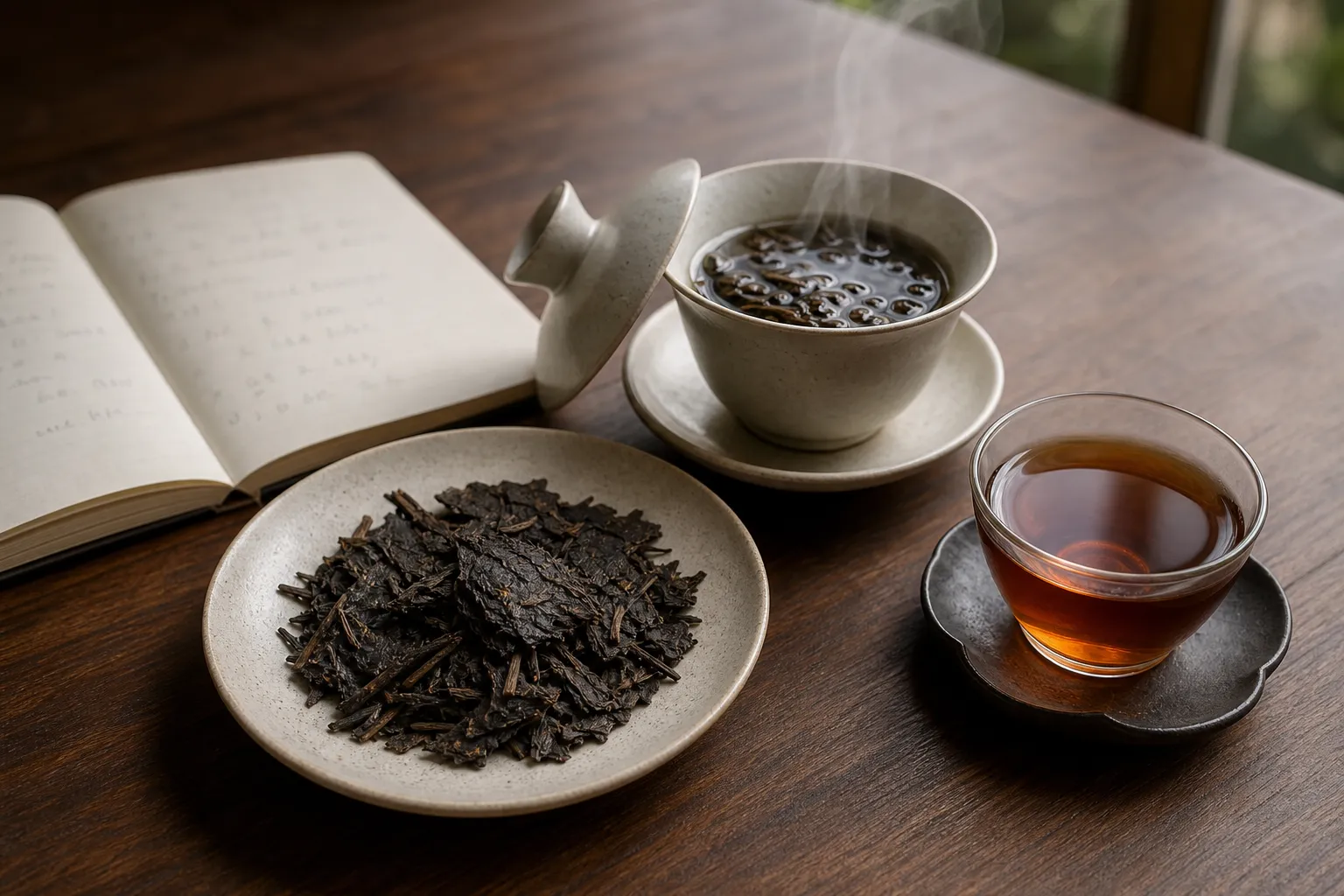
Before water touches the tea, look at the material in front of you. Dark tea may appear as loose leaf, a broken piece from a cake, a chunk from a brick, or smaller flakes from a compressed form. That form matters because it changes how quickly water reaches the inner leaf.
Notice size and density first. A tight chunk from a brick often opens more slowly than scattered loose leaf or thin fragments. A piece with many broken edges may release color and flavor sooner. A dense center may stay quiet in the first steep and become clearer later.
Look also at color variation. You may see dark brown, reddish brown, near-black, tan stems, or lighter leaf edges depending on the tea and storage history. Do not treat color alone as a verdict. In a simple session, color is more useful as a starting note: “mostly dark and compressed,” “loose with visible stems,” or “broken into small flakes.”
Smell the dry leaf briefly. Possible notes can include wood, earth, old paper, grain, dried fruit, mineral, or a neutral stored-leaf smell. If the aroma feels faint, that is still useful. A quiet dry leaf may become more expressive after warming or rinsing. If the smell is sharp, sour, stale, or unpleasant, write that down as an observation rather than forcing it into a final quality judgment.
Dry leaf tells you how to begin, not how the whole session will taste. Use it to choose patience, leaf amount, and steep length.
Warm, rinse, then smell again
After the dry check, warm the vessel and let the leaf meet heat. This can be as simple as placing the leaf in a warmed gaiwan, pot, or lidded cup and smelling before the first full steep. Warmed leaf aroma often gives a clearer preview than dry leaf because heat lifts aromatic notes.
Look for broad impressions rather than exact vocabulary. Does the aroma become woody, mellow, earthy, sweet, mineral, grain-like, or slightly smoky? Does it stay closed and muted? Does it feel heavy, clean, damp, sour, or flat? These are dark tea tasting cues, not final answers. They help you decide how carefully to brew the first cups.
Some drinkers rinse compressed dark tea before drinking, especially when the piece is tight or dusty. If you rinse, keep it short and observe the wet leaf aroma afterward. The wet leaf may smell deeper, cleaner, stronger, or more open than the dry leaf. It may also reveal possible earthy cues or woody cues that were not obvious at first.
Do not assume that an earthy smell is automatically a problem. Many dark teas can show earth, wood, cellar-like, or aged-storage associations depending on the tea and storage condition. At the same time, do not ignore an aroma that feels aggressively unpleasant, sour, or stagnant. A simple tea session cannot confirm origin, storage history, or broader claims, but it can tell you whether the cup is enjoyable enough to continue.
Warmed leaf aroma and wet leaf aroma guide attention. They do not replace tasting.
Watch the liquor color without overreading it
The first steep gives you a visible clue: liquor color. Pour into a cup where you can see the liquid clearly. White porcelain, glass, or a light interior cup makes changes easier to notice.
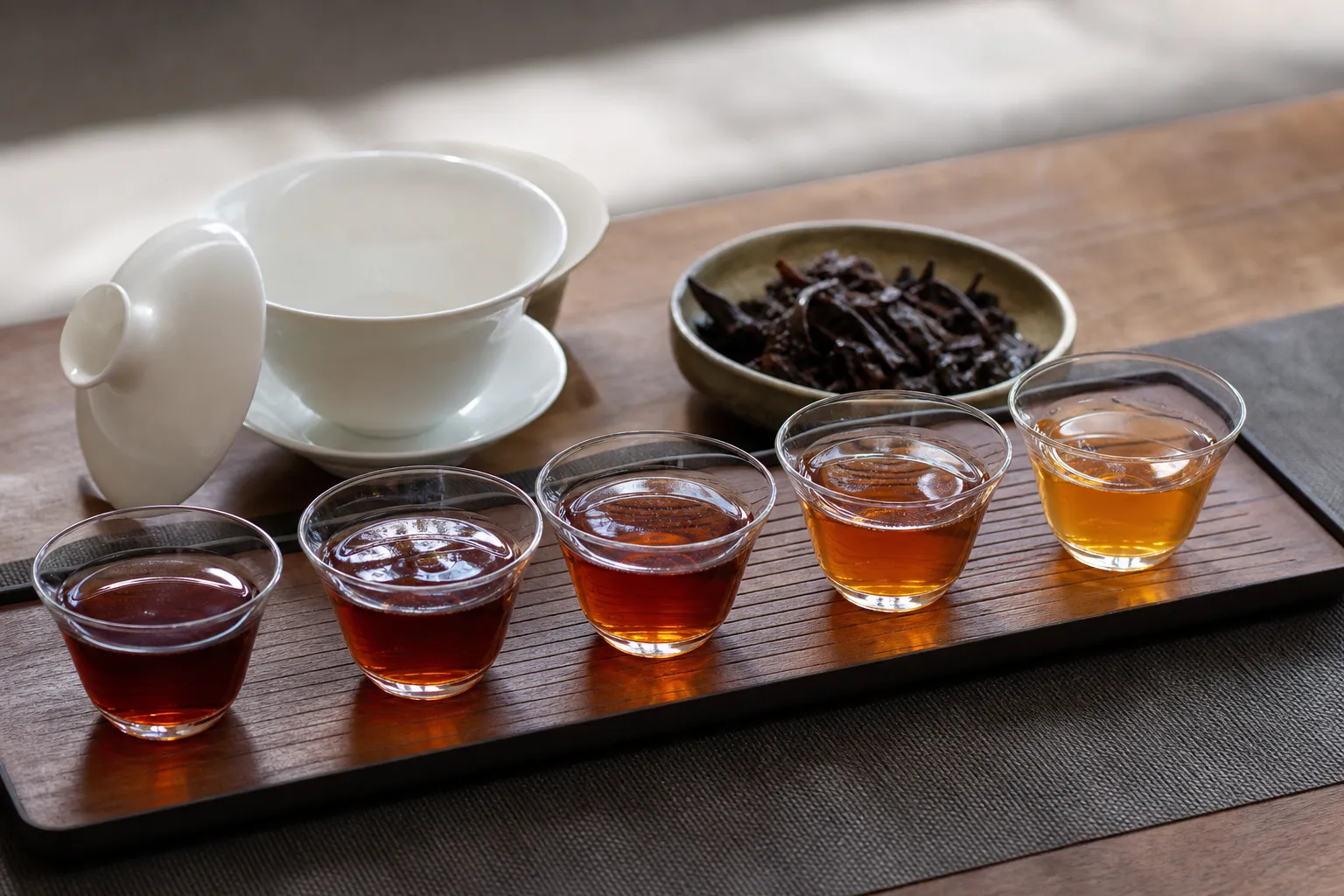
Dark tea liquor can appear amber, orange-brown, reddish brown, deep brown, or nearly opaque depending on leaf form, steeping time, water temperature, leaf amount, and compression. A fast, dark cup does not automatically mean the tea is strong in a pleasant way. A pale cup does not always mean the tea is weak; a compressed piece may simply need more time to open.
Notice clarity and density. Is the liquor bright and transparent? Cloudy? Thick-looking? Thin and light? Some cloudiness can come from broken leaf or a heavy pour, while a clean-looking liquor can still taste flat. Treat the cup’s appearance as one part of the session, not the whole judgment.
Color
Amber, red-brown, dark brown, nearly black
Depth
Pale, medium, deep, opaque
Clarity
Clear, hazy, cloudy, sediment-heavy
Change
Darkens, lightens, steadies, opens slowly
Across steeps, liquor color often tells you whether the leaf is still releasing. If the second or third cup becomes richer, the tea may have needed time to loosen. If the color collapses quickly, the leaf may be spent, under-leafed, or brewed with too much water for the amount used.
Use liquor color to adjust the next steep, not to announce the tea’s whole character.
Taste in layers: first sip, middle, and finish
For dark tea aroma, taste, and finish, separate the sip into three moments. The first sip tells you impact. The middle of the cup tells you shape. The finish tells you what remains after swallowing.
On the first sip, ask what appears immediately. Is it sweet, earthy, woody, mineral, bitter, sour, mellow, roasted, grain-like, or very light? Avoid trying to find rare flavor notes right away. Basic language is more useful in a simple tea session because it gives you something repeatable.
In the middle of the sip, notice balance. A tea may begin earthy but turn sweet. It may start mellow and become dry. It may feel smooth at first, then leave a rough edge. It may taste clean but thin. These middle-cup changes matter because they show how the brew is built, not just what the first contact suggests.
The finish is the aftertaste and physical echo. A dark tea finish may be short, lingering, sweet, drying, woody, cooling, heavy, or almost absent. A lingering finish is not automatically better; it depends on whether the aftertaste is pleasant to you. A short finish is not automatically a fault if the cup is easy, clean, and suited to casual drinking.
If the dark tea taste feels harsh, shorten the next steep or use slightly less leaf next time. If it tastes thin, lengthen the next steep, use a little more leaf, or give a compressed piece more time to open. If it tastes flat, check whether the water was too cool, the leaf amount was low, or the tea had already given most of what it had.
Taste should lead to one small adjustment, not a dramatic rebuild of the whole session.
Feel the mouthfeel, not just the flavor
Dark tea mouthfeel is the texture of the brew in the mouth. It is separate from flavor, although the two often influence each other. A cup can taste woody but feel thin. Another can taste mild but feel round and coating.
Notice weight first. Does the tea feel light, medium, thick, heavy, or watery? Then notice surface. Is it smooth, drying, rough, oily, soft, or powdery from fine particles? Finally, notice where it sits: on the tongue, cheeks, throat, or mainly at the front of the mouth.
Mouthfeel can change with brewing choices. More leaf, longer steeping, and finer broken material may produce a stronger or heavier cup. A tight chunk may begin thin and become fuller as it loosens. Too long a steep can make the cup feel rough or heavy in a way that hides quieter flavor notes.
If you are tasting casually, do not force a technical score. Use plain descriptions: “soft but light,” “thick and earthy,” “dry at the end,” or “smooth but not very sweet.” These notes are enough to help you repeat or adjust the brew later.
Mouthfeel is one of the clearest signs for adjusting strength, especially when flavor words feel uncertain.
Follow the changes across steeps
A simple dark tea session becomes more useful when you compare one steep with the next. You do not need a long ceremony. Three to five small cups can show whether the tea opens, fades, roughens, sweetens, or steadies.
For the first steep, notice whether the tea is ready or still closed. Compressed pieces may need time, while loose or broken leaf may speak quickly. For the second steep, look for a fuller aroma, deeper liquor color, or clearer flavor center. For later steeps, notice whether the finish remains, whether sweetness appears, or whether the cup becomes thin.
Changes across steeps are often more revealing than a single perfect cup. A tea that seems quiet at first may become round and woody later. A tea that starts very dark may lose structure quickly. A cup that feels too heavy may become more balanced when the next steep is shorter.
First steep
Main cue: pale, closed, light aroma. Adjustment thought: give the leaf more time.
Second steep
Main cue: deeper color, woody taste. Adjustment thought: keep the rhythm steady.
Third steep
Main cue: sweet finish, fuller texture. Adjustment thought: continue if pleasant.
Fourth steep
Main cue: thin, fading. Adjustment thought: lengthen or stop.
Do not expect every dark tea to improve steadily. Some are best early. Some need a rinse and patience. Some remain simple. The point is to notice the arc, not to force a preferred shape onto every leaf.
Judge the session by movement as well as flavor.
Common confusion during a simple dark tea session
One common confusion is treating all earthy notes as bad. Earthy, woody, damp-stone, old-paper, or storage-like impressions can appear in different ways, and they are not all the same. The useful question is whether the note feels integrated, pleasant, and supported by the cup, or whether it dominates in a sour, stagnant, or unpleasant direction.
Another confusion is reading dark liquor as depth. A very dark cup may come from small leaf fragments, long steeping, heavy leaf amount, or a compressed piece finally releasing. It may taste full, but it may also taste rough or muddy. Liquor color is a clue; taste and mouthfeel decide the next move.
A third confusion is expecting one dark tea profile. Dark tea is a broad drinking category in everyday use, and this page does not define every processing style, region, or naming system. For this session, stay with the cup: aroma, color, taste, texture, finish, and change.
A final confusion is turning tasting into performance. You do not need rare vocabulary to learn from a cup. “Woody and sweet, medium body, short finish” is more useful than a dramatic note you cannot recognize again.
Simple notes should make your next steep better.
A small checklist for the cup
Use this checklist when you want structure without making the session stiff:
- Dry leaf: loose, compressed, broken, dense, flaky, stemmy, dark, mixed-color.
- Warmed leaf aroma: quiet, woody, earthy, sweet, mineral, grain-like, sour, flat.
- Wet leaf aroma: more open, deeper, cleaner, heavier, sharper, or still muted.
- Liquor color: pale amber, red-brown, deep brown, opaque, clear, hazy, sediment-heavy.
- Taste: mellow, sweet, earthy, woody, mineral, bitter, sour, thin, heavy, balanced.
- Mouthfeel: light, round, smooth, drying, rough, thick, watery, coating.
- Finish: short, lingering, sweet, woody, drying, clean, heavy, or fading.
- Next steep: shorter, longer, same timing, more patience, or stop.
If you only write one line, make it practical: “Second steep was fuller and smoother; keep timing similar.” That kind of note helps more than a long description that does not guide the next cup.
What this session can and cannot tell you
A simple dark tea session can tell you what this tea does under your current conditions. It can show whether the leaf opens slowly or quickly, whether the aroma is pleasant to you, whether the liquor feels thin or heavy, and whether the finish encourages another steep.
It cannot confirm the tea’s exact origin, processing history, storage record, age, safety, or market value. The useful boundary is observational: describe what the cup shows, and leave wider conclusions out of the tasting note unless you have stronger information from outside the cup.
Your next decision should be small. If the cup is thin, extend the next steep. If it is harsh, shorten it. If the aroma is unclear, smell the warmed and wet leaf before judging. If the finish is pleasant, continue. If the session feels flat after several steeps, stop and save the note for comparison with another dark tea.