
Compressed tea tool choice
Can You Use a Kitchen Knife to Break Dark Tea
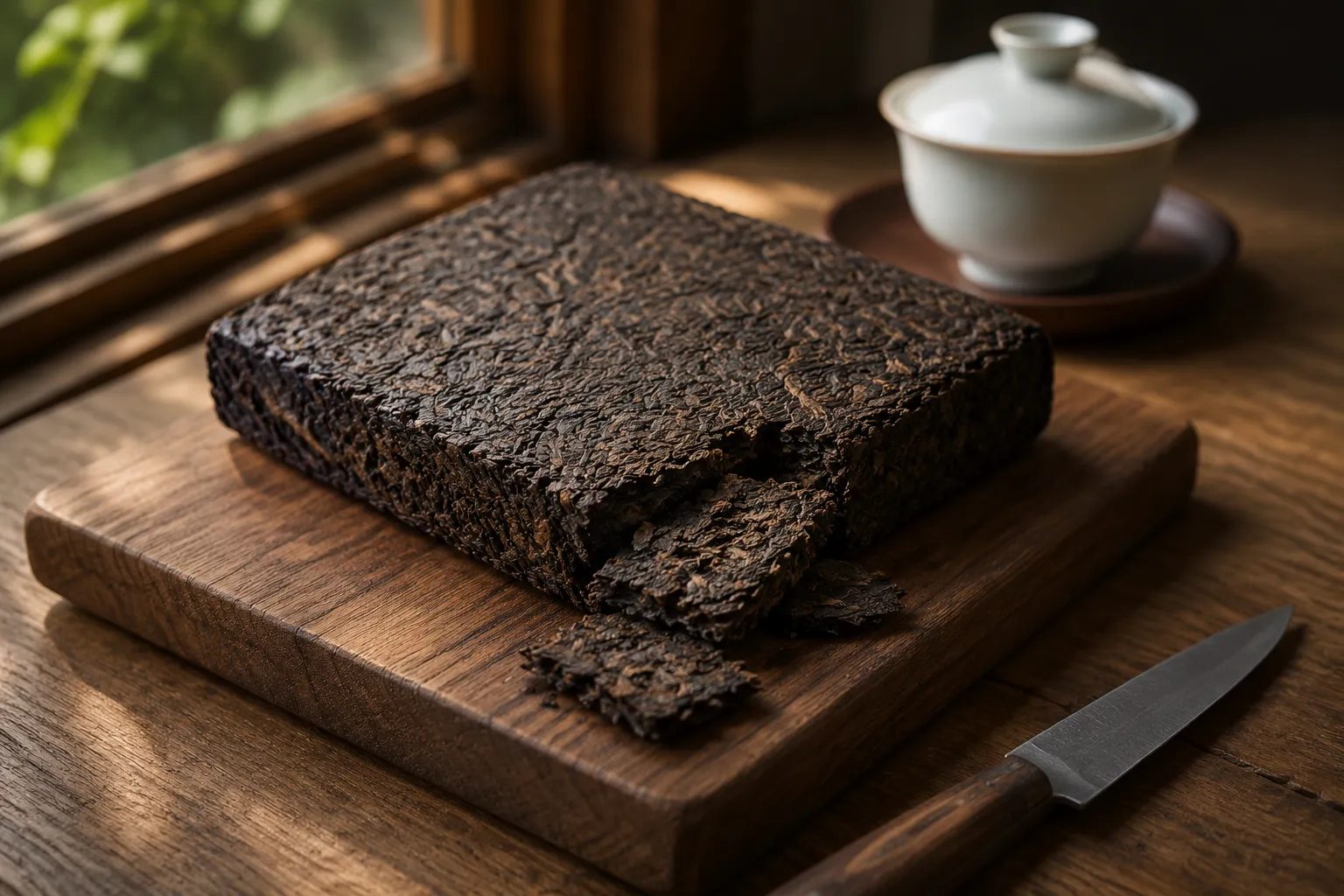
A compressed dark tea brick can look like something you should cut, but the better motion is usually to loosen, lift, and flake. You can sometimes use a kitchen knife for tea brick handling in a pinch, especially if the brick has a loose corner or visible seam. It should be a last resort, not your normal tool.
A tea needle, tea pick, or tea knife is usually better suited because compressed tea is opened by shallow prying, not by slicing downward. If you only have a regular kitchen knife, work from an edge, take small flakes, keep your fingers out of the blade’s path, and stop if the blade slips, bends, chips, or the brick resists.
upward
Start with the broader guide
Use the broader guide first if you need the full scope before this page.
Why a Tea Brick Is Loosened, Not Cut
A dark tea brick is compressed leaf material. Depending on the tea and pressing style, it may feel loose and layered, firm but workable, or so dense that the surface barely gives under light pressure. That difference matters more than the tool name.
When you prepare tea for brewing, the goal is not to carve a clean slice or split the brick like wood. The goal is to separate enough leaf for the next pot, gaiwan, mug, or thermos while keeping the broken portion reasonably intact. Thin flakes and lifted layers often brew more evenly than powder made by chopping.
The useful distinction is cutting versus prying:
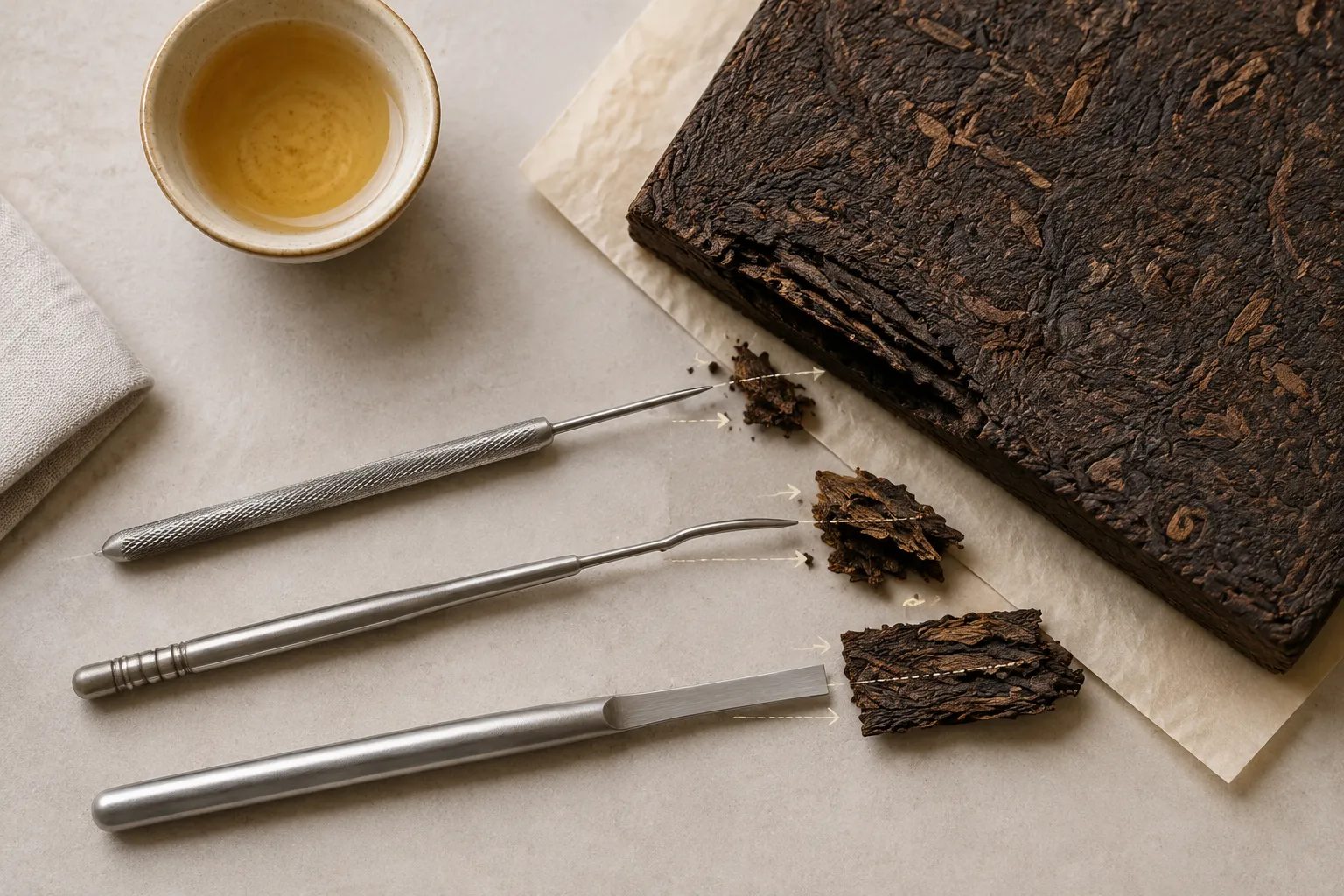
Tea needle
Better suited to shallow entry between tight layers. It can still puncture or slip if forced.
Tea pick
Better suited to controlled lifting from an edge or seam. It needs patience on dense bricks.
Tea knife
Better suited to loosening flakes or sheets from compressed tea. The shape varies by tool.
Kitchen knife
Better suited to cutting food on a board. It can slip or behave poorly when twisted sideways.
Paring knife
Better suited to small cutting tasks. Its pointed tip may tempt deep stabbing or levering.
A kitchen knife is designed around its cutting edge. When that edge is pushed into a hard tea brick and twisted sideways, the motion is no longer normal food cutting. General knife-safety guidance treats knives as cutting tools rather than pry tools; that boundary is enough for this tea-table question.
For compressed tea, control is usually more useful than sharpness.
When a Kitchen Knife Might Work
A kitchen knife for dark tea brick use is most plausible when the tea already gives you an entry point. Look for a lifted corner, a side seam, a layered edge, or a spot where the surface feels less locked together. If light pressure can free a few grams, you may be able to prepare one brew without a dedicated tea tool.
Keep the fallback narrow:
- Use a clean knife suitable for food contact.
- Place the brick on a stable board or tray, not in your palm.
- Work in good light.
- Keep your non-tool hand away from the direction the blade might move.
- Enter only shallowly at an edge, seam, or loose layer.
- Remove small flakes instead of trying to split the brick.
- Stop if the tool slips, bends, chips, or needs heavy force.
A short, controlled wiggle at a loose edge is very different from driving a sharp blade deep into the brick. If the knife starts to feel like a crowbar, the setup has moved outside the useful range.
Avoid chopping downward into the brick. Avoid cutting toward your hand. Avoid using a broad chef’s knife as a hard lever. A paring knife may look convenient because it is narrow, but its point can also make it easy to enter too deeply or pry with poor control.
If the brick is dense, wait for a tea needle, tea pick, or tea knife. More force does not make a kitchen blade a better compressed-tea tool.
Why a Tea Needle, Tea Pick, or Tea Knife Fits Better
A tea needle is narrow enough to enter between compressed layers. A tea pick gives you a small point or edge for controlled lifting. A tea knife may be broader than a needle, but it is still used more like a separator than a slicing knife.
The better tool is not always the sharpest one. It is the one that lets you enter shallowly, feel the compression, and lift a small amount without crushing the surrounding leaves. That is why tea-tool language often circles around pry, loosen, flake, and lift rather than cut.
The public tea-specific material on this exact question is limited. Oolong Owl’s hands-on comparison of tea picks, tea knives, and household items on compressed teas, including Fu bricks, supports a modest point: tool performance changes with compression, leaf style, and shape. A method that feels easy on a looser brick may not transfer to a tightly pressed one.
At the table, that means looking at the brick before choosing the tool. If it opens in thin layers, a shallow tool can coax out flakes. If it feels stone-like, a kitchen knife may invite force before it gives you control.
If You Have No Tea Tool Nearby
Before reaching for a kitchen blade, check whether you need a tool at all. A loose corner or lightly compressed edge may separate by hand. If the brick gives under gentle finger pressure, break off a modest piece and stop before crushing it into dust.
If hand pressure does not work and you still decide to improvise, use the least aggressive motion:
- Put the brick flat on a stable board or tray.
- Find an edge, corner, seam, or natural gap.
- Keep the knife angle shallow, not vertical.
- Ease the tip or narrow part in only a little.
- Lift gently, without hard twisting.
- Remove a small flake.
- Repeat from a nearby point if needed.
The amount you need is usually small. Patience is more useful than a dramatic split.
Watch what comes away. If the leaf turns to dust, reduce pressure and try another point. If it breaks into thick chunks, you can still brew them, but the interior may open more slowly. A chunk may need a rinse or a slightly longer early steep; thin flakes may release color and body faster.
The tool choice can change how evenly the brew begins.
Common Misunderstandings
“Any knife is basically a tea knife”
Not quite. A tea knife alternative should match the motion of separating compressed leaves. A kitchen knife may be sharp, but its usual job is cutting food. The problem appears when the blade is used sideways as a pry tool.
Some tea discussions mention screwdrivers, chisels, oyster knives, or butter knives as improvised options. Treat those as reader improvisations, not preferred recommendations. Cleanliness, food-contact suitability, shape, and control all matter.
“Sharper means better”
For a tea brick, sharper does not automatically mean better. Sharpness can help a blade enter the surface, but entry is only the first moment. Once the tool is inside, control matters more. A very sharp knife that slips toward your fingers is a poor tradeoff.
“A dense brick should be forced open”
A dense brick is a reason to change approach, not to increase force. Try a different edge, remove a smaller amount, or wait until you have a proper compressed-tea tool. If every shallow entry point resists, forcing it with a kitchen knife can damage the tea, the tool, or your control over both.
“Breaking by hand is always wrong”
Loose compressed tea does not always need metal. If a corner has already separated, gentle hand pressure can be enough. The boundary is simple: if you have to squeeze, crush, or tear hard, take a smaller piece or switch tools.
A Quick Table-Side Decision
- Loose edge, light compression: try fingers first, then a tea pick or tea knife if needed.
- Visible seam but firm brick: use a tea needle, tea pick, or tea knife with shallow prying.
- No tea tool, only a kitchen knife: proceed only if the entry point is easy and the motion stays light.
- Dense brick with no giving point: do not force it with a chef’s knife or paring knife.
- Tool slips or tea resists: stop and change the plan.
This keeps the question small. You are deciding whether this brick, this edge, and this tool can give you a small brewable amount without turning the session into a struggle.
So, Should You Use One?
Use a kitchen knife only as a careful fallback, and only for a small amount from an easy edge. For regular handling, a tea needle, tea pick, or tea knife is the better fit because breaking compressed tea is mainly shallow prying and loosening, not slicing.
Once you have the piece, let the cup guide the next adjustment. Thin flakes may open quickly; thicker chunks may need more time. The better tool is the one that gets you to a clean, controlled brew with the least force.
Sources
Sources and further reading
Reference links are limited to sources considered suitable for public citation in this page.