
Dark tea brick tool choice
Tea Knife vs Tea Needle: Which Tool Works Better for Dark Tea Bricks
A dark tea brick usually gives the first clue before you remove any leaf. If you can see a reachable edge, a seam, or a layered corner, a tea knife often works better because it gives you leverage. If the brick is tight, narrow, or you only need a small brewing portion, a tea needle can work better because it enters with less disturbance.
So the answer to tea knife vs tea needle is not one permanent winner. For everyday breaking tea bricks, choose by compression and break size: use a tea knife for leverage, and a tea needle for loosening.
upward
Start with the broader guide
Use the broader guide first if you need the full scope before this page.
The Quick Choice at the Tea Table
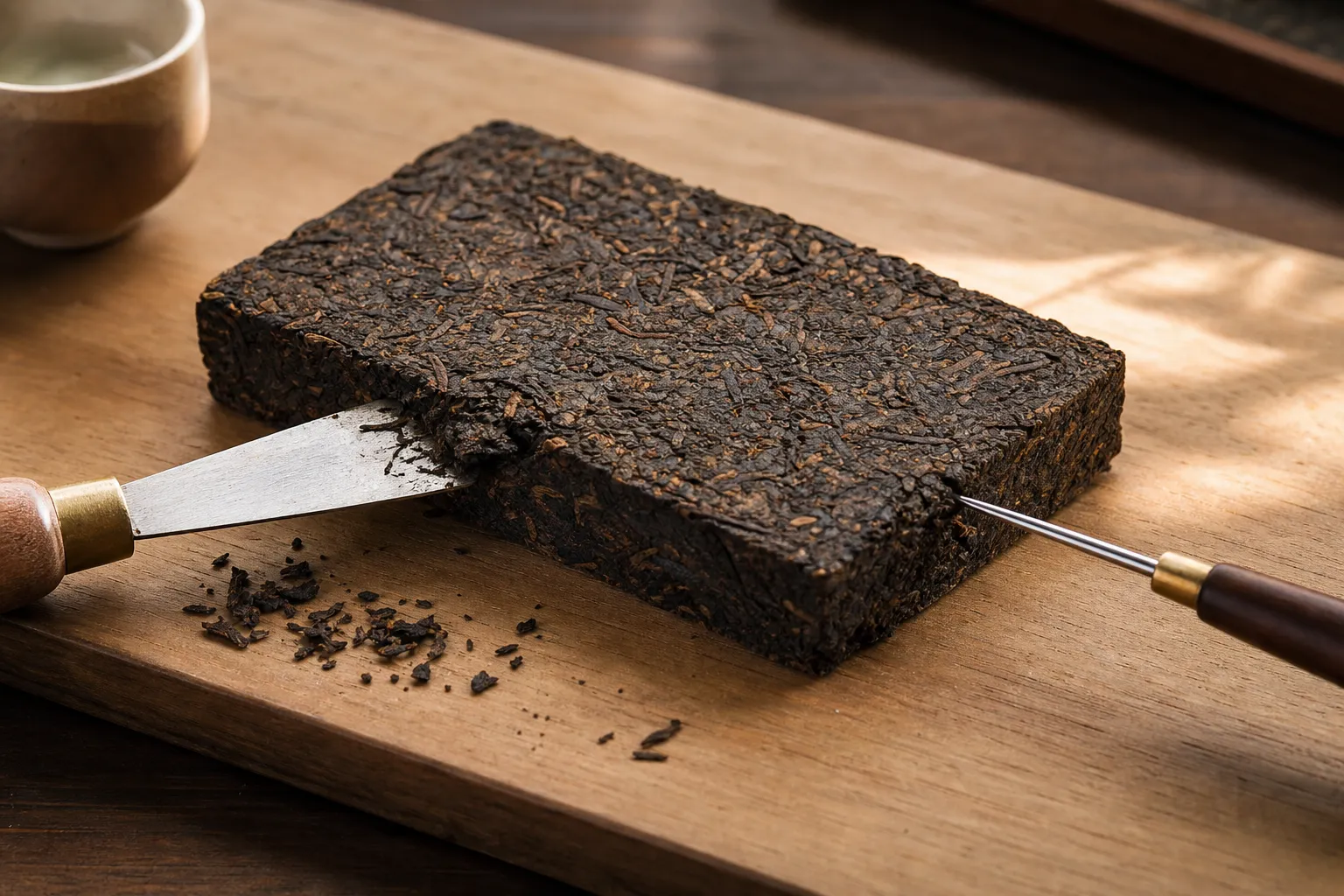
Use a tea knife when the brick gives you a place to work from. Look for edge access, a small gap, a pressed layer, or a corner that already shows slight separation. Slide the knife in at a low angle, then lift slowly until a flake begins to release. This is usually the better route when you want a broader piece instead of many small fragments.
Use a tea needle when the brick gives you no easy opening, or when you want to disturb less of the surrounding leaf. A needle is not just a smaller knife. It works more like a probe, useful for compact places where a wide pry would be clumsy.
Clear edge or visible seam
Try a tea knife first because it gives more leverage from an accessible line.
Very tight compression
Try a tea needle first because the smaller entry point allows gradual loosening.
Need a larger flake
A tea knife is often easier for lifting along a pressed layer.
Need a small portion
A tea needle is often better for teasing apart a compact spot.
Brick starts making crumbs
Either tool may still work, but use less pressure because angle, dryness, or leaf condition may be the issue.
Brick resists completely
Stop and change approach, because forcing usually reduces control.
Neither tool makes the tea better by itself. The cup still depends on tea material, storage, water, vessel, leaf amount, rinse choice, and steeping time. The tool only helps you remove a usable piece with a level of breakage you can accept.
Read the Brick Before You Push
Before choosing between a tea knife and a tea needle, turn the brick in your hand and look for structure. Some dark tea bricks show pressed layers, uneven corners, small fissures, or a side that has already loosened slightly. Others look dense and flat, with no obvious place to enter.
Visible seams matter because they give the tool a path. A tea knife works best when it can slide between layers instead of cutting straight down through the compressed mass. The motion should feel like easing open a line that already exists, not carving a new channel through the leaf.
A tea needle helps when the only workable point is small. Insert the tip shallowly and loosen in short, careful motions before trying to separate a portion. Once the section begins to open, you can continue with the needle or switch to a knife if a broader seam appears.
Compression changes the answer. A lightly compressed brick may separate with minimal pressure from either tool. A tightly pressed one may resist both, especially if you aim straight into the face. In that case, work from a corner, change the angle, or remove a smaller portion.
Leaf condition also matters. A dry, brittle edge may crumble even when your tool choice is reasonable. A more cohesive section may lift in flakes. That does not prove one tool is superior; it shows that compression, storage condition, and break point are shaping the result.
Leverage, Precision, and Break Size
The main difference between these dark tea brick tools is the kind of control they give you. A tea knife gives leverage. A tea needle gives precision. Both can be useful, but they solve different problems.
A tea knife is usually the better first choice when you want a larger brewing piece. Its wider blade can support a flake as it lifts, especially if you enter from an edge and keep the angle low. The knife works best when you let the brick’s own layers guide the break.
A tea needle is usually better when your target is smaller. It can loosen a compact section without committing to a wide pry. That makes it useful when you only need a few grams for a small pot or gaiwan, or when the brick is too dense for a knife to enter cleanly. The needle’s advantage is not force; it is small movement.
Pressure should follow the portion you want
- If you want one tidy portion, start at the edge, insert shallowly, and lift just enough to see whether a layer responds.
- If you want a smaller amount, make several light loosening points rather than one deep stab.
- A steep angle tends to drive force into the brick and can create crumbs or sudden splits.
- A lower angle often gives more control because the tool moves with the pressed layer.
Tool angle is a quiet but important variable. This matters most with a tea knife, but a needle also benefits from shallow entry when the surface is brittle.
The best sign is not a perfect-looking chunk. It is a portion that fits your brew without too much dust, too much shattered leaf, or pressure that feels uncontrolled.
If the Tea Brick Crumbles or Resists
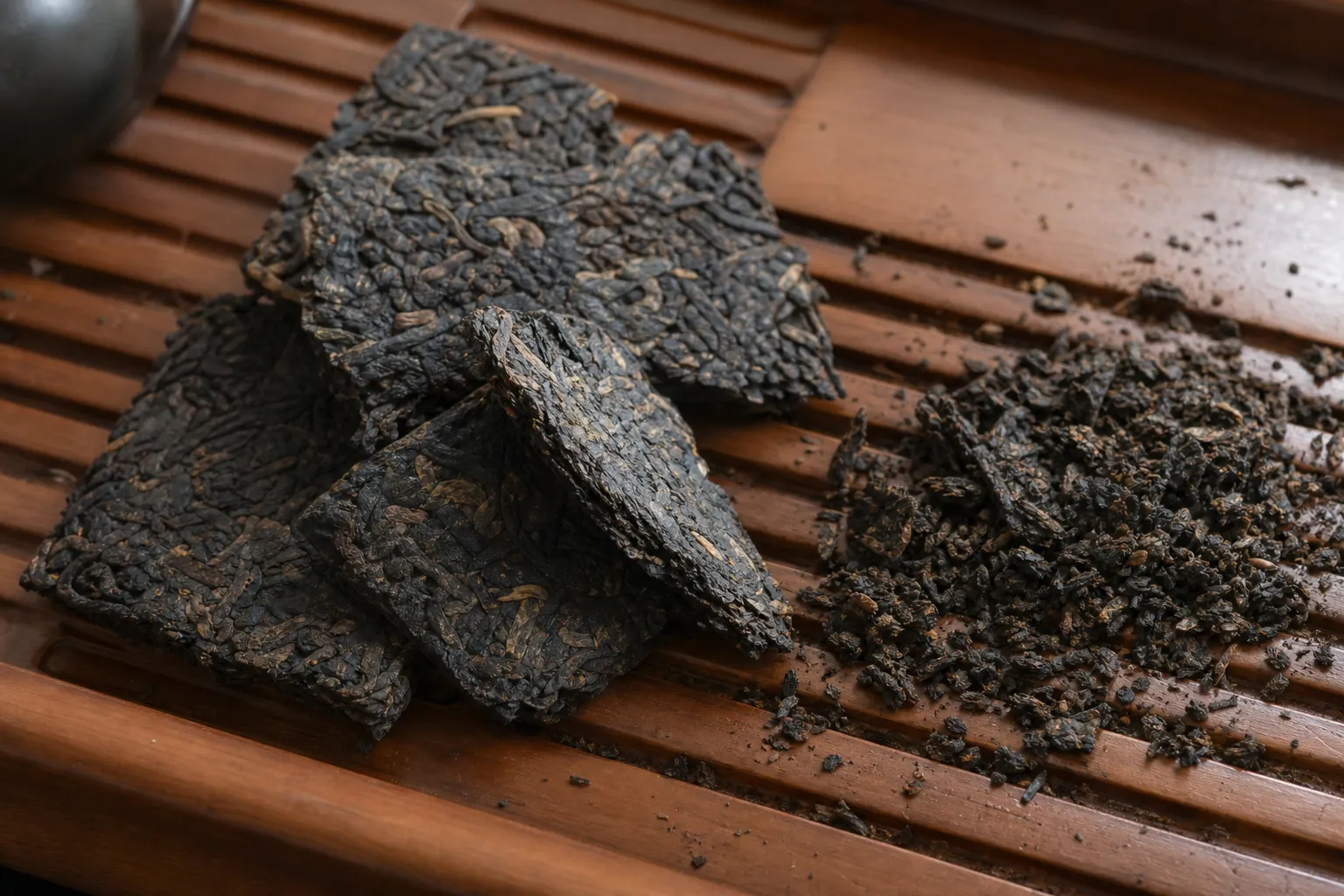
Crumbling does not always mean you used the wrong tool. It can mean the entry point was dry, the pressure was too direct, the portion was too large, or the brick does not support a clean flake at that spot. When a tea brick crumbles, pause before changing tools. Look at the fragments first.
If you are getting mostly dust and small chips, reduce pressure and work from a different edge. With a knife, lower the angle and try to slide along a seam rather than lift upward too soon. With a needle, make smaller loosening motions and avoid widening one hole aggressively. A little broken leaf is normal in many everyday brewing setups, but too much fine material can make measuring and rinsing less predictable.
If the tea brick resists, do not answer resistance with more force. Try a smaller target. Rotate the brick and search for another edge, corner, or layered side. A needle may help open a tight point first; a knife may help once that point becomes a visible line.
If a large piece breaks off unevenly, you can still brew from it. Separate the portion you need and keep the rest aside for later. For a practical cup, the more important question is whether you can dose the leaf reasonably and adjust the steep if the portion contains many small fragments.
Small fragments can infuse faster than intact flakes. If your broken portion includes many crumbs, start with a shorter first steep after the rinse and watch the liquor color. If the cup becomes too heavy early, reduce steeping time before blaming the tool.
Common Confusion About Tea Knife vs Tea Needle
One common confusion is treating the tea knife as the “strong” tool and the tea needle as the “delicate” tool. That is too simple. A knife can be clumsy if there is no seam. A needle can be rough if it is driven too deep. The better question is where the brick allows controlled entry.
Another confusion is assuming cleaner pieces always mean better tea. Cleaner pieces are easier to handle and may make dosing neater, but they do not promise a better cup. A slightly broken portion can still brew well if you adjust leaf amount, rinse, and steeping time.
Some drinkers also expect a tea brick to split exactly along visible lines. Sometimes it does. Sometimes the pressed leaf crosses those lines, or the corner breaks in a way you did not expect. Compression, age, storage, and leaf grade can all affect how the brick responds, so it is better to read the material in front of you than follow a fixed rule.
A final misunderstanding is that one tool must be the proper tool for all compressed dark tea. Everyday brewing does not need that certainty. A tea knife, a tea needle, or both can be reasonable depending on the brick. If you have only one tool, choose technique over force: shallow entry, careful pressure, and a smaller target when the brick resists.
A Simple Working Method
- Set the brick securely. Place the brick on a stable tea tray or surface where it will not slide. Keep your fingers away from the path of the tool, then examine the edges before touching the center. The most workable entry point is often not the prettiest face of the brick; it is the corner or side that shows a natural opening.
- If you begin with a tea knife, work the seam. Insert the tip or front edge lightly into a seam. Keep the angle low, then lift with gradual pressure. Stop as soon as the layer starts to separate. If the piece bends but does not release, move a little along the seam instead of forcing the same spot.
- If you begin with a tea needle, open a compact point. Choose a compact point near an edge rather than the middle of the brick. Insert shallowly, loosen in small motions, and watch whether the surface opens. Once there is enough access, you can continue with the needle for a small portion or use a knife to lift a larger flake.
- Check the break before brewing. If it is mostly intact leaf with a few small fragments, brew as planned. If it includes many crumbs, use a little less leaf or shorten the early steep. If it is too large, separate it further along the thinnest part rather than crushing it from the top.
The Practical Verdict
For dark tea bricks, a tea knife works better when you have edge access, visible seams, and a desire for a larger flake. A tea needle works better when the brick is tightly compressed, the entry point is small, or you want a modest brewing portion with gradual loosening.
The useful answer is to keep both ideas in mind: leverage when the brick offers a path, precision when it does not. If the leaf crumbles, soften your pressure and shorten the early brew if needed. If the brick resists, change the angle, reduce the portion size, or switch tools.
The next decision is at the cup, not the tool rack: once the portion is free, let the amount of broken leaf guide your rinse and first steep.