
Practical brewing decision
Do You Need a Scale for Brewing Dark Tea
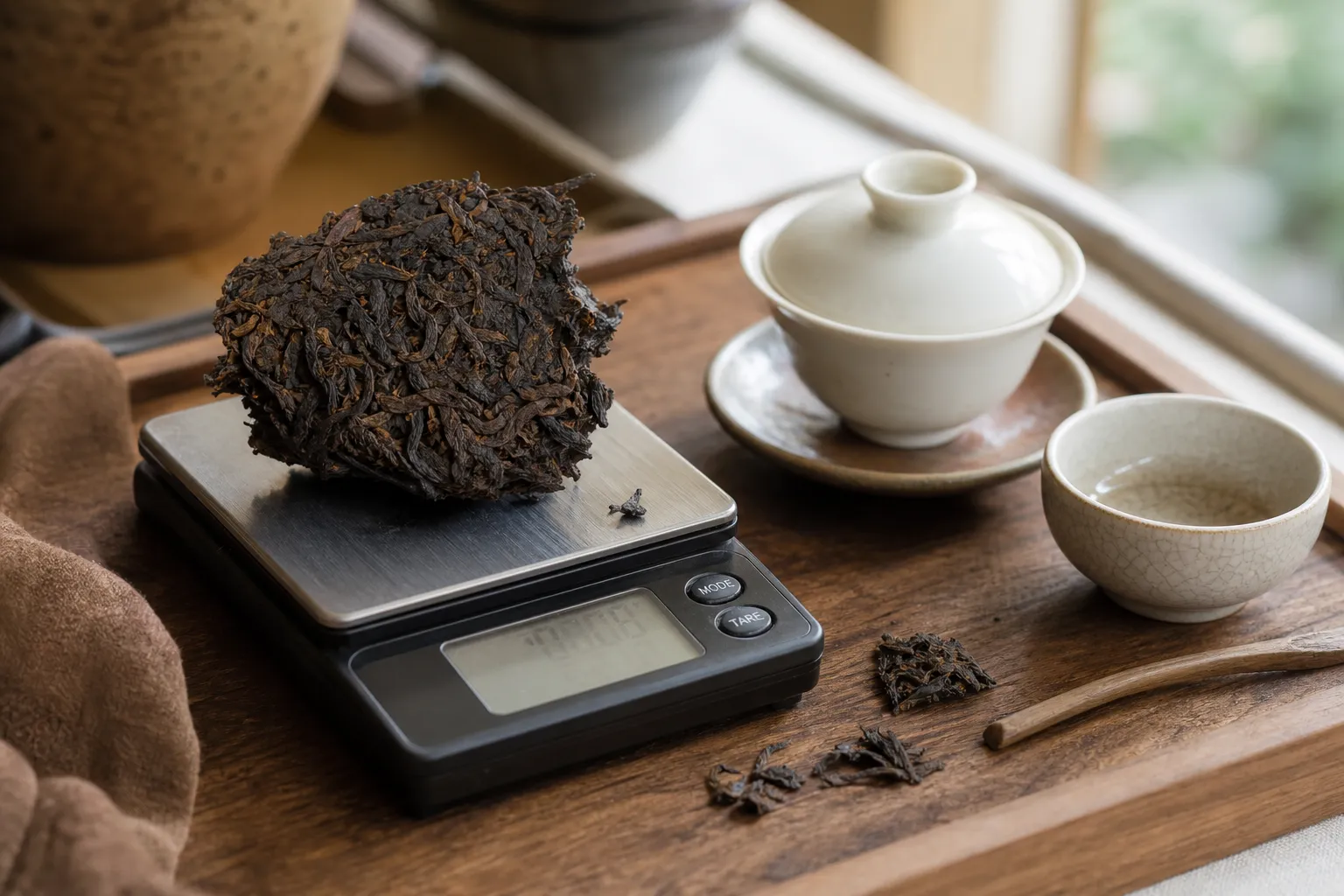
A broken corner of a dark tea brick can look small in the palm and still brew heavy in the cup. A loose pile from a related tea can look generous and taste thin. That is where a scale for brewing dark tea earns its place: it tells you how much leaf you actually used.
You do not need a scale to brew dark tea well. You may want one if you care about repeatability, small-vessel brewing, side-by-side comparison, or compressed pieces that are hard to judge by sight. For a casual mug, pot, or daily thermos-style brew, visual measuring and taste adjustment can be enough.
The scale is not the rule. It is a repeatable starting point.
upward
Start with the broader guide
Use the broader guide first if you need the full scope before this page.
When a Scale Actually Helps
A scale helps most when the leaf amount is difficult to read by eye. Dark tea often comes as cakes, bricks, dense chunks, broken flakes, loose leaves, or mixed fragments. One piece may be compact and heavy; another may be airy and light. A spoon can hold both, but it cannot show whether they weigh the same.
Gaiwan or small pot
A gram or two can change liquor strength quickly.
Side-by-side comparison
You can keep leaf weight and water volume steady, then focus on aroma, body, and aftertaste.
Compressed tea
Dense pieces can hide more leaf than they appear to hold.
Repeating a good session
You can return to the same dark tea leaf amount instead of guessing from memory.
This is less about precision for its own sake and more about removing one variable. If 5 g in a 100 ml gaiwan gave you a round, sweet, earthy cup, you can begin there again. If the brew felt too heavy, lower the leaf amount or shorten the first few steeps. If it tasted thin, add leaf, extend time, or use less water.
A tea gram scale is most useful when the number has context: vessel volume, water temperature, steep time, and what the cup tasted like. Without that, the weight is just a neat number on a screen.
When You Can Skip the Scale
You can skip the scale when the brew is casual, forgiving, and easy to correct. A large mug, simple pot, or daily thermos brew does not always need exact measuring. If you already know how your usual tea behaves, a familiar pinch, spoonful, or small piece may be enough.
This is especially true when you are willing to adjust by taste. If the first cup is too light, steep longer or use a little more leaf next time. If it turns heavy, woody, or overly dense, reduce the leaf amount or shorten contact time. Many everyday brewing setups work through that kind of correction.
Visual measuring can work well when:
- You brew the same tea often.
- The leaf form is consistent.
- You use the same mug, pot, or gaiwan each time.
- You are not comparing one tea against another.
- You enjoy adjusting dark tea by taste rather than following numbers.
A scale becomes less necessary when your goal is comfort rather than comparison. If the cup tastes good and you can repeat it well enough by eye, the tool can stay in the drawer.
The Spoon Measure Problem
The common spoon measure tea problem is simple: spoons measure volume, not weight. Dark tea does not fill a spoon in one consistent way.
A teaspoon of fluffy loose dark tea may weigh much less than a teaspoon of small broken fragments. A dense chip from a brick may weigh more than it looks. A curved piece from a cake may sit awkwardly on a spoon and leave air gaps underneath. The spoon looks exact, but the leaf shape is doing much of the work.
That does not make spoon measuring useless. It means it is most reliable when the tea is familiar and fairly uniform. If you brew the same loose tea every morning, your spoon can become a personal measure. If you switch from loose leaf to a compressed cake, or from large flakes to small broken bits, the old spoon habit may lead to a stronger or weaker cup than expected.
A better measuring habit
- Use sight for relaxed daily brewing.
- Use weight when the leaf shape changes.
- Use taste to correct both methods.
A scale cannot tell you whether the storage aroma is clean, whether the rinse opened the piece, whether the liquor feels too sharp, or whether the aftertaste is what you want. It only tells you the leaf amount.
Starting Points Without Turning Them Into Rules
There is no single dark tea ratio that fits every cake, brick, loose tea, vessel, and preference. Lower-leaf mug brewing and higher-leaf small-vessel brewing use different logic. Both can be useful, but neither should become a fixed standard for every tea.
Broad home starting bands
Mug or larger pot
About 2–3 g per 8 oz / 240 ml
Add leaf if thin; reduce leaf or time if heavy.
Small vessel brewing
About 3–6 g per 100 ml
Shorten early steeps if too strong; add time as the leaves fade.
Compressed pieces
Weigh first, then adjust by cup
Dense chunks may brew stronger than they look.
These ranges are only beginnings. A ripe, earthy dark tea may feel full with less leaf. A tightly compressed piece may need a rinse and a little time to open. A loose, aged, or broken tea may release flavor quickly. Vessel shape, water temperature, and steep time all change the result.
“Grams per 100 ml tea” makes sense in small vessel tea brewing because the water volume is small enough for tiny changes to show. “Grams per 8 oz tea” belongs more naturally to mug and pot brewing. Neither phrase helps much unless you know how much water your vessel actually holds during brewing.
A 120 ml gaiwan does not always mean 120 ml of brewing water once leaves are inside. A pot may have a stated size that differs from the amount you pour in practice. If you want dark tea brewing repeatability, measure the usable water volume at least once. Then the leaf weight has a real frame.
How to Use a Scale Without Letting It Run the Session
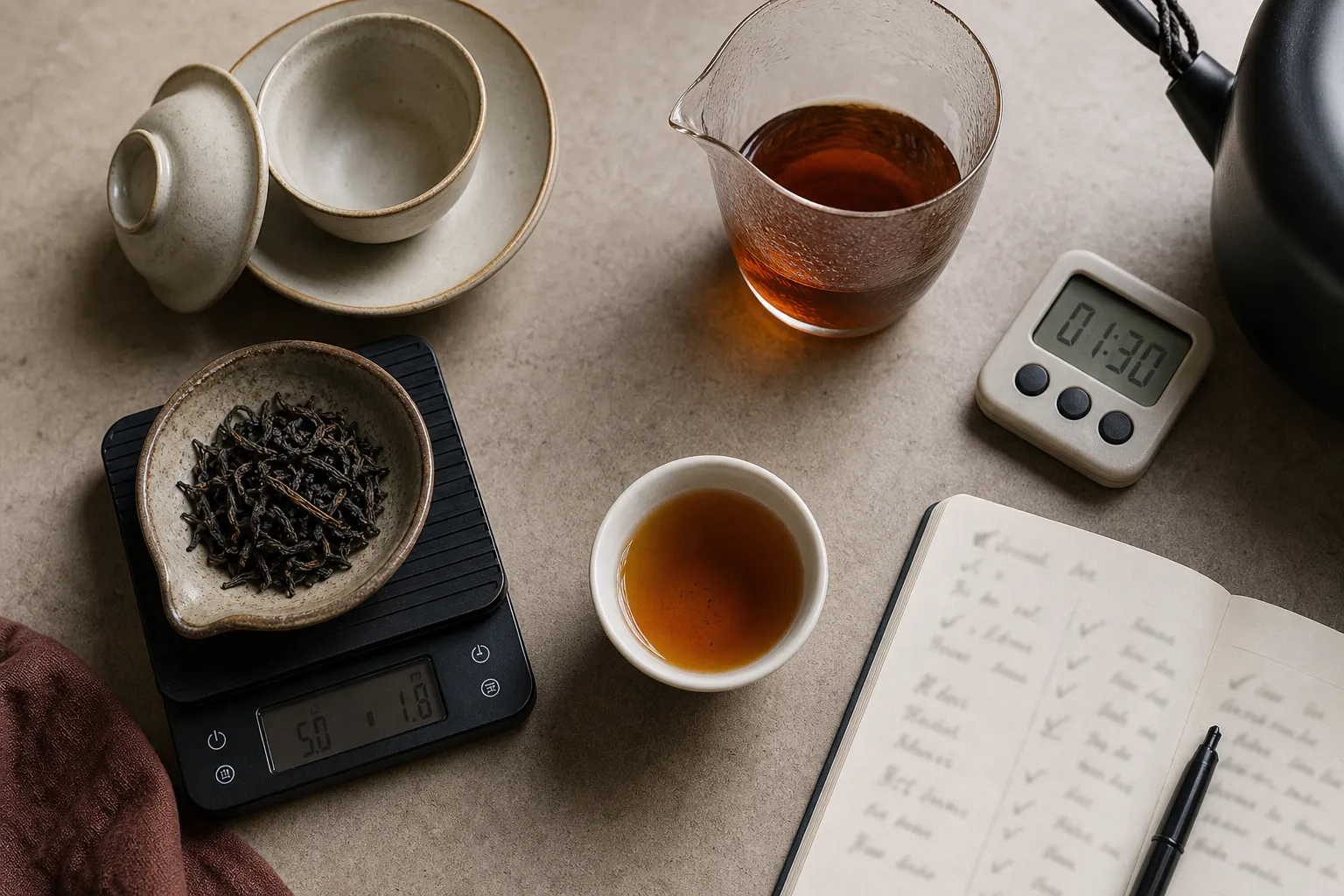
Weigh the leaf before it touches the vessel. If the gaiwan or pot does not sit comfortably on the scale, place a small dish, cup, or plate on the scale, use the tare function, and add the tea. The tare function resets the display to zero after the dish is placed on it, so you are weighing the leaves rather than the dish.
Keep the workflow simple
- Choose your vessel and water volume.
- Weigh a modest starting amount of leaf.
- Rinse if that is part of your usual practice for that tea.
- Brew the first steep short enough to read the tea.
- Adjust the next steep by liquor color, aroma, mouthfeel, and aftertaste.
The scale gives you a repeatable beginning. The cup gives you the correction.
If the liquor is pale, quiet, and watery, try more leaf, more time, hotter water, or a smaller pour. If it is very dark, rough, drying, or too earthy for your preference, reduce leaf, shorten time, or spread the strength across later infusions. If the aroma opens slowly from a compact piece, the first steep may not tell the whole story.
Weighing dark tea should feel calming, not fussy. You are making one variable visible so the next adjustment is easier.
What Kind of Scale Is Enough
Scale choice should not become the center of the tea table. For most dark tea brewing, look for a scale that reads grams clearly, responds at low weights, has a tare function, and stays on long enough for you to work without rushing.
Independent kitchen-scale testing, including Wirecutter’s reviews of general kitchen scales, looks at features such as readability, tare behavior, speed, accuracy checks, increments, and auto-shutoff behavior. That kind of testing can help with scale usability. It does not establish a dark tea ratio or predict flavor.
A full-gram kitchen scale can be enough for larger pots or rough daily measuring. For small vessel tea brewing, where you may use only a few grams, smaller displayed increments can feel more practical. Still, decimals on the display do not always mean dependable low-weight performance. What matters is whether the scale settles consistently when you add small amounts of leaf.
You do not need a special tea-labeled scale. A stable, readable gram scale is usually more useful than tea-specific marketing language. Put the attention back into the tea, the water, the vessel, and your notes.
A Simple Decision Check
Use a scale if you answer yes to any of these:
- You want to repeat a brew you liked.
- You brew compressed dark tea pieces that vary in density.
- You compare two teas side by side.
- You use a small gaiwan or pot.
- You keep overshooting strength by sight or spoon.
Skip it, or treat it as optional, if:
- You brew one familiar tea in one familiar vessel.
- You enjoy correcting by taste.
- Your mug or pot method is already consistent enough.
- You do not want another tool in the session.
The useful middle path is to weigh occasionally. Measure a few sessions, learn what 3 g, 5 g, or 7 g looks like in your hand and vessel, then decide whether the habit is worth keeping. Over time, the scale can train your eye instead of replacing it.
Bottom Line
You do not need a scale for brewing dark tea, but a scale can help when the leaf form is irregular, the vessel is small, or the goal is repeatability. It is most useful for measuring dark tea leaves in grams, pairing that weight with real water volume, and then adjusting the cup by taste.
Use the number as the first mark, not the final answer. The next decision still happens in the liquor: is it thin, heavy, sweet, earthy, smooth, sharp, or fading? That is where the brew tells you what to change.
Sources
Sources and further reading
Reference links are limited to sources considered suitable for public citation in this page.