
Practical tool choice
Gongfu Tea Tools for Dark Tea: What Each Piece Is For
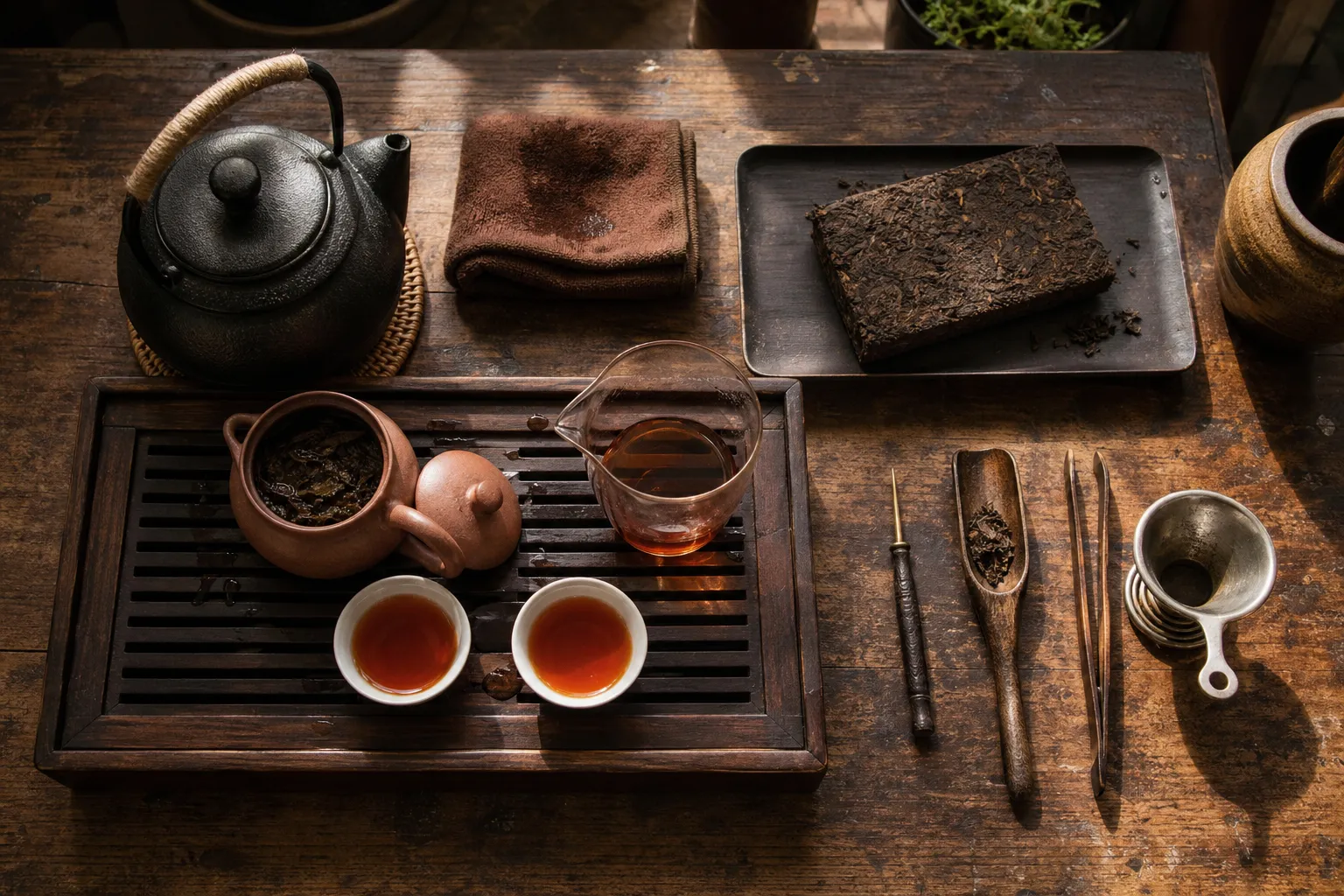
A compressed brick, a small kettle, and a wet towel can tell you more about gongfu tea tools than a full display stand. The useful tools are the ones that solve a table problem: loosening dense leaf, measuring a small amount, controlling a short steep, pouring cleanly, moving hot cups, or keeping rinse water under control.
For most dark tea drinkers, a simple gongfu setup can start with a gaiwan or small pot, a kettle, cups, and a towel. Add a tea pick, scoop, tongs, strainer, fairness cup, or tray when the tea form or table workflow asks for them.
The point is not owning a complete set. A larger tool kit does not prove skill, cultural correctness, tea quality, or a better cup. Dark tea changes with cake, brick, loose leaf, storage condition, vessel size, water, and personal taste, so each piece should earn its place by what it helps you control.
upward
Start with the broader guide
Use the broader guide first if you need the full scope before this page.
The Core Setup: Vessel, Kettle, Cups, and Pouring Path
The brewing vessel is the center of the table. For dark tea gongfu tools, this usually means a gaiwan or a small teapot. A gaiwan lets you watch the leaf open, smell the lid, and adjust the pour quickly. A small pot may hold heat more steadily and feel easier for repeated infusions. Neither is automatically better; the useful choice is the one that gives you control over steeping time and pouring speed.
Compressed dark tea often suits a smaller vessel because the leaf can release in stages. If the first steep tastes thin, lengthen the next infusion or use a little more leaf. If the cup turns heavy, woody, or too dense, shorten the steep or reduce the amount next time. The vessel matters because it sets the size of every adjustment.
The kettle is practical rather than ceremonial. It keeps hot water ready for repeated short steeps. Many compressed or older dark teas respond well to hotter water, but the tea in front of you still decides the adjustment. If the liquor feels flat, heat may help. If it feels rough, harsh, or muddy, shorter contact time may matter more than another tool.
Small cups complete the feedback loop. They make liquor color, aroma, mouthfeel, and aftertaste easier to compare from steep to steep. Brewing alone may need only one cup. Sharing across a table usually works better with several small cups and a clear pouring path.
That path can be direct, or it can pass through a fairness cup and strainer. Direct pouring is simpler. A fairness cup mixes one steep before serving, which can make several cups closer in strength. A strainer catches broken leaf, dust, and small fragments, especially with chopped, aged, or loosened compressed tea. Use these pieces when the pour needs them, not because the table looks unfinished without them.
Tools for Compressed Tea: Pick, Scoop, and Measuring Habits
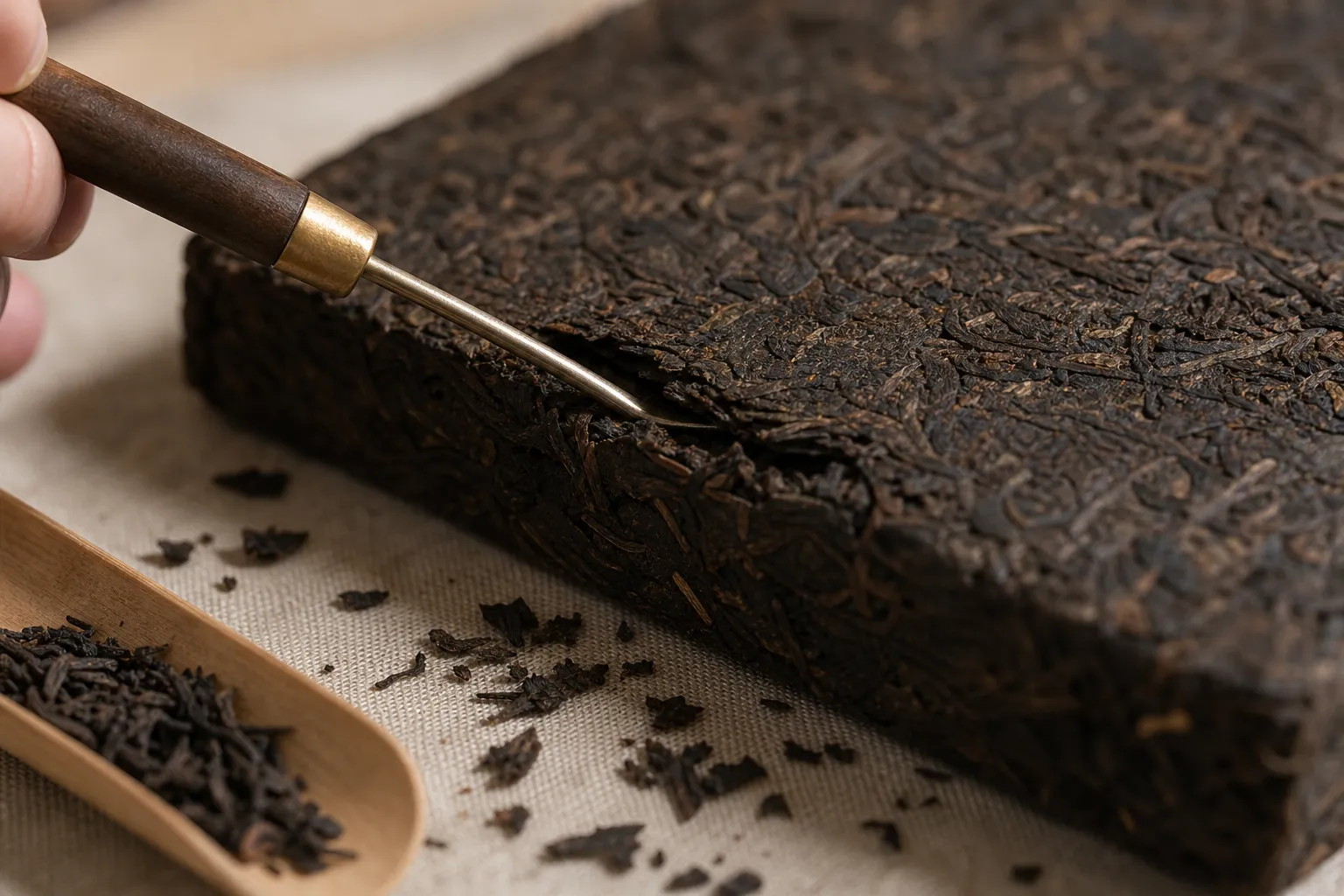
Compressed tea tools matter most when the tea begins as a cake, brick, or tightly packed piece. A tea pick for dark tea loosens leaf from compression. Its job is not to stab through the tea; it should enter along layers or seams where the leaf can separate with less breakage. More broken leaf can brew faster and may send fine particles into the cup, so opening the piece can affect the first few steeps.
A pick is useful when fingers cannot safely or cleanly separate the tea. It is less useful for loose-leaf dark tea, already broken pieces, or tea that flakes apart with light pressure. If the brick is very tight, work slowly from an edge and keep the point angled away from your hand. The goal is a manageable piece, not a perfect-looking shard.
The tea scoop moves and roughly measures dry leaf. It is not as exact as a scale, but it keeps leaf off the table and helps you repeat a session when the tea shape is similar. With loose leaf, a scoop can give a fairly consistent amount. With compressed chunks, volume can mislead because a dense piece may weigh more than it appears. Use a small scale when repeatability matters; use a scoop when casual brewing is enough.
A pick, scoop, or small tray also gives you a moment to inspect the dry material. Is it a tight chunk, loose flakes, coarse leaf, or fine broken material? That observation affects the brew more than the accessory itself. Tight compression may need a rinse or a slightly longer early steep to open. Fine fragments may brew quickly and benefit from shorter pours or a strainer.
Do not treat compressed tea tools as a buying checklist. If you drink mostly loose dark tea, a scoop and towel may matter more than a pick. If you often open cakes or bricks, the pick becomes practical. The tool follows the leaf form.
Handling Heat and Clean Pouring
Tongs for hot cups do one simple job: they let you move small cups after rinsing or warming them. They are useful when cups are too hot to handle comfortably, when several cups need arranging, or when you want to avoid touching the rim. They are optional if you brew alone, skip cup warming, or can handle the cups safely by their sides.
Tea scoop and tongs are often sold together, but they solve different problems. The scoop handles dry leaf. The tongs handle hot or wet teaware. If you only add one at first, choose from the problem you actually have: scattered leaf points toward a scoop; awkward hot cups point toward tongs.
A strainer helps when the tea releases small fragments. Broken compressed tea can cloud the pour or leave fines in the liquor. A strainer can make the texture cleaner, though it also adds another item to rinse. If the cup is already clear enough, or if you enjoy the added body, leave the strainer off the table.
The fairness cup is mainly about evenness and timing. When a steep is poured into a pitcher first, the liquor mixes before it is divided into cups. This helps when serving more than one person, or when the vessel pours so the first cup is lighter and the last cup stronger. If you drink alone and pour directly into one cup, it may add little.
A tea tray controls water. It catches rinse water, overflow, and drips from repeated steeping. This is especially useful when rinsing compressed tea, warming cups, or brewing several rounds quickly. A tray can be a draining tea tray, a simple plate, or another heat-safe surface. For a very small setup, a towel may handle enough moisture. For longer sessions, a tray reduces interruptions.
A towel is the quiet tool that often matters more than it looks. It dries the base of the vessel, catches small spills, and keeps cups from leaving wet rings. If you are choosing optional gongfu tea tools, a plain towel may do more for daily comfort than a decorative piece that rarely leaves its stand.
When a Simple Setup Is Enough
A simple gongfu tea setup is enough when it lets you control leaf amount, water, steeping time, and pouring without frustration. For one person drinking a familiar loose-leaf dark tea, that may mean only a small vessel, kettle, cup, and towel. If the pour is clean and the cup tastes balanced, there is no need to add pieces just to match a formal-looking table.
Start with the brewing problem:
This approach prevents a common confusion: more tools do not automatically mean more control. Extra pieces can slow the session, increase cleanup, and distract from the tea if they are not solving anything. Gongfu tea tool uses should remain visible in the hand: pick to loosen, scoop to move leaf, vessel to steep, pitcher to even the pour, strainer to catch fragments, tongs to handle heat, tray and towel to manage water.
Dark tea also changes as it opens. A tight piece may need help in the first few infusions and then become easier. A loose or broken tea may release quickly from the start. A tea with a heavy storage aroma may benefit from a rinse and a clean pouring path, but tools cannot correct every storage note or guarantee a preferred flavor. Watch the liquor and aroma, then adjust the brew before blaming or buying equipment.
The best minimum setup is the one you will actually use. If a small pot, one cup, and a towel help you brew attentively, that is a working table. Add tools only when the tea, heat, pour, or cleanup keeps interrupting the cup.
Common Misunderstandings About Gongfu Tea Tools
A complete tool set is not required
Many tools are helpful, but most are optional. A dark tea session can be careful and satisfying with only a few pieces if the brewer can manage the leaf, water, pour, and cup.
A gaiwan is not always the correct vessel
Gaiwan tools are useful because the lid, bowl, and saucer give direct control, but a small pot can also work well. The decision depends on hand comfort, heat retention, pour speed, and how the tea behaves.
Accessories are not proof of quality
Tools can support attention, but they do not verify tea origin, storage, price, or the skill of the person brewing. This page keeps the focus on visible table functions.
Tools cannot fix every flavor problem
They can help with control, but they cannot make every dark tea taste sweet, clean, deep, or smooth. Adjust leaf amount, water, time, and pour speed before blaming or buying equipment.
If a gaiwan feels too hot or awkward, forcing it will not improve the brew. If a cup tastes thin, adjust leaf amount, water, or time. If it tastes too strong, shorten the steep or pour faster. If the aroma seems stale or unpleasant, note the storage impression and compare with another tea before making a broad conclusion.
A Practical Tool-by-Tool Summary
Gaiwan or small pot
Steeps the tea and controls the pour. Most useful when you want short, repeatable infusions; often optional when brewing casually in a larger cup.
Kettle
Supplies hot water for repeated steeps. Most useful when compressed or heat-demanding leaf needs steady water; often optional for one simple mug.
Tea pick
Loosens compressed cakes or bricks. Most useful when the tea is too tight to separate by hand; often optional when the tea is loose or already broken.
Tea scoop
Moves and roughly measures dry leaf. Most useful when you want less mess and repeatable amounts; often optional when you use a scale or brew casually.
Fairness cup
Mixes one steep before serving. Most useful when sharing across several cups; often optional when drinking alone from one cup.
Strainer
Catches fragments and fine leaf. Most useful when broken compressed tea clouds the pour; often optional when the liquor is clean enough for your taste.
Tongs
Move hot cups or small teaware. Most useful when cups are rinsed or warmed; often optional when cups stay comfortable to handle.
Tray
Catches rinse water and drips. Most useful for longer sessions or repeated rinsing; often optional when a towel handles the moisture.
Towel
Wipes bases, spills, and wet surfaces. It is useful in almost any small table setup, and it can be any clean towel.
For dark tea, the useful question is not “Do I own the full set?” but “Which part of this brew is hard to control?” If the answer is compression, choose a careful pick. If it is uneven pouring, use a fairness cup. If it is heat, use tongs. If it is mess, use a tray or towel. Let the next tool answer the next problem at the table.