
Compressed tea guide
Tea Brick Size Terms: What Common Weights Mean
A tea brick size label usually tells you the net weight of the whole compressed unit, not the amount to brew in one session. If a wrapper says 250 g, 500 g, 1 kg, or 2 kg, that is the full brick before you break off tea for daily use.
For a buyer, the practical reading is simple: weight tells you how much tea you are taking home, dimensions tell you how much space it needs, and compression affects how easy it may be to pry, portion, and keep tidy after opening.
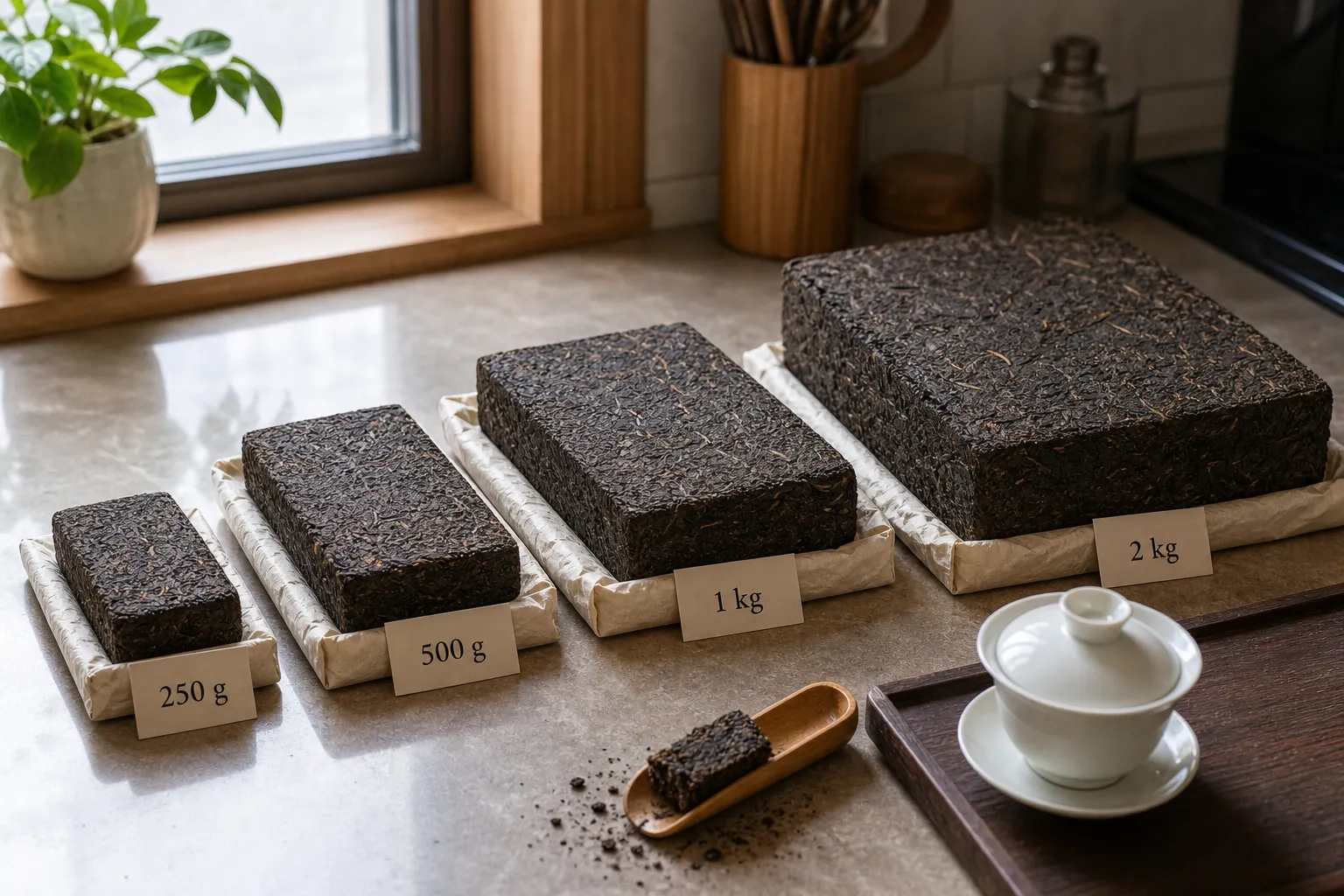
Quick answer: Do not read a tea brick weight label as a serving size. Read it as whole-brick net weight, then ask whether the form is small enough to store, easy enough to break, and realistic for how often you drink dark tea.
upward
Start with the broader guide
Use the broader guide first if you need the full scope before this page.
How to read a tea brick weight label
Start with the most concrete number on the wrapper or listing: net weight. It is usually shown in grams or kilograms and may appear beside a shape name such as brick, cake, tuo, roll, or basket-packed tea.
For daily use, the better question is not “Is this brick small or large?” It is: How much compressed tea am I buying, and how will I portion it?
A 250g tea brick is often the easiest size for a casual drinker to understand. It still gives many sessions, but it is not a kilogram-scale object. A 500g tea brick asks for more shelf space and more repeated use. A 1kg tea brick is a larger commitment: you will likely be breaking, wrapping, and revisiting it over time. A 2kg tea brick is not unusual in traditional dark tea contexts, but it needs more deliberate storage and portioning.
If dimensions are listed, read them with the weight. Two bricks can weigh the same but handle differently. A wide, thin brick may fit awkwardly in a drawer but expose more edge once opened. A thicker brick may stack neatly but be harder to pry if tightly pressed.
The tea name can also help. Labels such as Fu Zhuan, Hei Zhuan, Huazhuan, Kang Zhuan, Jin Jian, Pu’er brick, Pu’er cake, or tuo tea point toward different compressed forms. They are useful clues, but they do not replace weight, dimensions, and what you can see from the brick’s shape.
Common brick weights and what they usually imply
These are practical reading categories, not universal rules. Documented Chinese dark tea examples show a wide range of weights and shapes, while modern retail listings vary by producer, market, and packaging style.
A useful habit is to translate the label into brewing reality. If you normally brew a small gaiwan, teapot, or mug, a 1 kg tea brick still becomes many separate sessions. The brick’s size does not decide the serving. You break off a measured piece, brew, taste, and adjust.
If the cup tastes thin, use a little more leaf, extend the steep, or give a dense piece more time to open. If it tastes too heavy, earthy, harsh, or flat, reduce the broken amount, shorten the infusion, or let the leaves open more gently over several steeps.
Why traditional dark tea bricks may look larger than expected
“Brick” sounds like one simple shape, but compressed dark tea has appeared as cuboid bricks, cakes, bowl-like tuo forms, large cylindrical rolls, and basket-packed tea. That is why tea brick size can feel confusing when you first compare labels.
One review of Chinese dark tea gives concrete examples. Fu Zhuan is described as a cuboid brick, with one example around 35 cm × 18.5 cm × 4.5 cm. Hei Zhuan is described around 35 cm × 18 cm × 3.3 cm and 2 kg per brick. In the same source, Huazhuan is described as sharing the same weight as Hei Zhuan.
The same review lists Pu’er brick examples at 250 g, 500 g, 1000 g, 2000 g, and 3000 g, including 250 g brick dimensions of about 14 cm × 9 cm × 3 cm or 15 cm × 10 cm × 2.5 cm. It also notes Pu’er cake tea around 375 g with a roughly 20 cm diameter, tuo examples around 100 g, and very small pieces around 4 g.
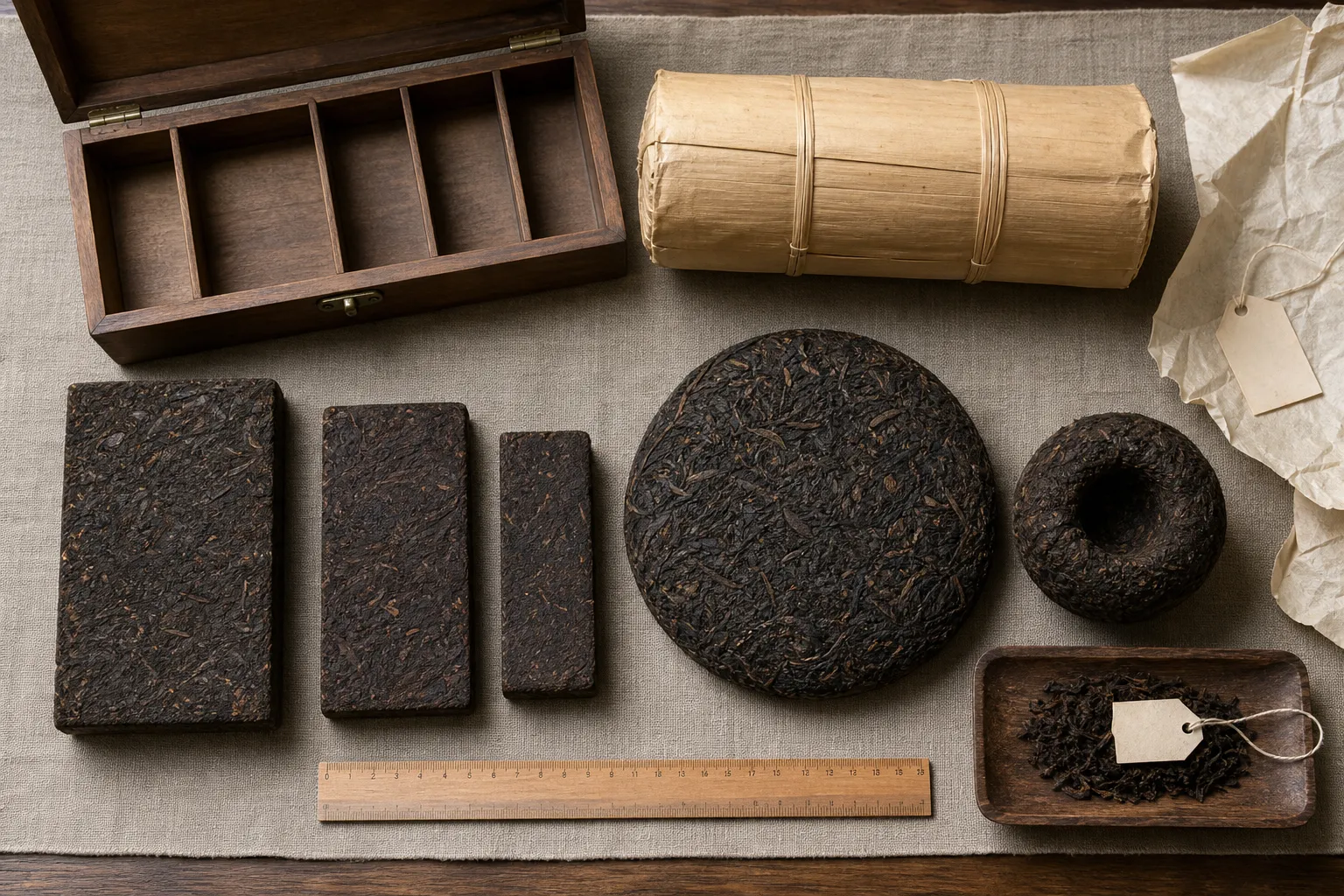
At the far end, some traditional compressed formats are much larger than an ordinary home tea brick. Hua Juan, associated with Qianliang tea, is described as a large cylindrical roll around 147 cm long, 20 cm in diameter, and 31.25 kg. Basket-packed Tianjian, Gongjian, and Shengjian are listed in much larger historical weights in the same review, with modern versions described there at about 2 kg.
Those numbers are useful because they prevent one common mistake: assuming “brick tea” always means a small rectangular block. It can, but compressed dark tea language is broader than that. Treat these as documented examples, not as a single rule for every brick sold online.
What size changes in daily use
A tea brick weight label affects four practical things: portioning, breakability, storage, and commitment.
Portioning
Portioning comes first. A larger brick does not mean a larger brew. You decide the amount by breaking off a small piece. If the piece crumbles, collect the loose fragments and brew them carefully; smaller bits often release flavor faster than intact chunks. If the piece is dense and slow to open, it may need a rinse, a longer first steep, or more patience across infusions.
Breakability
Breakability depends on compression, not just weight. Two 500 g bricks can feel very different if one is tightly pressed and another is looser. Tight compression may keep the brick neat but require more care when prying. Looser compression may shed flakes and edges more easily. When buying online, look for side-edge photos, thickness, and surface texture rather than relying only on the listed weight.
Storage space
Storage space matters more as the weight rises. A 250 g tea brick may fit in a small tea box or shelf space. A 1 kg tea brick needs a more deliberate place, especially once opened. A 2 kg brick or larger format can be awkward if you do not have dry, odor-free storage with enough room for wrapping, airflow, and separation from strong smells.
Commitment
Commitment is the quiet part of the label. A kilogram-scale brick asks whether you like that tea enough to return to it many times. Size does not promise better flavor, better aging, or better value. It simply means more tea in one compressed unit. For an unfamiliar tea, a smaller brick, cake, tuo, or sample-sized piece is often easier to learn from.
Seller adjectives are less useful than numbers
Retail descriptions may call a compressed tea brick “small,” “large,” “premium,” or “collectible.” Treat those words as loose selling language until the listing gives you net weight, shape, and dimensions.
A “small” brick from one seller may not match another seller’s “small.” A “large” brick may be large in weight, large in width, or simply large compared with that shop’s other products. The phrase “black tea brick” can also confuse English-language readers because Western “black tea” and Chinese dark tea are not always used consistently in translation. If you are looking for fermented dark tea, check the tea type and product name rather than relying only on the English label.
Use a plain checklist
- What is the whole brick net weight?
- Is it a brick, cake, tuo, roll, basket, or another compressed form?
- Are dimensions listed, or can you estimate size from photos?
- Does the shape look easy to store after opening?
- Does the brick look tightly compressed or relatively loose?
- Do you have a safe, controlled way to break off small pieces?
- Will you drink enough of this tea to make the weight practical?
If a listing gives only an adjective and no weight, it is not giving you enough information to compare compressed tea brick sizes carefully.
Do not confuse whole-brick weight with serving size
The main misunderstanding is simple: tea brick serving size is not determined by the full brick. A 250 g brick is not one serving. A 1 kg tea brick is not for one brew. A 2 kg brick is not brewed whole. These labels describe the unopened compressed unit.
For brewing, start with a modest broken piece that suits your vessel. Watch how the tea opens. Dense chunks may release slowly at first, then deepen. Crumbled flakes may color the liquor quickly and become strong sooner. Adjust by taste rather than by the printed brick weight.
The same dark tea brick weight can behave differently depending on water temperature, vessel size, leaf density, age, storage condition, and personal preference.
The practical way to choose a size
Choose the smallest brick that still fits your reason for buying. If you are learning a tea type, a 250 g brick or smaller compressed form is usually easier to live with than a kilogram-scale brick. If you already know the tea and drink it often, 500 g or 1 kg may make sense. If you are considering 2 kg or larger traditional dark tea bricks, think first about storage space, breaking method, and how long the tea will sit open.
The best reading of a tea brick size label is not “big means better” or “small means beginner.” It is: How much tea is here, what shape is it in, how compressed is it, and can I brew and store it comfortably?
That keeps the label tied to real use: choosing, breaking, brewing, and keeping the brick in good condition between sessions.
Sources
Sources and further reading
Reference links are limited to sources considered suitable for public citation in this page.