
Buyer reading guide
How to Read a Dark Tea Label Before You Buy
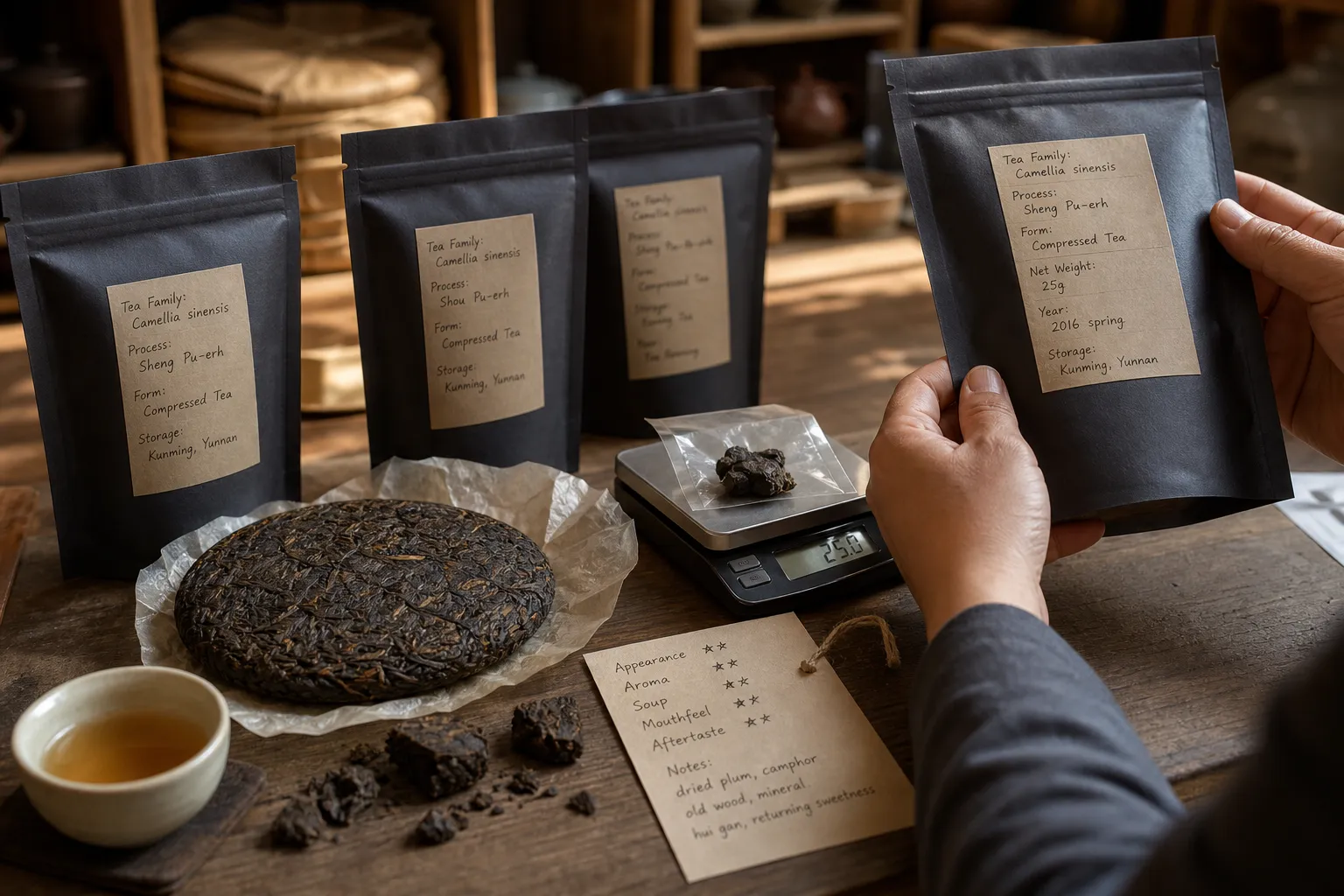
A dark tea label is worth reading in layers. Start with the tea family, then check the process words, physical form, weight, year statement, storage clues, and flavor notes. None of these details proves that the tea is good. They simply tell you what you are actually considering.
If a label says “post-fermented,” “ripe puer,” “Hunan dark tea,” “Fu brick,” or “2016 aged tea,” treat that as a starting point, not a verdict. Before you buy, your job is to separate concrete information from seller language and notice what is still missing.
upward
Read the full overview first
Use the broader guide first if you need the full scope before this page.
Quick read before purchase
- Category: Does it name a dark tea family such as puer, Liubao, Fu brick, Qingzhuan, or Hunan dark tea?
- Process: Look for raw/sheng, ripe/shu, post-fermented, pile-fermented, or aged.
- Form: Match the wording to the object: loose leaf, cake, brick, coin, log, or sample.
- Weight: Check whether you are buying a full piece, broken portion, or small tasting sample.
- Year: Ask what the date refers to: harvest, production, pressing, storage start, or seller inventory.
- Storage: If age is part of the pitch, look for storage description and current aroma condition.
- Flavor notes: Read earthy, smoky, sweet, woody, smooth, or aged as tasting clues, not promises.
Start with the tea family, not the sales phrase
The most useful line on dark tea packaging is the plain identity of the tea. Look for names such as dark tea, puer, Pu-erh, Puerh, pu’er, Liubao, Fu brick tea, Hunan dark tea, Qingzhuan, or another named regional family.
In English retail language, “dark tea” and “black tea” can be confusing. In the Chinese tea-category sense, dark tea usually points to post-fermented tea. English “black tea” usually points to oxidized tea. A black tea label, a “black label” product name, or ordinary black tea bags may have nothing to do with dark tea. Read the category line before assuming the tea belongs here.
Puer spelling is also inconsistent. “Puer,” “Pu-erh,” “Puerh,” and “pu’er” are often market-language or romanization differences. The spelling alone does not tell you grade, storage, authenticity, or taste. The better questions are: is it raw or ripe, what form is it in, what year is being claimed, and how has it been stored?
If the label only says “premium dark tea” or “ancient fermented tea” without a clearer family, treat it as incomplete. The tea may still be pleasant, but the label is not giving you enough to compare it fairly with another cake, brick, or loose-leaf sample.
Read process words as clues, not proof of quality
Process words matter because dark tea character is closely tied to production method and later storage. They help you ask better questions, but they do not settle the purchase.
Post-fermented tea
The tea is being presented within the dark tea family, where fermentation or later transformation is part of the processing discussion.
It does not prove flavor, age, storage quality, or value.
Pile-fermented
The seller is pointing to a managed fermentation step, often discussed with ripe puer and some dark tea processing.
It does not tell you whether the batch was handled well.
Sheng / raw puer
Usually used for raw puer, which can change over time with storage.
It does not mean the tea is old, gentle, or better.
Shu / ripe puer
Usually used for ripe puer, associated with deliberate pile-fermentation.
It does not mean the cup will always be earthy, smooth, or mellow.
Aged
The seller is emphasizing time after production or storage.
It does not explain storage conditions or cup character.
For a buyer, the practical move is simple. If a label says “sheng raw tea,” ask for the production or pressing year and storage background. If it says “shu ripe tea,” ask about production date, form, and current aroma. If it says only “post-fermented tea” with no family, region, or form, the term is too broad to carry the decision.
A process word is a map label. It is not the road itself.
Match origin, form, and weight
After category and process, check place and shape. Dark tea labels often use regional language because many well-known dark teas are tied to production areas and local traditions: Yunnan puer, Guangxi Liubao, Hunan Fu brick, Hubei Qingzhuan, and related names may appear in English-market descriptions.
Do not overread the place name. A Hunan dark tea label may prepare you to look for brick forms, post-fermented language, or notes such as sweet, woody, hay-like, pine-like, or smoky. But not every Hunan dark tea tastes the same, and the region name alone does not tell you how the tea was stored.
The physical form is more immediate:
- Cake: usually a round compressed form; check whether you are buying a whole cake or a sample.
- Brick: a rectangular compressed form; common in several dark tea families.
- Coin or mini tuo: small compressed pieces; convenient, but harder to inspect inside before opening.
- Log or column: a compressed form that may be cut or portioned.
- Loose leaf: easier to inspect visually, but still shaped by processing and storage.
- Sample: useful before committing, but ask whether it was broken from the same item shown.
Compression does not prove age or quality. A brick can be young, old, ordinary, excellent, carefully stored, or poorly stored. Compression mostly tells you how the tea will be broken, packed, brewed, and stored.
Weight also matters. A 357 g cake, 250 g brick, 100 g mini cake, and 10 g sample are different buying situations. If the price looks surprisingly low, check whether you are seeing a small sample, broken pieces, or a different form than expected.
Treat the year as a question until storage is explained
Age language is one of the easiest parts of a dark tea label to misread. A wrapper may show a year, say “aged,” mention “old stock,” or describe a cake as “from 2012.” That can be useful, but only if you know what the date means.
Before buying, ask:
- Is this the harvest year?
- Is it the year the base material was made?
- Is it the year of pile-fermentation?
- Is it the pressing year?
- Is it the year the seller acquired the tea?
- Has the tea stayed in one storage environment, or moved between places?
Storage matters because dark tea aging is not just time passing. Aroma and flavor can shift with humidity, temperature, airflow, raw material, compression, and handling. A retail label cannot compress all of that into one clean number.
This is why older tea is not automatically better. A young tea can be clear and lively. An older tea can be rounded and deep, or it can be flat, overly damp, sour, musty, or simply outside your taste. A year statement without storage context is an unfinished clue.
Useful seller information might include the general storage environment, whether the tea was kept sealed or with some airflow, whether the dry leaf smells clean, and whether there are visible signs of damage. You are not trying to audit a warehouse. You are trying to avoid buying a date instead of a tea.
Read packaging clues with aroma in mind
Dark tea packaging can hide or reveal storage clues. Online, you may only have photos and seller notes, but there are still things worth checking.
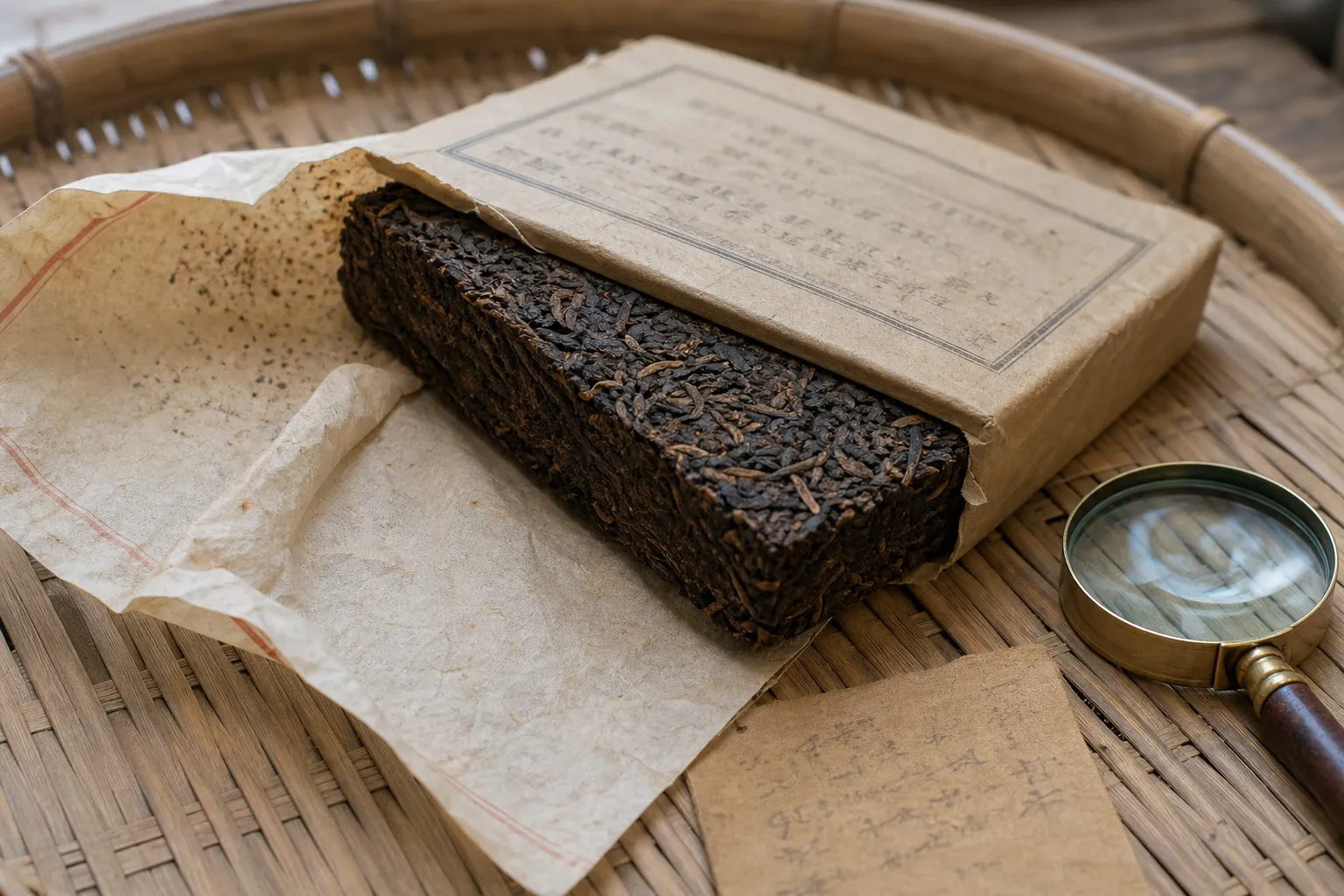
Look for packaging that appears dry, intact enough for the form, and consistent with the claimed age. Torn wrapping is not always a problem, especially with older compressed tea. Heavy staining, damp marks, fuzzy growth, or vague storage language should make you slow down.
For compressed tea, ask for more than a front-wrapper photo when possible. A useful listing may show the wrapper, side profile, back label, inner ticket if present, and the actual tea surface. Wrapper condition can matter, but it is not enough by itself. You want product name, weight, year explanation, and storage description.
Aroma language is more useful than decorative wrapper language. If the seller says the tea is aged, ask whether the dry leaf smells clean, woody, earthy, sweet, herbal, smoky, or damp. Some dark teas can have deep earthy or cellar-like notes, but “earthy” should not be used to excuse an unpleasant wet or sour impression.
If you are buying in person, smell the dry tea when possible. If you are buying online, ask for a recent description rather than relying only on old product copy. Tea can continue to change after a listing was written, especially if it has been opened, sampled, moved, or stored differently.
Separate seller flavor notes from facts
Tea seller flavor notes are useful when read as tasting language. They are not promises.
A dark tea label or product page may say earthy, smooth, leathery, barn-like, smoky, pine-like, hay-like, mellow, sweet, woody, or thick. These words can help you decide whether the tea sounds close to your preferred range, but they do not verify quality.
Flavor also changes with leaf amount, water temperature, steep time, vessel, compression, breakage, and personal palate. A ripe puer described as smooth may taste heavy if you use too much leaf. A raw puer described as sweet may taste sharp if brewed hard. A Fu brick described as hay-like may seem woody or smoky depending on storage and preparation.
A useful label has some internal agreement. “Hunan Fu brick, compressed brick, post-fermented, lightly sweet, hay-like, dry stored” gives you more to work with than “rare ancient dark tea with perfect smooth taste” and no form, date, or storage explanation.
When the adjectives get dramatic but the factual label is thin, trust the adjectives less.
When the label is too vague, ask these questions
A dark tea label does not need to answer everything, but it should give you enough to know what you are buying. If it does not, ask a few direct questions before purchase.
- What exact tea family is this? Dark tea is broad. Ask whether it is puer, Liubao, Fu brick, Qingzhuan, or another named type.
- If it is puer, is it raw/sheng or ripe/shu? This changes how you read process, age, and likely cup character.
- What does the year refer to? Harvest, production, pressing, storage start, and seller inventory dates are not the same.
- How has it been stored? You do not need a perfect technical answer, but you want more than “aged.”
- Is the photo of the exact item or a representative item? This matters for older wrappers, compressed tea, and sample listings.
- What is the net weight and form? A low price may simply reflect a small sample, broken pieces, or a different format.
- Are there added ingredients? Most dark tea is made from tea leaves, but blends and flavored products should say so clearly.
The biggest red flags are often ordinary omissions: no weight, unclear tea family, no process term, no explanation of the year, only vague age language, or flavor claims doing all the work. Health-outcome claims, future value promises, and overconfident rarity language should also make you step back when the basic label details are missing.
A simple final pass
Before you buy, read the label in this order:
Name → process → region → form → weight → year → storage → flavor notes → missing questions.
If the label gives you enough concrete information to compare the tea with another option, it is doing its job. If it mainly offers mood, status, age, or dramatic tasting language, treat it as incomplete.
A good dark tea label does not prove that the tea will suit you. It should help you know what you are about to taste, what to ask, and what not to assume.
Sources
Sources and further reading
Reference links are limited to sources considered suitable for public citation in this page.