
What to Check Before Buying a Compressed Dark Tea Brick
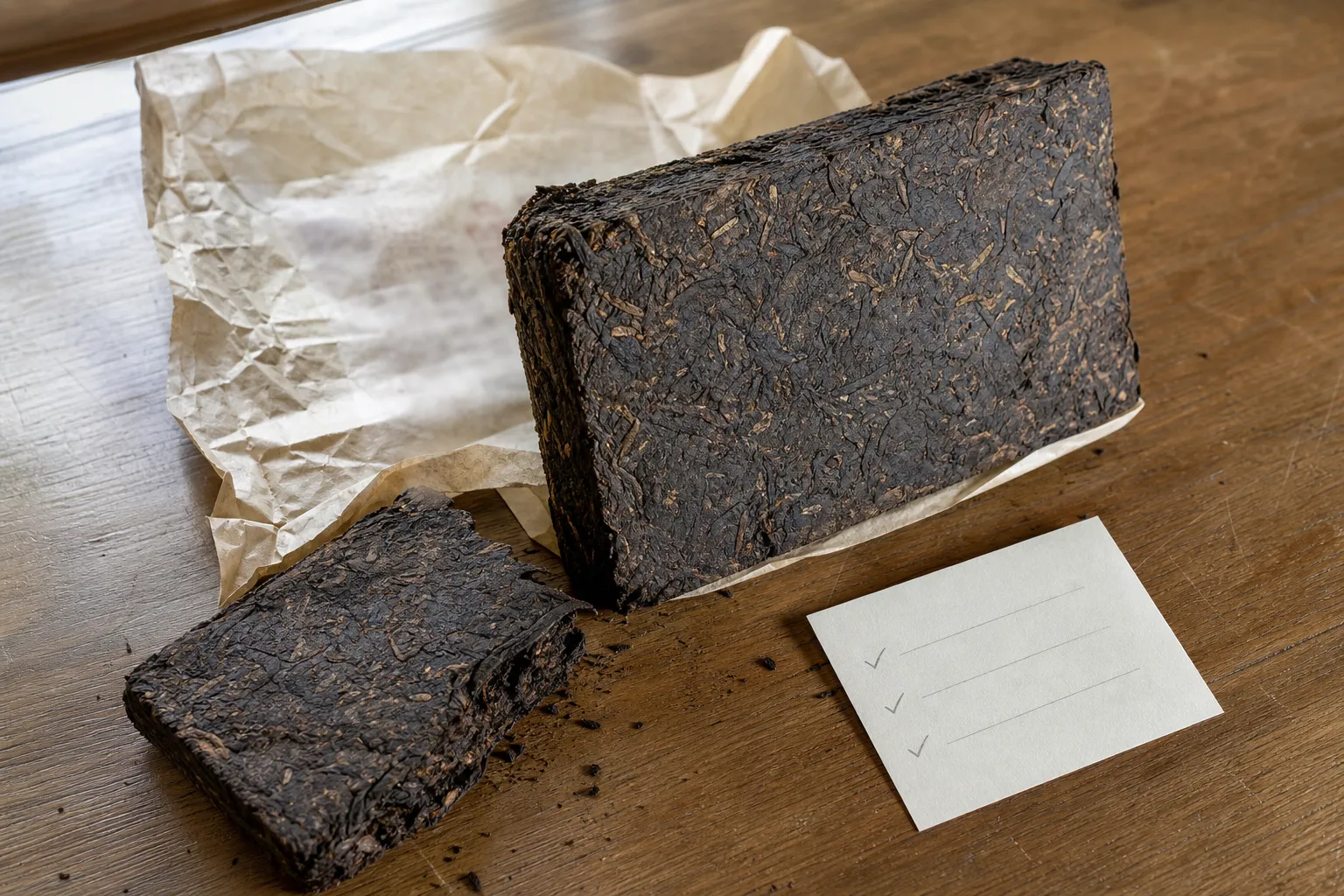
Before buying compressed dark tea brick, check the parts you can actually verify: the wrapper and date, both faces of the brick, the edges and corners, any broken or cut face, the dry aroma, the firmness of the compression, and how clearly the seller explains the tea type and storage history.
A good buying decision does not rest on one dramatic sign. A clean-looking surface, a dry and coherent brick, a clear enough label, a smell that fits the tea style, and sensible seller answers matter more than a single claim about age, region, hardness, or “golden flowers.”
If the brick looks damp, fuzzy, dirty, oddly patchy, or smells sour, fishy, swampy, stale-wet, or like a wet basement, pass on that brick rather than trying to explain the problem away.
upward
Read the full overview first
Use the broader guide first if you need the full scope before this page.
The quick compressed dark tea brick checklist
Use this as a practical filter before you pay, especially when the brick is large, expensive, or shown only online.
Wrapper and label
Look for tea type, production date, weight, and producer or lot details if available.
Be cautious with a missing date, vague tea type, or unclear seller answers.
Surface condition
Look for dry, reasonably clean faces with no damp shine or fuzzy growth.
Be cautious with white, green, black, gray, or gray-white spreading patches.
Edges and corners
Look for edges and corners that are intact enough to show handling and storage condition.
Be cautious with crushed corners, dirty breaks, heavy dust, or damp-looking edges.
Broken edge or cross-section
Look for leaf material, stems, interior condition, and Fu Brick golden flowers if relevant.
Be cautious when there are only polished surface photos and no interior view when golden flowers are the selling point.
Aroma
Look for clean earthy, woody, aged-wood, dried fruit, light herbal, grain-like, or mellow fermentation notes.
Be cautious with sour, dirty, swampy, fishy, stale-wet, or damp-basement smell.
Compression
Look for a brick that is firm and compact, but still usable.
Be cautious with a rock-hard brick sold as automatically superior, or dust-like crumbling with stale aroma.
Seller clarity
Look for specific answers about tea type, storage, age, and photos.
Be cautious with big claims and little visible evidence.
This checklist does not turn you into a tea grader. It simply helps you avoid a brick that already shows warning signs before it reaches your tea table.
Start with the label, then inspect the brick itself
A compressed dark tea brick is often wrapped, boxed, photographed, and described before you ever see the leaf. Begin with the plain information, not the romance.
Look for the tea type first. “Dark tea” or “Hei Cha” is a broad category of post-fermented tea. A brick may be Fu Brick or Fuzhuan, Qing Brick, Liu Bao-style compressed tea, ripe Pu-erh pressed into brick form, or another regional dark tea. The exact type changes what you should expect from the surface, aroma, leaf size, stems, and seller language.
Then check the production date, weight, and any lot or producer details shown on the wrapper. A date does not prove quality, but it gives you a starting point for asking storage questions. Older is not automatically better. A younger brick may taste brighter, sharper, or more direct; an older brick may taste smoother or deeper only if the starting material and storage have held up well.
For online compressed tea buying, do not rely on one front-facing product image. Ask for clear photos of:
- the wrapper and label;
- both broad faces of the brick;
- all four edges if possible;
- corners and chipped areas;
- a broken edge, cut side, or cross-section when available.
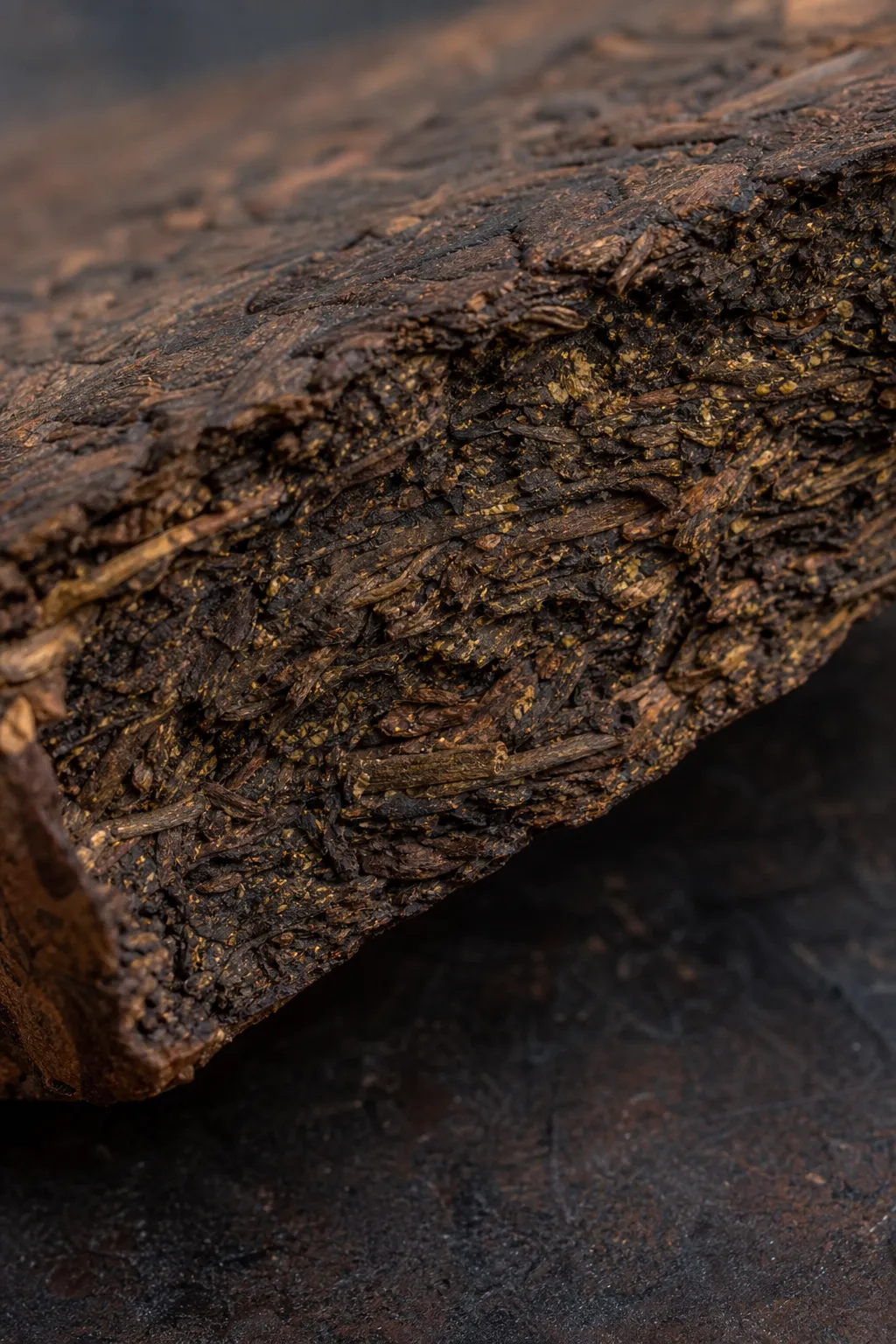
The broken edge inspection is useful because surface photography can hide more than it shows. A side view may reveal whether the brick is evenly compressed, whether the interior looks dry and coherent, and whether any claimed Fu Brick golden flowers are actually present inside rather than only mentioned in the sales text.
Read the surface, edges, and aroma together
A dark tea brick surface does not need to look delicate or pretty. Many dark teas are made from mature leaf material, and some Fu Brick teas include visible stems. Coarse texture, stems, and uneven leaf pieces are not automatic faults, especially in Fu Brick. Judging every dark tea brick by green-tea or bud-heavy standards will lead you in the wrong direction.
What you want is a surface that looks dry, stable, and reasonably clean for its style. The brick may be dark brown, reddish brown, black-brown, or mixed in tone depending on tea type and storage. Small chips or a few loose flakes can be normal handling marks. Corners may soften from transport.
Be more cautious when the surface shows fuzzy growth, spreading patches, damp-looking areas, dirty residue, or unusual white, green, black, gray, or gray-white zones that do not match the tea material. General food-safety guidance around mold is conservative because some molds and their byproducts cannot be judged reliably by sight. For a buying decision, you do not need to diagnose the patch. You can simply pass.
Aroma is the next filter. If buying in person, smell the dry brick before sampling. Many dark tea bricks can have earthy, woody, aged-wood, dried-date, herbal, or mellow fermentation notes. Some Fu Brick teas may carry a fungal-floral or warm grain-like impression. These aromas should feel integrated with the dry leaf.
Off-notes feel different. A sour, dirty, swampy, fishy, sharp-musty, or damp-basement smell is a reason to slow down or walk away, especially if it appears with suspicious surface patches or damp packaging. A clean aged note can be deep and earthy; a poor storage note often feels wet, stale, and intrusive.
Do not overread compression hardness
A compressed tea brick should usually feel compact. Compression helps the tea hold its shape, travel, and age in a stable physical form. But tea brick compression firmness is only a handling clue, not a simple quality score.
A firm brick that releases flakes with a tea pick or knife is normal. A very hard tea brick is not automatically higher quality. It may be inconvenient to break, especially for daily brewing, and the cup may be uneven if you have to pry off tiny chips and dust.
On the other side, a brick that collapses into powder can suggest rough handling, brittle age, dryness, damage, or poor storage, depending on the tea. The most useful question is not “Is it hard?” but “Does the compression make sense with the brick’s condition?”
Firm, dry, and coherent is different from rock-hard and impossible to portion. Slightly chipped is different from crushed and dusty. A little loose tea around the wrapper is different from a brick that looks dropped, soaked, or carelessly stored.
If the seller emphasizes hardness as the main dark tea brick quality sign, ask for more ordinary evidence: surface photos, edge photos, date, tea type, storage description, and whether a sample is available.
For Fu Brick, treat golden flowers as a type-specific cue
Golden-yellow specks are meaningful only in the right context. In Fu Brick Tea, also called Fuzhuan, terms such as Golden Flowers, Jin Hua, or fahua refer to yellow-gold fungal structures associated with Fu Brick fermentation. Tea-science sources discuss Fu Brick as a post-fermented dark tea in which microbial activity, including Eurotium cristatum in golden-flower development, is part of the manufacturing and sensory context.
For a buyer, the practical point is simpler: golden flowers can be a normal Fu Brick feature, but they are not a universal dark tea brick requirement. Do not reject every compressed dark tea brick because it lacks golden flowers. Qing Brick, ripe Pu-erh bricks, Liu Bao-style compressed forms, and other dark teas follow different appearance expectations.
When a seller makes golden flowers the main pitch, ask for a broken edge or cross-section. Interior distribution is often more informative than a surface glamour shot. Yellow-gold specks should look dry and integrated with the leaf matrix, not fuzzy, spreading, wet, or patchy in suspicious colors.
Also avoid the opposite mistake: more visible golden flowers are not automatically better. They do not prove the brick is clean, genuine, delicious, or well stored. They are one Fu Brick-specific appearance cue. Aroma, storage condition, leaf material, compression, date clarity, and seller transparency still matter.
Stems in Fu Brick also deserve a calmer reading. Mature leaves and stems can be part of the material style. Stems are not automatically a defect. The question is whether the brick looks balanced for its type and whether the seller can describe what you are buying without hiding behind vague praise.
Ask storage questions before age questions
Age language is one of the easiest ways to oversell a compressed brick. A date is useful, but storage decides whether age helped or hurt the tea.
Ask the seller how the brick has been stored. You are looking for a plain answer: dry or moderately humid environment, away from strong odors, protected from dampness, not kept in direct sun, and not stored beside incense, spices, smoke, perfume, or kitchen smells.
Packaging can offer clues. A wrapper that is lightly worn from handling is not a problem by itself. A wrapper that looks water-stained, greasy, strongly odor-contaminated, or dirty around the edges should make you cautious. If the brick is boxed, ask whether the photos show the actual brick or only unopened packaging.
For higher-priced bricks, buy a sample if possible. A small piece lets you inspect the broken material, smell the dry leaf, rinse and brew it, and decide whether the taste matches the seller’s description. Sampling is especially useful when the brick is very hard, old, heavily promoted, or described with broad claims but few photos.
A first brew does not reveal everything, but it can expose obvious problems. If the liquor smells sour, dirty, stale-wet, or unpleasantly sharp in a way that does not settle after a rinse, you have useful information before committing to the whole brick.
When to pass on the brick
The simplest buying rule is this: if several weak signs appear together, do not talk yourself into the purchase.
Pass when the brick has suspicious fuzzy or spreading growth, damp-looking patches, dirty residue, strong sour or musty odor, unclear storage history, missing basic label information, and a seller who avoids direct questions. One minor issue may have an explanation. Several issues in the same brick usually mean the better decision is to keep looking.
Also pass when the seller’s main proof is a slogan. “Old,” “rare,” “many golden flowers,” “very hard,” or “traditional” does not replace visible condition. For compressed dark tea, the best buying evidence is ordinary and concrete: photos, date, tea type, dry condition, aroma, edges, cross-section, and sample access.
A compressed dark tea brick is worth considering when the visible condition is sound, the smell is clean for its style, the compression is usable, the label is clear enough to place the tea, and the seller can answer storage and tea-type questions without turning every detail into a sales claim. That is not a promise of a perfect cup. It is a grounded way to reduce avoidable uncertainty before you buy.
Sources
Sources and further reading
Reference links are limited to sources considered suitable for public citation in this page.