
What a Pu-erh Cake Label Usually Tells You
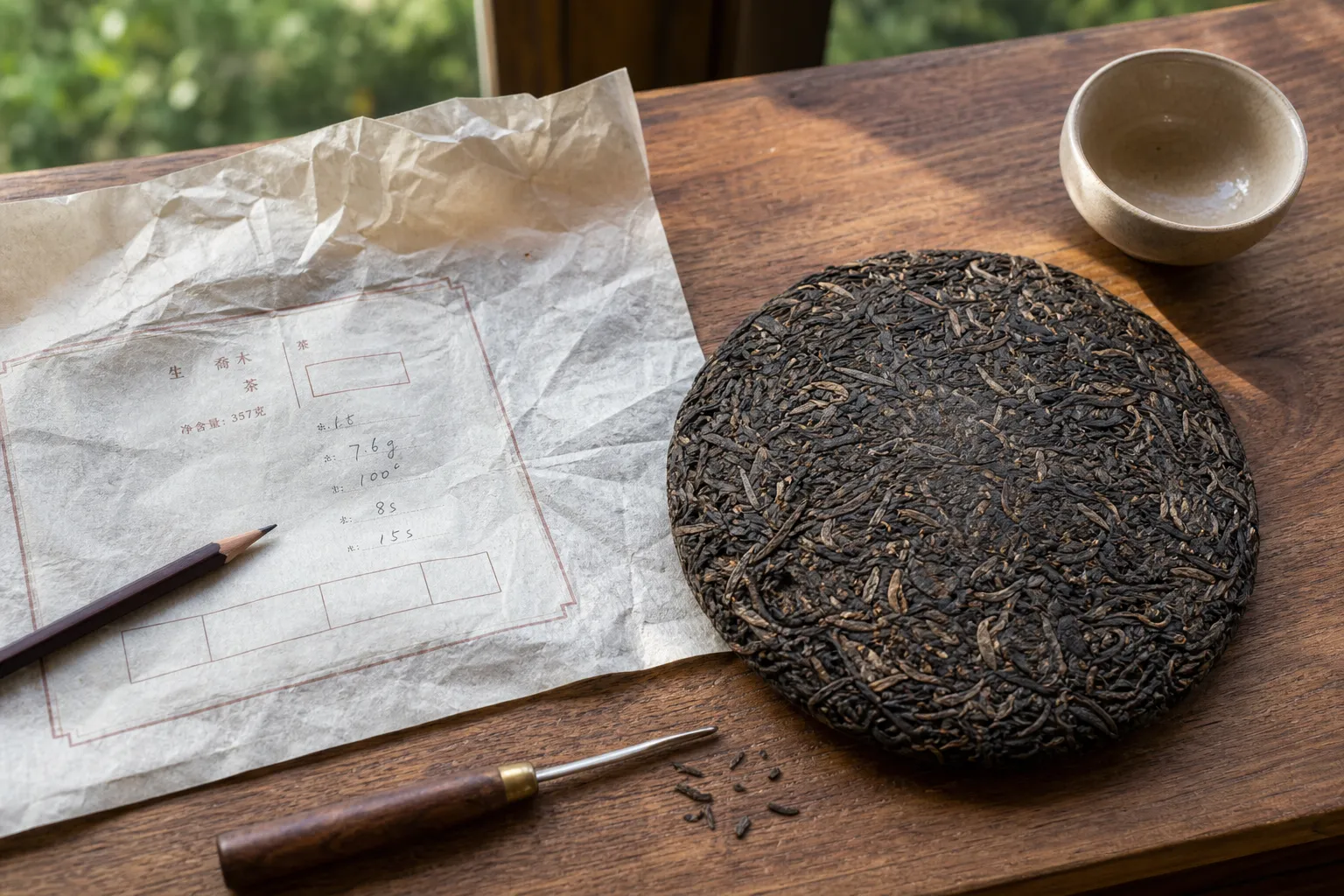
A pu-erh cake label usually gives you a starting map: tea type, product name, weight, production date or year, maker, origin wording, batch or recipe code, and sometimes sales terms such as aged, vintage, ancient tree, famous mountain, or Seven Sons Cakes.
What it does not do is finish the judgment for you. A wrapper cannot confirm how cleanly the tea was stored, whether the age or origin claim is well supported, or how the cake will taste in your cup.
Read the wrapper first for orientation. Then check the cake itself: dry leaf color, compression, aroma, storage smell, liquor color, mouthfeel, price, seller clarity, and, when the cake is costly, a small sample before buying the whole piece.
upward
Start with the broader guide
Use the broader guide first if you need the full scope before this page.
Start with the type line, not the praise words
The most useful first clue on a pu-erh wrapper is often the tea type. Look for wording such as:
- Sheng / Raw
- Shu / Shou / Ripe
This matters because raw and ripe pu-erh usually give you different starting expectations.
A young sheng cake can brew brighter, more aromatic, more bitter-sweet, or more astringent depending on leaf material and storage. A shu cake is made with an added pile-fermentation step and often starts from a darker, thicker, earthier, woodier cup profile. Age, compression, water, brewing style, and storage can shift those expectations, but the sheng or shu line is still the first practical field to find.
Do not read “raw” and “ripe” as simple flavor adjectives. They usually point to different processing paths. If the seller title says one thing and the wrapper says another, pause and ask for clarification before using the label as your guide.
Spelling is not much of a quality clue by itself. English listings may say pu-erh, puerh, pu’er, pu erh, or pu erh cake tea. Those differences often reflect translation style rather than the tea inside the paper.
Common pu-erh wrapper terms and what to check next
Not every cake shows every field clearly. Some wrappers are sparse, some are decorative, some have an inner ticket or small pressed-in paper, and some rely on the seller page for extra details. Still, these are the fields worth knowing when you are trying to read a pu-erh wrapper.
The table is a reading order, not a legal checklist. The label helps you ask better questions; it does not finish the tea.
Date, factory, origin, and batch are clues
A pu-erh production date is one of the easiest fields to overread. It can help you understand whether the wrapper presents the tea as new, mid-aged, or old. Still, treat it as a recorded or claimed date unless you have stronger supporting information. This matters most when a cake is priced as old tea.
Research on pu-erh authentication often studies age, variety, and geographical origin with independent chemical or spectral methods. For a home drinker, the practical lesson is simple: if age and origin can require outside methods to investigate carefully, the wrapper alone should be treated as a clue rather than a final answer. You do not need lab equipment to enjoy tea, but you do need caution when label language is tied to a high price.
The same restraint applies to a factory name. A producer, factory, or brand line can be useful context, especially when comparing two cakes from the same seller. But a familiar-looking name, traditional design, or strong product title does not tell you how the cake was stored or whether that batch suits your taste.
Origin wording needs the same care. A pu-erh origin label may name Yunnan, a region, a mountain, or a village. A mountain name can help explain how the tea is being positioned and why it is priced a certain way. It does not, by itself, settle the exact source of the leaf. Names such as Lao Banzhang, Bingdao, Yiwu, Jingmai, or Xigui carry strong market attention, so they deserve more checking, not less.
Batch numbers and recipe names are useful when you compare wrapper photos, seller listings, or different years of a named product. They are less useful if no one can explain what the number means for that specific cake. Treat a pu-erh batch number as an identifier first, not a promise of taste.
The wrapper cannot smell the storage for you
Storage is where the wrapper becomes quiet. A cake may have a clean-looking label and still carry a flat, musty, sharp, smoky, sour, or damp storage note. Another cake may have plain paper but a pleasant dry leaf aroma and a balanced cup. The wrapper can suggest identity; it cannot replace your nose.
Before judging the tea from label language, check the cake itself:
Dry leaf color
Sheng often changes with age and storage, while shu is usually darker from the start. Color alone is not enough, but a strong mismatch with the claimed type or age is worth questioning.
Compression
Very tight compression can slow how the cake opens in brewing. Loose or broken edges can make the first steeps release faster.
Dry aroma
Look for clean woody, herbal, dried fruit, camphor-like, earthy, sweet, or grain-like notes depending on the tea. Be cautious with strong damp basement, moldy, chemical, or stale odors.
Liquor color
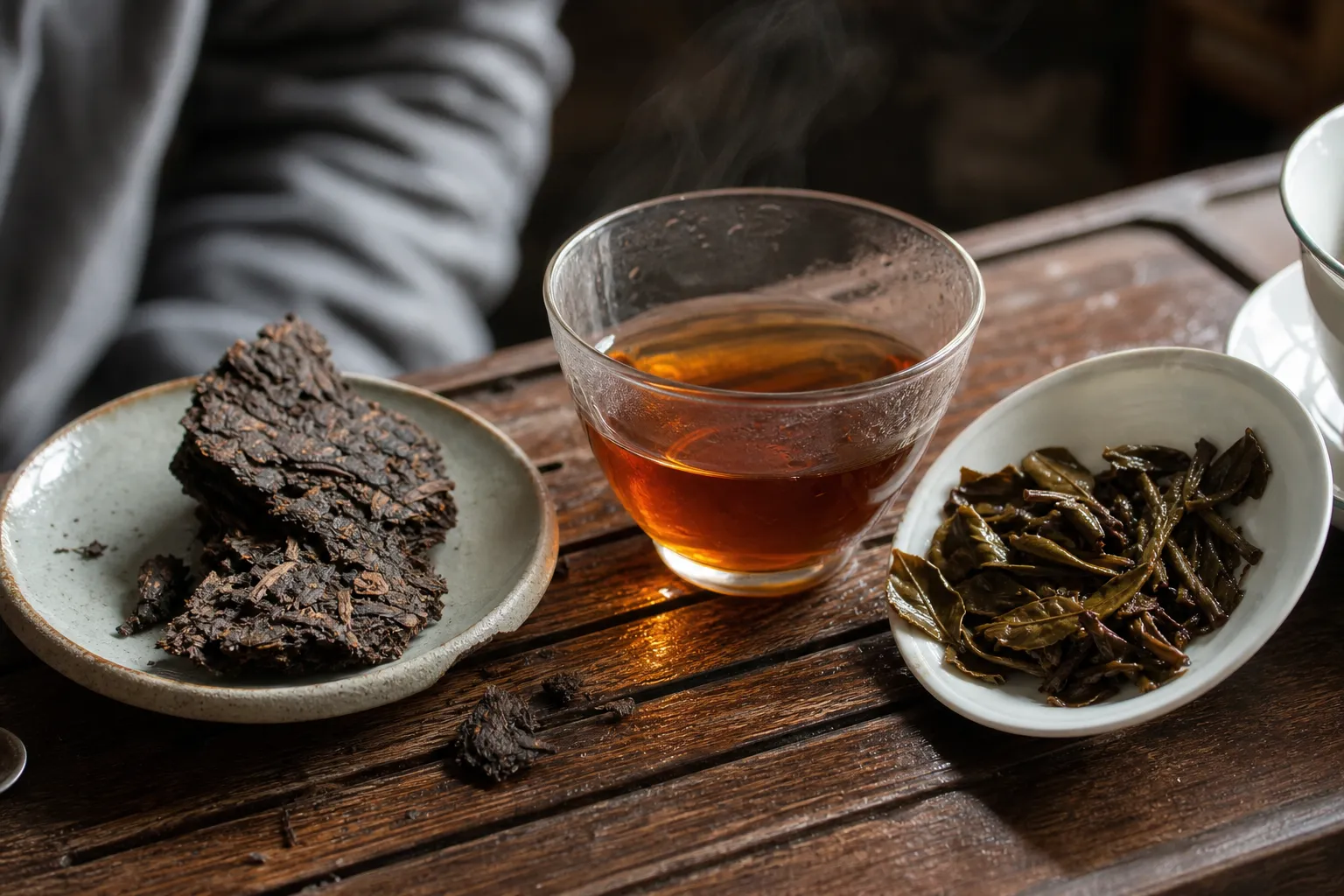
Young sheng often brews lighter than shu, while ripe pu-erh commonly brews deep red-brown to dark brown. Storage and steeping strength can shift this, so use color as one clue, not the whole answer.
Mouthfeel
A label may say “premium” or “aged,” but the cup should still show something you can feel: body, clarity, sweetness, returning aroma, or at least a clean finish.
Wet leaf aroma
After rinsing or steeping, storage notes often become clearer. This can reveal more than the wrapper.
This is not a full brewing guide. For label checking, one or two short tasting steeps can already show whether the wrapper’s story and the tea’s behavior are moving in the same direction.
Market words should raise better questions
Some tea cake label terms are useful because they show what the seller wants you to notice. They are also easy to overvalue.
Aged and vintage may indicate that the tea is being sold around its year. Ask what date is printed, what date is claimed by the seller, where it was stored, and whether a sample is available.
Decades-old should make you slow down. Old pu-erh depends on starting material, storage environment, humidity, airflow, odor exposure, and handling. Older is not automatically better for every drinker or every cake.
Ancient tree and old tree are common premium-positioning terms. They may be part of how the tea is marketed, but the wrapper alone does not establish tree age or taste quality. If the price rises sharply because of this phrase, the seller should be able to give more context than the words on the paper.
Famous mountain wording can be meaningful in a seller’s classification system, but it is also one of the easiest areas for a beginner to misunderstand. A well-known name is not a tasting note. It is a claim to examine.
Authentic, top grade, rare, limited, and similar praise words are not the same as practical puerh cake information. They tell you about marketing tone. They do not tell you whether the tea will be clean, balanced, strong, gentle, sweet, earthy, or enjoyable.
Wrapper design deserves similar caution. Traditional graphics, old-looking paper, red or blue styling, and a neatly placed inner ticket can create confidence. They may help identify a product line, but they should not be the main basis for judging age, origin, storage, or cup quality.
A simple order for reading a pu-erh cake label
When you are holding a cake and do not know where to start, use this order:
- Find the type: sheng/raw or shu/shou/ripe.
- Find the date or year: note what the wrapper records, but do not stop there.
- Find the maker or brand: factory, producer, commissioned party, or seller line if present.
- Find origin wording: region, mountain, village, or raw-material description.
- Find batch, recipe, or product name: useful for comparing listings and asking questions.
- Check the weight: especially when comparing price between cakes.
- Circle the market claims: aged, vintage, ancient tree, famous mountain, rare, premium.
- Cross-check with the tea: dry leaf, aroma, liquor, mouthfeel, storage smell, and sample tasting.
For an inexpensive daily cake, this may be enough to decide whether to try it. For an expensive old cake, famous-origin cake, or cake sold mainly on ancient tree label claims, the wrapper should only begin the conversation. Ask for clearer photos, storage notes, seller background, and a sample if possible.
A pu-erh wrapper is useful because it gives you vocabulary. It tells you what to look for, what to ask, and what expectations to test in the cup. The better habit is not to distrust every label, but to avoid letting the label drink the tea for you.
Sources
Sources and further reading
Reference links are limited to sources considered suitable for public citation in this page.