
Dark tea field note
Qingzhuan Tea Explained: What Makes Hubei Green Brick Tea Different
Qingzhuan tea is Hubei green brick tea: a compressed Chinese dark tea associated especially with the Yangloudong / Chibi area of Hubei. The confusing part is the English name. “Green brick tea” does not mean a fresh green tea pressed into a block. It is a dark tea brick shaped by Hubei place identity, post-fermented processing, and a sturdy compressed form.
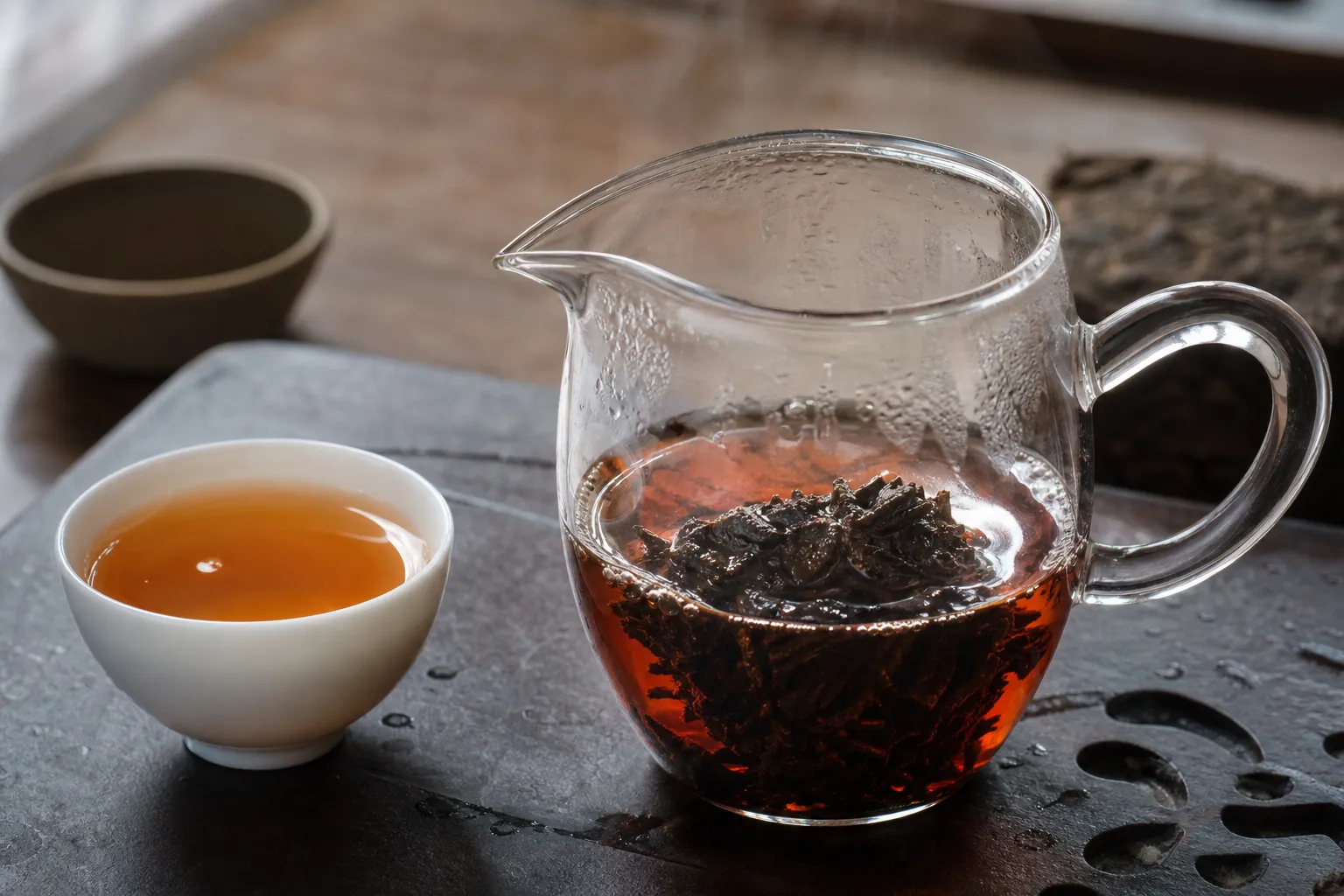
In the cup, Qingzhuan often moves away from grassy sharpness and toward warmer, darker notes: wood, mature leaf, mild earth, grain, or quiet sweetness. The liquor may run amber-orange, orange-red, reddish, or deeper brown-red depending on the brick, storage, dose, water, and steeping time.
If you have a piece in front of you, the better first question is not “Is this like Pu-erh?” It is: “Does this behave like a Hubei dark tea brick?”
upward
Read the full overview first
Use the broader guide first if you need the full scope before this page.
The quick way to recognize Qingzhuan tea
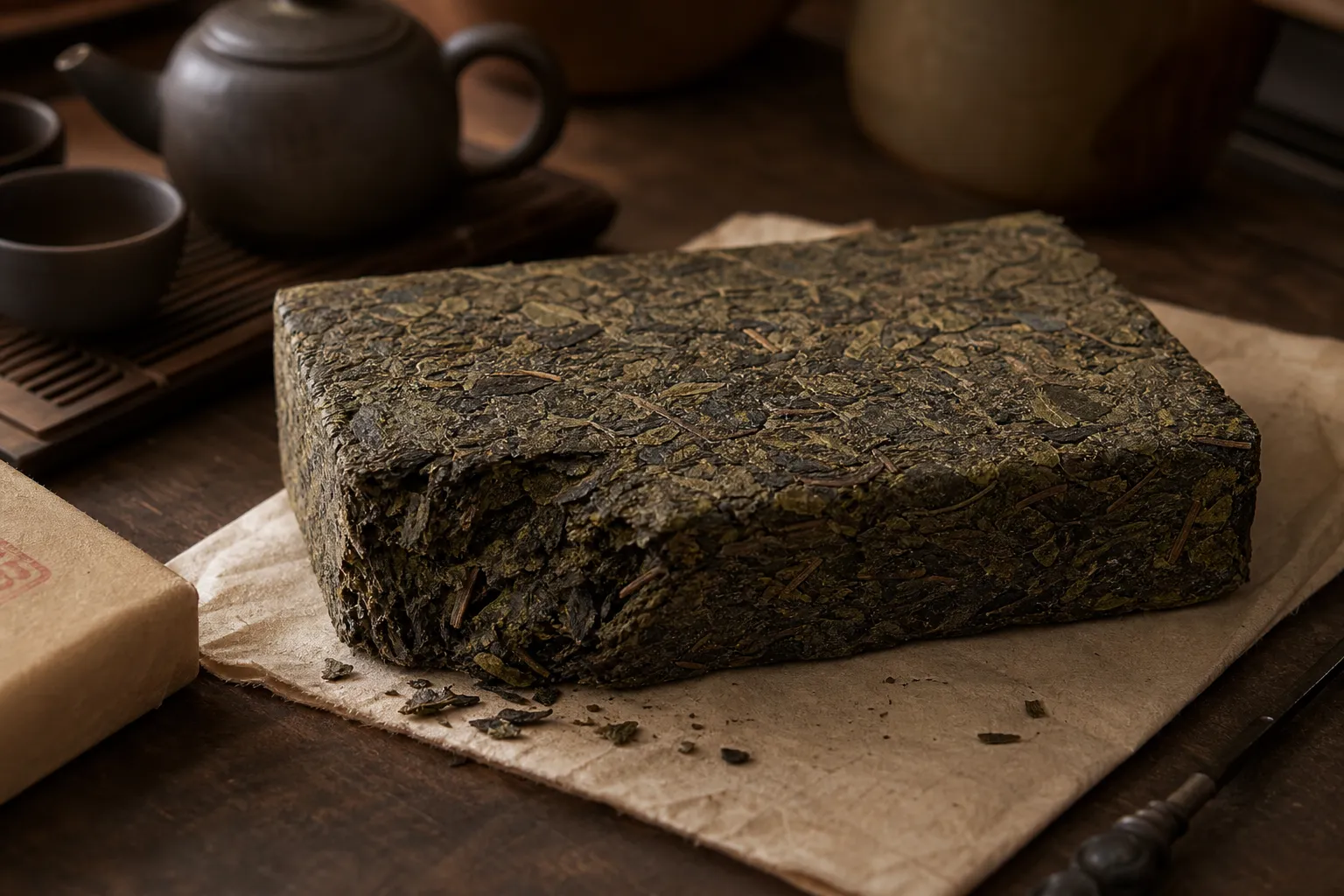
A Qingzhuan brick is usually firm, flat, and compressed rather than loose. Labels may say Qingzhuan tea, Qing Zhuan Cha, Hubei green brick tea, Chibi Qingzhuan, or Chinese dark tea brick.
Use these cues as orientation, not as a pass-fail test:
Tight rectangular brick
A compressed tea made for transport, storage, and portioning.
Green-brown, auburn, or darkened surface
Dark tea brick material rather than fresh loose green tea.
Mature leaf and some stem
Common in many compressed dark teas.
Orange-red to reddish liquor
A possible Qingzhuan cup cue, especially with stronger brewing.
Less grassy, rounder taste
Often connected with dark-tea processing and storage conditions.
A young, tightly pressed, or lightly stored brick may brew pale at first. A looser or older piece may release more quickly. The same brick can also taste thin in one vessel and heavy in another, simply because compression, break size, and steep time change the extraction.
Why Hubei green brick tea is dark tea, not green tea
Green tea is generally handled to preserve fresher, greener character. Qingzhuan goes in a different direction. Processing descriptions for Qingzhuan and related Chinese dark teas include steps such as fixing, rolling, drying, pile fermentation or heaping, and, for brick tea, steaming, pressing, cooling, and drying.
That processing matters in a practical way. Heat, moisture, time, and microbial activity can change aroma compounds and flavor-related substances during pile fermentation. Qingzhuan-specific studies describe this stage as important to the formation of its characteristic quality. For the drinker, the main takeaway is simple: do not brew or judge Qingzhuan as if it were Longjing, sencha, or another fresh green tea.
The brick form also changes the cup. A compressed piece opens in layers. Broken edges release first; the dense inner leaf can take a few infusions to loosen. If the first steep tastes thin, the tea may not have opened yet. If it tastes rough or too heavy, the piece may be too large, too broken up, or steeped too long.
The Hubei and Yangloudong connection
Qingzhuan tea is closely tied to Hubei. Historical descriptions link Hubei green brick tea with Yangloudong in the old Puqi area, now commonly connected with Chibi. That place identity is why “Hubei green brick tea” is often more useful than the broader phrase “dark brick tea.”
The brick itself makes sense in that setting. Compressed tea was practical: it could be packed, moved, stored, and divided more easily than loose leaf. Hubei green brick tea is often discussed in relation to older trade routes and distribution toward northern and northwestern China, with wider links to Russia and Mongolia.
That background helps explain the form, but it does not tell you whether a modern brick is pleasant, well kept, or right for your taste. For that, you still need to inspect, smell, brew, and adjust.
How Qingzhuan differs from Pu-erh, Liu Bao, and Fu Zhuan
Many English-language drinkers meet Qingzhuan after Pu-erh, so the comparison is useful. The mistake is treating every Chinese dark tea as a Pu-erh variation. Qingzhuan, Pu-erh, Liu Bao, and Fu Zhuan all sit within the broader dark-tea landscape, but they come from different regional and product traditions.
Qingzhuan
Main identity cue: Hubei green brick tea, often linked with Yangloudong / Chibi.
Useful boundary: not green tea, and not simply Pu-erh.
Pu-erh
Main identity cue: Yunnan dark tea family, often found as cakes or loose tea.
Useful boundary: its storage language should not be copied onto every Qingzhuan brick.
Liu Bao
Main identity cue: Guangxi dark tea, often associated with basket storage in market language.
Useful boundary: can share dark, aged notes, but has a separate regional identity.
Fu Zhuan
Main identity cue: brick tea often discussed through “golden flower” appearance.
Useful boundary: Qingzhuan is not defined by visible yellow colonies.
The Fu Zhuan comparison causes a lot of confusion. Some Fu Zhuan marketing teaches drinkers to look for yellow “golden flowers.” Qingzhuan should not be judged by the expectation that it must show the same feature. If a seller describes every dark brick through that one story, read the label and origin details more carefully.
The Pu-erh comparison also needs restraint. Some Qingzhuan bricks can change with storage, and dark tea may develop deeper aroma under suitable conditions. But older is not automatically better. Original material, compression, humidity, odor exposure, and handling all matter.
What Qingzhuan tea may taste like
Qingzhuan tea is best described in ranges. A balanced cup may be mellow, woody, warm, earthy, grain-like, or quietly sweet. Some descriptions of Hubei green brick tea mention orange-red liquor, stronger aroma, mild taste, and coarse dark-brown infused leaves. Not every brick will show all of those traits.
Watch the cup rather than chasing one fixed flavor:
- Liquor color: amber-orange, orange-red, reddish, or brown-red, depending on dose, time, water, and the brick.
- Aroma: dry wood, warm leaf, mild aged notes, earth, grain, or subdued sweetness may appear.
- Mouthfeel: often rounded when balanced; can become heavy if over-brewed.
- Astringency: usually less grassy-sharp than green tea, though a strong infusion can still feel drying.
- Aftertaste: may be woody, sweet-edged, quiet, or plain.
A flat cup is not always a failed tea. It may be under-extracted, too tightly compressed, or brewed too gently. A harsh cup is not always a failed brick either. Try a smaller piece, a shorter steep, or a quick rinse to wake the leaf and clear the broken surface.
A practical brewing approach for a small piece of Qingzhuan brick
Consumer-facing brewing data for Qingzhuan is limited, so treat any timing as a starting point rather than a rule. The brick, vessel, water, and your taste should decide the final adjustment.
For a small teapot or gaiwan:
- Break off a small piece cleanly. Use a tea pick or careful pressure along a seam. Avoid crushing the brick into powder unless you want a faster, heavier brew.
- Use hot water. As a compressed dark tea, Qingzhuan usually responds better to high heat than to gentle green-tea temperatures.
- Consider a quick rinse. This can warm the leaf and help the compressed surface open more evenly.
- Start shorter than expected. If the liquor darkens quickly, pour sooner. If it stays pale and thin, extend the next infusion.
- Adjust from the cup. Thin means more time, more leaf, or hotter handling. Heavy or muddy means less time, less leaf, or a cleaner break from the brick.
For mug brewing, use a modest piece and give it room. A dense chunk can keep releasing for a long time. If the liquor becomes too strong, dilute with hot water or remove the remaining piece once the cup reaches the weight you like.
For storage, keep the brick dry, shaded, and away from kitchen smells or damp spaces. If it carries an unpleasant stale or musty odor that does not clear after airing and rinsing, do not explain it away as age character.
Common confusions to clear up
“Qingzhuan” here means Hubei green brick tea.
Search results can mix it with unrelated “Qing” phrases, antiques, or menu wording.
“Green brick tea” is not loose green tea in a novelty shape.
It is a compressed dark tea with post-fermented processing background.
It does not need to taste like Pu-erh.
Qingzhuan has its own Hubei identity. Use Pu-erh only as a rough orientation point, not as the standard.
Place language is context, not a quality grade.
Hubei, Chibi, Yangloudong, and heritage references help place the tea culturally and historically. They do not replace looking at the brick, smelling it, brewing it, and judging the cup.
Bottom line
Qingzhuan tea is different because it is a Hubei green brick tea: compressed, post-fermented, place-linked, and usually darker in cup character than green tea. Its identity comes from the overlap of Hubei / Yangloudong history, dark-tea processing, brick form, and practical brewing behavior.
Expect a tea that may brew orange-red, woody, mellow, earthy, or quietly sweet, but let the actual brick set the terms. Break a small piece, use hot water, watch the liquor, and adjust from what the cup gives you.
Sources
Sources and further reading
Reference links are limited to sources considered suitable for public citation in this page.