
Dark tea buying guide
How to Read Dark Tea Labels, Shapes, and Size Terms
A dark tea wrapper can look like a map, a sales pitch, and a brewing clue at the same time. If you are comparing a pu-erh cake label, checking tea brick size, or trying to decode words such as sheng, shou, bing, zhuan, and tuo, start by separating practical information from packaging noise.
Dark tea labels can help you identify form, weight, processing direction, date wording, and claimed origin. They cannot, by themselves, prove taste, storage history, provenance, or future value. Read the wrapper as a set of clues, then compare those clues with the leaf, aroma, compression, and cup.
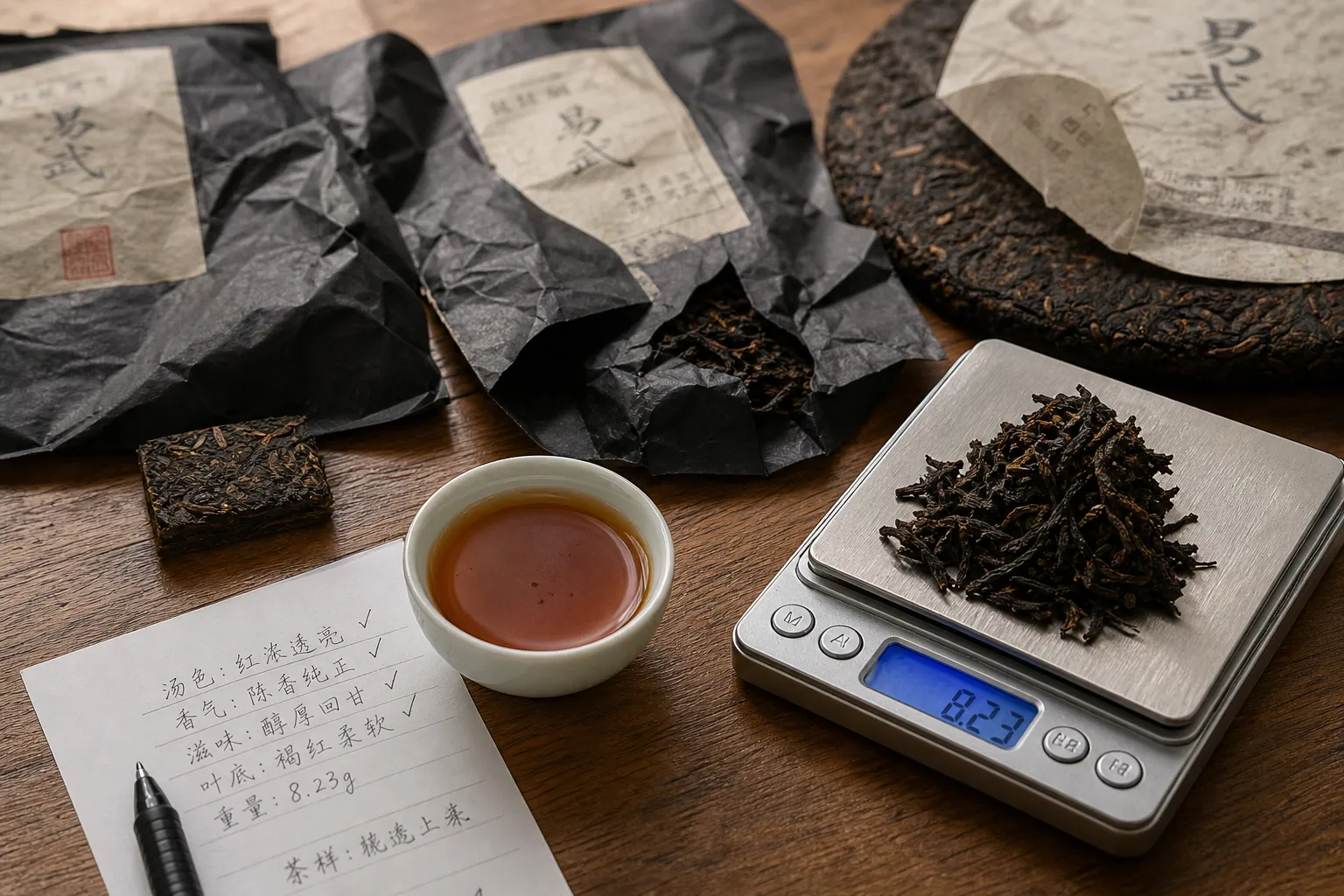
upward
Start with the broader guide
Use the broader guide first if you need the full scope before this page.
How to Read a Dark Tea Label Before You Buy
Before looking for prestige words, read the parts that affect your actual decision:
- What form is it?
Loose tea, cake, brick, tuo, column, basket, or sample piece?
- How much tea is there?
Weight matters for price comparison, portioning, storage space, and whether you are buying a taste sample or a long-term drinking supply.
- What processing direction is claimed?
For pu-erh, this often means raw/sheng or ripe/shou/shu. For other dark teas, the label may lean more on regional or brick-tea names.
- Which claims need a second look?
Date, origin, factory, batch, storage, vintage, tree-age, and region words can be useful, but they are not proof on their own.
A common buyer mistake is treating every printed word as a rank. “Cake,” “brick,” “raw,” “ripe,” “aged,” “Yunnan,” “Liubao,” or “old tree” may describe form, processing, region, or market language. None of those words alone tells you whether the tea will suit your brewing style.
First-pass label clues
Tea type or category
Helps decide whether you are looking at pu-erh, Liubao, Fuzhuan, Qingzhuan, or another dark tea.
Cannot prove overall quality alone.
Shape word
Helps decide how you will pry, portion, brew, and store it.
Cannot prove that one shape tastes better than another.
Net weight
Helps with price per gram and storage planning.
Cannot prove drinking value without tasting.
Raw/ripe or processing cue
Helps set expected brewing direction and likely flavor range.
Cannot prove a fixed flavor result.
Date or vintage wording
Helps decide which timeline questions to ask.
Cannot prove verified age or storage condition alone.
Region, factory, batch
Helps with comparison and record-keeping.
Cannot prove full provenance without stronger records.
If the wrapper is decorative or partly untranslated, the product page may carry more detail than the paper itself. Read both together. A beautiful wrapper with vague date, weight, and storage language is incomplete information, not a special mystery.
What a Pu-erh Cake Label Usually Tells You
A pu-erh cake label may include the outer wrapper, a small embedded paper in the cake, and sometimes a separate inner ticket. English-language sellers often translate or summarize these parts, but terms do not always line up perfectly across brands, factories, and sellers.
Look first for
- Tea name or series name: May be a product name, factory line, mountain name, blend name, or seller-created title.
- Raw or ripe marking: Often written as raw, sheng, Puerh Sheng, ripe, shou, shu, or Puerh Shu.
- Weight: Usually shown in grams.
- Date language: Harvest, production, pressing, packing, and storage claims may appear separately or be blurred together.
- Region or material claim: May name Yunnan, a smaller region, a mountain, a village, or a broader origin phrase.
- Factory, recipe, or batch language: Useful for comparison, but not a shortcut to taste.
Nei Fei and Nei Piao
Two inner-paper terms come up often in pu-erh cake discussions:
- Nei fei usually refers to a small paper ticket embedded into the surface of a compressed cake.
- Nei piao usually refers to a larger inner ticket or insert placed with the cake.
These papers can help match a cake to its wrapper, especially if the wrapper has been removed or damaged. They are still only part of the evidence trail. Papers can be missing, damaged, imitated, or separated from context, so treat them as clues rather than final proof.
Is a Red Label Tea Black Tea?
Searches around “red label,” “yellow label,” “black tea labels,” and branded tea-bag labels often lead people into dark tea by accident.
In English, black tea usually means oxidized tea such as breakfast tea. Dark tea refers to post-fermented tea categories, including many pu-erh and brick teas. A red, yellow, dark blue, or vintage-style wrapper color does not define the tea category. Label color is packaging design unless the seller clearly explains it as a product line or naming convention.
Raw and Ripe Markings: Sheng, Shou, and Shu
For pu-erh labels, raw and ripe markings are among the most useful words to decode.
- Raw pu-erh is commonly labeled sheng, sheng pu-erh, Puerh Sheng, or raw.
- Ripe pu-erh is commonly labeled shou, shu, shou pu-erh, shu puerh, Puerh Shu, ripe, or ripened.
These are processing-direction cues, not quality grades. Ripe/shou is not simply “old raw tea.” Raw and ripe pu-erh are commonly discussed as different processing paths, and they often behave differently in the cup.
Raw / sheng
Usually signals less accelerated post-fermentation at the start. It can be brighter, more astringent, and more variable with age and storage.
Ripe / shou / shu
Usually signals a ripened processing path often associated with wet-piling before drying and possible compression. It can lean darker, smoother, earthier, or heavier, depending on material and storage.
No clear marking
Treat the label as incomplete or unclear. Ask before buying, especially if price depends on type or age.
Do not rely on liquor color alone. A dark cup may come from ripe processing, heavy storage, long steeping, fine leaf particles, or simply a strong brew. A lighter cup does not automatically mean raw tea. Water temperature, leaf amount, vessel size, steeping time, compression, and storage all affect what you see.
If the label is unclear, ask directly: “Is this raw/sheng or ripe/shou?” A plain answer is more useful than a long paragraph of romantic tasting language.
Bing, Zhuan, Tuo, and Other Compressed Tea Shape Names
Compressed tea shape names tell you what you are physically handling. They affect how the tea sits on a shelf, how easily you can pry it, how much edge or center compression you meet, and how convenient it is to brew regularly.
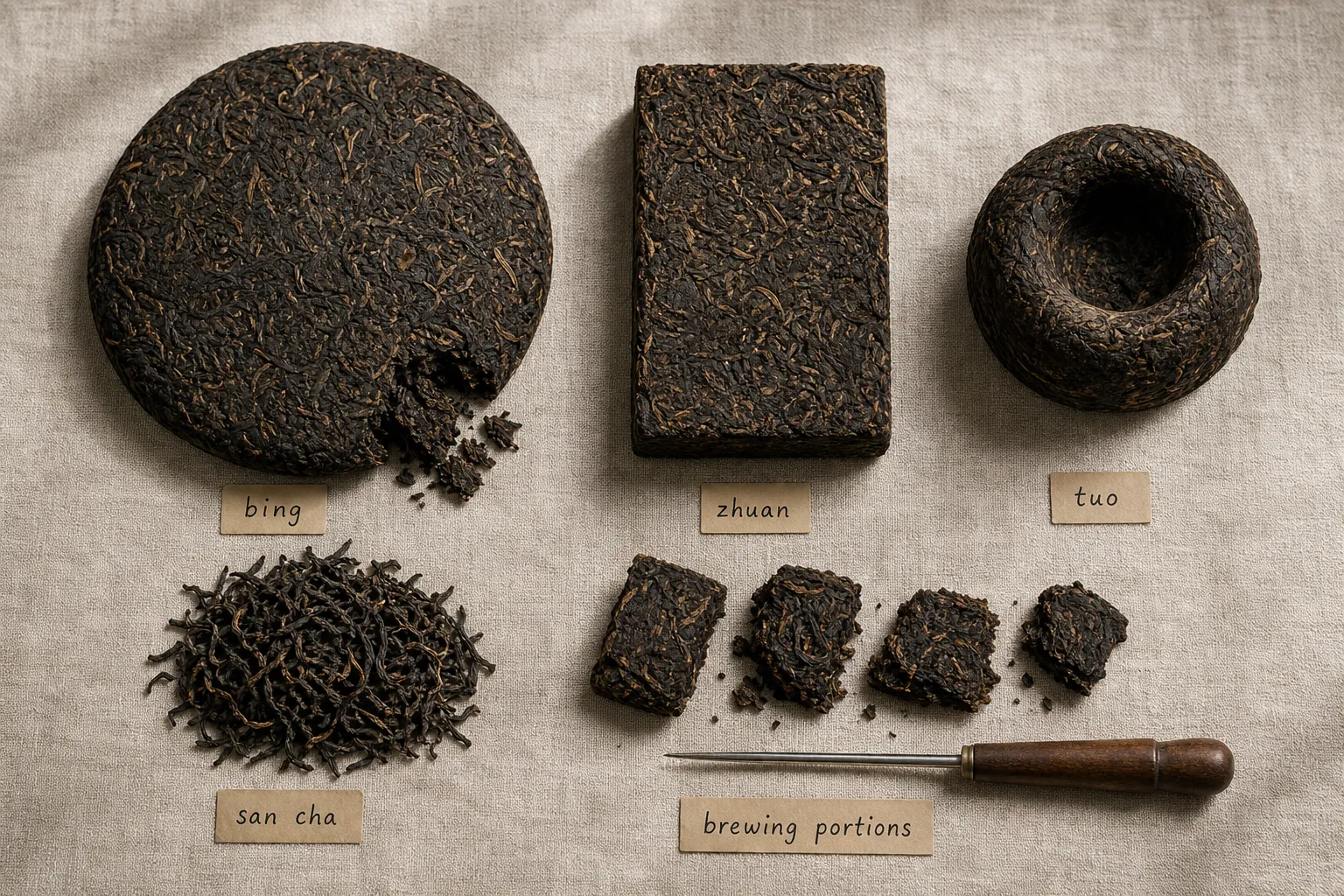
Bing
Cake or disc. Stores flat; prying depends on compression and edge access.
Zhuan
Brick. Tidy to stack; corners and faces may be firm.
Tuo
Nest or bowl-like compressed tea. Compact shape; prying can be awkward if tightly pressed.
San cha
Loose tea. No prying needed; easy to portion; needs care around air and odor.
Mini tuo or small nest
Small compressed portion. Convenient, though the portion may not match your vessel.
Column, log, or basket form
Seen in some dark tea traditions. Storage, cutting, and portioning may take more planning.
Shape does not equal quality. A bing is not automatically better than a zhuan, and loose tea is not automatically less serious than compressed tea. Compression is often connected with transport, storage, and presentation, but the cup still depends on leaf material, processing, storage, and brewing.
How Shape Affects Brewing
Compressed tea adds one step: opening the leaf without turning it into dust.
A practical approach
- Use a stable surface.
- Work from an edge, seam, or natural gap when possible.
- Pry thin layers rather than forcing the tool straight down.
- Keep broken fines separate if they make your cup too harsh or cloudy.
- Let very tight chunks rest briefly after a rinse or first steep so water can enter the center.
Loose dark tea is simpler to portion, but it can brew quickly if the leaf is fine or broken. Compressed chunks may start slowly and then release more strongly as they open. If the first infusion tastes thin, extend the next steep or let the chunk hydrate. If later infusions become heavy or rough, shorten the steep or use slightly less leaf next time.
Tea Brick Size Terms and Common Weights
Tea brick size terms affect cost, storage, and brewing habits. The safest rule is simple: read the printed net weight, not just the shape name.
A “brick” can be small or large. A “cake” can be full-sized, sample-sized, or made in a special format. Without a visible weight, shape words are not enough.
Many English-language buyers notice that 357g pu-erh cakes are common. This weight is widely encountered for full-size pu-erh cakes, but it is not a rule for every cake or every producer. You may also see smaller cakes, larger cakes, mini cakes, sample pieces, bricks in many weights, and loose tea sold by grams.
Price comparison
Compare cost per gram when two teas use different formats. A small cake may look cheaper until you check the weight.
Brewing commitment
A 25g sample and a full cake are different decisions. A sample lets you test leaf, storage, and brewing fit. A full cake needs more shelf space and a longer drinking plan.
Storage and handling
Larger compressed tea needs clean, stable storage. Smaller pieces are easier to open but may have more exposed surface area.
Qian Liang Cha and Tael Weight Names
Some dark tea names include older weight language. Qian Liang Cha is commonly explained as a large strapped column of tea associated with “thousand tael” wording; one academic summary describes it as a column weighing about 36.25 kg.
For ordinary buyers, the lesson is not to convert every traditional name into a brewing portion. It is to notice that some names carry historical weight language, while modern retail listings should still give a practical net weight.
If a seller uses a traditional weight name without a clear modern weight, ask for the actual grams or kilograms before comparing price or storage needs.
Production Date Versus Pressing Date on Dark Tea Labels
Date language is one of the easiest places to overread a wrapper. A label may mention harvest year, production year, pressing date, packing date, storage period, or vintage. These are not always the same thing.
- Harvest date points to when the leaf material was picked.
- Production date may refer to processing, though the exact meaning can vary by product and label context.
- Pressing date points to when loose or processed material was compressed into a cake, brick, tuo, or another form.
- Packing date may only tell you when the final package was prepared.
- Vintage or age language may summarize a claim rather than explain the full timeline.
General food-label guidance treats date and storage wording as consumer information. Dark tea adds another layer because some products are stored, compressed, re-packed, or sold long after initial processing. A cake pressed in one year from older material is not the same timeline as a cake made and pressed from that year’s material.
Ask for clarity when the date affects price or your buying decision
- Was the material harvested in the same year it was pressed?
- Is the date a pressing date or a packing date?
- Was the tea stored loose before compression?
- Where and how was it stored before sale?
- Is the seller describing a documented date or using broad vintage language?
Storage time can affect aroma and chemistry in dark tea, but conditions matter. Humidity, airflow, temperature stability, light exposure, and nearby odors can all shape the tea. Older does not automatically mean better. A cleanly stored younger tea may be more useful to you than an older tea with vague storage language.
Batch Numbers, Leaf Grade Words, and Region Names
Batch, grade, and region words help organize information. They are often misread as proof of quality.
What Do Batch Numbers Mean on Tea Packaging?
A batch number can identify a production run, recipe version, packing group, or seller inventory reference. It is useful when you want to compare two wrappers, reorder the same tea, or ask whether two cakes come from the same lot.
A batch number does not explain taste by itself. Two teas from the same general year can differ by material, blending, storage, compression, and handling. If you keep a tea notebook, record the batch number alongside your own brewing notes: leaf amount, vessel, water temperature, steep time, aroma, liquor color, mouthfeel, and aftertaste.
Leaf Grade Words
Leaf grade words can refer to sorting, tenderness, size, or appearance, depending on the tea and labeling system. In ripened pu-erh discussions, grade language is often connected with loose-tea sorting before blending or compression.
Finer grades may brew differently from coarser material, but “higher grade” on a label does not automatically mean a better cup for every drinker. Fine leaves and buds can release quickly. Coarser leaves and stems may bring structure, sweetness, or slower extraction in some teas.
The better question is not “Is the grade high?” but “Does this material fit how I brew and what I like?”
Region Names on Tea Labels
Region names can indicate broad origin, production area, brand identity, or a more specific material claim. You may see Yunnan, Guangxi, Hunan, Hubei, Sichuan, Liubao, Fuzhuan, Qingzhuan, Kangzhuan, mountain names, village names, or broader terroir language.
Use region names as comparison anchors, not automatic conclusions. Research on tea provenance and vintage treats origin and age as difficult verification problems, often requiring methods far beyond ordinary wrapper reading. For a buyer, that means the label tells you what is being claimed. Transparency, consistency, seller records, and the tea itself still matter.
Vintage, Storage, and Wrapper Claims That Deserve Caution
Some dark tea wrapper terms are descriptive. Others are persuasive. The more a word affects price, the more carefully you should read it.
Be especially cautious with
- Vintage or aged claims without clear date explanation.
- Storage claims that sound impressive but do not describe conditions.
- Tree-age language such as old tree or ancient tree without context.
- Very specific region claims unsupported by other information.
- Wrapper style that looks old but is not matched by clear records.
- Health-outcome language on product pages or stickers.
- Future-value language around aged tea.
A useful test is: “What decision does this word help me make?” If the word helps you choose a brewing method, portion size, storage setup, or comparison note, it is useful. If it only asks you to admire the tea without giving concrete information, keep reading.
A Quick Example: Reading a Hypothetical Label
Suppose a product page says:
2018 Yunnan Sheng Pu-erh Bing, 357g, spring material, batch 1801, dry stored, pressed in 2020.
A careful reading would be:
- Sheng: raw pu-erh processing direction; brew and taste it as raw, not ripe.
- Bing: cake form; you will need to pry it.
- 357g: full-size purchase; useful for price-per-gram comparison.
- 2018 and pressed in 2020: material date and pressing date may differ; ask what happened between those dates if it matters to you.
- Yunnan: broad region claim; useful, but not a complete provenance record.
- Batch 1801: useful for comparison and seller questions.
- Dry stored: storage claim; ask what this means in the seller’s context and check aroma when you receive it.
Nothing in that label proves the tea will taste good to you. But it gives enough structure to ask better questions and brew with fewer surprises.
A Practical Dark Tea Label Checklist
Before buying or opening a dark tea, run through this short checklist:
- Can I identify the tea type or category?
- Is the form clear: bing, zhuan, tuo, loose, or another shape?
- Is the net weight visible?
- For pu-erh, is it marked raw/sheng or ripe/shou/shu?
- Are date words separated clearly: harvest, production, pressing, packing, or vintage?
- Are batch, factory, recipe, or region claims present?
- Does any claim affect price more than it explains the tea?
- Do I know how I will store it after opening?
- Can I compare the label with leaf appearance, aroma, compression, and cup behavior?
The best use of dark tea labels is not blind trust or automatic suspicion. It is better sorting. A wrapper can tell you what to look at next: the shape in your hand, the weight on the scale, the way the compressed tea opens, the aroma after storage, and the way the cup changes when you adjust leaf, water, vessel, and time.
Sources
Sources and further reading
Reference links are limited to sources considered suitable for public citation in this page.