
Storage comparison
How Storage Differs for Loose Leaf Dark Tea and Tea Bricks
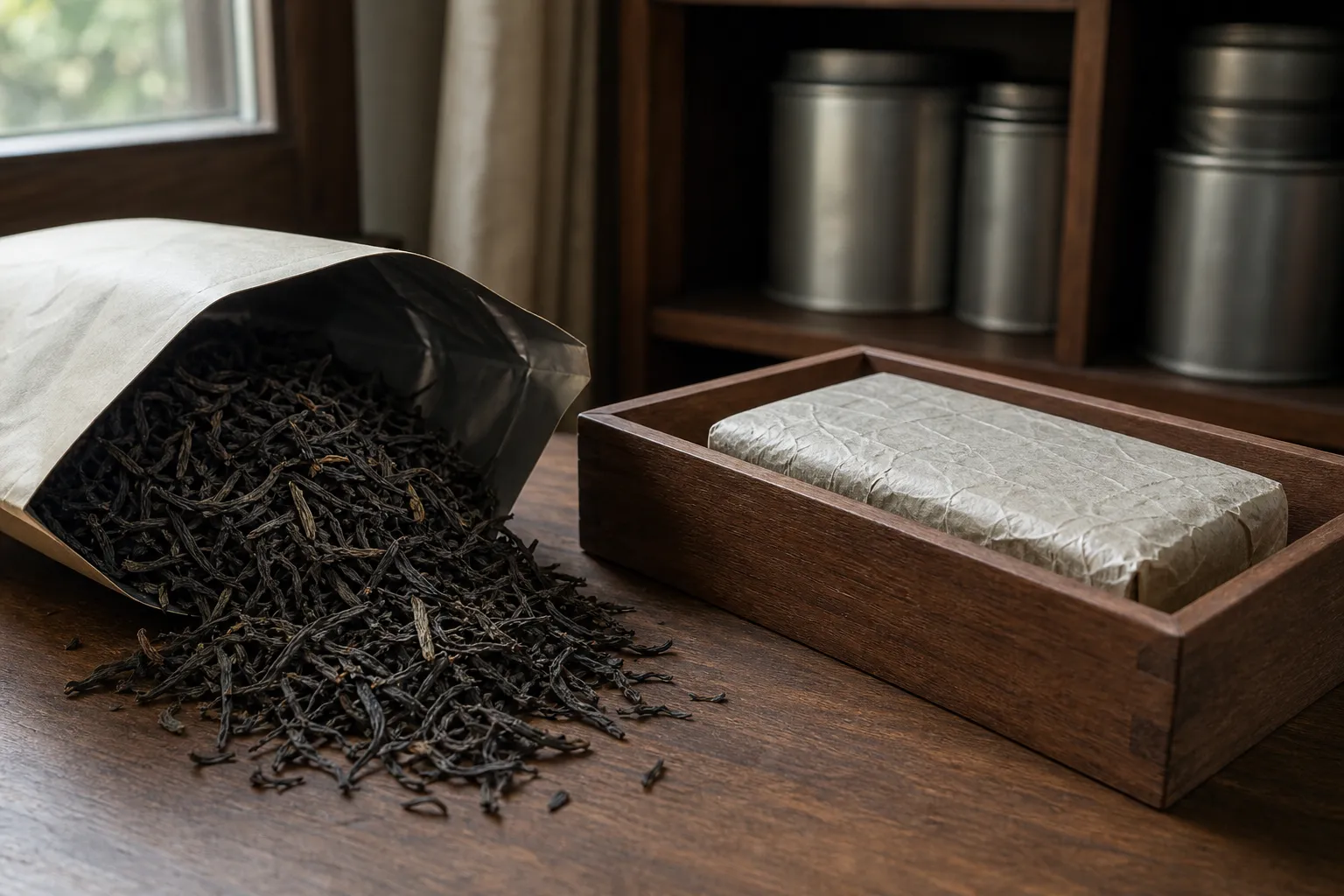
Loose leaf dark tea usually needs tighter protection from room air, light, moisture swings, and household odors. A dark tea brick, while not immune to bad storage, has compression and often a paper wrapper working in its favor. That is the practical difference in storing loose leaf dark tea vs tea bricks: loose tea behaves like many exposed edges; an intact brick behaves more like one buffered mass until you break it apart.
This is not a fixed household rule proven for every tea. It is a storage judgment based on form, surface exposure, wrapper condition, airflow, humidity, and smell.
Home cabinet baseline
upward
Start with the broader guide
Use the broader guide first if you need the full scope before this page.
Quick comparison for a home cabinet
Start both forms in the same kind of place: dry, shaded, odor-free, away from heat, and not in the refrigerator for normal everyday storage. Then adjust the container to the tea’s form.
For most homes, loose dark tea should be a little more contained. A brick should be protected, but not sealed into a damp or smelly space. “Contained” does not mean moist and stale; “breathable” does not mean exposed on a kitchen shelf.
Why loose dark tea needs more protection
Loose dark tea exposes many cut, torn, curled, or broken surfaces. If it sits near a stove, spice drawer, scented candle, laundry shelf, or damp wall cabinet, more of the tea is ready to absorb whatever the room offers.
A good loose tea container blocks light and odors while staying dry and neutral. A paper-lined tin, odor-free ceramic jar, shaded glass jar, opaque box, or resealable pouch can all work if the inside is clean and does not smell like metal, plastic, soap, cardboard glue, spices, or a previous tea. The container does not need to be expensive. It needs to be quiet.
Loose tea often shows storage mistakes quickly. A tea that once smelled woody, mellow, earthy, or grain-like may become flat, sharp, sour, stale, or oddly perfumed if it takes on room odors. The dry leaf aroma is usually the first clue. Smell the container before you smell the tea. If the container smells like food, incense, detergent, damp wood, or plastic, the tea is already sharing that environment.
Moisture needs the same attention. Dark tea can continue to change in storage, and studies on dark tea, Fu brick tea, Pu-erh, and related post-fermented teas describe changes in aroma compounds and microbial communities over time. That does not mean a damp cabinet is helpful. In a home setting, dampness plus poor airflow can push tea toward mustiness or visible spoilage rather than pleasant aged notes.
For loose tea, watch for clumping, a damp-feeling leaf surface, a stale basement smell, or a pouch that feels soft from moisture. In humid seasons, it is usually better to give loose dark tea a more protective outer container and check it occasionally than to leave it open for “airflow.”
Why a wrapped brick can use breathable shelter
A dark tea brick is compressed. While it remains intact, less surface is exposed than the same tea broken into small pieces. Its paper wrapper, if clean and dry, also gives a first layer of protection. That is why dark tea brick storage often looks different: the brick may stay in its wrapper, then sit in a paper-lined box, ceramic jar, purple clay jar, cabinet, or clean tea rack.
The goal is not to shut out all air forever. In many dark tea storage customs, especially around Pu-erh and other compressed teas, people speak of dry storage, breathable paper, clean airflow, jars, boxes, and racks. These are common practices, not universal rules. The useful idea is simple: an intact brick often does well with shelter that buffers the room without trapping moisture.
The wrapper matters. A dry, intact paper wrapper can stay on. It reduces handling, dust, light exposure, and direct contact with other objects. If the wrapper is torn, greasy, damp, strongly scented, spotted, or stained by its storage surroundings, do not treat it as harmless tradition. The wrapper is part of the tea’s storage environment.
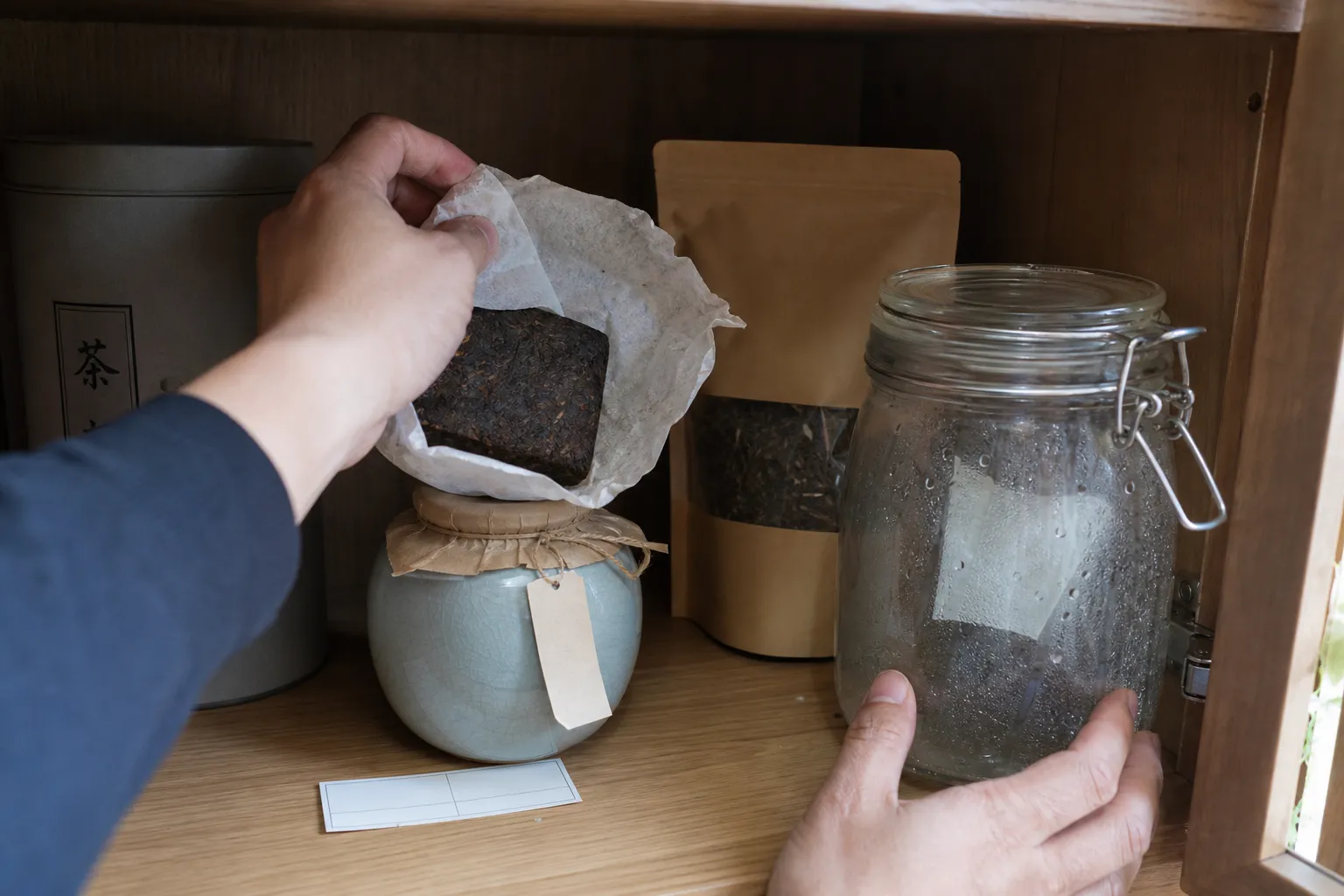
If you remove the wrapper and place a brick in a jar, keep the tea away from light and foreign smells. Ceramic and purple clay jars are often used because they can provide shade and some buffering, but the material alone does not solve storage problems. A jar that smells like incense, damp clay, glaze dust, old herbs, or perfume is not ready for tea.
A brick also changes once you break it. A pried chunk has exposed faces. A fully broken brick is no longer being stored as a brick in any practical sense. Keep those pieces closer to loose tea: dry, shaded, odor-free, and not left as crumbs on a tray.
Container choices without the container myths
Good dark tea storage is less about a magic material and more about controlling odor, light, moisture, and heat.
Paper wrapping
Paper wrapping is useful for many compressed teas because it gives a light barrier without acting like a sealed plastic bag. For loose tea, paper alone may be too exposed unless it sits inside a clean box, tin, or cabinet.
Ceramic and purple clay jars
Ceramic and purple clay jars can work when they are dry, shaded, and odor-free. A loose-fitting lid may suit a stable, dry room. A tighter lid may help with odor control, but only if both tea and container are dry.
Opaque tins and boxes
Opaque tins and boxes are practical for loose dark tea if they do not smell metallic, musty, or perfumed. If a tin once held another tea, spice, or food, air it thoroughly and smell it before using it.
Glass jars
Glass jars are not automatically wrong. The problem is usually clear glass plus light. A glass jar inside a dark cabinet can be acceptable if it is dry and odor-free. A clear jar on a sunny shelf is a poor choice.
Plastic bags and plastic boxes
Plastic bags and plastic boxes need caution. Some plastic carries odor, traps dampness, or lets light through. A clean plastic outer bin may help organize wrapped bricks temporarily, but thin plastic bags are often a poor long-term match for dark tea if they smell, sweat, or seal in damp air.
Refrigerator storage
Refrigerator storage is usually the wrong default for dark tea. Cold storage can create condensation when tea is removed, and refrigerators carry food odors. For ordinary loose dark tea and tea bricks, a clean cabinet is usually more sensible.
The checks that matter most
Before choosing a “perfect” container, test the storage place.
Smell the cabinet
A shelf above the stove, beside spices, near cleaning products, or close to incense is not neutral. Loose tea usually shows odor pickup faster, but wrapped bricks are not sealed against the world.
Check light and heat
Dark tea does not need theatrical darkness, but direct sun and bright display shelves are poor habits. Light and heat often travel together.
Look at the wrapper and container walls
A dry wrapper should feel like paper, not soft, clammy, oily, or spotted. A jar should not show condensation. A box should not smell like damp wood or old cardboard. If rainy months change the room, move the tea before the problem becomes obvious.
Separate aged aroma from contamination
Many dark teas can smell earthy, woody, grain-like, cellar-like, old-book-like, camphor-like, or mellow, depending on tea type and storage history. That is different from a sharp moldy odor, sour rot, chemical smell, detergent, smoke, perfume, food odor, or visible fuzzy growth. Do not treat a strong unpleasant moldy smell as normal aging. If tea looks moldy or smells clearly contaminated, do not drink it.
Finally, remember that aging is not a promise. Research shows that dark tea and Pu-erh can change over time, but it does not show that every tea improves in every home. Tea material, compression, dryness, airflow, temperature, cleanliness, and storage history all matter.
A simple setup for each form
For loose dark tea
Use an opaque, dry, odor-free container. Keep it in a shaded cabinet away from food, spices, smoke, incense, detergent, and damp walls. If the tea came in a pouch that seals well and smells neutral, the pouch can stay as the inner layer, with a box or cabinet as outer protection. Open it briefly, take what you need, and close it again.
For a wrapped dark tea brick
Keep the original paper if it is clean, dry, and intact. Store the brick in a shaded, odor-free cabinet, paper-lined box, ceramic jar, purple clay jar, or clean shelf area with gentle room airflow. Do not press it against a damp wall or keep it near aromatic items. If you pry off pieces for daily brewing, store those pieces separately as loose tea.
For multiple teas
Separate strong-smelling teas, smoky teas, damp wrappers, and clean bricks. A questionable wrapper should not sit against loose tea you care about.
The simplest rule is this: loose dark tea needs closer protection because it is already open to the room; a brick needs clean, breathable shelter because it is still compact. Both need shade, dryness, and freedom from foreign smells.
Sources
Sources and further reading
Reference links are limited to sources considered suitable for public citation in this page.