
How to Tell Major Dark Tea Types Apart by Leaf, Liquor, and Aroma
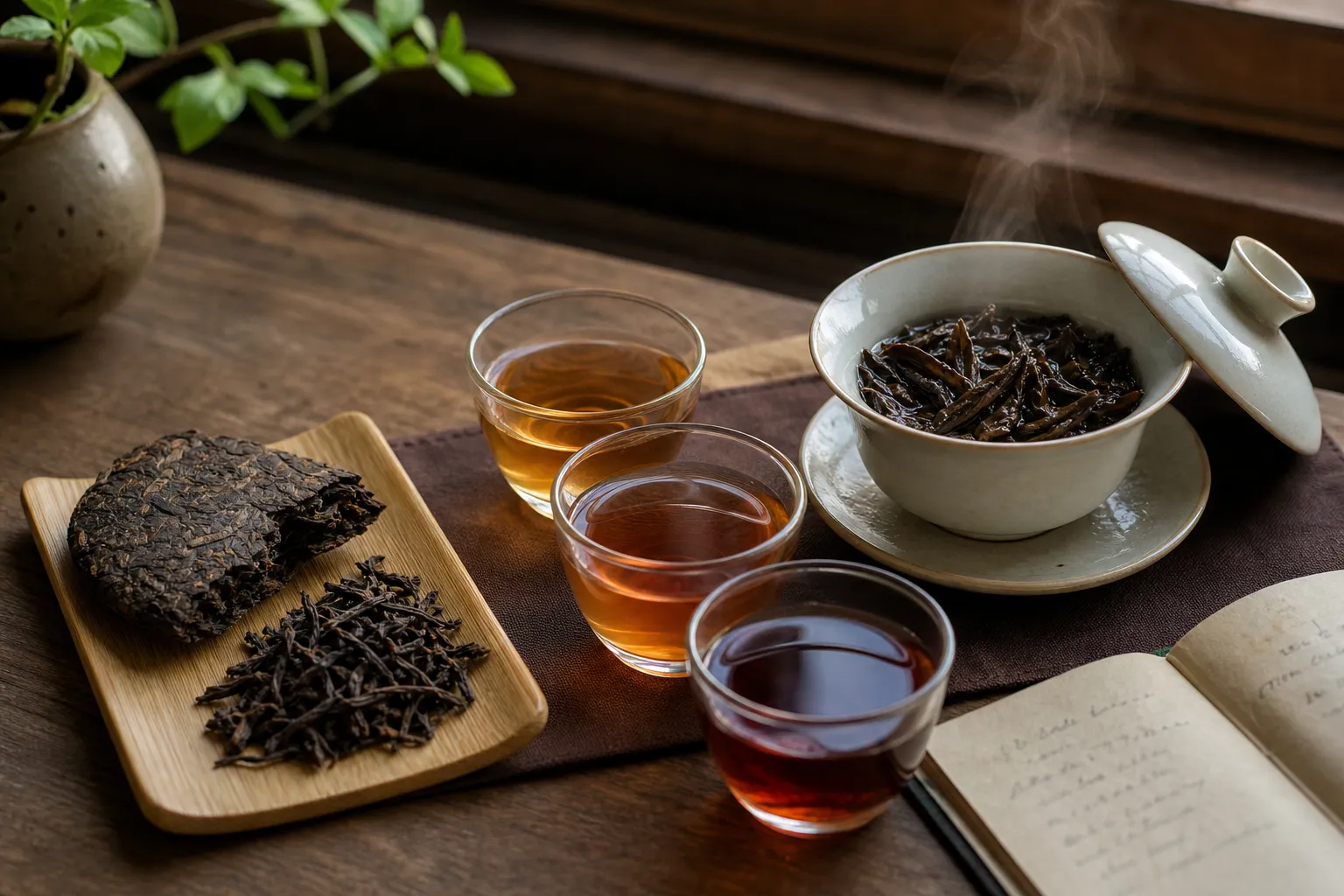
To answer how to identify dark tea types, do not start with liquor color alone. Start with a cluster: the dry leaf or compressed form, how the liquor behaves across a few infusions, and the fermented or storage-shaped aroma from the warmed leaf and cup.
Pu-erh, Liu Bao, Fu brick or Fuzhuan-style tea, Qing brick, Kang brick, and other regional dark teas can overlap in brown leaf color, red-brown liquor, and earthy aroma. A better question is: does the tea look loose or compressed, coarse or fine, cake-like or brick-like; does the cup move from reddish amber to deep brown; and does the aroma lean clean aged, woody, sweet, fungal, earthy, smoky, or damp?
Quick field rule: read dark tea in three passes. First, inspect the leaf or compressed piece. Second, brew with a steady leaf amount, vessel size, and steeping time. Third, smell both the wet leaf and the liquor. One cue can mislead; a repeated pattern is more useful.
upward
Read the full overview first
Use the broader guide first if you need the full scope before this page.
The three-cue method: leaf, liquor, aroma
Dark tea is usually discussed as a post-fermented tea category, not simply as “black tea with a darker cup.” Microbial fermentation and later storage can affect the leaf’s aroma, color, texture, and cup behavior. That is why practical identification works best when you compare several observable signs at once.
Use this order:
- Dry leaf or form. Look at whether the tea is loose, pressed into a cake, brick, tile, bowl-like form, column, basket-like mass, or broken from compression. Notice whether the material is whole, coarse, stemmy, chopped, tightly compacted, or loosely separated.
- Liquor behavior. Watch the first two or three infusions, not only the first cup. A dark tea may brew reddish brown, orange-red, mahogany, deep brown, or dark amber depending on form, age, storage, dosage, and steep length.
- Aroma pattern. Smell the dry leaf, the warmed leaf, the wet leaf, and the cup. Fermented tea aroma may be described as earthy, woody, mellow, aged, sweet, grain-like, fungal, camphor-like, smoky, vegetal, or musty. Treat these words as prompts, not proof.
If the leaf form, liquor, and aroma point in the same direction, you have a stronger identification cue. If only one cue points that way, keep the label tentative.
What the dry leaf or compressed form can tell you
Dark tea appearance begins before brewing. Many dark teas were historically shaped for transport and storage, so compressed forms are common: cakes, bricks, square pieces, bowl-like forms, and larger packed shapes. Loose leaf dark tea also exists, and broken pieces from cakes or bricks are common in everyday brewing.
A compressed piece can suggest category language, but it does not identify the tea by itself. A brick may point toward Fu brick, Qing brick, Kang brick, or another compressed dark tea tradition. A cake may suggest Pu-erh to many English-language drinkers. A loose dark tea may make some readers think of Liu Bao. These are useful starting associations, not final answers.
Dry-form comparison cues
Tight cake or broken cake piece
Often associated with Pu-erh in English tea settings.
Other teas can be compressed; storage changes aroma and color.
Rectangular brick or tile
Often associated with Fu brick, Qing brick, Kang brick, or Anhua-style teas.
“Brick” describes shape, not one single tea type.
Loose dark strands or chunks
May appear in Liu Bao or loose dark tea offerings.
Loose form can also come from broken compressed tea.
Coarse stems and larger leaves
Common in some compressed dark tea materials.
Coarseness varies by producer, region, and intended style.
Fine fragments or dusty breakage
Can brew dark and strong quickly.
Particle size affects extraction, not identity.
Leaf size matters because small fragments expose more surface area to water. A broken corner of a brick, crumbs from a cake, or fine loose material can produce a darker-looking infusion faster than a larger intact piece. Before deciding that a tea is a certain type because the cup is very dark, ask whether the leaf was simply broken, heavily dosed, or steeped longer.
How to read dark tea liquor color without being fooled
Dark tea liquor color is a clue, but it is easy to overread. Many dark teas can show red-brown, dark amber, mahogany, or deep brown liquor. Fermentation can move tea liquor away from lighter yellow-green tones toward red-brown and darker tones, but in a home cup, color is also shaped by brewing choices.
When comparing two teas, keep these variables steady:
- similar leaf weight or visual amount;
- similar vessel size;
- similar water temperature;
- similar rinse or no-rinse choice;
- similar first steep length;
- similar amount of broken material.
Then compare the liquor over several steeps.
A tea that gives a quick dark first cup from tiny fragments may not be “darker” in type than a larger compressed piece that opens slowly. A tea stored longer, kept in more humid conditions, or broken into smaller pieces may look deeper than a younger or drier-stored tea of a related category.
A simple tasting setup helps
- First infusion: note whether the color is orange-red, reddish brown, clear amber-brown, or opaque dark brown.
- Second infusion: notice whether the color deepens, steadies, or drops quickly.
- Third infusion: check whether the liquor remains rounded and colored, or becomes thin and pale.
This does not turn color into a verdict. It simply helps you avoid the common mistake of treating one dark cup as a complete identification.
Aroma cues: useful, but never single-word labels
Aroma is where dark tea becomes interesting and easy to misread. Research on dark tea aroma describes volatile profiles shaped by raw material, microbes, pile fermentation, and storage. For everyday drinkers, that means one word such as “earthy” or “musty” is too blunt.
Use aroma in layers.
Clean aged, woody, or mellow notes
Many dark teas are described with aged, woody, mellow, or earthy language. In the cup, this may show as damp wood, old books, dry forest floor, cellar-like depth, warm grain, or soft sweetness. These impressions can appear in ripe Pu-erh, Liu Bao, Qing brick, and other dark teas, depending on storage and processing.
The key is whether the aroma feels integrated with the liquor. A clean aged note often sits with sweetness, smoothness, or a rounded body. A harsh or unpleasant damp note is a different signal, but aroma alone should not be used to make a broad judgment about the tea.
Fungal, “golden flower,” and Fu brick associations
Fu brick or Fuzhuan-style teas are often discussed in connection with microbial growth during processing, especially the “golden flower” language readers may see in tea shops. Research on Fuzhuan brick tea treats microbial fermentation as central to aroma and flavor formation.
In practical tasting, look for grainy, fungal, woody, sweet, or mellow notes. Do not treat visible specks or shop language as a badge of identity by itself. For identification, keep it plain: note what you see, smell the warmed leaf, brew consistently, and compare the liquor with the dry form.
Earthy versus musty
- Earthy can suggest soil, forest floor, mineral depth, damp wood, or aged leaf.
- Musty can suggest enclosed storage, dampness, stale air, or a cellar-like impression.
- Sour, chemical, or sharply unpleasant odors are different from ordinary tasting vocabulary and should not be brushed aside as just “dark tea character.”
For this page’s purpose, the point is not to judge storage safety. The point is identification humility: a musty fermented tea aroma may come from storage conditions, age, compression, humidity, or the tea’s processing path. It does not automatically prove Liu Bao, ripe Pu-erh, or any other type.
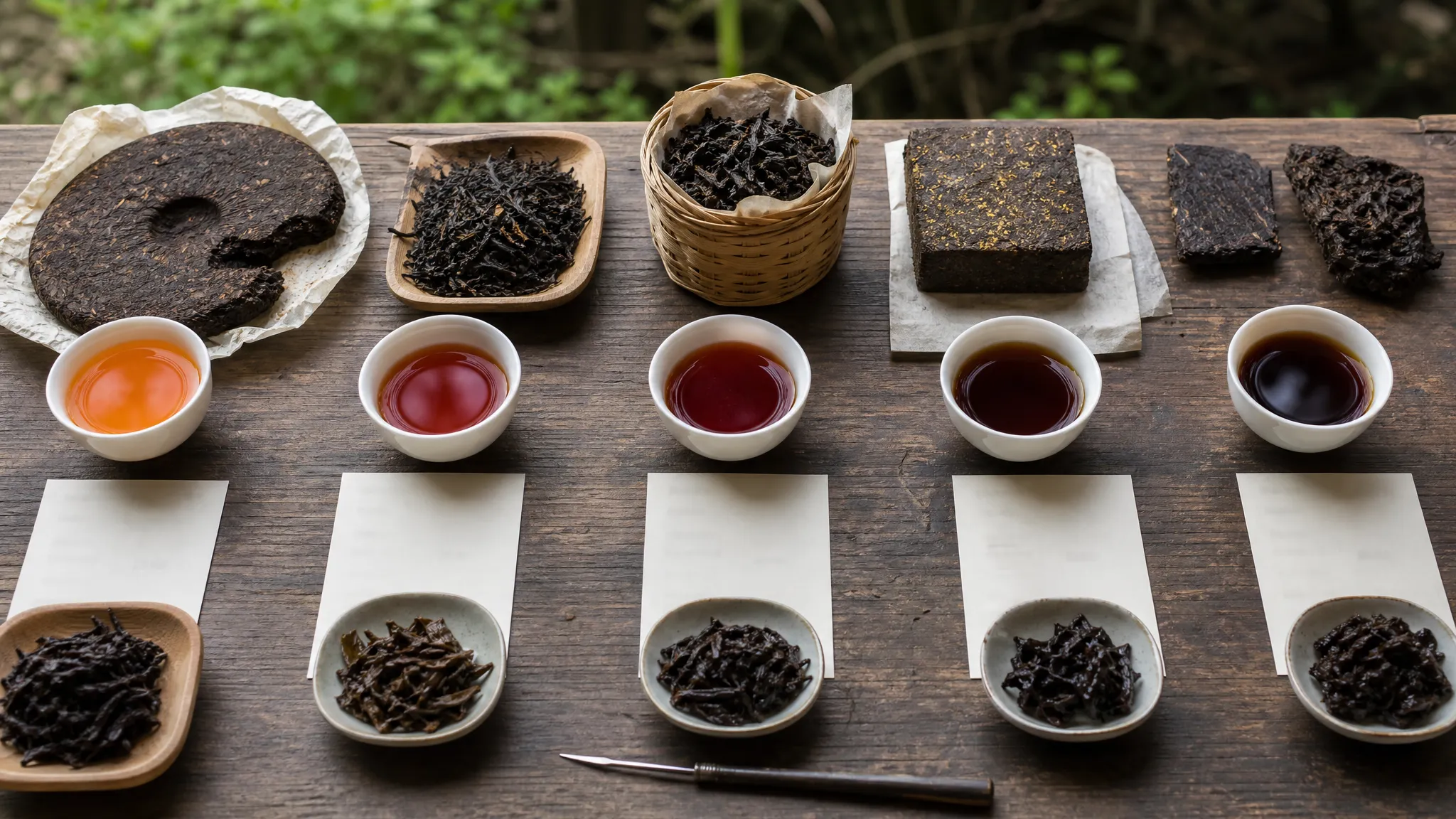
Major dark tea examples and the cues to compare
The examples below are not a full classification system. They are practical comparison anchors for English-language readers trying to separate familiar dark tea names without relying on color alone.
Ripe Pu-erh
Leaf or form: often seen as cake, brick, tuo-like form, or loose material.
Liquor: often red-brown to deep brown depending on age, breakage, and steeping.
Aroma: earthy, woody, mellow, aged, sometimes camphor-like or sweet.
Raw or aged Pu-erh
Leaf or form: often compressed as cakes or other forms; appearance varies strongly with age.
Liquor: can range widely; young material may not look like ripe dark tea.
Aroma: can be vegetal, floral, woody, smoky, aged, or storage-influenced depending on age.
Liu Bao
Leaf or form: often encountered as loose leaf, baskets, or compressed/broken forms in market language.
Liquor: often dark amber to reddish brown, depending on storage and brewing.
Aroma: earthy, woody, betel-nut-like in some descriptions, clean aged, sometimes cellar-like.
Fu brick / Fuzhuan-style tea
Leaf or form: brick form is a common cue; may include visible microbial features depending on product.
Liquor: often amber-brown to red-brown, but brewing strength changes quickly with broken pieces.
Aroma: grainy, woody, fungal, sweet, mellow, warm.
Qing brick, Kang brick, and other regional bricks
Leaf or form: compressed brick or block forms; sometimes coarser material.
Liquor: brown, red-brown, or darker liquor depending on compression, age, and steeping.
Aroma: aged, woody, earthy, smoky, coarse-leaf, or storage-shaped notes.
Treat this table as a comparison map, not a verdict machine. If a tea is unlabeled, a brick shape plus red-brown liquor plus woody aroma can narrow your guess, but it does not prove the origin or processing tradition. If a tea is labeled, the same cues help you decide whether the cup behaves in a way that makes sense for that label.
The black tea vs dark tea color trap
One common confusion is black tea vs dark tea. In English, “black tea” usually refers to a separate tea category made through oxidation. In Chinese tea naming, the same broad category is often called “red tea” because of the red tone of the brewed liquor. Dark tea, by contrast, is better understood through post-fermentation and storage-influenced development.
This naming mismatch creates two mistakes:
- assuming that dark tea is simply black tea with a darker liquor;
- assuming that red tea liquor color means the tea is dark tea.
Neither works. A black tea can brew red, burgundy, or dark brown. A dark tea can brew reddish brown, orange-red, or deep brown. Category names, leaf processing, liquor color, and market labels do not line up in a simple color ladder.
If the cup is dark but the dry leaf smells malty, brisk, bright, and sweet in a black-tea way, do not force it into dark tea. If the cup is not extremely dark but the leaf form, aroma, and label point toward post-fermented tea, do not reject it as dark tea only because it is lighter than expected.
When the cues conflict
Conflicting cues are normal. Dark tea identification becomes uncertain when:
- the tea is broken into small particles;
- the piece comes from the edge of a compressed cake or brick;
- the storage aroma is strong;
- the label is vague or translated loosely;
- the first steep was too long;
- the tea was brewed with much more leaf than usual;
- the sample is blended, re-pressed, or sold under broad market language.
When that happens, reset the comparison. Use a smaller amount of leaf, shorten the first steep, smell the wet leaf after the rinse or first infusion, and watch whether the liquor becomes clearer or more balanced in later steeps.
If the tea still gives only one strong cue and no supporting pattern, keep the identification broad: “compressed dark tea,” “ripe Pu-erh-like,” “Liu Bao-like,” or “storage-forward dark tea” is more honest than a precise claim.
A compact checklist for identifying a dark tea sample
Before naming the tea, ask:
- Is it loose, compressed, or broken from a larger form?
- Does the shape suggest cake, brick, basket, column, or mixed loose material?
- Are the leaves coarse, stemmy, whole, chopped, or crumbly?
- Does the liquor stay red-brown or deep amber across several steeps, or only in the first cup?
- Does the aroma lean earthy, woody, aged, grainy, fungal, smoky, vegetal, sweet, or damp?
- Could particle size, dosage, steep time, or storage be making the cup look or smell stronger?
- Does the label give a region or type, and do the sensory cues support it?
The best answer is rarely one dramatic sign. For dark tea, identification is strongest when the dry appearance, liquor behavior, and aroma notes agree over repeated brewing.
Sources
Sources and further reading
Reference links are limited to sources considered suitable for public citation in this page.