
Dark tea comparison
Loose Leaf Dark Tea vs Compressed Tea Bricks
Choosing between loose leaf dark tea vs compressed tea is rarely a matter of one being better. The real question is how you want to handle the tea before it reaches the cup.
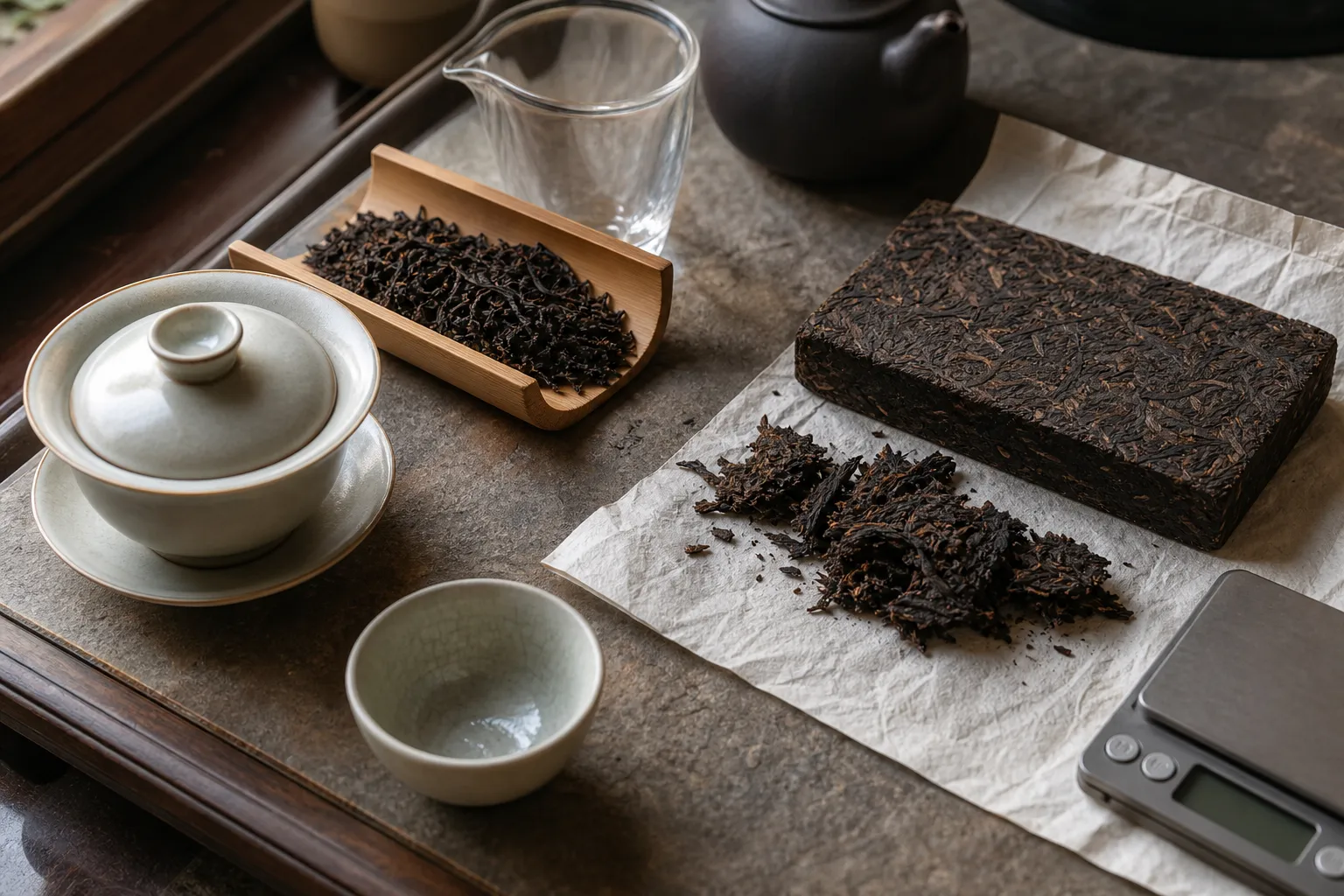
Loose leaf dark tea is usually easier to measure, rinse, and brew on an ordinary day. Compressed tea bricks and dark tea cakes ask for more care at the start: prying, loosening, managing dust, and giving dense pieces time to open. In return, they can be compact, durable, and satisfying for slower multi-infusion sessions.
The useful comparison starts with form, then follows what changes in your hands, your vessel, your storage shelf, and the taste of the first few infusions.
upward
Read the full overview first
Use the broader guide first if you need the full scope before this page.
The main difference is form, not tea category
Compression is a format. It is not a separate tea type.
Dark tea can be sold as loose leaves, broken leaf, chunks, bricks, cakes, tuo-shaped nests, small balls, coins, sticks, or other pressed forms. A dark tea cake and a compressed tea brick may both belong to the wider dark tea world, but shape alone does not tell you the processing style, storage history, age, or flavor.
This matters because compressed tea often comes with strong market language: deep, traditional, compact, age-worthy, or more serious. Loose leaf dark tea is often described as easy, aromatic, or beginner-friendly. Those can be useful clues, but they are not proof. A loose Liubao-style dark tea can be mellow and layered. A pressed dark tea can be flat, too tightly compressed, dusty, rough, or poorly stored.
Research on dark tea and Fu brick tea often discusses microbial fermentation, metabolite changes, pressing, drying, storage, and extraction behavior. That helps explain why dark tea can be chemically and sensorially complex. It does not give a direct consumer rule that loose leaf always brews faster, compressed tea always tastes deeper, or one form stores better in every home.
For this comparison, the evidence is most useful when it keeps the claims modest: compression changes physical access to the leaves, and that can affect dosing, hydration, extraction speed, and storage convenience.
Which form is easier to brew?
For most everyday brewing, loose leaf dark tea is easier.
You can open the bag or tin, weigh or scoop the leaves, rinse if you like, and begin. There is no need for a tea pick, tea knife, or careful pressure against a hard block. If you are brewing before work, making a casual mug, or still learning how a tea behaves, that simplicity matters.
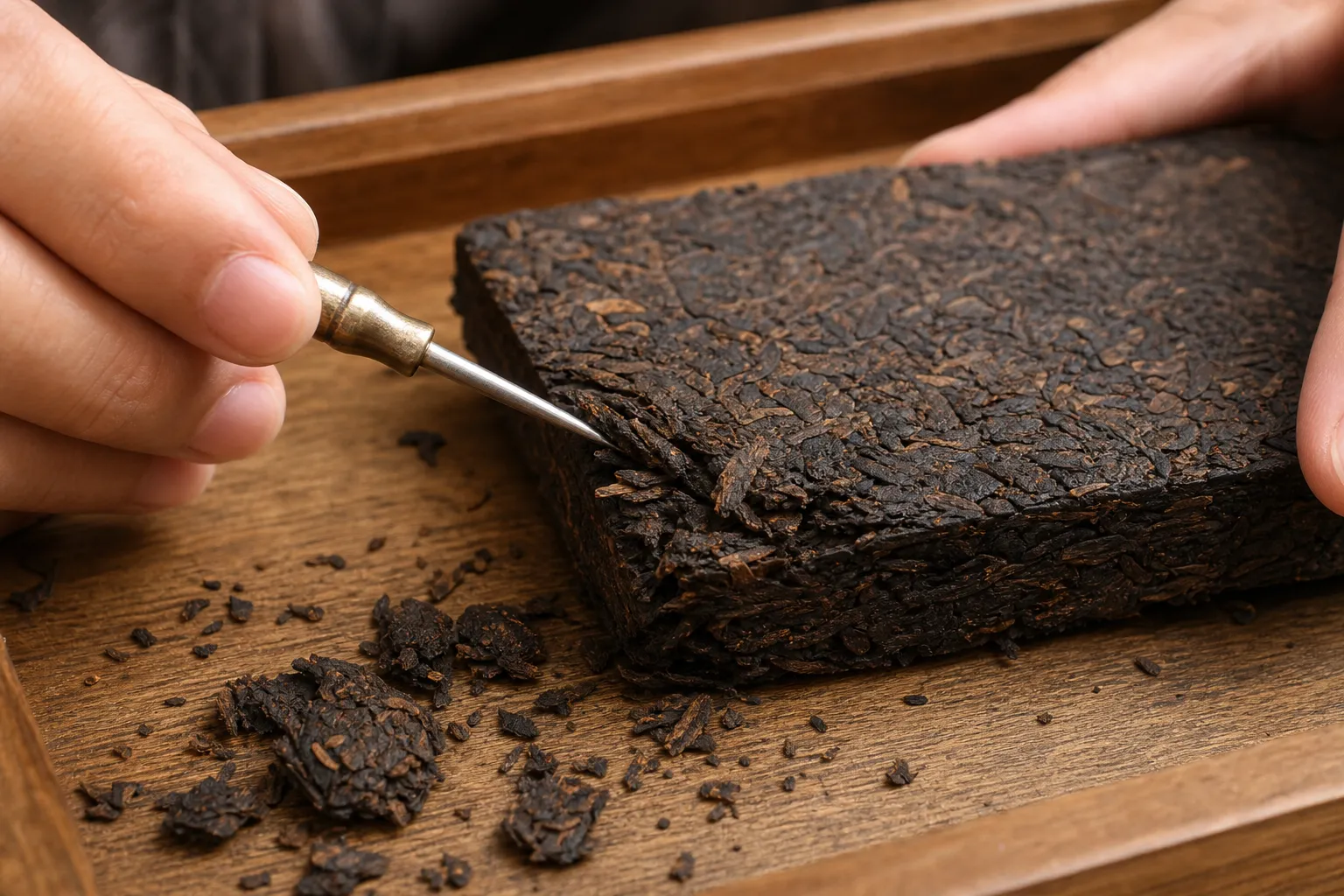
Compressed dark tea adds one step before brewing: you need to separate a usable amount. With a loosely pressed cake or brick, this can be simple. Slide a tea pick into a natural seam, lift gently, and remove a flake. With a tightly pressed brick, the process can be slower. If you push straight down or twist aggressively, the tea may break into dust and small shards instead of lifting away in layered pieces.
How to break a dark tea brick without crushing the leaves
The goal is not to stab the brick apart. The goal is to loosen it along its layers.
- 1. Place the brick or cake on a stable surface. Use a tray or cloth so fragments do not scatter.
- 2. Look for a seam, corner, or looser edge. Compressed tea often separates more cleanly from the side than from the center.
- 3. Insert the tea pick shallowly. A tea pick, tea knife, or tea needle should slide between layers, not punch through them.
- 4. Wiggle, lift, and pause. Small movements reduce crushing.
- 5. Use a mix of flakes and small chunks. This often hydrates more evenly than one hard pebble.
- 6. Move if the brick resists. Forcing one tight area usually creates more powder.
Some dust is normal, especially around corners, cut faces, and older or more brittle pieces. A little tea dust in a tea brick is not automatically a problem. It becomes more meaningful as a buying or handling clue when the brick is mostly powder, smells stale or damp, sheds heavily from poor packaging, or gives a muddy cup even when brewed gently.
Dosing, rinsing, and the first infusions
For a small gongfu-style session, many drinkers start around 5–7 grams of dark tea for a 100–120 ml vessel, then adjust by taste. For a larger mug or casual pot, the leaf-to-water ratio is often lower, especially if the tea extracts quickly.
Treat those numbers as starting points, not rules. Leaf grade, compression, age, storage, water, vessel size, and personal preference can all move the answer.
How much dark tea brick to use for one brewing session
With loose leaf, dosing is straightforward: weigh the leaves or use a consistent scoop. With a brick, dosing can be awkward because the piece may not break exactly where you want. If you pry off 8 grams when you wanted 6, you can save the extra dry leaf or brew with slightly shorter steeps.
It helps to separate the compressed portion before heating water. You can remove obvious splinters, balance dense chunks with smaller flakes, and avoid rushing with a sharp tool.
Think in terms of both weight and shape
- Thin flakes hydrate faster and can brew stronger early.
- Dense chunks may taste light at first, then deepen as they open.
- Mostly dust can cloud the liquor and extract quickly.
- Large unbroken pieces may need a longer rinse or a few gentle early steeps.
Should you rinse loose leaf dark tea and compressed tea the same way?
Not always.
Many dark tea drinkers use a short rinse to warm the vessel, wake the leaves, and clear fine particles. With loose leaf, a quick rinse may be enough because water reaches the leaves immediately. With compressed tea, especially a dense chunk, the rinse also begins hydration. The first pour may run around the outside of the piece without fully opening the inner layers.
- Loose leaf dark tea: start with a brief rinse if the tea is dusty, aged, tightly twisted, or simply tastes better to you after rinsing.
- Compressed dark tea: consider a slightly longer rinse or a short pause after the rinse so the piece can soften.
- Very dusty broken tea: rinse gently and pour carefully to avoid pushing too much powder into the cup.
If the first infusion tastes thin, the tea may not be weak. The compressed piece may not have opened yet. If the second or third infusion suddenly becomes heavy, shorten the next steep instead of increasing everything at once.
Does compressed dark tea taste different from loose leaf dark tea?
It can, but not because compression creates one guaranteed flavor.
Taste depends first on the tea itself: raw material, dark tea type, processing, fermentation, storage, age, and brewing. Compression changes the physical behavior of the leaves. That can influence how quickly aroma, color, body, bitterness, sweetness, or earthiness enters the cup.
In many everyday brewing setups, loose leaf dark tea can brew stronger faster because more surface area is exposed to hot water. The leaves hydrate quickly, separate quickly, and release color and aroma early. That can be pleasant when the tea is clean, sweet, woody, earthy, or mellow. It can also become too strong if the dose is high or the steep is long.
Compressed tea often behaves more slowly at first. A tight piece may give a pale or quiet first infusion, then open into a fuller second, third, or fourth infusion. This is especially noticeable when the chunk remains compact after the rinse. The cup may seem to arrive gradually: first light wood or earth, then deeper body, then sweetness, mineral texture, or a longer aftertaste depending on the tea.
Studies on Fu brick tea and related dark tea processing show that aroma- and taste-related compounds can shift during manufacturing and extraction, and that volatile release during boiling-water extraction can be gradual. That supports a cautious practical point: flavor release is not always instant. It does not prove that pressed tea tastes better or that loose tea is less complex.
Why a dark tea brick opens slowly in the first infusions
A compressed piece gives water less immediate access to the inner leaves. The outside softens first. The interior needs time to hydrate, swell, and separate. The tighter the compression, the more this matters.
If your tea brick first infusions taste too light:
- use a slightly longer rinse;
- let the wetted chunk rest briefly before the first steep;
- pry the next session into thinner flakes;
- increase the first steep slightly, then shorten later steeps once the tea opens.
If the cup becomes heavy or rough later, the issue may be delayed extraction rather than poor tea. Adjust the later steeps instead of pushing every infusion longer.
Storage: loose leaf dark tea storage vs compressed tea storage
Compressed tea has an obvious advantage in footprint. A brick or cake can hold its shape, stack neatly, and take less room than the same weight of bulky loose leaf. This is one reason compressed tea has long been associated with transport and storage efficiency. The daily version is simple: bricks and cakes are easier to organize if you keep several teas.
Loose leaf has the advantage of access. You can open a container, take what you need, and close it again. You do not need to pry the tea repeatedly, and you avoid creating extra fragments. The tradeoff is space: loose leaves can be bulky, and fragile leaves may break if handled carelessly in a bag.
Practical storage judgment for both forms
- keep tea away from obvious dampness;
- avoid strong kitchen, spice, smoke, perfume, or cleaning-product odors;
- keep tea out of direct light;
- avoid wet containers or sealed spaces that trap unpleasant smells;
- check aroma and appearance before brewing.
The available material does not support precise home-storage thresholds for humidity, surface growth risk, or aging results. A tea that smells sharply musty, feels wet, shows visible fuzzy growth, or carries a strong off odor should not be treated as normal storage variation.
Compressed tea may change over time under suitable conditions, but better flavor is not promised by the brick or cake shape. Loose leaf dark tea may also change in storage. The result depends on the tea and the environment, not only on whether the leaves are pressed.
What to check before buying a compressed dark tea brick
A compressed brick asks you to judge more than the label. Since you cannot see every inner leaf clearly, the outer signs matter.
Clean, recognizable aroma
Earthy, woody, sweet, nutty, aged, or gently smoky notes can all appear in dark tea, depending on type. A damp, sour, chemical, or strongly off smell is a warning sign.
Reasonable compression for your use
Very tight bricks may store neatly but can be difficult to pry. Looser compression is easier to break but may shed more.
Edges and corners
Some breakage is normal. Excessive powder may suggest rough handling, brittle material, or poor packaging.
Visible leaf texture
A brick does not need to look delicate, but it should not appear like a block of anonymous dust unless that is clearly the intended grade.
Clear naming
“Dark tea cake,” “Fu brick,” “Hei Cha brick,” “Liubao,” or another specific description is more useful than vague prestige language.
Storage clues from the seller
Packaging should protect the tea from crushing, moisture, and strong odors. Do not rely on shape alone as proof of quality.
Your own brewing habits also matter. If you dislike tools and fragments, a brick may annoy you even if the tea itself is good.
For a first compressed dark tea, a smaller brick, sample piece, or already loosened portion is often easier than a large hard block. If you enjoy the tea, then a full brick or cake makes more sense.
Loose leaf dark tea or compressed brick for daily drinking?
Choose loose leaf dark tea if you want low-friction brewing. It suits a morning mug, office setup, travel kettle, shared pot, or any routine where measuring and cleanup need to be easy. It is also useful when you are learning a tea because you can change the dose precisely.
Choose a compressed tea brick or dark tea cake if you enjoy slower preparation, want compact storage, or prefer session brewing where the tea opens across several infusions. Pressed tea can make the process feel more deliberate: pry, rinse, wait, watch the chunk loosen, and adjust as the cup changes.
Neither form is always more advanced. Loose leaf is not merely for beginners. Compressed tea is not automatically higher quality. A good choice is the one that matches how often you brew, how much attention you want to give the tea, and what kind of storage space you actually have.
A simple decision frame
- For quick daily cups: loose leaf usually wins.
- For compact storage: compressed tea often wins.
- For precise dosing: loose leaf is easier.
- For slower multi-infusion sessions: compressed pieces can be rewarding.
- For avoiding tools: choose loose leaf or pre-loosened compressed tea.
- For exploring texture and gradual opening: try a brick or cake.
- For uncertain storage conditions: buy smaller amounts and check aroma often.
A clear way to judge loose leaf dark tea vs compressed tea
When comparing the two forms, do not ask only, “Which tastes better?” Ask what changes before and during brewing.
Loose leaf gives you immediate access. It is easy to dose, fast to rinse, and usually quick to extract. That can bring aroma and body forward early, but it also means overbrewing can happen quickly.
Compressed tea adds structure. You must break off a portion, manage dust and chunks, and allow time for the tea to open. That can slow the first infusions, but it can also make the session unfold in a satisfying way when the tea is well handled.
The best comparison is not loose leaf dark tea versus compressed tea as rival camps. It is loose leaf versus brick in your actual setting: your vessel, water, shelf space, patience, tools, and taste. If you want easy brewing, start loose. If you want compact storage and do not mind prying, try a compressed brick or cake. If you drink dark tea often, keeping both forms can make sense: loose leaf for simple days, pressed tea for sessions where the opening of the leaves is part of the pleasure.
Sources
Sources and further reading
Reference links are limited to sources considered suitable for public citation in this page.