
Daily form choice
Loose Leaf Dark Tea or Compressed Brick for Daily Drinking
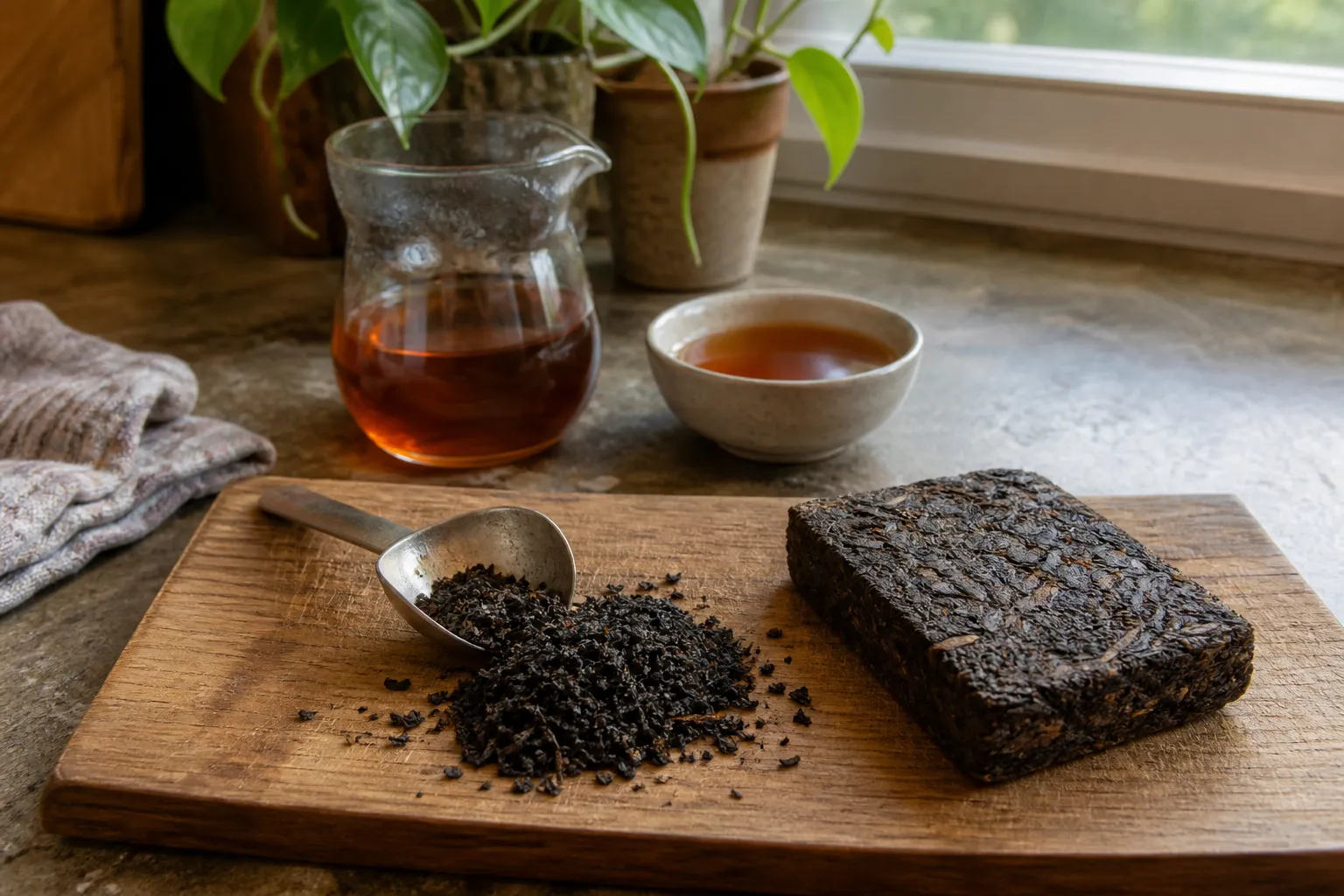
For most daily drinkers, loose leaf dark tea is the easier form to live with: it measures quickly, brews more evenly, and lets you adjust the next cup without first prying tea apart. A compressed dark tea brick makes more sense when shelf space matters, when you enjoy preparing tea by hand, or when the brick is loose enough to break into clean portions.
So the practical answer to loose leaf dark tea or compressed brick is simple: choose loose leaf for speed and easy adjustment; choose a brick for compact storage and a slower, more deliberate routine.
The form is not a grade. Loose tea is not automatically casual, and a brick is not automatically a better cup. Daily usefulness depends on compression, portioning, leaf breakage, storage, and how the tea responds when the liquor tastes thin, heavy, flat, sharp, or too earthy.
upward
Read the full overview first
Use the broader guide first if you need the full scope before this page.
Start with the part you handle every day: portioning
The biggest difference appears before the water touches the leaf.
Loose dark tea can be scooped, weighed, or measured by eye with little preparation. If you use the same mug, gaiwan, or teapot most days, it becomes easy to repeat a portion and then make small changes.
A compressed brick adds one step: you need to loosen a piece. That can be pleasant if you like the small ritual of handling tea, but it can feel like friction on a busy morning. The real question is not only “brick or loose leaf?” It is “how hard is this particular brick?”
A loosely compressed brick may flake apart with gentle pressure. A tightly pressed one may need a tea pick, careful hand placement, and patience. If you force the tool straight into the face of the brick, you can create splinters and fine tea dust. Working from an edge, corner, or visible layer usually gives more control.
If your routine looks like this
You brew before work and want no tool step.
Loose leaf
If your routine looks like this
You weigh the same amount most mornings.
Loose leaf
If your routine looks like this
You like preparing several portions ahead.
Compressed brick
If your routine looks like this
You have limited storage space.
Compressed brick
If your routine looks like this
You dislike fragments and fine dust in the pot.
Loose leaf, or a softer brick
If your routine looks like this
You enjoy handling the tea before brewing.
Compressed brick
If you already own a brick but want weekday brewing to feel easier, break off several small portions when you have time. Keep those pieces in a dry, odor-free container near the tea, and leave the rest of the brick intact. That gives you some of the convenience of loose leaf without turning the whole brick into crumbs.
Loose leaf adjusts faster; dense pieces need a little patience
Loose leaf usually gives faster feedback in the cup because the leaves are already separated. If the liquor tastes thin, you can add a little more leaf or lengthen the next infusion. If it becomes too heavy, rough, or dark for your taste, you can shorten the steep or reduce the amount.
Compressed tea can be just as enjoyable, but a dense piece may open unevenly. The outside of the chunk may release flavor before the inner layers have fully loosened. This is why an early infusion from a brick can seem quiet, while a later one suddenly becomes much stronger.
A useful starting point for many everyday dark tea sessions
- 4–5 g tea per 200 ml water
- freshly boiled water, unless that specific tea tastes too sharp
- a brief hot-water warm-up, about 7–10 seconds
- a first main infusion around 45–60 seconds
- later infusions adjusted as the leaves open
Use those numbers as a starting place, not a rule. Dark tea varies by origin, processing, age, storage, leaf size, and compression. A mug, a small lidded cup, and a large teapot will not behave the same way.
The warm-up step is especially helpful with compact pieces. It is not only about washing away dust; it can help pressed layers loosen before the first real pour. After that, watch the leaf. If the chunk still looks tight, give the next infusion slightly more time. If the liquor turns thick quickly, shorten the next steep.
For loose leaf, the adjustment is more direct. If the cup is weak, increase leaf or time. If it becomes rough, reduce steeping time before you reduce the tea amount. If it tastes flat, check whether the leaf has picked up damp air or kitchen odors before blaming the format.
A brick is convenient for storage first, brewing second
A compressed brick is convenient, but not in the same way loose leaf is convenient.
Compressed tea is compact, tidy, and easy to keep as one labeled piece. Historically, pressed tea forms also helped with transport and storage, which is one reason bricks, cakes, and other shapes remain familiar in dark tea culture.
Storage convenience
How neatly the tea fits on a shelf.
Brewing convenience
How quickly you can prepare a repeatable portion.
Compressed tea often wins the first. Loose leaf often wins the second.
If cabinet space is limited, a brick can hold a lot of tea in a small footprint. It may also be easier to track one compact block than several loose bags. Once opened, though, the same storage basics still matter: keep the tea away from kitchen steam, damp cupboards, strong odors, and direct light.
Loose tea takes more volume for the same weight and can be more exposed to air if the container is opened often. On the other hand, it does not need repeated prying, so the leaves may suffer less handling damage in daily use.
For many daily drinkers, the best answer is moderate rather than extreme. A very hard brick may look satisfying on the shelf but become annoying at the tea table. A loose tea may be easy to brew but messy if stored in a weak pouch. A moderately compressed brick, with a few pieces prepared ahead, can be practical. A well-kept loose dark tea in a dry tin or pouch can be just as useful.
Loose and tight compression can change the whole answer
Do not judge a compressed dark tea brick by the word “brick” alone. Compression varies widely.
A loose or moderately pressed brick may come apart in flakes or small chunks. It can give you intact pieces, some broken leaf, and a manageable amount of dust. This kind of brick can work well for daily dark tea brewing because it keeps the storage advantage without making every session feel like a project.
A tightly compressed brick is slower. It may need a sturdier tool and more careful pressure. If you pry too aggressively, the tea can break into splinters and dust. Fine dust is not always a problem, but it brews fast. Too much of it can make the liquor heavy, murky, or rough before the larger pieces have opened.
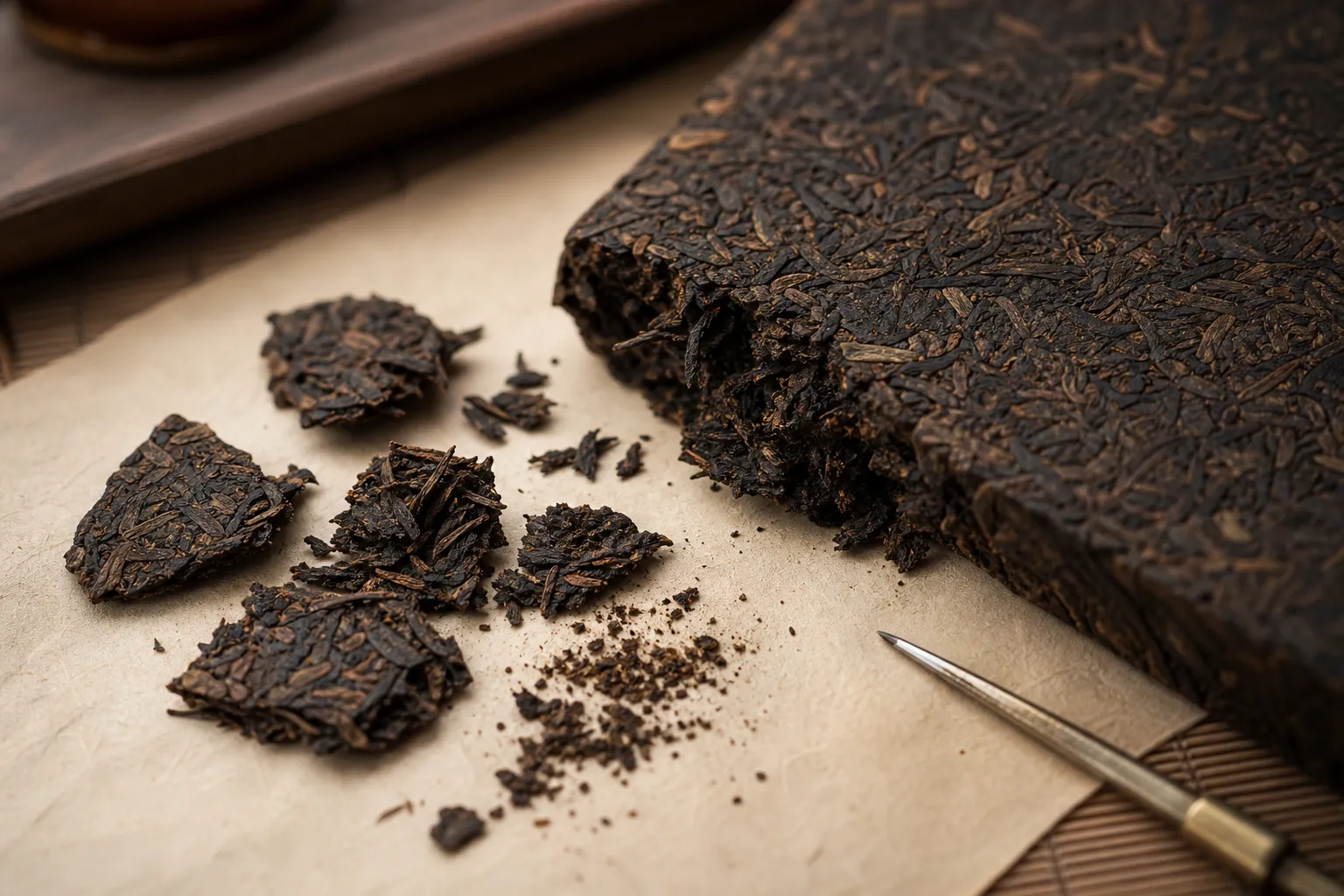
When breaking compressed tea brick portions, aim for control rather than force
- Work from an edge, corner, or visible layer.
- Insert the tool shallowly instead of driving it deep.
- Lift or wiggle gently to loosen a flake.
- Stop before the piece shatters into mostly powder.
- Save dust separately and brew it with shorter timing if you use it.
If one pot contains both large chunks and fine dust, expect uneven release. A brief warm-up can help, but the first main infusion may still need a careful pour and a shorter time than usual.
Let the cup tell you what to change
The better daily form is the one that lets you respond to the cup without fighting the tea.
If the cup tastes thin
- using a little more leaf
- lengthening the infusion
- warming up a compressed piece before the main steep
- giving dense chunks more time to open before judging the tea
If the cup tastes heavy or too earthy
- shortening the first infusion
- keeping excess dust out of the pot
- using a slightly smaller portion
- pouring fully between infusions so wet leaves do not keep stewing
If the cup tastes sharp or unexpectedly astringent
- reducing steep time
- checking whether the portion contains too many small broken bits
- looking at storage exposure, especially damp air or odor pickup
If the aroma is dull, sour, or unpleasantly musty, treat it as a caution cue rather than ordinary character. Some Fu brick teas are discussed with “Golden Flower” vocabulary, a golden-yellow fungal feature associated with certain production contexts. That does not mean every visible growth on stored tea is desirable. Unexpected fuzzy growth, damp sour odor, or an aroma that makes you hesitate should not be normalized as dark tea character.
This is where storage and format meet. A brick may be compact, but compactness will not protect the cup if it sits in a humid cupboard or beside cooking smells. Loose tea may be easy to brew, but an open pouch near steam or spices can lose clarity quickly.
Common confusion: form, tradition, and drinking quality are separate questions
Buying language around dark tea often blurs three things:
- Is the tea loose or compressed?
- Does the underlying material and processing suit your taste?
- Has the tea been stored in a way that preserves a pleasant aroma and cup?
Only the first question is about form.
Compressed tea can feel more traditional because many dark teas have long been sold as bricks, cakes, and other pressed shapes. Fu brick tea is one familiar example, and some Fu brick discussions include Golden Flower terminology. But that context should not become a rule that all compressed tea is better, all loose tea is less serious, or all golden-looking growth is a positive sign.
Research comparing Fu brick tea and Fu loose tea suggests that pressing can affect sensory and chemical profiles in that specific context. That is useful as a boundary: compression is not only packaging. Still, it should not be stretched into a universal verdict for every dark tea on a daily drinker’s shelf. Leaf material, processing, storage, brewing ratio, water temperature, and personal taste still decide the cup.
A simpler way to choose is to ask what problem you are solving
- For morning speed, choose loose leaf.
- For small-space storage, choose a brick.
- For repeatable strength while learning, loose leaf is easier.
- For keeping a larger supply compact, a brick makes sense.
- For less mess from prying, look for looser compression or prepare portions ahead.
- For a flat or off-smelling cup, check storage before blaming the form.
The simplest buying or brewing decision
Choose loose leaf dark tea for daily drinking if you want the lowest-friction routine: measure, brew, taste, adjust. It is especially friendly if you are still learning your preferred strength or want a repeatable cup without tools.
Choose a compressed dark tea brick if compact storage matters, if you enjoy handling the tea, or if you are willing to break portions in advance. It can be very practical when the compression is not too tight and the opened tea is kept dry and away from odors.
If you are undecided, choose the routine you will actually keep. A loose tea you brew calmly every day may serve you better than a beautiful hard brick you avoid opening. A compact brick portioned once a week may serve you better than loose tea that spills, dries unevenly, or takes over the shelf. The better daily form is the one that lets you make a cup, notice what changed, and adjust the next infusion without turning the decision into work.
Sources
Sources and further reading
Reference links are limited to sources considered suitable for public citation in this page.