
Guest brewing
How to Share a Dark Tea Brick Piece During a Guest Session
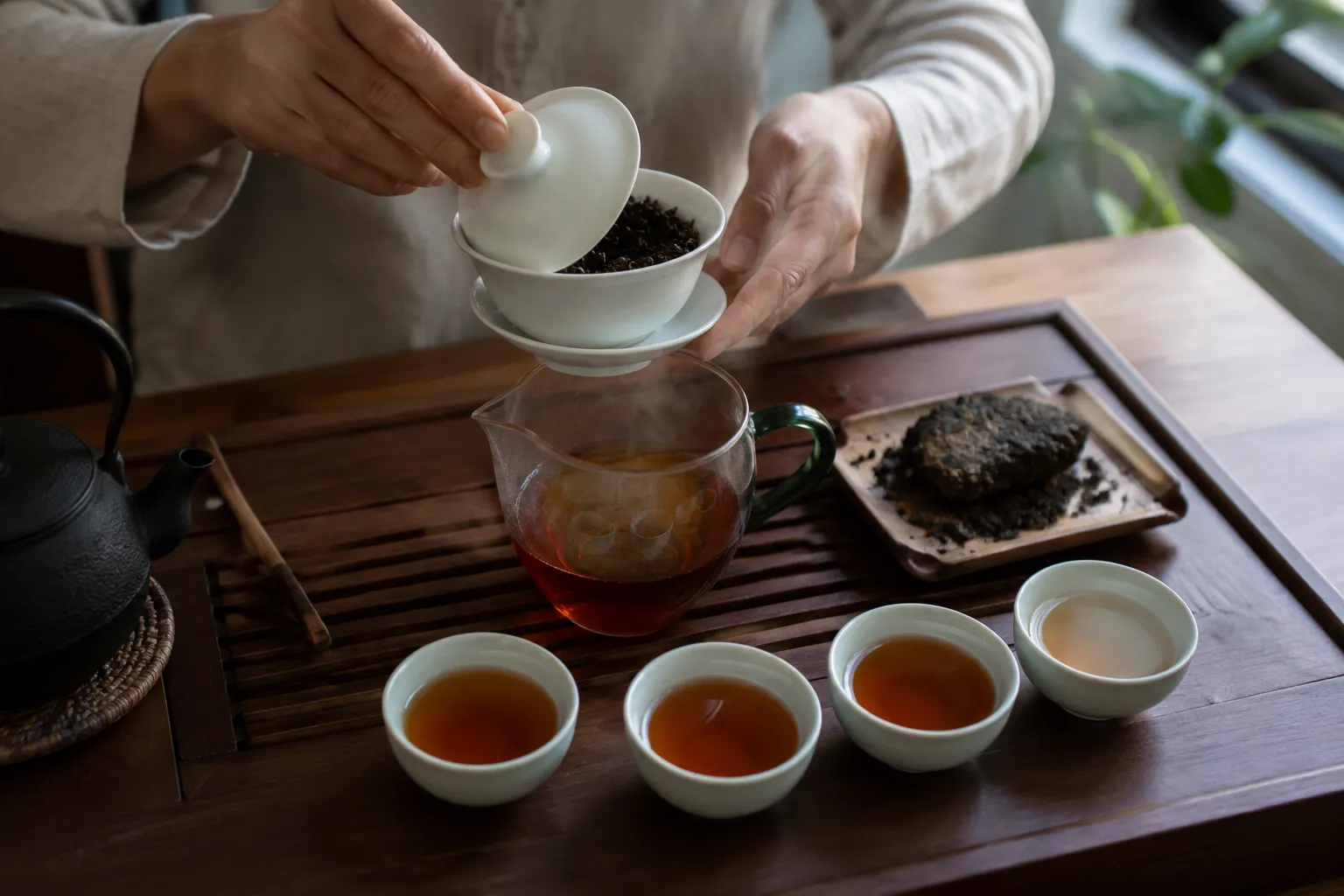
A compressed brick piece is usually not “shared” by handing each guest a dry shard. To share dark tea brick at the table, loosen a measured portion from the piece, brew it in a small vessel you can empty completely, pour the full infusion into a fairness pitcher, then divide the liquor evenly among the cups.
Start a little light if your guests are new to dark tea. Use a quick rinse only when the piece seems dusty, very tight, or storage-heavy. After that, let the cup guide you: liquor color, aroma, mouthfeel, and strength matter more than a fixed script.
The useful goal is simple: one brick piece, one controlled brew, even cups, and calm adjustments.
upward
Start with the broader guide
Use the broader guide first if you need the full scope before this page.
Set up for even pouring, not performance
For serving compressed dark tea, the best setup is the one that lets you control extraction and pour evenly. A small teapot, gaiwan, or lidded brewing cup works well because you can decant the liquor fully before the next steep. A fairness pitcher is helpful because it blends the infusion before anyone receives a cup; without it, the first cup may be lighter and the last cup may be stronger.
A practical guest tea session setup can be simple:
- A stable tray or table surface
- A small brewing vessel, often around 100–200 ml
- Small cups for guests
- A fairness pitcher or heat-safe serving pitcher
- A kettle with hot water
- A tea pick, tea knife, or thin tool if the brick piece is dense
- A small scale if you want repeatable portions
For many dark brick and Fu brick sessions, very hot water is a common starting point. Treat that as a beginning, not a rule for every tea. A clean, mellow piece may welcome hotter water; a sharp, dusty, or storage-heavy piece may need a shorter first drinkable steep.
If you like numbers, about 1 gram of tea for 20 ml of water is a strong small-vessel reference point often seen around dark brick and Fu brick brewing. For guests who are new to the style, start lighter than that, or keep the first infusion brief. Vessel size, compression, age, storage, and guest preference all change the cup.
Loosen the brick piece without making dust
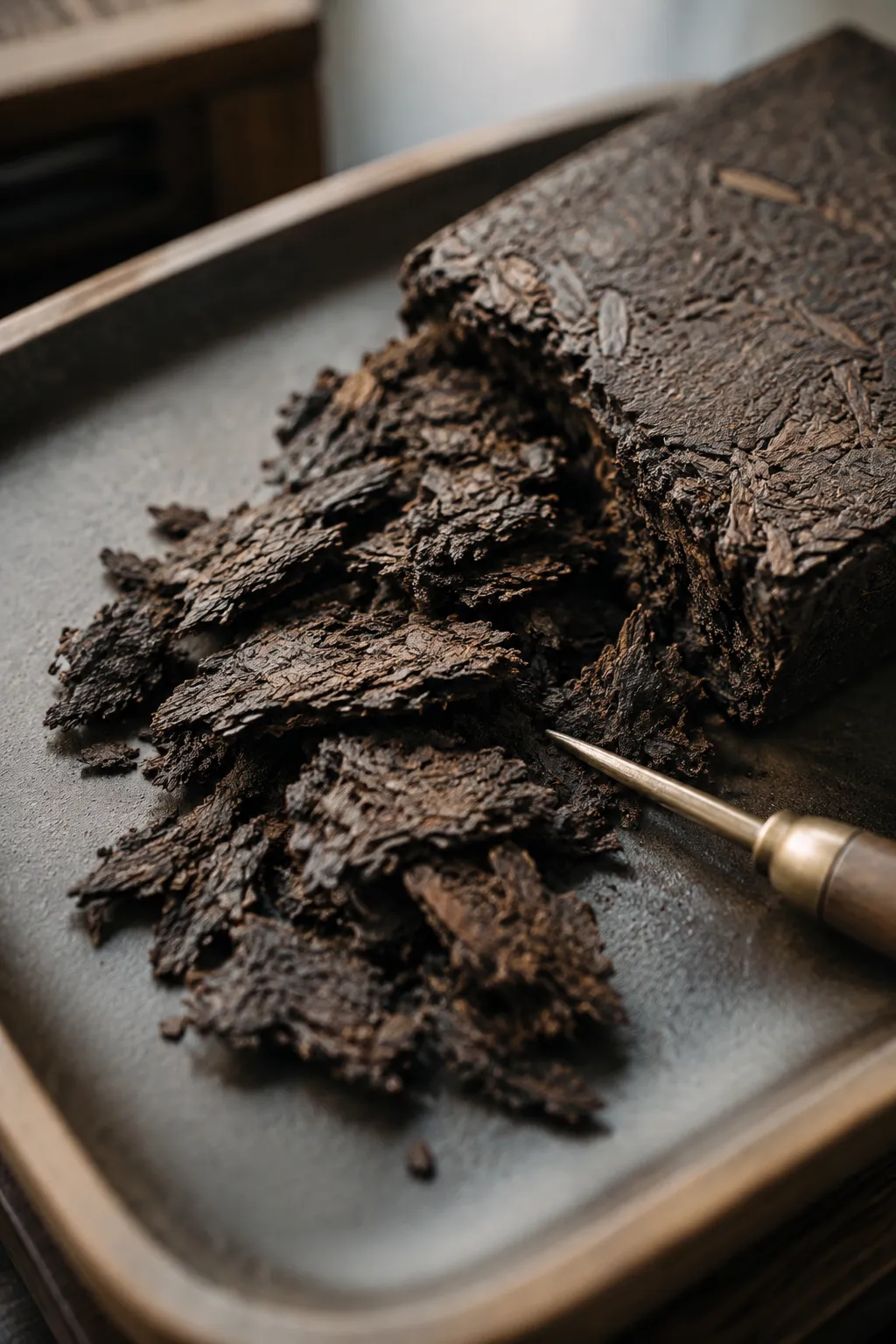
Portion the dark tea brick before water enters the vessel. If the piece is already a clean loose chunk, you may only need to separate it by hand. If it is dense, place it on a stable surface and look for an edge, seam, layer, or corner where the compression naturally gives you an entry point.
Use small, controlled pressure. Do not drive a tool straight through the middle of a hard piece. That is how tools slip, leaves shatter, and the host loses control before the kettle is even involved. Work along the layers if you can see them, lift a little, pause, and separate flakes or small chunks.
Some breakage is normal. Pulverizing the tea is not the goal.
For a casual table, the portion does not need to look perfect. A mix of small flakes and compact chips can brew well, but it will open unevenly. The flakes may release flavor quickly, while denser bits may wait until the second or third infusion. That is one reason to watch the first few cups instead of assuming the first steep tells the whole story.
If the piece feels stubborn, stop forcing it. Turn it, find another edge, or take a smaller amount from a looser corner. The practical boundary is simple: loosen the brick enough to measure and brew it, not enough to separate every leaf intact.
Portion the compressed tea brick for the table
The right portion depends less on the number of guests and more on the water volume, vessel, and style of service. With a small vessel and short steeps, the same tea can be infused several times and shared in small cups. With a larger pot, use less leaf per water volume, steep longer, and expect fewer rounds.
For a small guest session, begin with a portion that lets you control the first infusion. If you are unsure, start slightly light. It is easier to lengthen the next steep than to rescue a first round that tastes heavy, harsh, or muddy.
A scale helps if you want repeatability, but it is not required for a friendly table. What matters is that the portion fits the vessel and leaves room to adjust later infusions.
Rinse, steep, and pour the first round
A quick rinse is common in many compressed dark tea and small-vessel brewing contexts, but it is a choice. Rinse if the piece is dusty, very compact, or carrying a storage aroma you want to wake gently before serving. Skip or shorten the rinse if the piece is already loose, clean-smelling, and you want to keep the early aromatics.
A rinse should be brief: add hot water, cover the leaves, then pour it off promptly. Do not let the rinse become the first full brew unless you intend to serve it.
After the rinse, smell the warmed leaf. Look for practical signs: earthy, woody, sweet, stale, smoky, mineral, or flat. The aroma gives you a cue for the first drinkable infusion.
For the first infusion, compressed dark tea often behaves in one of two ways. If the piece is still closed, the cup may be light, thin, or quiet. If the portion has many flakes, the liquor may darken quickly. Start with a short steep, especially in a small vessel. Pour everything into the fairness pitcher, then divide the liquor among guests.
Avoid pouring directly cup by cup from the brewing vessel unless you can keep the strength even. Tea continues extracting while you pour, so the last cup can receive a stronger concentration. To pour tea evenly for guests, decant the whole infusion first, then serve from the pitcher.
Adjust later infusions from the cup
The host’s real work begins after the first round. A compressed brick piece can open gradually; the second infusion may be fuller than the first, and the third may become stronger if dense inner chunks finally loosen. Later, once the leaf has given up much of its strength, the same tea may need longer steeps.
Use the cup, not a fixed script.
- If the cup is thin: lengthen the next steep, use hotter water, or give the dense chunks another round to open. Thinness in the first cup does not always mean the portion is too small.
- If the cup is too strong: shorten the next steep, pour faster, or add a little hot water to the pitcher before serving.
- If it tastes heavy or muddy: reduce steep time and make sure you are decanting fully between rounds. Liquor left sitting on the leaf can thicken the next cup.
- If it is harsh: lighten the next infusion. Shorter contact time often helps more than changing the whole setup.
- If it feels flat: extend the steep slightly, use fresh hot water, or accept that the portion may be fading.
- If the earthy note feels too much for guests: serve smaller pours and keep the next infusion shorter. Dark tea varies widely by type, storage, and compression.
Small cups help because each infusion becomes a small reading of the brick piece. You are not asking every guest to commit to a large mug before you know how the tea is opening.
Common confusion when sharing a dark tea brick
Should each guest get a piece of the brick?
Usually, no. In a guest session, the host shares the brewed liquor. Giving each guest a dry shard makes the brewing uneven unless each person has a vessel and knows how to handle compressed tea. If the goal is a shared table, brew one portion and divide the infusion.
Is there one correct dark tea brick brewing ratio?
No. Some brewing notes give confident numbers, and stronger small-vessel ratios are common around compressed dark tea. Use those as starting points, not final standards. A hard brick piece, a loose broken piece, a Fu brick, and a long-stored brick can behave differently in the cup.
Do visible specks in Fu brick mean I should change the session?
If your piece is Fu brick or Fu Zhuan, visible internal features may be part of what drinkers notice first. This page cannot judge storage condition or quality from appearance alone. For hosting, stay with what you can observe at the table: aroma, liquor clarity, taste, mouthfeel, and whether the tea seems pleasant enough to serve.
The practical boundary
Public material on exact dark tea brick guest-service rules is limited. Much of the available instruction comes from vendor brewing pages, compressed pu-erh analogies, enthusiast discussions, and general small-vessel tea demonstrations. That is enough to support a cautious table method, but not enough to turn one ratio or rinse habit into a rule for every brick.
So keep the session practical. Portion the compressed tea brick gently, brew in a vessel you can empty completely, use a fairness pitcher for tea guests, and adjust the next infusion from what the cup actually shows. If the first round is quiet, give the piece time to open. If the second round becomes too strong, shorten the steep. The next useful decision is already in the pitcher.
Sources
Sources and further reading
Reference links are limited to sources considered suitable for public citation in this page.