
Brewing note
Does Ripe Pu-erh Need a Different Rinse Than Other Dark Teas
Usually, yes—but only a little. In many everyday brewing setups, ripe Pu-erh benefits from a more deliberate first rinse than some other dark teas because shu Pu-erh is pile-fermented, often compressed, and can release a dense earthy or storage-heavy opening as soon as hot water reaches the leaf.
The practical answer to rinse ripe pu-erh vs dark tea is not “two rinses every time.” A better starting point is this: give most ripe Pu-erh one very quick rinse, then consider a second flash rinse only if the tea is tightly compressed, dusty-smelling, very earthy, storage-heavy, or pours especially dark and murky on contact.
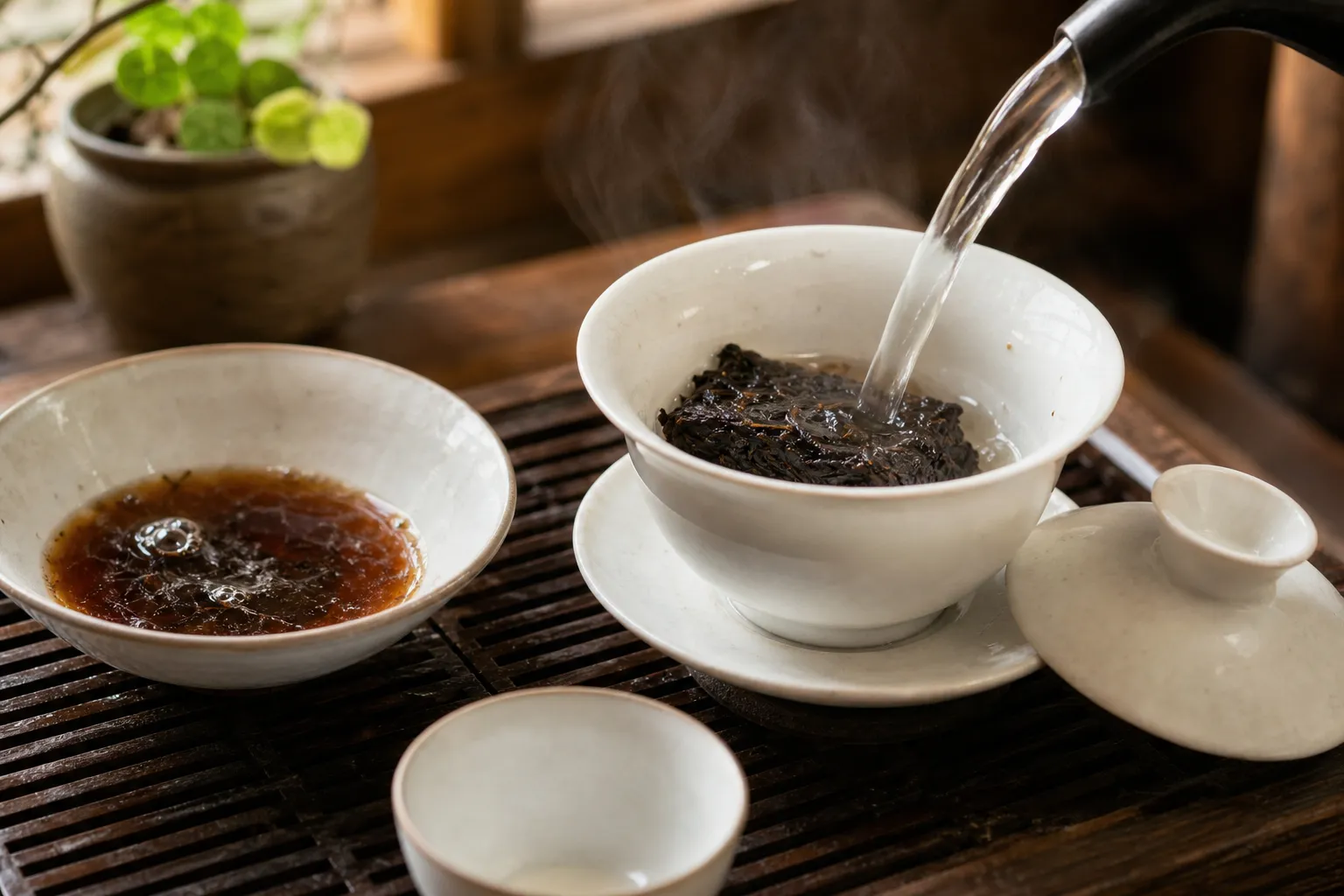
The rinse is not the first drinkable infusion. It is a brief discarded pour used to warm the vessel, loosen the leaf, and check how the tea is opening before you brew the cup you actually taste.
upward
Start with the broader guide
Use the broader guide first if you need the full scope before this page.
A simple starting rule for ripe Pu-erh
For a piece of ripe Pu-erh cake, brick, tuo, or loose shu, start here:
Loose, clean-smelling ripe Pu-erh
First rinse to try: One flash rinse.
When to adjust: Skip a second rinse unless the first drinkable cup tastes muddy or heavy.
Broken piece from a cake or brick
First rinse to try: One quick rinse.
When to adjust: Add a second flash rinse if the chunk stays tight or the first pour is very dark.
Tightly compressed tuo or brick
First rinse to try: One rinse, then check the leaf.
When to adjust: A second flash rinse can help open the center before the first drinking steep.
Storage-heavy ripe Pu-erh
First rinse to try: One rinse, then smell the wet leaf.
When to adjust: Use a second flash rinse if the aroma remains dusty, pondy, or closed.
Cleaner, looser dark tea that is not ripe Pu-erh
First rinse to try: Short rinse or no rinse.
When to adjust: If the first drinkable cup tastes thin after rinsing, the rinse may be unnecessary.
In gongfu brewing, the rinse for ripe Pu-erh is often only a few seconds: hot water in, brief contact, then pour out. The next infusion may also be short, especially in a small gaiwan or teapot with a generous leaf amount.
In a mug or larger teapot, the same idea applies, but the rhythm changes. The rinse should still be brief. The first drinkable infusion will usually be much longer than a gongfu steep because the vessel is larger and the leaf-to-water ratio is lower.
Why ripe Pu-erh often gets different treatment
Ripe Pu-erh is part of the post-fermented tea family, and its familiar shu character comes from pile fermentation, often called wo dui in Pu-erh discussions. Tea research describes ripe Pu-erh as a microbial post-fermented tea made from Yunnan sun-dried large-leaf material, with processing and storage contributing to its darker liquor, mellow profile, and changed composition compared with raw material or raw Pu-erh.
That background does not create a fixed rinse rule. It simply helps explain why the first hot-water contact can feel different in the cup.
With ripe Pu-erh, the first pour may bring several things at once:
- loose dust or crumbs from compression and breaking;
- a concentrated earthy aroma from the surface of the leaf mass;
- a storage note that is more obvious before the leaves open;
- a very dark early release from small broken particles;
- uneven extraction if the chunk is still tight in the middle.
A quick rinse can soften that first heavy edge and help the next infusion taste more like the tea itself rather than the outside of the compressed piece. That is why shu Pu-erh is often rinsed even when some other teas are brewed directly.
The important word is “can.” A clean, loose, well-aired ripe Pu-erh may need only one very short rinse. A delicate or broken-leaf dark tea may lose too much early sweetness if rinsed too long. A heavily compressed ripe Pu-erh may need the rinse mostly to open the leaf, not because the tea is unfit to brew.
How to choose one rinse or two
Use the first rinse as a quick diagnostic step. After pouring it out, look at the leaf and smell the wet material before brewing the first drinkable infusion.
Use one quick rinse when
One quick rinse is usually enough when:
- the dry leaf smells clean, woody, sweet, date-like, or gently earthy;
- the piece separates easily after hot water touches it;
- the rinse liquor is dark but clear rather than cloudy with fine crumbs;
- the wet leaf smells open rather than stale or pondy;
- you want to preserve body in the first drinkable cup.
For many ripe Pu-erh sessions, this is the best balance. You warm the vessel, loosen the leaf, discard the first burst, and move straight into brewing.
If using a gaiwan, pour the rinse quickly. Do not let it sit like a full steep. With a compressed piece, it is fine if the water takes a moment to pass through the leaves, but the intention is still a flash rinse.
Consider a second flash rinse when
A second rinse can be useful when the tea is telling you it is not ready yet:
- the cake, brick, or tuo remains tightly locked after the first pour;
- the rinse water looks very dark and murky from crumbs;
- the wet leaf gives a dusty, basement-like, pondy, or storage-heavy aroma;
- the first rinse smells much sharper or heavier than the dry leaf;
- the tea has a thick surface note you do not want in the first cup.
Keep the second rinse even shorter than the first if the leaf has already started to open. The goal is not to wash away flavor. The goal is to move past the heavy opening edge.
After the second flash rinse, make the next infusion drinkable but controlled. In gongfu style, that may mean a short early steep. In a larger pot, it may mean a normal longer steep, but not an unattended soak.
Skip or shorten the rinse when
A rinse may be too much when:
- the tea is loose and opens quickly;
- the aroma is clean and mild;
- the first drinkable infusion after rinsing tastes flat, thin, or hollow;
- the tea is a small broken grade that releases flavor immediately;
- you are brewing with a low leaf amount in a large mug.
This is especially relevant when comparing ripe Pu-erh with other dark teas. Some dark teas are compressed and storage-rich; others are loose, lighter in the first pour, or brewed in a way where the first infusion is part of the intended cup. The category alone is not enough. Leaf form and sensory cues matter more.
Rinse timing in gongfu and larger-pot brewing
A common mistake is mixing gongfu rinse language with Western-style steeping time.
In gongfu brewing, the vessel is small, the leaf amount is relatively high, and the early infusions are short. A gongfu rinse Pu-erh routine might look like this:
- Place the ripe Pu-erh in a warmed gaiwan or small teapot.
- Add hot water.
- Pour out after only a few seconds.
- Smell the wet leaf and check whether the chunk has started to open.
- Brew the first drinkable infusion briefly, then lengthen later infusions as the leaf settles.
In a larger teapot or mug, the drinkable infusion may be several minutes. If you choose to rinse, keep the rinse short anyway. Do not turn the rinse into a one-minute steep and then wonder why the first cup tastes weak. The rinse is a preparation pour, not a full extraction.
This matters for compressed Pu-erh rinse decisions. A tight chunk may need hot water contact to loosen, but if you hold that water too long, you may remove some of the early body you wanted in the cup. If the next infusion tastes washed out, shorten the rinse next time or use only one rinse.
Let the first drinkable infusion judge the rinse
The best check is not the rinse water by itself. It is the first drinkable infusion after the rinse.
If that cup tastes clear, rounded, and recognizably like ripe Pu-erh—earthy, woody, mellow, sweet, or thick depending on the tea—your rinse choice probably worked.
If it tastes dusty, stale, muddy, or overly heavy, the tea may have needed a second flash rinse, a shorter first drinking steep, or a little more time for the chunk to open before judging it.
If it tastes thin, watery, or strangely emptied out, the rinse may have been too long or unnecessary in that brewing setup. This can happen with loose shu, small broken pieces, or lighter dark teas where the first release is part of the tea’s body.
If it tastes harsh or flat at the same time, do not blame only the rinse. Leaf amount, water temperature, compression, storage condition, and steep length all affect the cup. Extraction research broadly supports what brewers notice in practice: time, temperature, and tea-to-water ratio change what moves into the infusion. For this question, that simply means the rinse is one variable, not a magic correction.
Common confusion about rinsing fermented tea
The biggest misunderstanding is treating rinsing as a cleanliness rule. A quick rinse can clear loose dust or crumbs from some compressed or stored teas, but it should not be framed as solving hidden storage or quality problems. If a tea has visible spoilage or an aroma that remains clearly wrong after ordinary airing and careful brewing, that is outside a rinse-adjustment problem.
Another confusion is assuming that all post-fermented tea rinse practices are the same. Ripe Pu-erh often gets extra attention because of pile fermentation, compression, and its dense first aromatic release. Other dark teas may share some of those features, but they do not automatically need the same rinse count. A compressed dark tea with a heavy storage note may behave more like ripe Pu-erh. A loose, clean-smelling dark tea may not.
A third confusion is calling the discarded rinse the “first infusion.” For clarity, separate the terms:
Rinse
A very brief pour that is discarded.
First drinkable infusion
The first cup you evaluate for flavor.
Second rinse
Another flash pour only when the leaf condition calls for it.
That distinction prevents over-steeping the rinse and under-brewing the real cup.
Practical takeaway
If you are holding ripe Pu-erh and want a reliable first move:
- Use one quick rinse for most ripe Pu-erh.
- Make it a flash pour, not a full steep.
- Smell the wet leaf before deciding on a second rinse.
- Add a second flash rinse only for tight compression, heavy storage aroma, murky first pour, or an overly dense earthy opening.
- Judge the choice by the first drinkable infusion.
- For other dark teas, let compression, aroma, and cup strength decide rather than copying the ripe Pu-erh habit automatically.
So, does ripe Pu-erh need a different rinse than other dark teas? Often, yes: it commonly deserves a slightly more attentive rinse. But the best version is still modest—short, sensory-led, and easy to adjust once the first real cup tells you what the leaf needed.
Sources
Sources and further reading
Reference links are limited to sources considered suitable for public citation in this page.