
Pu-erh label reading
How to Read Raw and Ripe Markings on Pu-erh Labels
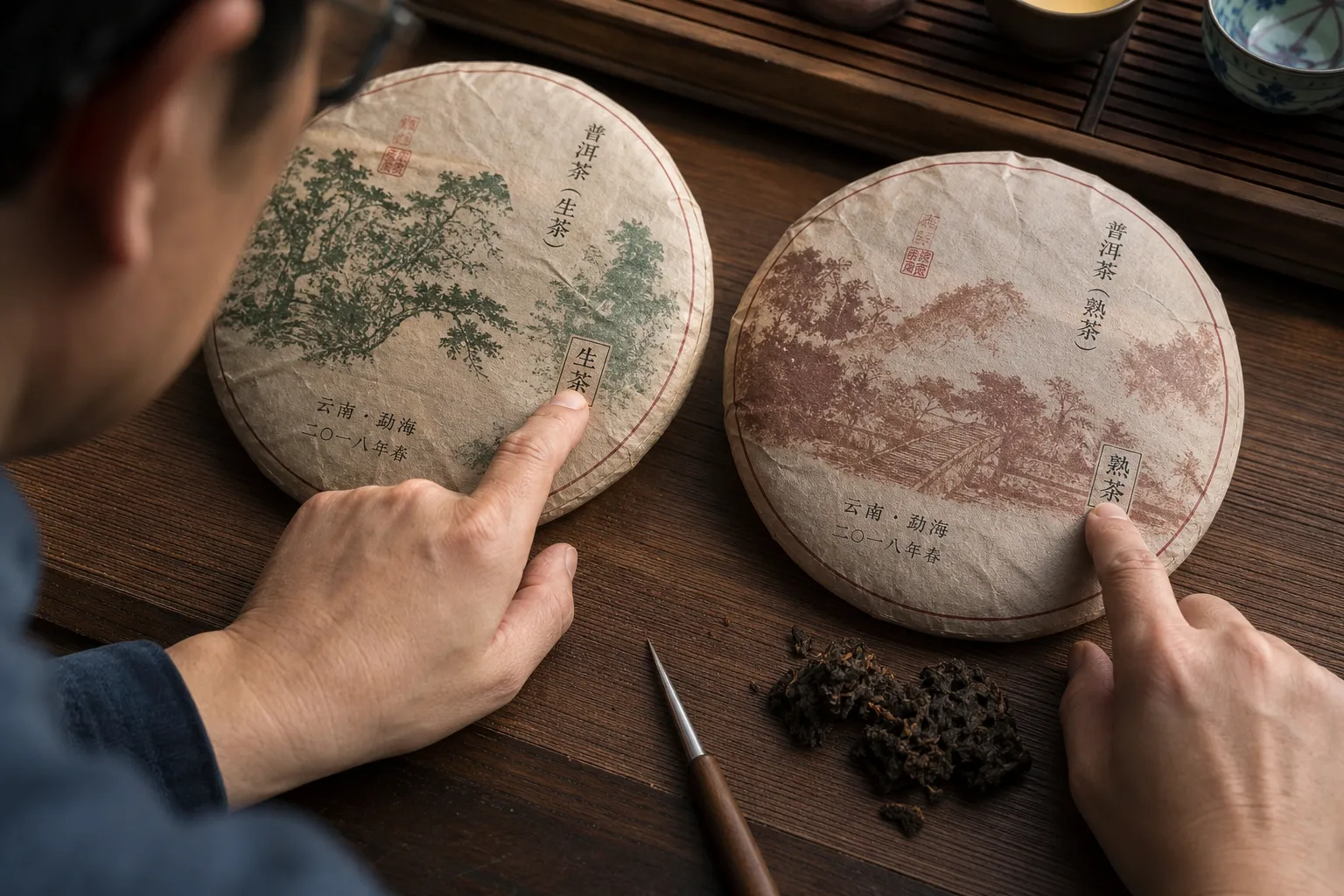
To read a raw ripe pu-erh label, start with the type words before you study the artwork, mountain name, or date. Raw Pu-erh is commonly marked Raw, Sheng, Shēng, or 生茶. Ripe Pu-erh is commonly marked Ripe, Shu, Shou, Shú, Shóu, or 熟茶.
If the wrapper has Chinese text and little English, the two characters to remember are simple: 生茶 usually points to raw/sheng Pu-erh, while 熟茶 usually points to ripe/shu Pu-erh.
After that, sanity-check the label against what you can see and brew: production date, factory or brand name, batch or recipe code, dry-leaf color, liquor color, and broad aroma direction. None of those details identifies everything on its own, but together they help you avoid two common mistakes: reading an aged raw cake as ripe only because it looks dark, or trusting a market-heavy label that never clearly says the tea type.
upward
Start with the broader guide
Use the broader guide first if you need the full scope before this page.
Find 生茶 or 熟茶 first
Pu-erh wrappers and product pages may use English, pinyin, Chinese characters, or a mixture of all three.
Raw markers
- Raw usually means Raw Pu-erh, commonly read as Sheng.
- Sheng / Shēng usually means Raw Pu-erh, commonly read as Sheng Pu-erh.
- 生茶 usually means Raw Pu-erh, literally “raw tea.”
Ripe markers
- Ripe usually means Ripe Pu-erh, commonly read as Shu or Shou.
- Shu / Shú usually means Ripe Pu-erh, commonly read as Shu Pu-erh.
- Shou / Shóu usually means Ripe Pu-erh, commonly read as Shou Pu-erh.
- 熟茶 usually means Ripe Pu-erh, literally “ripe tea.”
The practical shortcut is this: 生 points toward sheng/raw, and 熟 points toward shu or shou/ripe. The second character, 茶, means tea. So when you are comparing 生茶 versus 熟茶, you are usually comparing raw Pu-erh versus ripe Pu-erh.
The spelling varies because Chinese terms are being represented in Roman letters. Some sellers write shu, others write shou. In English-facing Pu-erh talk, both are commonly used for ripe Pu-erh. If the label includes 熟茶, let that carry more weight than the spelling variation.
A wrapper that only says “Pu-erh tea” or “Yunnan tea cake” has not answered the raw-versus-ripe question yet. Keep looking for the type word before leaning on age, origin, or wrapper style.
Use the nearby label fields as context, not as the answer
Once you find the sheng or shu term, read the surrounding information. It can help you understand the tea, but it should not replace the raw/ripe marker.
Common label-adjacent fields include:
Production date
The year or full date associated with production, pressing, or packaging, depending on how the seller presents it.
Factory or brand name
The producer, brand, or tea company.
Batch or recipe code
A number or code used by some factories or sellers.
Cake weight
Often listed in grams for cakes, bricks, or tuo forms.
Region or mountain name
A place name used to describe origin, style, or market identity.
Storage or age wording
Terms such as aged, vintage, old, or years-stored.
Tree-age language
Phrases such as old tree or ancient tree.
A famous place name does not tell you whether the tea is sheng or shu. A date does not tell you whether the tea is naturally aged raw tea or pile-fermented ripe tea. A decorative wrapper does not settle the category.
This matters because raw and ripe Pu-erh are made on different paths. Raw Pu-erh is generally understood as a tea that can change through storage over time. Ripe Pu-erh uses a pile-fermentation step to create a darker, more matured profile sooner. That processing difference is why the label category matters before you judge flavor notes, age language, or price.
If a product page says “aged Pu-erh” but never says raw, ripe, sheng, shu, shou, 生茶, or 熟茶, ask for clarification. “Aged” is not a tea type.
Check the wrapper against the leaf and liquor
A wrapper can be vague, mistranslated, or incomplete. After reading the pu-erh tea label terms, use the tea itself as a practical cross-check. This is not a lab-style identification method; it is a way to see whether the label and the tea point in the same general direction.
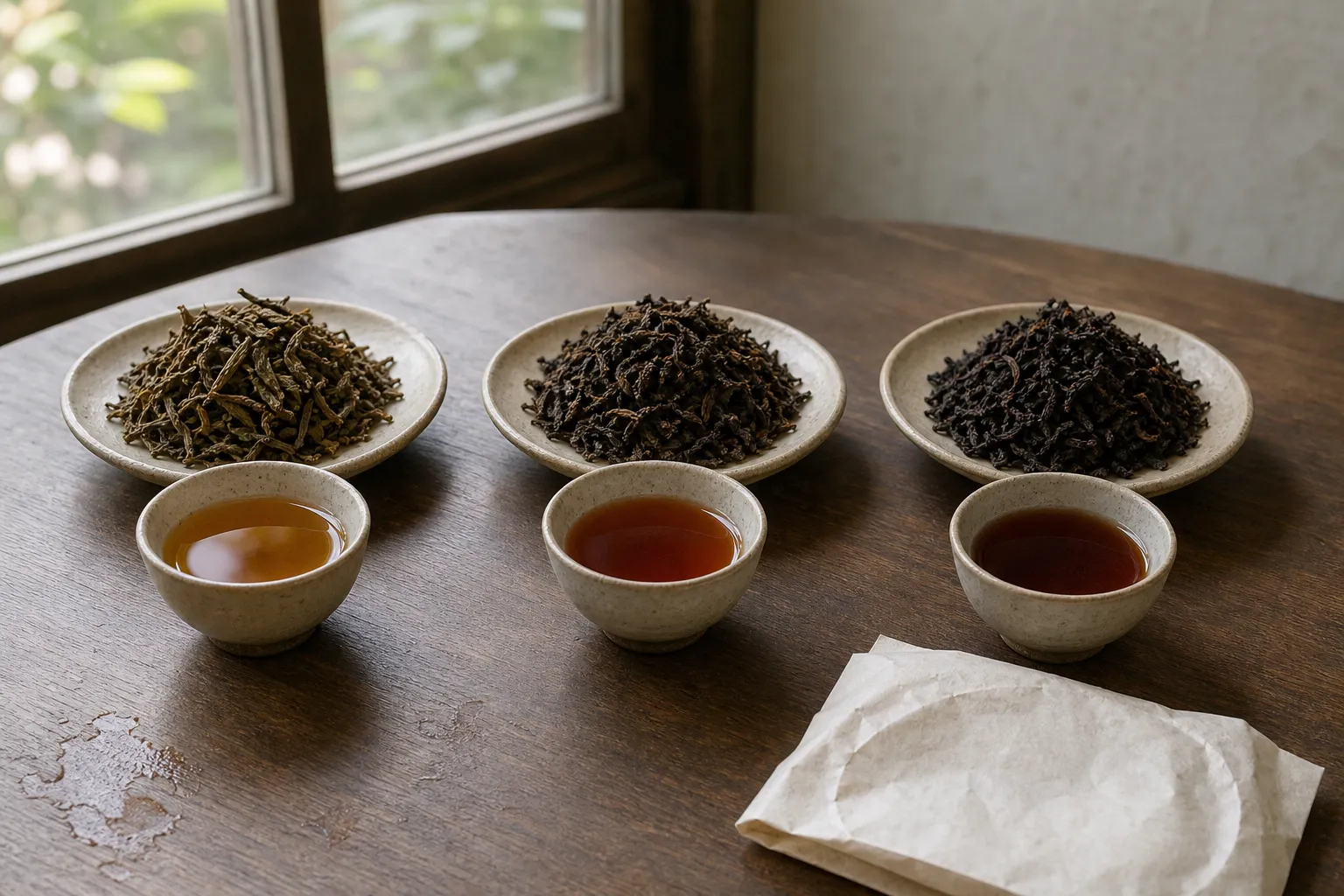
Dry-leaf color
Young sheng Pu-erh often has a greener or more mixed look: olive, dark green, yellow-green, brown-green, and sometimes pale tips. The cake may look lively and uneven in tone, especially when it has not been heavily aged.
Shu Pu-erh often looks darker from the start: dark brown, chestnut brown, or nearly black, with a more uniformly dark compressed surface. Loose ripe Pu-erh can also look dark and heavy compared with young raw tea.
The main catch is aged raw Pu-erh. A well-aged sheng cake may no longer look green. If a dark cake is labeled raw, do not dismiss that reading only because the leaf is brown. Check the Chinese characters, the date, the liquor, and the seller’s description together.
Liquor color
Young raw Pu-erh often brews pale yellow, yellow-gold, or light golden. With age and storage, raw Pu-erh may deepen toward orange, amber, or reddish amber.
Ripe Pu-erh often brews deeper red-brown, dark reddish brown, or nearly opaque in stronger infusions. The cup usually darkens quickly, especially with more leaf or a longer steep.
Liquor color is a clue, not the final decision. A strong steep of aged raw tea can look dark. A light steep of ripe tea can look clearer than expected. Use the cup to support the wrapper reading, not to override every other clue.
Aroma and taste words
Tasting language can add context when the label or seller notes include it. Young sheng is often described with brighter, greener, brisker, more bitter, or more astringent language. Depending on material and storage, raw teas may also be floral, grassy, mineral, fruity, or sweet.
Shu is often described with darker and rounder language: earthy, woody, mellow, smooth, deep, dark, cocoa-like, coffee-like, or caramel-like. Not every ripe Pu-erh fits those words, and poor storage can bring unpleasant aromas that should not be treated as normal ripe character.
For label reading, the useful question is not “is this tea good?” but “does the type word match the general leaf, liquor, and aroma direction?”
A quick wrapper-reading sequence
Use this order when you are holding a cake, brick, tuo, sample bag, or reading an online listing:
- Find the type marker. Look for Raw, Sheng, 生茶, Ripe, Shu, Shou, or 熟茶.
- Check the Chinese characters if English is unclear. 生茶 is the main sheng Pu-erh label clue; 熟茶 is the main shu Pu-erh label clue.
- Read the date. Note it, but do not treat date as category, storage condition, or drinking quality.
- Note factory, brand, batch, or recipe code. These may help identify the tea, especially in factory-style Pu-erh, but they are not the raw/ripe answer.
- Slow down around market-heavy words. Aged, vintage, famous mountain, ancient tree, old tree, and named regions can matter in some contexts, but they are not type markers.
- Cross-check with dry leaf and liquor. Young sheng often looks and brews lighter; shu often looks and brews darker; aged sheng is the main exception.
- Ask for clarification if the type remains unclear. A clear answer should state raw/sheng or ripe/shu, not only “old Pu-erh” or “premium Yunnan cake.”
This sequence keeps the task narrow. You are not trying to authenticate the whole tea from the wrapper. You are trying to identify the raw sheng ripe shu category and catch obvious mismatches.
Common label confusion
“Shu” and “shou” are usually not two separate tea types
For English readers, shu Pu-erh and shou Pu-erh are usually two spellings used around ripe Pu-erh. The character 熟茶 is the cleaner clue when it appears. If a seller writes “shou puerh” and the Chinese says 熟茶, read it as ripe Pu-erh.
Dark does not always mean ripe
This is the easiest visual trap. Young raw Pu-erh and ripe Pu-erh can be simple to separate by color, but aged raw Pu-erh can become darker in both leaf and liquor. Research comparing aged raw and ripened Pu-erh also suggests that older raw teas and ripe teas can be harder to separate by simple appearance than young raw versus ripe examples. That is why one color cue should not carry the whole decision.
Old date does not mean raw
A production date can tell you when a tea was produced, pressed, or packaged, depending on the label. It does not automatically tell you whether the tea is sheng or shu. Ripe Pu-erh can also be stored over time, and raw Pu-erh can be sold young. Always return to the type marker.
Famous origin words are not raw/ripe markers
Names such as Lao Banzhang, Bingdao, Yiwu, Jingmai, Xigui, Xishuangbanna, Lincang, or Pu’er City may appear in Pu-erh market language. They may describe origin, style, or prestige. They do not, by themselves, answer the sheng Pu-erh vs shu label question.
“Ancient tree” wording does not identify the category
Old-tree and ancient-tree terms are common in Pu-erh selling language. They may shape how a tea is marketed, but they do not tell you whether the tea is raw or ripe. First find 生茶 or 熟茶; then decide how much weight to give the rest of the description.
What the label can and cannot tell you
A clear raw/ripe marking helps you set a better expectation for the tea. If the wrapper says 生茶, the tea is being presented as raw Pu-erh: often brighter when young, more variable with storage, and sometimes deeper after age. If it says 熟茶, the tea is being presented as ripe Pu-erh: usually darker from processing, often deeper in liquor, and commonly described with rounder dark-tea notes.
The label cannot settle every question a buyer might care about. It cannot, by itself, establish storage history, age accuracy, famous-origin claims, tree-age claims, or overall drinking quality. Research on Pu-erh classification and authentication uses analytical methods because wrappers, visible cues, and market descriptions all have limits. For everyday buying, that does not mean you need a lab result; it means the wrapper is one layer of evidence.
The practical reading is:
- 生茶 / Sheng / Raw means the tea is being presented as raw Pu-erh.
- 熟茶 / Shu / Shou / Ripe means the tea is being presented as ripe Pu-erh.
- Date, factory, batch, and origin describe the tea but do not replace the type marker.
- Leaf and liquor help you catch mismatches, especially when the wrapper is unclear.
- Prestige language deserves a slower read, especially on expensive cakes.
If you remember only one thing, remember the characters: 生茶 for raw/sheng, 熟茶 for ripe/shu. Then let the dry leaf, liquor color, and surrounding label details either support that reading or tell you to ask one more question before buying or brewing.
Sources
Sources and further reading
Reference links are limited to sources considered suitable for public citation in this page.