
Controlled side-by-side brewing
How to Brew Ripe Pu-erh Beside Another Dark Tea for a Fair Comparison
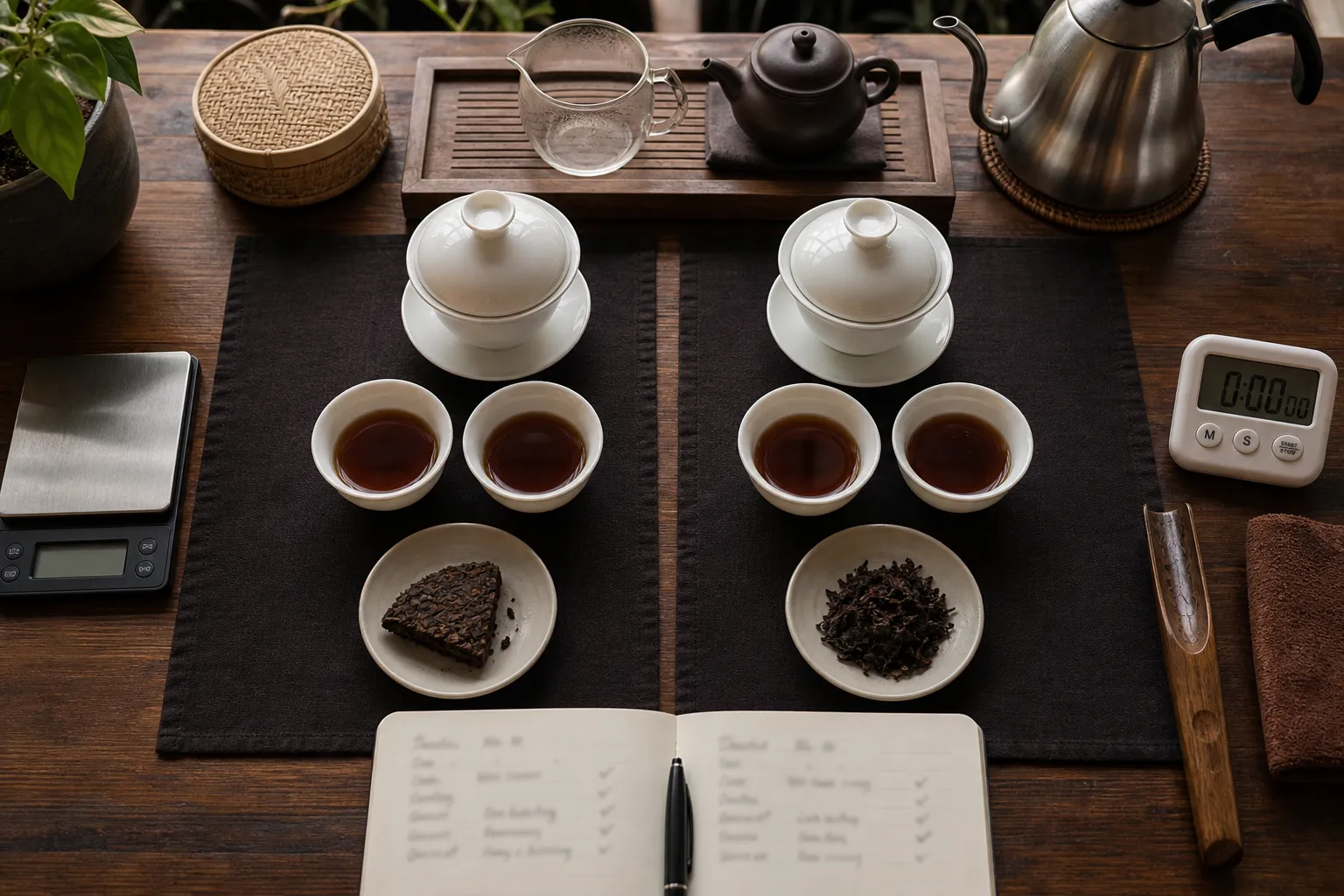
To brew a ripe Pu-erh comparison fairly, make the first round as controlled as you can: same water, same temperature, similar vessels, matching leaf weight, matching water volume, the same rinse decision, and the same first steep time. Then compare aroma, liquor color, body, sweetness, earthiness, storage notes, and aftertaste before changing the brew.
A side by side tea tasting is not meant to prove that ripe Pu-erh is above or below another dark tea. It is a way to see what each tea does under shared conditions. Once you have a baseline, you can adjust steep timing, leaf amount, or rinse choices and see how each tea responds.
upward
Start with the broader guide
Use the broader guide first if you need the full scope before this page.
Set up the comparison before the kettle boils
Choose two teas that can reasonably sit beside each other. One is ripe Pu-erh, often called shu Pu-erh or shou Pu-erh in English-language tea writing. The other can be Liu Bao, Fu brick, Qing brick, or another post-fermented dark tea. Liu Bao is a useful example, but the method should not depend on that one category.
Before brewing, look at the leaves as physical material, not just as names on labels. Note:
Form
Loose leaf, cake, brick, tuo, or broken fragments.
Compression
Tightly compressed tea often opens more slowly.
Leaf size
Small, dusty, or broken leaf can extract faster.
Dry aroma
Wood, earth, grain, fruit, storage, camphor-like notes, or flatness.
Leaf color
Useful to observe, but not a verdict by itself.
Age and storage clues
Record them if known, but let the cup confirm what matters.
This step matters because equal category names do not create equal extraction. A loose dark tea and a dense piece of ripe Pu-erh cake can behave very differently at the same weight. A broken ripe Pu-erh sample may brew thick and dark quickly, while a compact cake chunk may need a round or two to loosen.
Research on dark teas supports the broader point that processing, fermentation, raw material, and storage can influence aroma, taste, liquor color, and mouthfeel. That does not create one required home brewing ratio or steep time. For this kind of tasting, the useful lesson is simpler: control what you can, then write down what you actually observe.
Keep the first brewing variables equal
For a fair tea brewing comparison, do not give one tea an advantage through hotter water, a larger vessel, a longer steep, or a warmer cup.
| Variable | Keep it equal at first | Why it matters |
|---|---|---|
| Leaf weight | Same grams for both teas | Reduces one obvious bias |
| Water volume | Same volume in each vessel | Controls thickness and extraction |
| Vessel type | Similar size and material | Heat retention changes the brew |
| Water | Same kettle and water source | Water affects aroma, body, and clarity |
| Temperature | Same temperature for both | Extraction speed changes with heat |
| Rinse rule | Same rule unless noted | Rinsing changes the first drinkable cup |
| First steep time | Same time for both | Creates a comparable opening round |
| Cup shape | Same or similar cups | Aroma and heat loss affect perception |
For a gongfu-style tasting, a workable starting point is about 5 g of each tea in 100 ml vessels, adjusted proportionally for your teaware. Use freshly boiled or near-boiling water if that is your normal dark tea habit. The exact number matters less than keeping the ratio and temperature matched.
For a larger-cup comparison, use a lighter ratio and longer steep, again matching both sides. The same principle holds: equal leaf-to-water ratio, equal time, equal vessel conditions.
Pre-warm both vessels and cups. If you only have one suitable vessel, brew the teas sequentially rather than literally side by side. Repeat the timing carefully and note that the comparison is a little less controlled.
Should you rinse both teas?
A rinse is common in many dark tea routines, especially with compressed tea. For comparison, the key question is not whether rinsing is always right. The key is whether you handle both teas consistently.
Use one of these approaches:
- No rinse for either tea if you want the first infusion to show everything from the start.
- One quick rinse for both teas if that is your usual ripe Pu-erh routine.
- A noted exception if one tea is a dense chunk and the other is loose, or if one has a strong storage-forward aroma you want to open gently.
If you rinse only one tea, do not treat the first cup as fully equal. Write it down: “Ripe Pu-erh rinsed once because of compression; comparison tea not rinsed.” That note keeps brewing treatment separate from tea character.
Run the first three infusions as a controlled tasting
The first infusion is not always the clearest expression of a dark tea. It may show compression, surface dust, storage aroma, or slow opening. Compare at least two or three matched rounds before deciding what you are noticing.
A simple sequence:
- 1. Warm the vessels and cups.
- 2. Smell the dry leaf.
- 3. Add matching leaf weights.
- 4. Rinse both teas the same way, if rinsing.
- 5. Smell the warmed or wet leaf.
- 6. Brew the first matched steep.
- 7. Pour into matching cups.
- 8. Compare liquor color, aroma, body, sweetness, and finish.
- 9. Repeat with the same timing for the second infusion.
- 10. Adjust only after you have a baseline.
If one tea is much slower to open because it is tightly compressed, you can gently loosen the wet leaf after the first round, but note that intervention. If one tea is mostly broken leaf, be careful with longer steeps; it may become heavy or muddy faster than the other.
Taste in the same order each round, or alternate the order if the first cup seems to dominate your palate. Ripe Pu-erh can often show a dense body and earthier profile. Other dark teas may show woody, fruity, nutty, herbal, mineral, or storage-forward notes depending on type and storage. Treat these as possibilities, not category rules.
What to write down while comparing
A useful dark tea aroma comparison does not need a formal score sheet. It needs consistent language. Separate what you see, smell, feel, and taste.
| Tasting area | What to notice |
|---|---|
| Dry leaf | earthy, woody, sweet, stale, fruity, grain-like, dusty, clean, flat |
| Wet leaf aroma | deeper earth, wood, mushroom-like, fruit, leather, grain, storage |
| Liquor color | red-brown, amber-brown, dark brown, cloudy, clear, bright, dull |
| Body | thin, round, thick, smooth, sticky, heavy, watery |
| Sweetness | immediate, delayed, caramel-like, dried fruit-like, mild, absent |
| Earthiness | soft earth, damp wood, pile-heavy, mineral, muddy |
| Bitterness or astringency | low, drying, rough, sharp, balancing, lingering |
| Aftertaste | short, sweet, woody, fresh-feeling, drying, flat, long |
| Infusion change | opens fast, fades fast, becomes sweeter, becomes rougher, clears up |
Be careful with liquor color. A darker cup does not automatically mean stronger character, older tea, deeper fermentation, or a fairer brew. Ripe Pu-erh can produce a very dark liquor quickly, especially when the leaf is broken or the ratio is high. Another dark tea may look lighter but carry a longer aftertaste or more aromatic detail.
Body is also easy to misread. Studies of ripe Pu-erh often discuss mellow, thick, or smooth sensory qualities in relation to fermentation-related changes. At the tea table, keep it practical: does the cup feel thin, round, sticky, heavy, drying, or smooth? Then compare that feeling across matched infusions.
Adjust after the baseline, not before it
The first matched rounds are for fairness. Later rounds are for learning. Once you have a baseline, adjust each tea according to what it needs instead of forcing both to remain identical forever.
If one cup tastes thin
- a slightly longer steep in the next round
- a little more leaf in a second session
- more time for a compressed piece to open
- hotter water if you brewed below your usual dark tea temperature
If one cup tastes heavy, muddy, or too earthy
- shorter steeps
- slightly less leaf in the next session
- a quick extra rinse in a future comparison
- faster pouring, so the bottom of the vessel does not over-concentrate
If one cup tastes bitter or rough
- shorter timing
- a lower leaf ratio
- slightly less aggressive heat if your vessel holds heat strongly
- tasting later infusions before judging the tea as a whole
If one cup tastes flat
Check the setup before blaming the tea. Was the vessel cool? Was the leaf under-measured? Was the water different? Was one tea tightly compressed and not yet open? Was the tea recently shipped or stored in a way that may affect aroma? These questions do not prove the cause, but they keep the comparison honest.
If one cup is sweet, woody, fruity, or storage-forward, describe where that note appears. Is it in the wet leaf aroma, the first sip, the aftertaste, or the empty cup? A note that appears only in aroma is different from one that remains after swallowing.
Common confusion in ripe Pu-erh side by side tasting
The easiest mistake is turning the session into a category ranking. “Ripe Pu-erh versus Liu Bao” or “ripe Pu-erh versus another dark tea” can be useful as a learning exercise, but one session cannot define every example of either category. Processing, age, storage, leaf grade, compression, and brewing choices can outweigh the broad label.
Another confusion is mixing up ripe and raw Pu-erh. Raw Pu-erh and ripe Pu-erh follow different processing paths and often behave differently in the cup. If your real question is ripe versus raw Pu-erh, set up a separate tasting. This page is only about ripe Pu-erh beside another dark tea.
A third confusion is assuming that identical treatment is always fair. Identical treatment is useful for the baseline. But if one tea is a compact chunk and the other is loose, the compact tea may need time to open. If one sample is dusty or broken, it may need shorter timing. Fair comparison means you first control the variables, then interpret the tea’s physical form.
A compact comparison note you can reuse
Use this format during the session:
- Tea A: ripe Pu-erh, form, known age/storage if known
- Tea B: other dark tea, form, known age/storage if known
- Ratio: grams of leaf / ml of water
- Vessels: size and material
- Water: same source and temperature
- Rinse: none / both rinsed / exception noted
- Infusion 1: time, liquor color, aroma, body, sweetness, finish
- Infusion 2: what changed
- Infusion 3: what opened, faded, thickened, or sharpened
- Adjustment idea: longer, shorter, less leaf, more leaf, extra rinse, or no change
The useful result is not a permanent winner. It is a clearer sentence: “With the same ratio and timing, this ripe Pu-erh was thicker and earthier, while the other dark tea was lighter in body but more woody in the aftertaste,” or “The comparison tea opened faster because it was loose, while the compressed ripe Pu-erh became sweeter after the second infusion.”
That is what a fair brew ripe Pu-erh comparison should give you: not a universal ranking, but a repeatable way to see how two dark teas behave under shared conditions, and how to adjust the next round without losing track of what changed.
Sources
Sources and further reading
Reference links are limited to sources considered suitable for public citation in this page.