
Pu-erh cake paper labels
What Nei Fei and Nei Piao Mean Inside a Pu-erh Cake
If you opened a wrapped pu-erh cake and found paper in or around the tea, you are probably looking at one of the cake’s inner paper labels. In everyday tea language, nei fei nei piao usually points to two related but different things: nei fei is the small printed label often pressed into the surface of a pu-erh cake; nei piao is commonly used for a larger inner or accompanying ticket that sits with the cake but is not necessarily pressed into the leaves.
These papers may give clues about producer identity, series, brand imagery, origin claims, or production context. They are useful packaging clues. They are not enough on their own to settle age, quality, storage history, authenticity, or price.
upward
Start with the broader guide
Use the broader guide first if you need the full scope before this page.
First, look at where the paper sits
The easiest way to separate the terms is placement, not artwork.
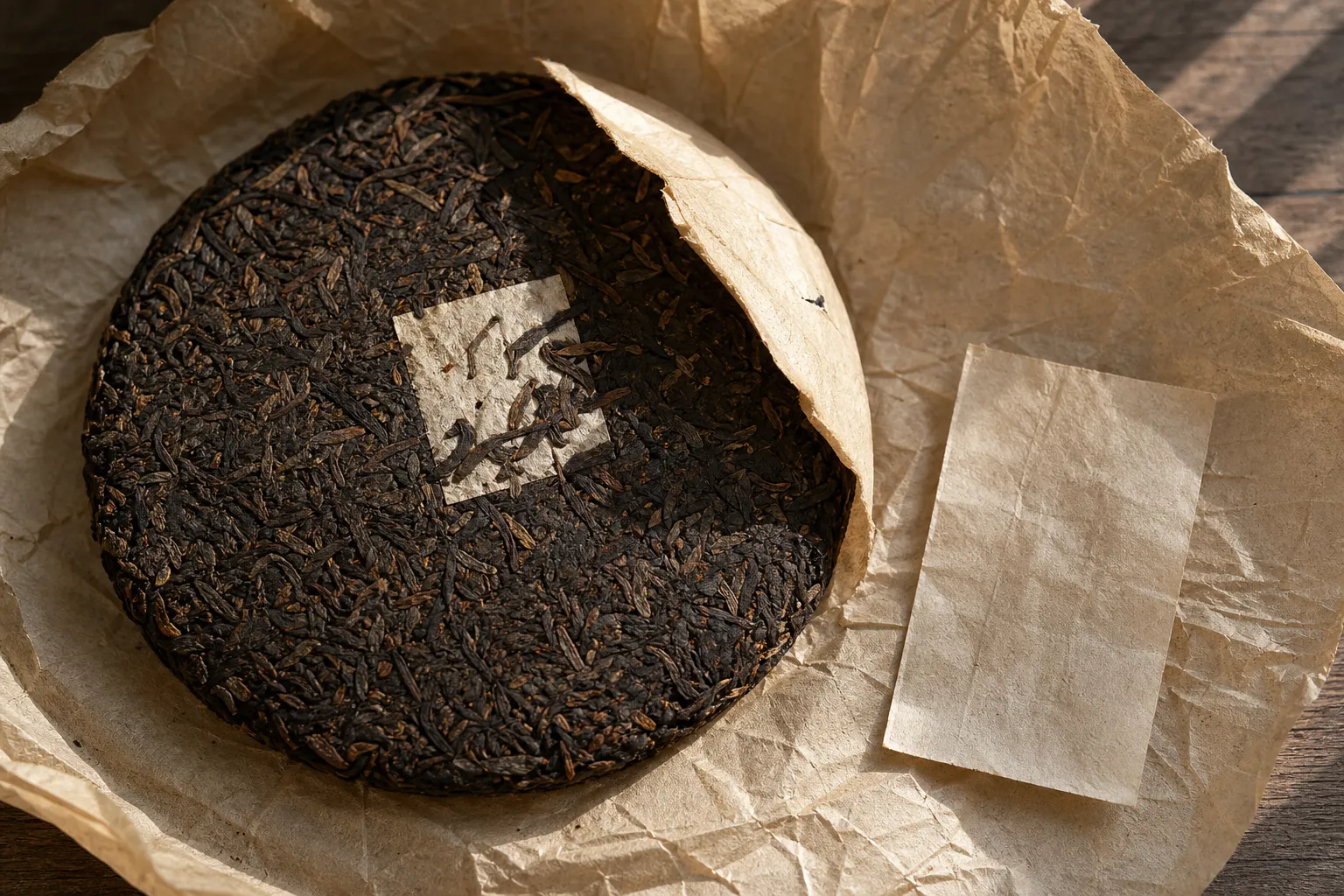
A puerh nei fei is the small label that appears to be part of the cake itself. On many cakes it is pressed into the tea during compression, so you may see only part of the paper on the surface. It can look like a small square, rectangle, rounded mark, or printed slip caught in the pressed leaf. If you pry tea from that area, the paper may tear or stay attached to compressed leaves.
A nei piao, often translated loosely as an inner ticket, is usually a larger paper that accompanies the cake. It may sit inside the outer wrapper, lie against the cake, fold around part of the cake, or appear as a loose puerh ticket. It is not the same object as a paper visibly embedded in the tea face.
A tong piao belongs to a wider packaging context. A tong is commonly discussed as a bundle or stack of cakes, often seven cakes together. A tong-level paper is therefore different from the small embedded label on one cake.
What you see
Small printed paper pressed into the cake surface
Likely term: Nei fei. Think of it as an embedded tea cake inner label.
What you see
Larger paper loose inside the wrapper or accompanying the cake
Likely term: Nei piao. Think of it as an inner or accompanying ticket.
What you see
Paper associated with a wrapped bundle or stack of cakes
Likely term: Tong piao. Think of it as bundle-level paper.
What you see
Seller card, storage note, receipt, or modern insert
Likely term: Not necessarily any of these. Treat it as extra paperwork and compare before naming it.
This placement-based reading is more useful than judging from decoration alone. Producers, eras, and market styles can vary in paper size, layout, printing, and wording.
What a nei fei may communicate
A nei fei can act like a producer identity clue. It may show a factory name, brand mark, series design, emblem, or other production-context information. In some cakes, the embedded puerh label is part of the tea’s visual identity: when the wrapper is opened, the small paper tells the drinker, collector, or buyer what the cake is presenting itself to be.
That does not mean every nei fei carries the same kind of information. Some are simple. Some are decorative. Some repeat wrapper imagery. Some may point toward a producer, mountain, recipe, batch, or selling story, depending on the cake and period.
Older puerh paper labels may also be less explicit than modern packaging. A missing printed year, for example, is not automatically suspicious. Some older printed materials were not designed around the date-forward style many buyers now expect.
For an everyday drinker, the useful question is not “Does the nei fei settle the matter?” It is: “Does the nei fei match the rest of what I can observe?”
Look for consistency with
- the outer wrapper design and printing style;
- the cake’s shape, compression, and edge condition;
- the leaf material visible on the surface and back;
- the aroma when the wrapper is opened;
- storage impressions such as clean aged notes, dampness, smoke, stale paper, wood, or mustiness;
- the seller’s provenance story, especially whether it is specific or vague;
- reliable comparison examples, if you have them.
A nei fei is one clue in that group. It is not the whole reading.
What a nei piao is likely doing
A nei piao, or pu-erh inner ticket, is usually a larger paper associated with the cake rather than embedded into it. Depending on the tea, it may carry a fuller presentation: producer language, product name, production area claims, batch information, storage or brewing text, promotional description, or a general statement about the tea.
The exact use of the term can vary, and public reference material is thinner than ideal for a single fixed definition across all periods and producers. In practical English, readers often use “inner ticket” for a loose paper found inside the wrapper. That is a useful working description, but not a universal rule for every cake.
The main confusion comes from the word “inside.” A paper can be inside the wrapper without being inside the cake. If it falls out when you unwrap the cake, it is more likely an accompanying ticket. If it is pressed into the surface and held by compressed leaves, it is more likely the nei fei.
A loose inner ticket can still matter. It may help identify how the tea was packaged, presented, or sold. It may preserve language from the producer or distributor. It may help you compare the cake with other examples from the same line. But, like the embedded label, it should not be read alone.
What these papers cannot tell you by themselves
The biggest mistake is treating a neat paper label as a final answer. Printed materials can be copied. Wrappers can be changed. Tickets can be added, lost, replaced, or separated from cakes. A cake may have convincing old-looking paper and still need careful comparison with the tea itself.
A nei fei or nei piao cannot, by itself, establish
- the true production year;
- the original storage history;
- the quality of the leaf material;
- whether the cake was kept in clean conditions;
- whether the aroma and taste will suit you;
- whether the producer identity is exactly as presented;
- whether the cake is worth a certain price.
This matters because pu-erh market language often leans heavily on age, origin, storage, and producer identity. Technical research may approach origin, vintage, and traceability through chemical, spectral, isotope, image, or other methods. That does not mean an everyday drinker needs a lab to enjoy tea. It simply shows why a paper insert should not be asked to do more than it can do.
For daily tea decisions, a calmer approach works better: read the paper, compare it with the wrapper and cake, smell the tea, brew a small amount if appropriate, and keep notes on what you actually observe.
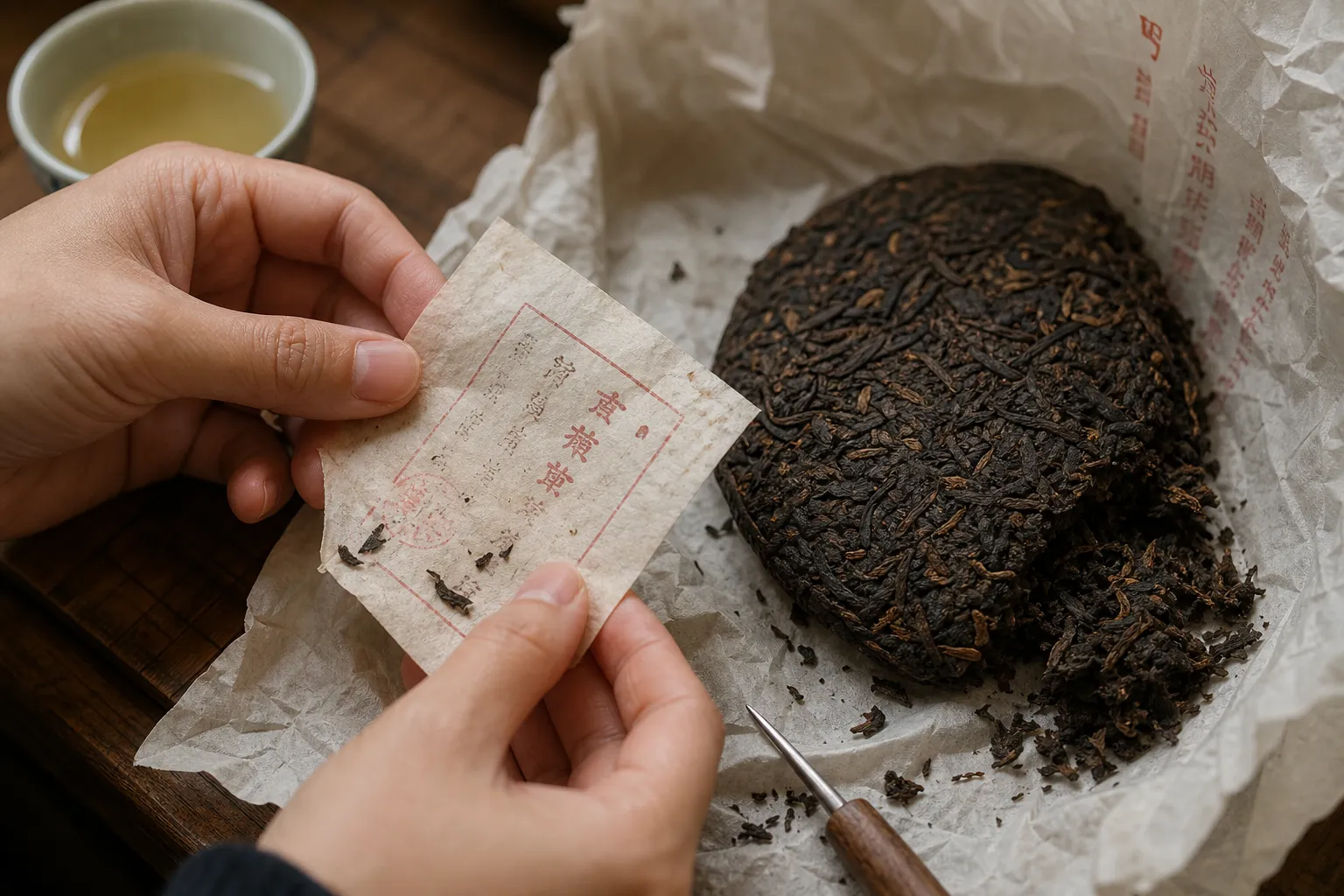
A simple check when you find paper inside a cake wrapper
When you find paper inside a pu-erh cake wrapper, move slowly before naming it. The paper may be fragile, and the cake may shed small bits of leaf near the label.
- 1. Check placement first. Pressed into the cake surface suggests nei fei. Loose with the cake suggests nei piao or another insert.
- 2. Compare size and function. Small embedded paper usually acts as a tea cake inner label. A larger loose sheet usually gives more product or producer context.
- 3. Look for consistency, not perfection. Do the artwork, wrapper, paper color, print style, and cake presentation seem to belong together? Inconsistency does not settle the issue by itself, but it is worth noting.
- 4. Do not overread the date. Some papers may include a year or batch clue; some may not. Absence of a clear year is a detail to examine, not a conclusion.
- 5. Smell the tea. Paper gives packaging context. Aroma tells you something about the tea’s current condition. Look for clean, woody, herbal, camphor-like, sweet, smoky, humid, stale, or musty impressions without forcing a conclusion from one sniff.
- 6. Keep the paper with the cake. If you store the tea, keep the loose ticket and wrapper together. If you break the cake, avoid tearing out the embedded label unless you have a reason to remove that section.
This is not a full authentication process. It is a practical way to avoid confusing every piece of paper with the same term.
Common confusions around puerh cake paper labels
“The paper is inside the wrapper, so it must be nei fei.”
Not necessarily. Nei fei usually refers to the small paper embedded or pressed into the cake. A loose paper inside the wrapper is more likely an inner ticket or another insert.
“A cake with a nei fei must be genuine.”
No. The label can be a useful identity clue, but printed labels can be copied or mismatched. Compare it with the wrapper, cake, leaf, aroma, and provenance.
“Old puerh should always have a clear production year on the paper.”
Not always. Older printed materials may not present dates in the way modern buyers expect. A missing date is a clue to examine, not proof of anything by itself.
“Nei piao and tong piao are the same.”
They are better kept separate. Nei piao is usually discussed as an inner or accompanying ticket for the cake. Tong piao belongs to the bundle or tong context.
The practical meaning
Nei fei and nei piao are best understood as parts of pu-erh’s compressed-cake packaging language. The nei fei is usually the small embedded puerh label pressed into the cake. The nei piao is commonly the larger loose inner ticket that accompanies the cake. A tong piao relates to the bundle rather than the single embedded label.
Read them as clues. They may help you identify producer presentation, product line, and packaging context. Then bring the tea itself back into the decision. The wrapper, compression, leaf appearance, aroma, storage condition, and provenance all matter. A piece of paper can help you ask better questions, but it should not answer every question for the cake.
Sources
Sources and further reading
Reference links are limited to sources considered suitable for public citation in this page.