
Label reading guide
What Qian Liang Cha and Other Tael Weight Names Mean
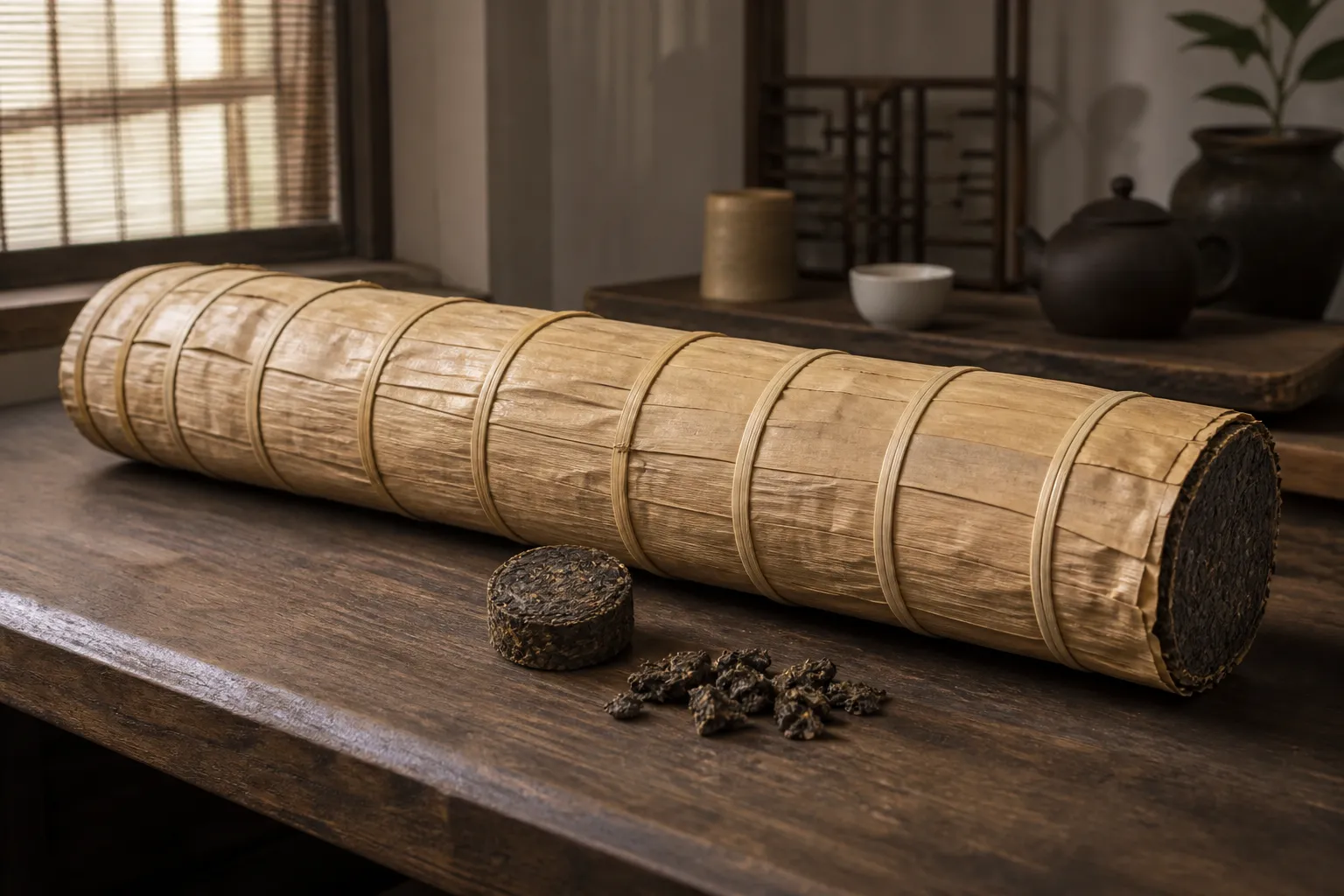
Qian Liang Cha is a Hunan dark tea name built around an old weight term: qian liang means “thousand liang,” often translated as “thousand taels.” In tea-context descriptions, the full traditional form is a large compressed column, commonly cited at roughly 36 kg—not the small packet, slice, disc, or sample you may have in front of you.
The practical reading is simple: Qian Liang Cha weight usually refers to the traditional full-column name, while the item sold today may be only a cut piece or modern retail format. A 30 g packet labeled “Thousand Tael Tea” is not saying the packet weighs a thousand taels. It is using the name of the tea form.
upward
Read the full overview first
Use the broader guide first if you need the full scope before this page.
The name points to the old column form
If you see Qian Liang Cha, Thousand Tael Tea, Thousand Liang Tea, or 千兩茶, read it first as a traditional Hunan dark tea form name.
The full form is associated with a long, tightly compressed tea column. One tea-culture source describes it at about 1.5 meters long and about 68 cm around, using a tea-context calculation of about 36.25 g per liang, or roughly 36.25 kg for 1000 liang. That number is useful for scale, but it should not be treated as a universal conversion for every modern label. Historical and local values for liang or tael have varied, and English product pages do not always translate the term cleanly.
For a buyer, the main point is this: a full thousand-tael column is large and heavy, so most retail tea is sold as a portion, slice, sample, or adapted shape.
Label wording
What it may mean
Qian Liang Cha / Thousand Tael Tea
A tea named after the traditional thousand-liang column style
10 g, 30 g, 50 g, 100 g
A sample or small retail portion
Round slice or disc
Often a cut section from a column, or a modern format based on that form
Full column / pillar / roll
Closer to the traditional large form
“Thousand Ounce”
Usually a poor English rendering; the tea term is liang/tael, not ounce
The safest habit is to separate the two pieces of information: the traditional name tells you the tea style; the printed net weight tells you what you are buying.
Why “Thousand Tael Tea” can be a small slice
Most confusion comes from modern retail packaging. A full Qian Liang column is not convenient for many drinkers, shops, or international shipments, so sellers often offer smaller pieces.
That smaller item might be:
- a sawed cross-section from a long column;
- a thin round slice;
- a small sample bag;
- a compressed disc or cake-like piece;
- a brick-shaped adaptation;
- loose or broken material taken from a larger form.
A round Qian Liang slice can look like a tea cake in photos, especially if you are used to seeing pu’er cakes. But the shape alone does not make it a pu’er-style cake. It may simply be a cut section of a Hunan dark tea column.
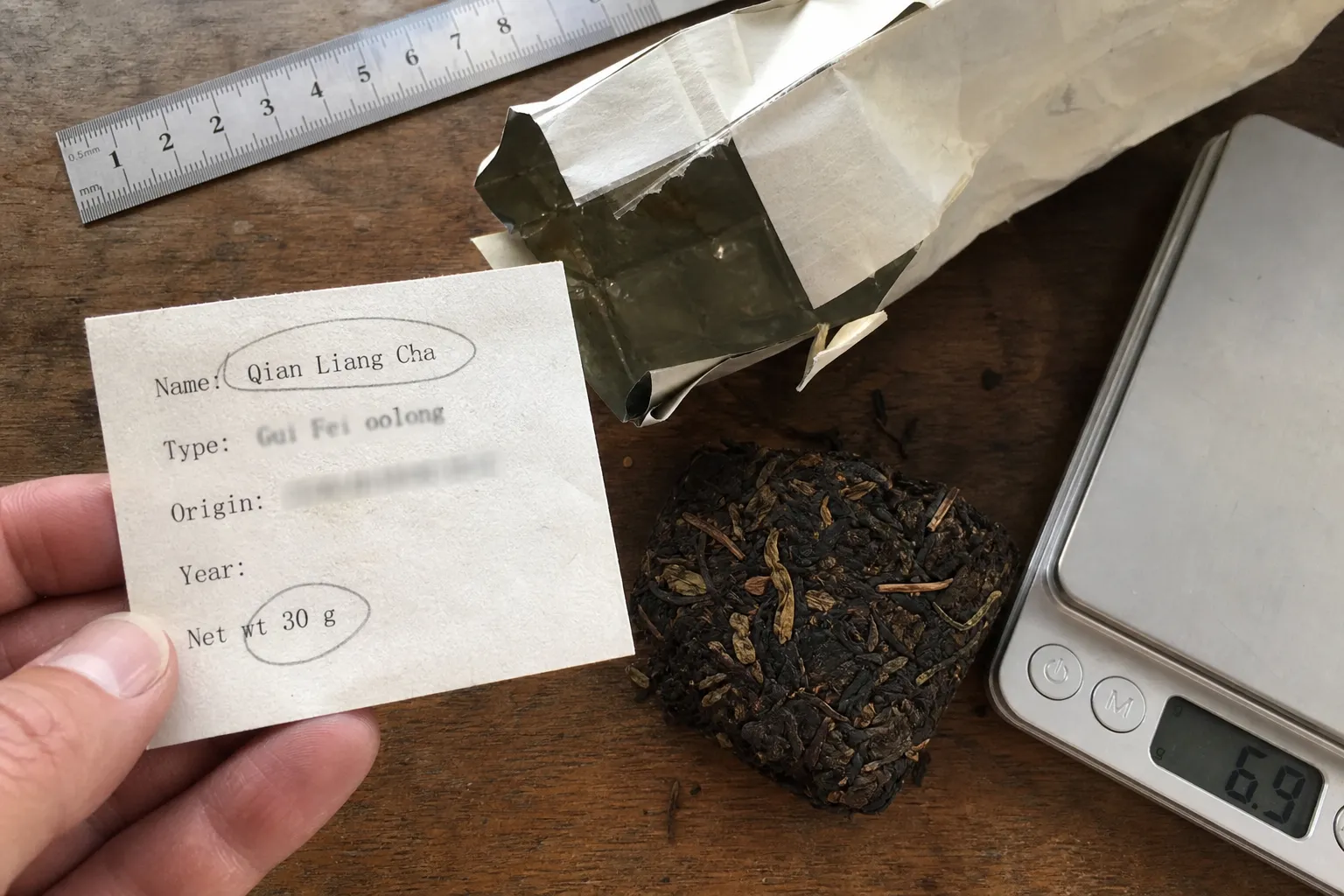
So if the label says “Qian Liang Cha 30 g,” the real package amount is 30 g. The “Qian Liang” part gives the traditional name or form context; it does not override the net weight.
Liang, tael, and related names
Liang is a Chinese weight term often translated as tael. In this Hunan dark tea context, it appears in several related names:
- Qian Liang Cha — Thousand Liang Tea / Thousand Tael Tea
- Bai Liang Cha — Hundred Liang Tea / Hundred Tael Tea
- Shi Liang Cha — Ten Liang Tea / Ten Tael Tea
- Hua Juan — a related term connected with this rolled or column-style Hunan dark tea family
These names work more like traditional denomination or form names than precise promises about the retail package in front of you. “Hundred Tael” and “Ten Tael” may point to smaller traditional forms, but the same rule applies: check the actual net weight.
A useful reading order
- Identify the name: Qian Liang, Hundred Tael, Ten Liang, Hua Juan.
- Separate the form name from the package size.
- Check the printed net weight.
- Look at the physical form: full column, slice, disc, brick, loose piece, or sample.
- Avoid forcing an exact gram conversion unless the producer clearly states it.
That prevents the common mistake of assuming every “Thousand Tael Tea” item must physically weigh a thousand taels as sold.
Hunan dark tea, not Western black tea
Another label issue is translation. Chinese hei cha is sometimes rendered word-for-word as “black tea,” but in English tea categories it is better understood as dark tea or post-fermented tea. Western “black tea” usually means fully oxidized tea, which is a different category.
Qian Liang Cha belongs in the Hunan dark tea setting, especially the Anhua tea context. Broad dark-tea literature supports the category distinction: Chinese dark teas are shaped by post-fermentation, processing, origin, storage, and microbial environment. That background helps explain the family of teas Qian Liang belongs to, but it does not tell you the exact weight, age, storage condition, or flavor of a particular retail piece.
If an English page calls Qian Liang “black tea,” read carefully. In this context, it is usually a translation issue around hei cha, meaning dark tea.
What the weight name can and cannot tell you
A Qian Liang name can point toward
- a Hunan dark tea tradition;
- a large compressed column form;
- a family of tael-based names;
- a reason why a round slice may not be a standard tea cake.
It does not reliably tell you
- the exact weight of the retail package;
- the exact modern gram value being used for the tael;
- the tea’s age;
- the storage condition;
- the producer’s grade or style choices;
- whether the piece was cut from a full column or made as a modern format;
- how the tea will taste in your cup.
Flavor is especially easy to overread from the name. Qian Liang-style teas can show woody, sweet, earthy, smoky, tannic, malty, or lighter notes, but the cup depends on the specific tea, storage, cut size, water, vessel, and steeping or boiling method. The weight name is not a flavor promise.
For buying and brewing, the more useful checks are physical:
- What is the actual net weight?
- Is it a full column, slice, disc, brick, cake-like piece, or loose portion?
- Does the dry tea smell clean, woody, smoky, stale, sour, damp, or musty?
- Is the compression easy to loosen, or very dense?
- Does the seller clearly separate the traditional name from the package size?
Those details help more than trying to calculate the whole purchase from the words “Thousand Tael.”
A quick way to read the label
First, read the form name
“Qian Liang Cha” means the tea is being presented as Thousand Liang or Thousand Tael Hunan dark tea, linked to the traditional column style.
Then read the package facts
“30 g,” “100 g,” “one slice,” “sample,” or “disc” tells you what you are actually buying or brewing.
If those two pieces seem to conflict, they usually do not. They answer different questions. The traditional name explains the tea’s form lineage; the package weight tells you the amount in your hand.
A small packet labeled Qian Liang Cha is not automatically suspicious. It may simply be a retail portion from a much larger style of tea. What matters is whether the seller makes the actual package weight clear.
Short answers to common label questions
Is Qian Liang Cha supposed to weigh 1000 taels?
The traditional full form is named for a thousand liang or taels, and one tea-context account gives a full-column weight around 36.25 kg. A modern retail item with the same name may be only a slice, disc, brick, sample, or adapted package. Use the printed net weight for buying and brewing.
Is “Thousand Ounce Tea” the same thing?
It is usually a confusing English rendering. The Chinese term is liang, commonly translated as tael, not ounce. If you see “Thousand Ounce” next to Qian Liang or 千兩茶, rely on the product’s net weight rather than the English phrase.
Are Hundred Tael and Ten Tael teas smaller versions?
They are related tael-weight names in the same naming family. They may point to smaller traditional denominations or related forms, but the actual retail weight still depends on the product. Treat the name as a form cue, then verify the net weight separately.
Sources
Sources and further reading
Reference links are limited to sources considered suitable for public citation in this page.