
Tea terminology
What Does Hei Cha Mean Compared With Dark Tea
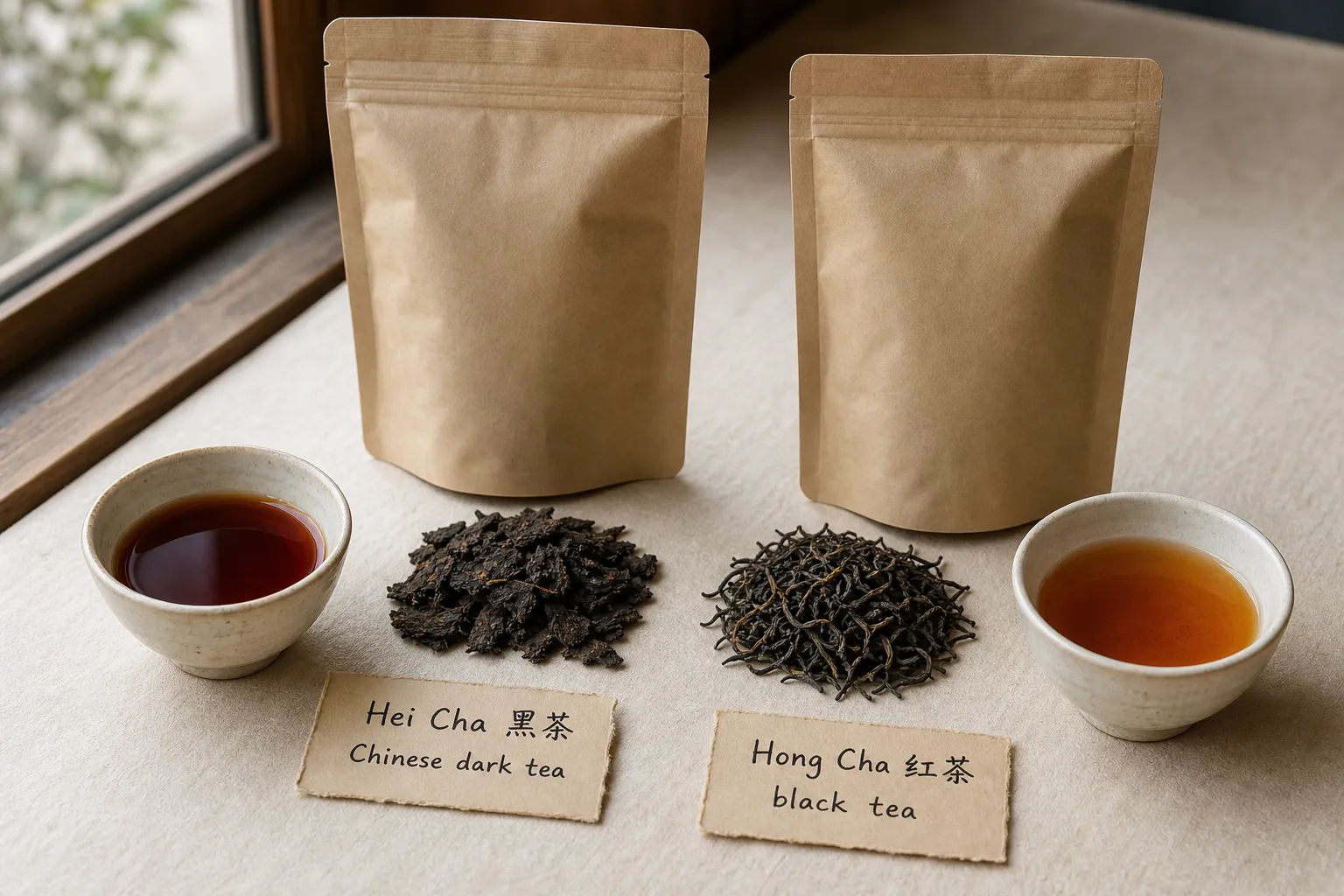
Hei Cha means 黑茶, a Chinese tea-category name usually rendered in English as Chinese dark tea or post-fermented tea. The key point is simple: Hei Cha is not Western black tea.
In Chinese tea language, the tea English speakers usually call black tea is more often Hong Cha 红茶, literally “red tea.” So the practical hei cha meaning is: a Chinese dark tea category shaped by post-fermentation language, not a direct label for breakfast-style black tea.
If you are reading a tea label, dark tea is usually the safer translation for 黑茶. “Black tea” may be a literal word-by-word rendering, but it can send English readers toward the wrong shelf.
upward
Start with the broader guide
Use the broader guide first if you need the full scope before this page.
Hei Cha, Dark Tea, and Black Tea in One Pass
The confusion starts with the character 黑, which can mean “black” or “dark.” On its own, that makes Hei Cha look like it should mean black tea.
But English tea categories already use black tea for oxidized teas such as Assam, Darjeeling, Ceylon, Keemun, Dian Hong, and many breakfast blends. That is why English tea writing often uses dark tea for Hei Cha.
A useful working map:
- Hei Cha 黑茶: Chinese dark tea, commonly discussed as post-fermented tea.
- Hong Cha 红茶: Chinese red tea, usually the category English calls black tea.
- Black tea in English: generally oxidized tea, not Hei Cha.
- Dark tea in this context: a Chinese post-fermented tea category, not simply any tea that brews dark.
Tea-science sources commonly describe Chinese dark teas through post-fermentation, microbial change, pile fermentation, storage, and aroma variation. That processing frame explains why “post-fermented tea” appears on labels. It does not mean every dark-looking cup is Hei Cha.
A Simple Label-Reading Table
| Term you see | Literal or common wording | Better practical reading | Watch for this on labels |
|---|---|---|---|
| Hei Cha / Heicha / 黑茶 | Literally close to “black tea” | Chinese dark tea; often post-fermented tea | Liu Bao, Fu Zhuan, some brick teas, ripe Pu-erh in some contexts |
| Dark tea | Can sound color-based | Usually the English category name for Hei Cha | Chinese dark tea, post-fermented, pile-fermented, compressed |
| Black tea | English tea category | Usually Hong Cha 红茶 in Chinese terms | Oxidation language, red/copper liquor, breakfast tea, Assam, Keemun, Dian Hong |
| Hong Cha / 红茶 | Literally “red tea” | Chinese term for what English calls black tea | Do not read it as rooibos or herbal “red tea” without context |
| Post-fermented tea | Processing description | Tea changed after initial processing through microbial or storage-related transformation | Dark tea, ripe Pu-erh, Liu Bao, Fu Zhuan, pile-fermentation language |
| Pu-erh / Pu’er | Regional tea name with its own classification issues | Related, but not always identical to Hei Cha | Ripe Pu-erh is often discussed with dark tea; young raw Pu-erh needs more context |
This table is a reading aid, not a universal naming law. Sellers, importers, and writers do not always choose the same English wording.
Why Dark Tea Does Not Mean Any Dark-Colored Tea
The dark tea meaning here is category-based, not color-only.
A heavily oxidized black tea can brew very dark. A roasted oolong can look deep amber or brown. An aged white tea can also darken over time. Those visual clues do not make the tea Hei Cha.
For Hei Cha, better clues are processing and naming:
- Does the label say Hei Cha, dark tea, or Chinese dark tea?
- Does it mention post-fermented tea?
- Does it name a common dark-tea example, such as Liu Bao, Fu Zhuan, Qing brick tea, Kang brick tea, Ya’an Tibetan tea, or some forms of ripe Pu-erh?
- Does it describe pile fermentation, microbial fermentation, aging storage, or compressed brick/cake forms?
- Does the seller contrast it with Hong Cha or Western black tea?
Some Chinese dark teas brew reddish-brown, deep amber, brown, or nearly coffee-dark depending on leaf form, age, storage, water, and steeping time. Flavor notes may lean woody, aged, earthy, mellow, mineral, or low in astringency. Those clues can help, but they are not enough by themselves. A label that only says “dark color” or “rich black tea flavor” may still be describing ordinary English black tea.
Hei Cha vs Hong Cha: The Common Translation Trap
The phrase hei cha black tea appears often because the literal translation points English readers in the wrong direction. The clearer comparison is Hei Cha vs Hong Cha.
Hei Cha 黑茶 uses 黑, meaning black or dark. In English tea-category language, it is usually called dark tea because it points toward Chinese post-fermented tea.
Hong Cha 红茶 uses 红, meaning red. In Chinese tea naming, this usually refers to the category English speakers call black tea. The “red” often describes the brewed liquor more than the dry leaf.
So when comparing dark tea vs black tea, the difference is not just cup color:
English black tea is usually an oxidized tea category.
Chinese Hei Cha is commonly framed as a post-fermented dark tea category.
Chinese Hong Cha is usually the Chinese category corresponding to English black tea.
That is why a tea shop may write “Hei Cha, or dark tea” instead of “Hei Cha, or black tea.” The second version may be literal, but it often creates the wrong expectation.
Where Post-Fermented Tea Fits
The phrase post-fermented tea explains why Hei Cha sits apart from green, oolong, and black tea in many Chinese tea classifications.
In simplified terms, many dark teas are made from tea leaves that have first been heated enough to reduce the fresh-leaf enzyme activity associated with ordinary oxidation. Later, under particular moisture, heat, storage, or piling conditions, microorganisms and related biochemical changes can shape the tea’s aroma and cup character.
For a buyer or brewer, the useful takeaway is small:
- Post-fermented explains why the tea may be grouped with Hei Cha or dark tea.
- It often appears near aged, compressed, brick, basket, or cake forms, though loose dark teas also exist.
- It helps explain why storage, age, and humidity history can matter.
- It does not promise one fixed flavor profile.
A Liu Bao, a Fu Zhuan brick, and a ripe Pu-erh may all sit near the dark-tea conversation, but they do not taste the same. Origin, processing, storage, compression, and brewing method can move the cup from clean and woody to heavier, sweeter, more mineral, more earthy, or simply flat if brewed poorly.
Hei Cha vs Pu-erh: Related, Not Interchangeable
Pu-erh adds another layer because it is the most visible post-fermented tea name for many English readers. A safe boundary is this: Pu-erh and Hei Cha overlap in many discussions, but they are not always interchangeable words.
Ripe Pu-erh, often called Shou Pu-erh, is commonly discussed alongside post-fermented dark teas because its processing includes an accelerated pile-fermentation step.
Raw Pu-erh, often called Sheng Pu-erh, is more context-dependent. Young raw Pu-erh does not go through the same ripe pile-fermentation process. Some writers discuss aged raw Pu-erh near dark tea because it changes during storage. Others keep Pu-erh separate because of regional material, processing, and classification boundaries.
For label reading, avoid two shortcuts:
- Do not assume all Pu-erh equals Hei Cha.
- Do not assume Hei Cha only means Pu-erh.
If a package says “ripe Pu-erh,” “Shou Pu-erh,” “post-fermented,” or “dark tea,” it is likely close to the Hei Cha conversation. If it says “young raw Pu-erh,” read more carefully before treating it as the same thing.
Practical Cues When You See Hei Cha on a Tea Page
When a shop page, wrapper, or tea article uses Hei Cha, read around the word before deciding what you have.
First, look for the Chinese characters. If you see 黑茶, the writer is probably referring to Hei Cha / Chinese dark tea. If you see 红茶, the tea is more likely Hong Cha, the Chinese category English calls black tea.
Second, look for processing words. “Post-fermented,” “pile-fermented,” “microbial fermentation,” “aged dark tea,” and “compressed dark tea” all point toward Hei Cha language. “Fully oxidized,” “red liquor,” “black tea,” “breakfast tea,” or names like Dian Hong and Keemun point more toward Hong Cha / English black tea.
Third, check the specific tea name. Liu Bao, Fu Zhuan, Qing brick tea, Kang brick tea, Ya’an Tibetan tea, and ripe Pu-erh may appear in Chinese dark tea discussions. These names help more than color words alone.
Fourth, keep brewing expectations flexible. Many dark teas tolerate hot water well in everyday brewing, and compressed pieces may need a rinse or a short opening steep to loosen. Still, the right brew depends on age, storage, compression, leaf size, vessel, water, and taste. If the cup tastes thin, try a little more leaf or a longer steep. If it tastes heavy, muddy, or too strong, shorten the steep or use less leaf next time.
The Clean Answer to Remember
Hei Cha means Chinese dark tea, usually discussed as post-fermented tea; it should not be confused with English black tea, which usually corresponds to Chinese Hong Cha.
That wording keeps the translation useful without overclaiming. Dark tea is the better English category term for Hei Cha because it avoids the black-tea trap. Post-fermented tea explains the processing idea behind the category. Pu-erh can be related, especially ripe Pu-erh, but it should not replace Hei Cha in every context.
When in doubt, read the label in this order: Chinese characters, category term, processing words, specific tea name, then brewing notes. That sequence is more reliable than judging by the darkness of the leaf or liquor alone.
Sources
Sources and further reading
Reference links are limited to sources considered suitable for public citation in this page.