
How to Pick a Dark Tea for Gongfu Brewing
Pick a dark tea for gongfu brewing by looking for three things before you worry about exact timing: a clean aroma, a manageable leaf form, and enough body to stay interesting through repeated short infusions.
The tea does not need to be rare, expensive, or labeled for gongfu. It should portion cleanly, smell pleasant when warmed, release flavor without turning muddy immediately, and keep some aroma or mouthfeel after the first few steeps.
For a first gaiwan session, choose a tea that gives you control: not mostly dust, not a rock-hard piece you cannot break sensibly, not strongly damp-smelling, and not so light that it disappears after two quick pours. The goal is not one perfect grams-and-seconds formula. It is choosing a tea that responds well in a small vessel with concentrated, brief infusions.
upward
Start with the broader guide
Use the broader guide first if you need the full scope before this page.
What makes a dark tea suitable for a gaiwan session
Gongfu-style brewing exposes the tea quickly. A small vessel, relatively high leaf amount, and fast repeated pours make weak points easier to notice than in a large mug brew.
A stale storage note becomes louder. Powdery fragments can flood the cup with thickness before aroma has time to unfold. Over-compressed chunks may stay closed in the center while the broken edges brew too strongly.
A dark tea is usually a better fit for this style when it has these traits:
Clean dry-leaf aroma
Earthy, woody, nutty, date-like, grain-like, lightly sweet, or aged notes can all work if they smell clean and settled.
Manageable form
Loose leaves, flakes, small chunks, or carefully broken compressed pieces are easier to control than a dense lump or a pile of dust.
Steady liquor behavior
The first few infusions should not be the whole story. The tea should have some ability to open, soften, deepen, or sweeten across rounds.
Pleasant concentration
Because gongfu dark tea is brewed stronger than casual mug tea, the flavor should still be enjoyable when concentrated.
Durable leaf or pieces
Intact or semi-intact material often gives more room for timing adjustments than very fine broken material.
Dark tea flavor depends on raw material, processing, fermentation, storage, and age. Research on dark tea aroma and taste formation describes complex changes in volatile compounds and other components during fermentation and later storage. For the brewer, the practical lesson is simple: two dark teas with similar names may behave very differently in short infusions.
Let the tea in front of you guide the session.
Inspect the tea before water touches it
If you are choosing dark tea for gaiwan brewing, inspect it as brewing material, not just as a label.
Start with aroma. Smell the dry tea at room temperature, then place a small portion in a warmed gaiwan or cup and smell again. Warmth often makes storage character easier to notice.
You are looking for a clean, integrated scent. “Earthy” does not automatically mean flawed; many post-fermented teas have earthy, woody, aged, grainy, or mellow notes. The concern is sharp dampness, sour basement smell, unpleasant mustiness, or visible material that makes you uncertain. If the tea smells clearly off or looks questionable, choose another tea rather than trying to solve it through brewing.
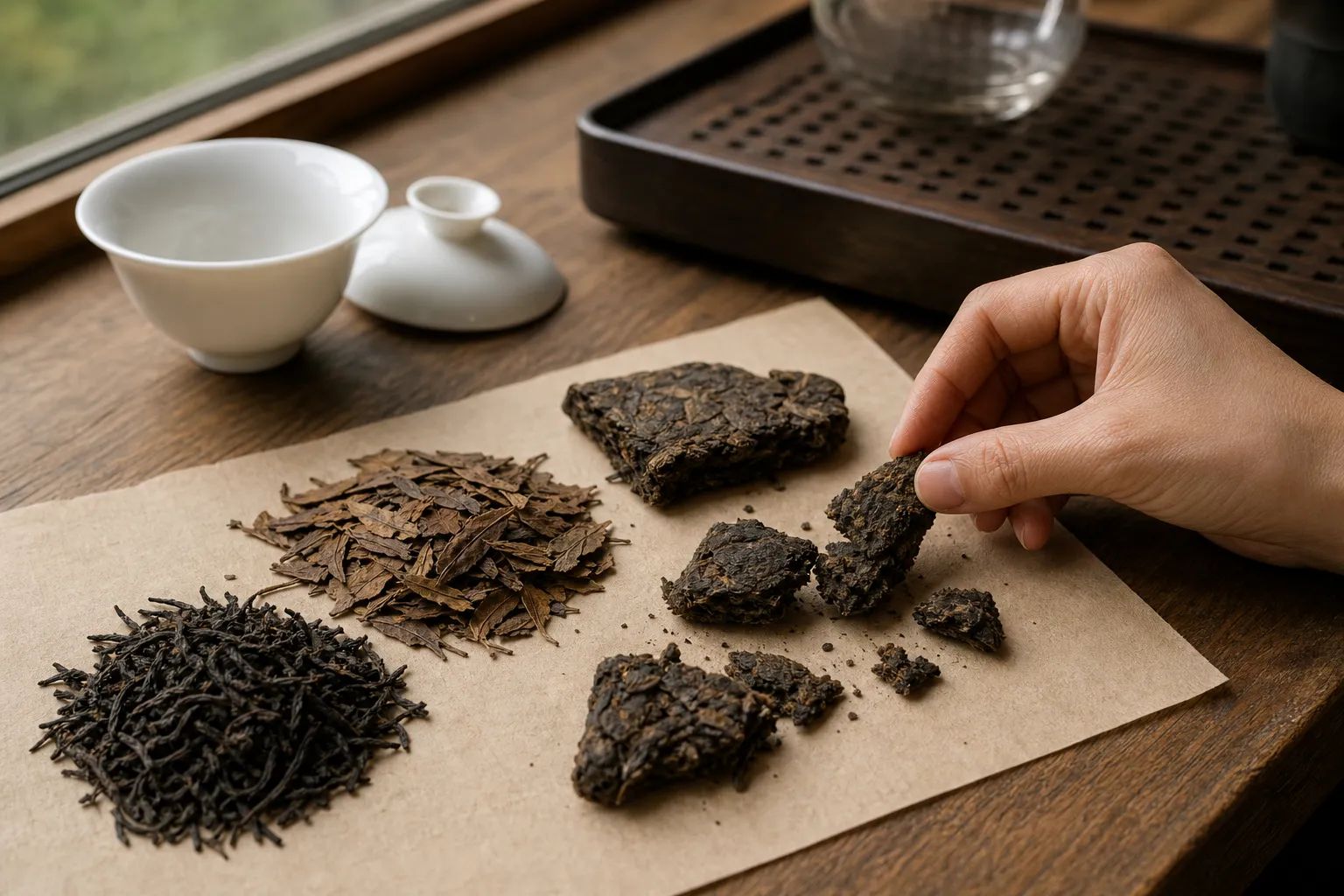
Next, check particle size. A little dust is normal when breaking compressed dark tea, but a session made mostly of powder and tiny crumbs is harder to control. Fine fragments release quickly. In a small gaiwan, they can make the liquor heavy, cloudy, or flat before the larger pieces have opened.
For controlled dark tea short infusions, choose a portion with some structure: flakes, intact leaf, stems mixed with leaf, or small chunks that can hydrate gradually.
Then check compression. Compressed dark tea for gongfu can work very well, but the piece has to be practical. If it is too dense, water may only extract the outside at first. If it has been smashed into uneven shards, the tiny bits may overbrew while the larger center stays quiet. For cakes, bricks, and tight chunks, aim for a portion with layers and surface area, not dust.
Finally, match the tea to the vessel. A 90–120 ml gaiwan or small pot is often easier for testing than a large vessel. It keeps leaf use reasonable and lets you pour quickly. The point is control: you want to see how the tea changes from one infusion to the next without making the session too strong, wasteful, or slow to handle.
Loose, compressed, and broken dark tea: how to choose
Different forms can all work for gongfu brewing, but they ask for different attention.
Loose dark tea is often the easiest starting point when choosing dark tea for gaiwan brewing. You can dose it cleanly, adjust quickly, and see how the leaf hydrates without wondering whether the problem is compression.
Compressed dark tea is still worth choosing when the piece is manageable. The advantage is not mystique; it is structure. A good small piece can open gradually and give you a useful sequence: rinse, early release, middle-round body, later sweetness or woodiness. But if the piece is too large for the gaiwan, do not force it. Break it smaller, or choose another portion.
Broken fragments are not automatically poor. Many real sessions begin with a sample bag or brick corner that includes flakes, leaf, stems, and dust. The issue is proportion. If the portion is mostly tiny particles, shorten the first infusions and expect the tea to give up flavor faster. If you want a calmer, more readable session, pick larger flakes and leave excess powder behind.
Do a small brewing test before committing
A dark tea may smell promising and still behave poorly in short infusions. A quick brewing test tells you whether it suits your gaiwan style.
Use a small, fast-pouring vessel. Many everyday gongfu setups start around 80–120 ml. Use enough tea to produce body, but do not treat any ratio as fixed. For many dark teas, a practical starting range is about 4–6 g in a small gaiwan, adjusted by leaf density, compression, vessel size, and your own preference.
A simple test:
- Warm the vessel and smell the tea. If the warmed aroma becomes unpleasantly damp, sour, or stale in a way that bothers you, stop there.
- Rinse briefly if the tea needs waking. For compressed or aged-feeling dark tea, a quick rinse can help hydrate the surface. For very loose or fine tea, the rinse may remove too much early flavor, so keep it brief or skip it.
- Start with short steeps. Try early infusions around 10–20 seconds if the tea is loose or already open. Dense pieces may need a little more time after the rinse, but avoid long guessing at the start.
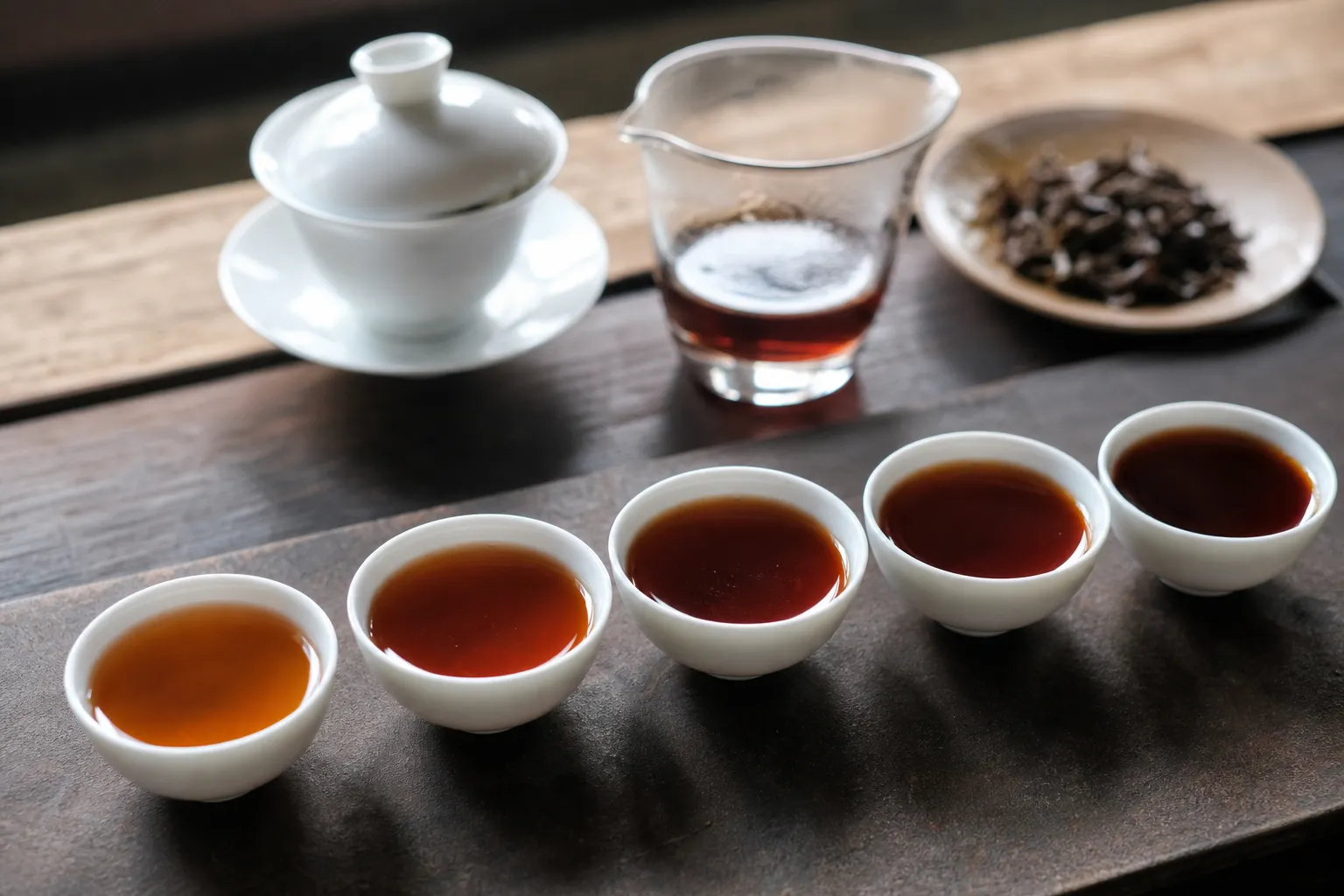
- Watch the liquor, not the clock alone. Darker liquor is not always better. Look for clarity, body, aroma, and whether the flavor feels rounded or rough.
- Extend gradually. As the tea fades, add time. Later rounds can be longer because the fastest-extracting parts have already moved into the cup.
This is not a standard. It is a practical way to learn whether the tea gives you enough control for small vessel dark tea brewing.
What the first few infusions tell you
If the first infusion is thin
The tea may need more leaf, a longer opening steep, hotter water, or more time for a compressed piece to hydrate. If the aroma is good but the liquor is light, do not reject it too quickly. Some dense dark tea pieces wake slowly.
If the first infusion is harsh or gripping
Reduce the steep time, use a little less leaf next time, or check whether the portion contains too much dust. Some bitterness or astringency may be part of the tea’s profile, but in gongfu brewing it should not dominate every cup unless that is the style you want.
If the liquor turns muddy immediately
The portion may be too broken, too dusty, or too heavy for the vessel. Try selecting cleaner flakes, pouring faster, or lowering the leaf amount. Muddy does not only mean color; it can also mean the aroma, body, and aftertaste blur together.
If the tea feels flat by the second or third infusion
It may not be ideal for repeated short infusions. That does not make it useless. It may simply be better with a longer steep in a larger cup, or suited to a direct, simple dark tea brew rather than a layered session.
If the middle infusions improve
You have a promising gongfu dark tea. Many good sessions do not peak in the very first cup. A tea that becomes smoother, sweeter, deeper, or more aromatic after the rinse and early steeps is usually worth exploring further.
Common confusion when choosing dark tea for gongfu
Exact numbers do not choose the tea for you
One common misunderstanding is that gongfu brewing is mainly about exact numbers. Numbers help you begin, but they do not choose the tea for you. Dark tea leaf-to-water ratio, steep timing, and rinse length all depend on the tea’s form, storage, density, vessel, water, and how strong you like the cup.
Compressed tea is not automatically better
Another confusion is thinking that all compressed tea is better for gongfu. Compression can support repeated infusions when the piece is well portioned, but it can also make brewing uneven. A clean loose dark tea may be a better beginner choice than a famous-looking brick that crumbles into dust or stays closed in the center.
Earthy does not always mean flawed
A third confusion is treating every earthy note as a flaw. Post-fermented dark teas can have earthy, woody, aged, grainy, or mellow aromas because their flavor is shaped by processing and storage. The practical distinction is whether the aroma feels clean and pleasant to you. Clean earthy dark tea notes can be welcome. Strong damp, sour, or visibly questionable signs call for caution.
A label cannot replace a brewing test
Finally, a tea name that includes “gongfu” or is marketed for careful brewing does not automatically mean it will suit your gaiwan. Judge the leaf, the warmed aroma, the portion size, and the way the liquor behaves across short steeps.
Practical selection checklist
Use this when choosing dark tea for gongfu brewing from a shop sample, tea table, or your own storage.
Choose the tea if most of these are true:
- The dry and warmed aroma is clean and appealing.
- The portion includes flakes, leaf, stems, or chunks with some structure, not mostly powder.
- Compressed pieces can be broken into a size that fits your gaiwan.
- The tea remains pleasant when brewed concentrated, not only when diluted.
- Early infusions show body, aroma, or a clear direction of development.
- The tea does not collapse completely after one or two short rounds.
- You can adjust it with timing rather than fighting the material every infusion.
Choose a different tea if:
- The smell is strongly damp, sour, basement-like, or unpleasant to you.
- The sample is mostly dust and you want controlled repeated infusions.
- A hard chunk is too large or dense for your vessel.
- The liquor becomes harsh, muddy, or flat no matter how you shorten the steeps.
- You only enjoy the tea when brewed lightly and do not like it concentrated.
A good dark tea for a gaiwan is one that gives you room to respond. It does not need to match a universal recipe. It needs clean storage character, workable form, and enough durability to make short infusions worth your attention.
Sources
Sources and further reading
Reference links are limited to sources considered suitable for public citation in this page.