
Daily thermos brewing
Ripe Pu-erh or Other Dark Tea for Daily Thermos Brewing
Ripe pu-erh is often the easiest starting point for a daily thermos if you want a dark, smooth, earthy cup with plenty of body. It can sit in hot water for a long time without turning sharply bitter as quickly as many more astringent teas.
But it is not the only good choice. Liu Bao and other dark teas can work well when the leaf smells clean, tastes settled in a short test steep, and does not turn sour, muddy, or overly heavy during long extraction. For ripe pu-erh for thermos brewing, choose by clean aroma and cup behavior, not by the label alone.
A thermos is less forgiving than a small gaiwan or teapot. The leaf stays in contact with hot water, so whatever the tea carries—sweet body, woody depth, earthy thickness, storage roughness, sourness, or stale aroma—usually becomes easier to notice.
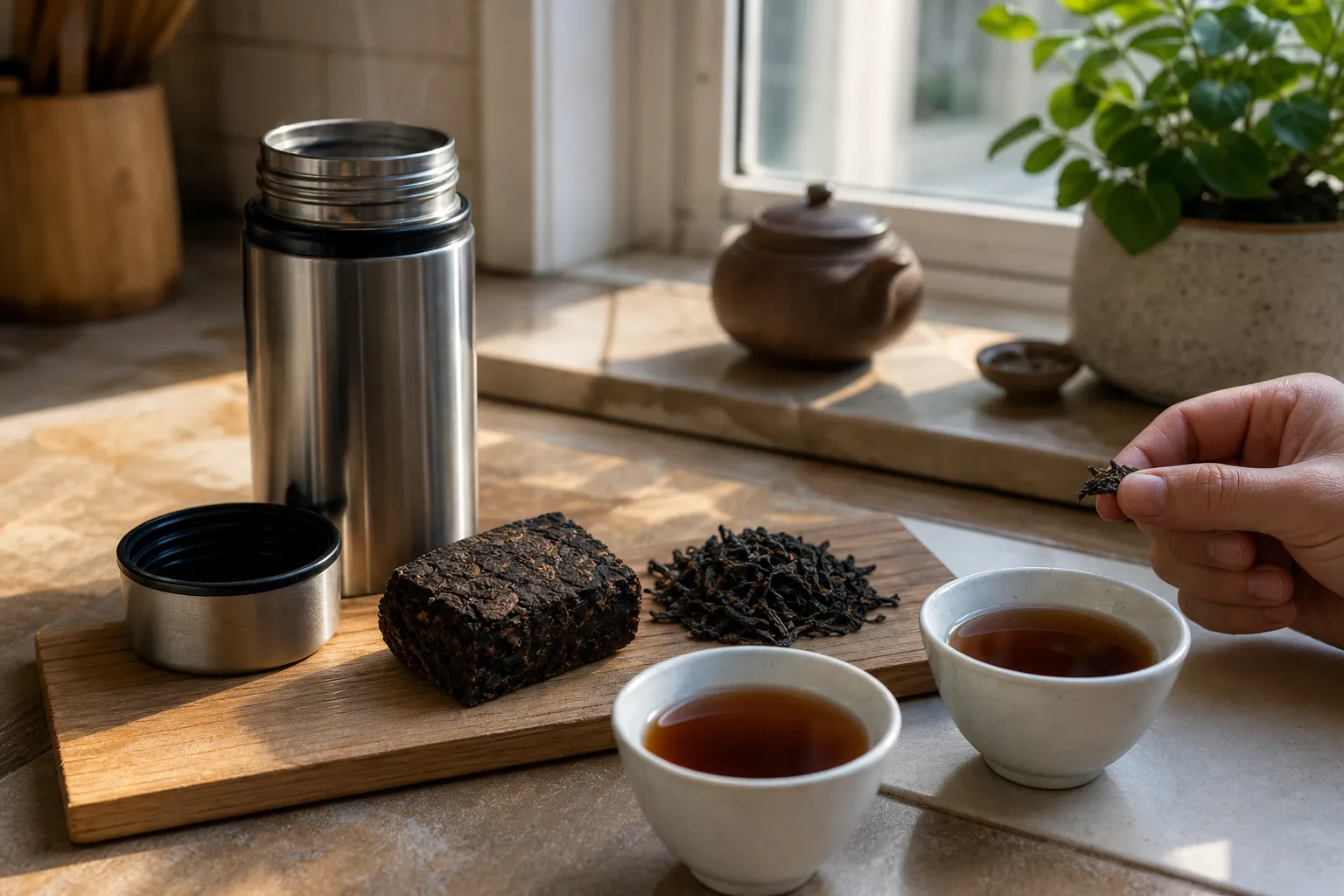
upward
Start with the broader guide
Use the broader guide first if you need the full scope before this page.
The quick choice: ripe pu-erh, Liu Bao, or another dark tea
If you are filling a bottle for work, travel, or a long morning, start with the tea that behaves best under heat and time.
Ripe pu-erh, also called shu or shou pu-erh
When it makes sense: You want a dark, smooth, mellow, earthy, thick cup.
Watch for: It can become too heavy, flat, muddy, or pile-like if the tea is rough or the dose is high.
Liu Bao
When it makes sense: You want a dark tea that may feel a little brighter, woody, nutty, or dried-fruit-like depending on the tea.
Watch for: It can still become musty, sour, thin, or harsh if storage or leaf quality does not suit you.
Another hei cha or post-fermented tea
When it makes sense: You want to explore beyond ripe pu-erh and Liu Bao.
Watch for: Category names do not predict thermos performance; test first.
English “black tea”
When it makes sense: Usually a different decision.
Watch for: In Chinese tea context, dark tea or hei cha means post-fermented tea, not ordinary black tea.
For a first daily thermos, a smooth daily ripe pu-erh is a sensible default. Many ripe pu-erh teas are processed to give a dark liquor, rounded body, and lower sharpness. Research on ripe pu-erh taste chemistry connects its mellow, thick character with changes shaped during pile fermentation, including larger tea compounds and polysaccharide-related material. That does not make every ripe pu-erh good in a thermos, but it helps explain why the style often suits long, hot brewing.
Liu Bao is worth trying when ripe pu-erh feels too dense, too earthy, or too flat. In tasting language, Liu Bao is often described through woody, nutty, sweet, or sometimes dried-fruit impressions. Those are not promises for every basket or batch, but they give you useful cues when comparing Liu Bao vs ripe pu-erh in a thermos.
Test the tea before giving it a full bottle
A thermos should not be the first test of an unknown dark tea. Long extraction can make a pleasant tea comforting, but it can also magnify rough edges.
Use a small check first:
-
Smell the dry leaf.
Look for clean earth, wood, grain, nut, old paper, dried fruit, or a gentle cellar-like note if you enjoy that style. Be cautious with leaf that smells fishy, sour, muddy, sharp, stale, or unpleasantly musty.
-
Make a quick rinse or short steep.
This is not about ceremony. It is a fast aroma check. If the wet leaf already smells aggressive in a way you dislike, a thermos will rarely hide it.
-
Taste a small cup.
Ask whether the tea is smooth enough, whether the body feels pleasant, and whether the aftertaste stays clean. A tea that is only strong can be adjusted. A tea that tastes sour, dirty, or badly stored is a poor thermos candidate.
-
Start with less leaf than you think.
A small teapot brew ends in minutes. A thermos keeps extracting. If the cup becomes too thick or dull halfway through the morning, reduce the leaf next time before changing tea category.
This test matters more than whether the wrapper says ripe puerh, shou pu-erh, cooked pu-erh, Liu Bao, basket tea, hei cha, or post-fermented tea. The category tells you the family. The thermos reveals the behavior of that particular leaf.
What long extraction does to dark tea
Thermos brewing is not just “brewing ripe pu-erh for longer.” It shifts the balance of the cup.
In a short steep, ripe pu-erh may show sweetness, soft earth, grain, wood, and rounded texture without becoming too dense. In a thermos, the same tea can turn darker, thicker, and more coating. That can be satisfying if you like a full-bodied cup. It can feel tiring if you prefer brightness or a lighter finish.
Liu Bao and other dark teas do not behave in one fixed way. Some stay lively and woody. Some become thin unless you use enough leaf. Some show storage notes more clearly after sitting hot. The useful question is not “Is Liu Bao better than ripe pu-erh?” but “Does this particular Liu Bao stay clean and balanced after long contact with hot water?”
Use the cup as your guide:
- If the tea tastes thin: use slightly more leaf, break compressed pieces more evenly, or choose a tea with more body.
- If the tea tastes heavy or muddy: use less leaf, drink earlier in the brew, or choose a brighter dark tea that passes your clean-aroma test.
- If the tea tastes harsh: the leaf may not suit long extraction, or the dose may be too high.
- If the tea tastes flat: try a cleaner, more aromatic tea before simply adding more leaf.
- If the brewed aroma is unpleasant: do not expect the same tea to improve in a thermos next time.
Fermentation and storage both matter. Studies on ripe pu-erh and dark tea describe changes in taste, aroma, body, and perceived thickness during pile fermentation and later storage. For the drinker, the takeaway is simpler: long hot brewing highlights the tea’s fermentation and storage character.
A workable daily thermos starting point
There is no single well-supported public formula for every ripe pu-erh, Liu Bao, bottle size, and drinking habit. Treat any ratio as a starting point, not a rule.
For many daily setups, a modest approach works better than an aggressive one:
- Use a clean thermos.
- Pre-warm it if you want the tea to stay hot longer.
- Start with a small amount of leaf for your bottle size.
- Use hot water.
- Taste during the first part of the brew if possible.
- Reduce leaf next time if the tea becomes heavy before you finish it.
For a small travel bottle, a few grams may be enough. For a larger work thermos, you may need more, but increase slowly. Dark tea can look mild at first and then continue deepening as it sits.
Compressed ripe pu-erh needs one extra check: avoid tossing in a dense chunk that extracts unevenly. A tight piece may taste weak early, then suddenly become too strong. If you are using cake, brick, or tuo material, break off a piece with a mix of surface and inner leaf rather than a hard lump.
Loose Liu Bao or loose ripe pu-erh may be easier to adjust because extraction is more predictable. If the leaf is dusty or very broken, use less. Broken material extracts faster and can make a thermos brew feel thick, dark, and slightly muddy.
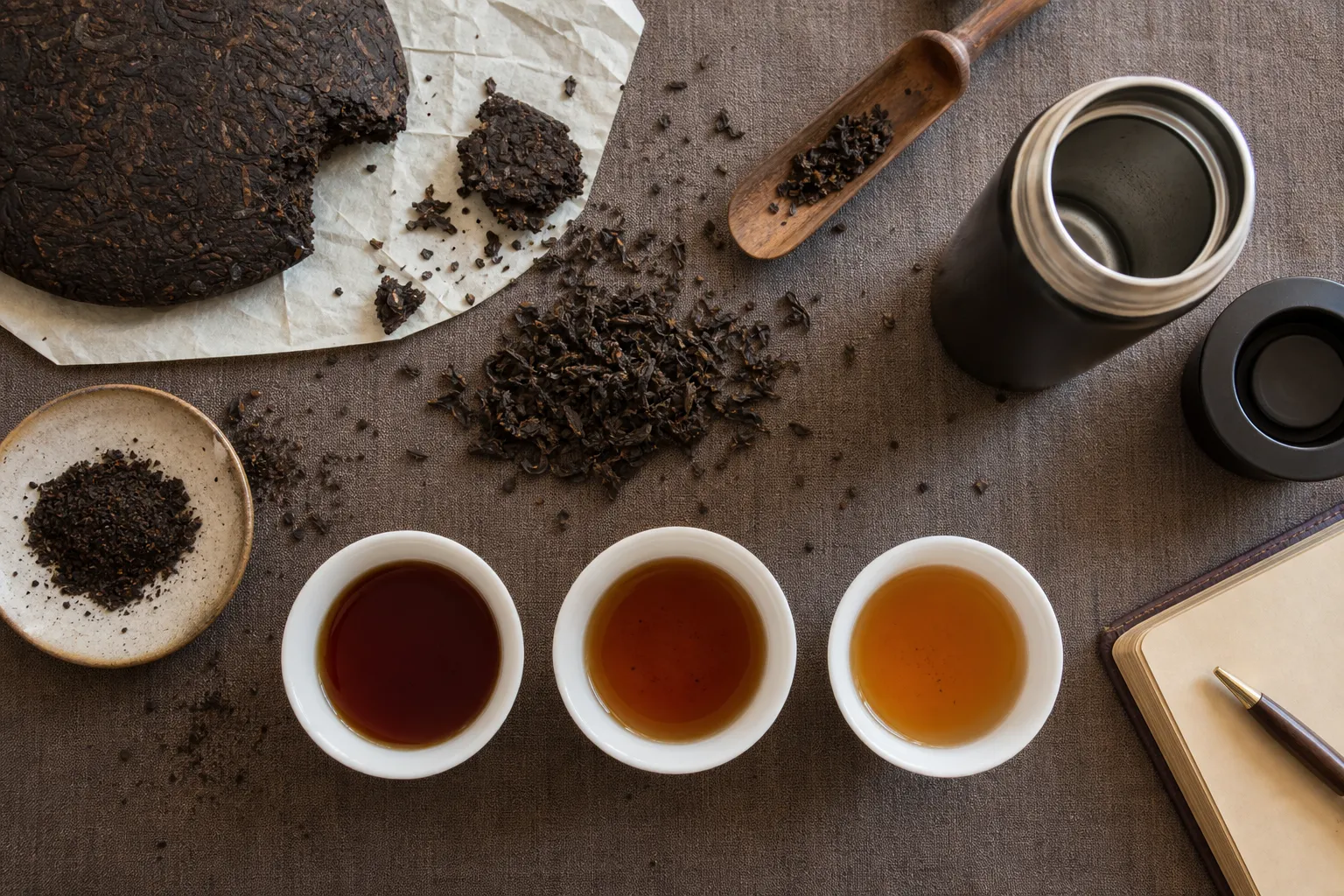
Clean aroma matters more than age claims
Many drinkers hope age alone will make dark tea better for a thermos. Rested tea can be pleasant, and research on ripe pu-erh storage shows that aroma and chemical profiles can change over time. But age is not a guarantee of clean flavor. Storage character can be good, neutral, or distracting.
For thermos brewing, judge what is in front of you:
- Does the dry leaf smell clear rather than stale?
- Does the wet leaf smell settled rather than sour or fishy?
- Does the first sip feel rounded rather than dirty or sharp?
- Does the finish stay pleasant after the tea cools slightly?
- Would you want this flavor for a whole morning?
A young ripe pu-erh that smells clean may be more useful in a thermos than an older tea with unpleasant storage. A Liu Bao with a tidy woody or nutty profile may be more appealing than a ripe pu-erh that feels thick but dull. The reverse can also be true. Category, age, and origin are clues, not final answers.
This is also where “dark tea vs black tea” confusion matters. English black tea often becomes brisk, tannic, or drying under long hot extraction, depending on the tea. Dark tea in the Chinese hei cha sense is a post-fermented category, and many examples are less sharp in long brewing. That is why ripe pu-erh, Liu Bao, and related teas come up so often in thermos-brewing discussions.
Common misunderstandings
“A thermos will smooth out rough tea.”
Not reliably. Long hot extraction often amplifies what is already there. If the tea starts sour, fishy, muddy, or unpleasantly musty, the thermos may make those notes harder to ignore.
“Ripe pu-erh is always better than Liu Bao for daily drinking.”
Ripe pu-erh is a common default, not a universal winner. For shu pu-erh daily drinking, the best choice is a clean, smooth tea that stays pleasant as it gets stronger. Liu Bao for thermos brewing can be just as practical when its aroma and body suit your taste.
“Liu Bao and ripe pu-erh are interchangeable.”
They overlap because both belong to the broader dark tea world, but they can differ in material, processing, storage, and flavor direction. Use the same thermos test, but do not expect the same cup.
“More leaf makes a better thermos.”
More leaf makes a stronger thermos. Sometimes that helps; often it just makes the cup heavier. If your ripe pu-erh becomes too thick, reduce the dose before giving up on the tea.
The useful boundary
The strongest available material supports the background: ripe pu-erh is a post-fermented dark tea; pile fermentation changes taste chemistry and aroma; storage can further change the profile; and dark teas vary widely inside their categories. That helps explain why ripe pu-erh often gives a mellow, thick cup and why Liu Bao or another hei cha can be a real alternative.
What the evidence does not settle is the exact daily thermos formula. There is no strong thermos-specific source confirming one best leaf amount, holding time, or universal ripe pu-erh-versus-Liu Bao result. So the reliable method is practical and sensory: use a clean vessel, choose clean-smelling leaf, begin with a conservative dose, and adjust from the cup you actually get.
For most drinkers, the decision is simple. Start with ripe pu-erh if you want dark, smooth, earthy body. Reach for Liu Bao or another dark tea if you want a cup that may feel woody, nutty, brighter, or less dense. Keep whichever one remains clean, balanced, and drinkable after long extraction.
Sources
Sources and further reading
Reference links are limited to sources considered suitable for public citation in this page.