
Handling comparison
Dark Tea Cake, Brick, and Loose Leaf: What Changes in Handling
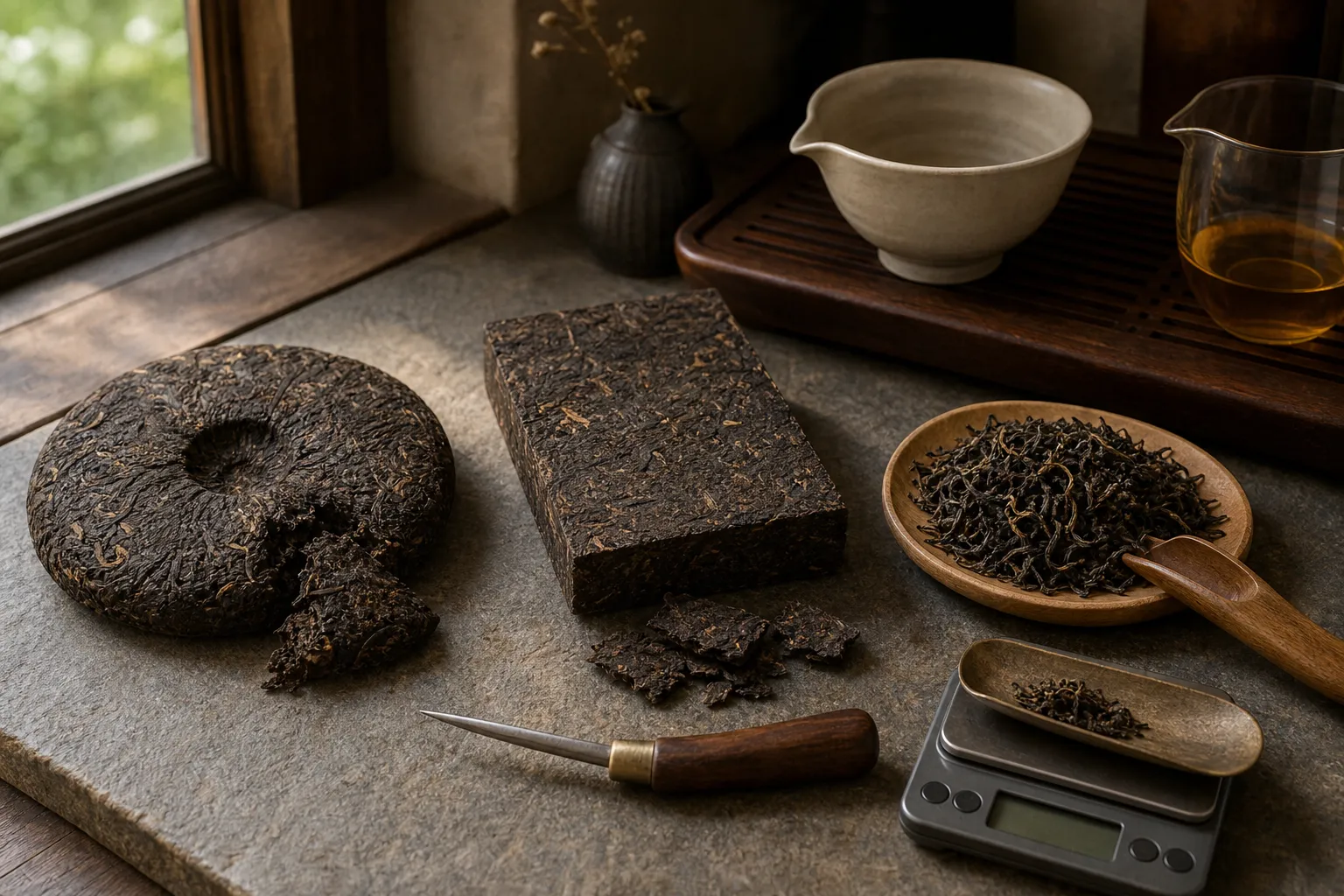
A dark tea cake, brick, and loose leaf differ less by “quality” than by what your hands must do before brewing. In a dark tea cake vs brick vs loose leaf comparison, the handling changes you notice first are prying, portioning, storage exposure, and how quickly the leaves open in water.
Cakes and bricks usually need to be loosened before brewing. Loose leaf can usually be weighed or scooped directly. Bricks often store compactly. Cakes vary widely depending on compression. Loose leaf is the most convenient for daily brewing, but after opening it has more exposed surface and can pick up odors more easily if stored carelessly.
The useful question is not “Which form is best?” It is: which form fits the way you brew, store, and adjust tea on an ordinary day?
upward
Start with the broader guide
Use the broader guide first if you need the full scope before this page.
The first difference is physical: prying, breaking, or scooping
A dark tea cake is a compressed form, often round and flat. A tea brick is also compressed, usually rectangular. Loose leaf dark tea is not pressed into a solid block, so the first step is simpler: open the container, measure the leaf, and brew.
With a cake or brick, the first task is loosening the tea without crushing too much of it into powder. This is where the label “cake” or “brick” can mislead. Compression matters more than shape.
A loosely pressed cake may flake from the edge with little effort. A dense tea brick may resist the tool and come away in hard chunks. A very tight cake can be harder to pry than an ordinary brick. The shape gives a clue, but the feel of the tea tells you more.
Look for these handling signs
- Clean flakes: easier to portion, often less dusty.
- Hard chunks: may need more time to open during brewing.
- Many crumbs or fines: can brew quickly and make the liquor heavier.
- Splintering under pressure: slow down and work from another edge or seam.
- Damp wrapper or strange odor: pause, inspect, and keep it away from other tea until you know what you are dealing with.
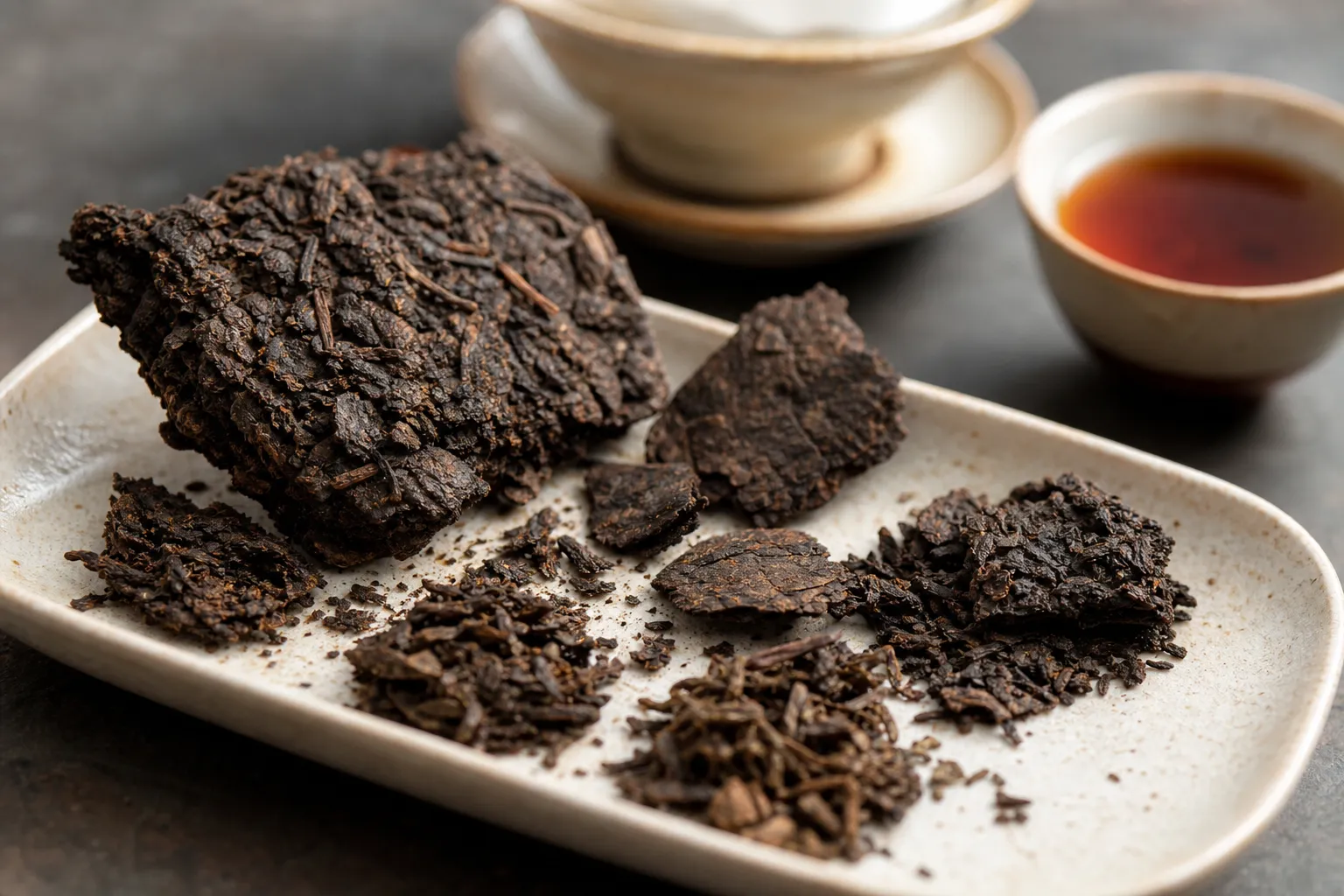
For compressed tea, loosen a small amount gradually rather than forcing off a large piece. Work from an edge, corner, or visible separation in the leaf mass. The goal is not a perfect-looking chunk; it is a usable portion with some intact leaf and not too much dust.
Loose leaf removes this step. That is why many drinkers reach for loose leaf dark tea on workdays, in the office, or for small casual brews. It is easier to repeat and less likely to require a tool. The tradeoff appears later in storage.
Portioning changes: shape affects how accurately you measure
Dark tea portioning is easiest when the leaf is already loose. A scoop or scale can give you a repeatable amount. If you use a small gaiwan, teapot, or mug infuser, loose leaf makes it easy to adjust by a gram or two.
With cakes and bricks, the portion is shaped by the break. You may want 6 grams, but the piece comes off as 4 grams of chunk plus 2 grams of crumbs, or as one stubborn 8-gram block. That does not make compressed tea difficult, but it does make the first attempt less exact unless you weigh after prying.
A simple way to manage compressed dark tea
- Loosen a little more than you need.
- Separate large chunks, flakes, and crumbs.
- Weigh the portion if you want repeatability.
- Save extra dry fragments in a small clean container, or return them carefully to the wrapper if they are dry and odor-free.
The mix of particle sizes matters. A portion made mostly of intact chunks behaves differently from a portion full of thin flakes and fines. If you compare dark tea cake vs loose leaf using the same weight, the cup may still taste different because water reaches the leaf differently.
Dark tea cake
Portioning feel: may flake cleanly or break unevenly.
Watch: chunk size, crumbs, tool pressure.
Tea brick
Portioning feel: compact, stackable, sometimes dense.
Watch: hard corners, tight compression, dust from forceful breaking.
Loose leaf dark tea
Portioning feel: usually easiest to scoop or weigh.
Watch: more exposed leaf surface, broken-leaf ratio.
If the cup tastes thin, you may not have used too little tea. A dense chunk may simply not have opened yet. If the cup tastes harsh, heavy, or muddy, too many crumbs may have released quickly.
Brewing behavior: chunks open slowly, crumbs speak early
Compressed tea brewing is not a separate rulebook. It is a small adjustment problem. Cakes and bricks can give you chunks, flakes, and crumbs in the same session. Loose leaf usually hydrates more evenly at the beginning because water reaches more surface from the start.
Research on dark tea and Fu brick tea often discusses post-fermentation, storage change, and aroma release during hot-water extraction. For brewing at the table, the practical cue is simpler: watch how the leaves open over the first few infusions.
With compressed tea
- Large chunks may need a rinse or a slightly longer early infusion to loosen.
- Thin flakes often release sooner.
- Crumbs and fines can darken the liquor quickly and push the cup toward heaviness.
- Mixed pieces may brew unevenly at first, then settle once the leaf opens.
With loose leaf
- The first infusion often gives a clearer read on strength.
- Hydration is usually more even early in the session.
- Broken leaves can still release quickly, so loose leaf is not automatically gentle.
- Storage aroma, if present, may show up quickly because more surface is exposed.
Start with your normal leaf amount, then adjust time before assuming the form needs a completely different recipe. If a chunked cake or brick tastes weak in the first infusion, extend slightly or let the leaves open through another short steep. If a crumb-heavy portion tastes too strong, shorten the next steep or use fewer fines next time.
For bowl, mug, or casual grandpa-style brewing, loose leaf is often easier because there is no prying step. For short infusions in a small vessel, compressed tea works well once the portion is broken into manageable pieces. The important part is not the name of the shape; it is the size and density of what you actually put in the vessel.
Storage after opening: compactness versus exposed surface
Storage is where compressed tea shapes become more than a brewing convenience. A cake or brick is compact. It can be wrapped, stacked, and kept together with less loose surface exposed than a jar of fully loose leaf. That does not make compressed tea automatically protected, but it often gives you a tidier object to manage.
Loose leaf dark tea has more exposed surface area. This makes it convenient to brew and easy to measure, but it also asks for more care after opening. It can pick up cabinet smells, kitchen odors, perfume, smoke, cardboard notes, or stale container smells if stored carelessly. Light, heat swings, dampness, and excessive air movement can also change tea over time.
For all three forms, the useful home-storage question is conditional
- Is the room humid, very dry, or prone to temperature swings?
- Is the tea dry and clean-smelling?
- Is the wrapper intact?
- How often will you open the container?
- Is the storage place free from strong odors?
- Will the tea be exposed to sunlight or condensation?
A cake left in a torn wrapper beside spices may absorb unwanted smells. A brick stored in a damp corner may become questionable to keep with other tea. Loose leaf in a clean, odor-neutral container may stay more pleasant than compressed tea stored in a poor environment.
Use observable caution signs rather than fixed rules. If you notice condensation, damp wrappers, visible mold-like growth, a strong musty smell, or a foreign odor that dominates the tea, stop and inspect before brewing. Keep questionable tea away from other tea. Appearance alone cannot settle every storage concern.
For everyday storage after opening
- Keep tea away from direct sunlight.
- Avoid kitchens, scented cupboards, smoke, and perfume.
- Do not store tea where condensation forms.
- Keep loose leaf in a clean, odor-neutral container.
- Rewrap cakes and bricks neatly so broken areas are not left fully exposed.
- Label loose fragments if you separate them from the original wrapper.
Compressed forms are often easier to keep compact. Loose leaf is often easier to use. Neither advantage replaces clean, stable storage.
Cake vs brick is often less important than compression
Many readers search for dark tea cake vs brick as if shape alone decides handling. In practice, the answer is narrower: shape affects how you grip, stack, and approach the tea, but compression decides much of the difficulty.
A cake gives you a curved edge and broad face. Some cakes loosen well from the edge. Others, especially dense examples, resist prying and shed small fragments if forced.
A brick gives you corners and flat sides. It may stack neatly and store efficiently, but a dense brick can be hard to break, especially if you try to remove a piece from the center instead of working gradually from a corner or edge.
Market names can add confusion. Terms such as tea cake, tea brick, tuo cha, Fu brick tea, and other compressed tea shapes describe form, tradition, or product type. They do not automatically tell you how easy the tea will be to loosen, how it will taste, or how it should be stored in your room.
A practical choice looks like this
- Choose loose leaf dark tea if you want fast measuring, no prying, and easy small sessions.
- Choose a dark tea cake if you like compressed tea and want a form that may flake easily when not too dense.
- Choose a tea brick if compact storage and stacking matter, and you do not mind breaking from corners or edges.
- Do not buy by shape alone if handling matters; ask or inspect how tightly the tea is pressed when possible.
The most useful comparison is the actual tea in front of you: how tight it is, how dry it feels, how it breaks, how it smells, and how the first infusions behave.
A quick handling check before you brew
Before brewing any dark tea cake, brick, or loose leaf, spend a few seconds with the dry material.
Check the tea
- Does it smell clean, aged, woody, earthy, sweet, or mellow?
- Does it instead smell like damp cloth, smoke, perfume, kitchen spice, or cardboard?
- Is the wrapper dry and intact?
- Are the leaves loose, flaky, chunky, or powdery?
- For compressed tea, does the edge separate naturally, or does it resist heavily?
Then match the brew to what you see. Mostly chunks? Expect slower opening. Many crumbs? Shorten the early steeps. Loose leaf? Start normally, but watch for quick strength changes. If the tea has picked up a storage odor, brewing technique may not fully hide it.
This is the handling difference in its simplest form: compressed tea asks for a breaking step and rewards attention to chunk size; loose leaf saves time but needs cleaner storage discipline. The better choice is the one that fits your brewing rhythm, storage space, and patience before the kettle is ready.
Sources
Sources and further reading
Reference links are limited to sources considered suitable for public citation in this page.