
Practical dark tea handling
How to Break a Dark Tea Brick Without Crushing the Leaves
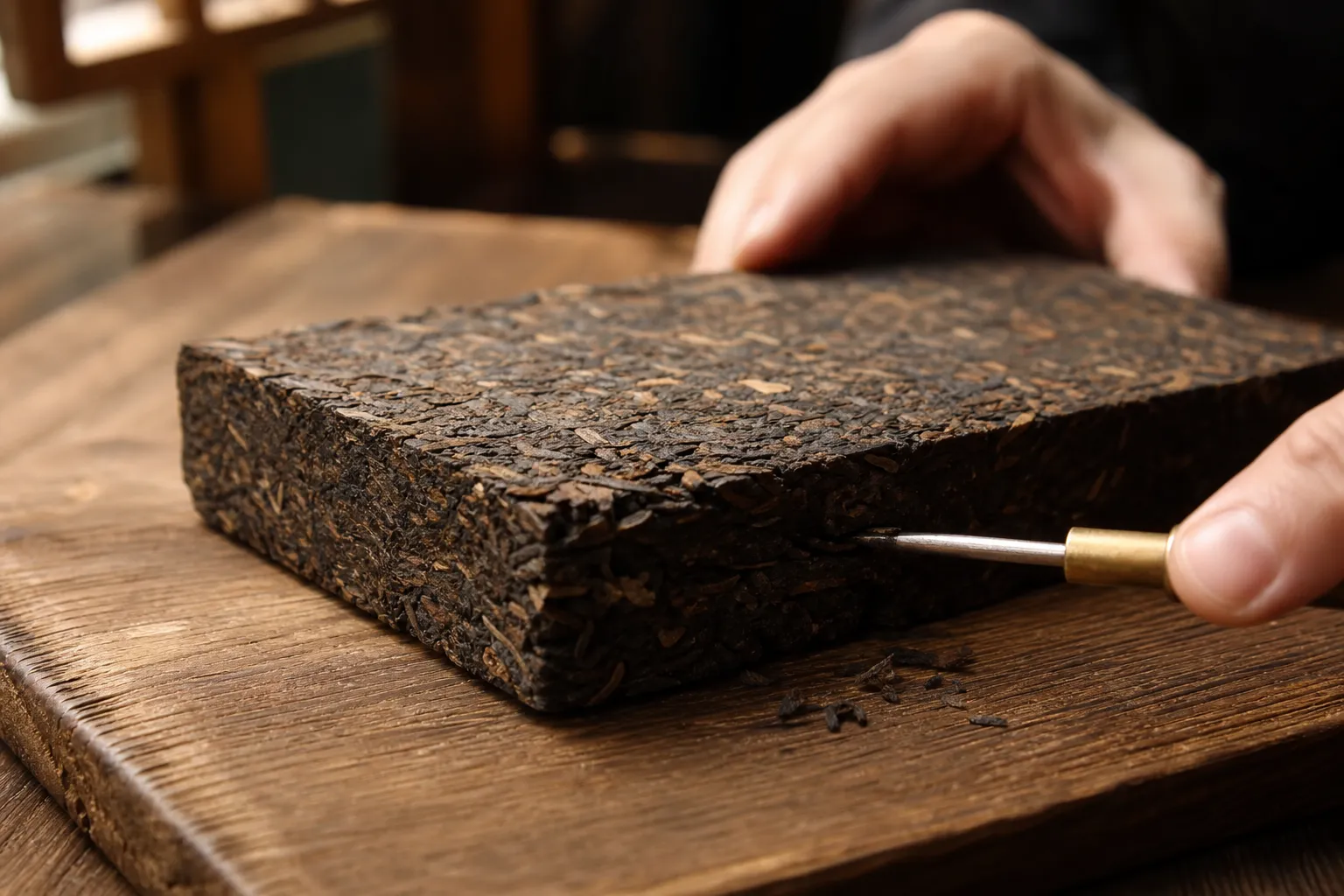
To break a dark tea brick without crushing the leaves, do not snap it by hand or cut down through the flat face. Set the brick on a stable tray or cutting board, find an edge or corner where the compressed layers are visible, and use a tea needle or tea pick to pry from the side. Keep the tool almost parallel to the layers, wiggle gently, and repeat shallow insertions until a brewable piece loosens.
That is the practical answer to how to break a dark tea brick: start at the edge, loosen before lifting, and accept a few crumbs instead of forcing the brick apart.
The aim is not perfect whole-leaf separation. Compressed dark tea is meant to hold together. A good result is a small layered chunk, some flakes, and only a modest amount of fine dust.
upward
Read the full overview first
Use the broader guide first if you need the full scope before this page.
Set up the brick before using force
A tightly compressed dark tea brick can feel almost wooden, but the cleanest method starts with control rather than strength. Work on a table, counter, tea tray, or cutting board that will not slide. If the brick shifts while the tool is inside it, the pick can jump.
Keep the setup dry. For ordinary portioning, moisture is not needed, and it can create storage problems if the remaining brick is not dried and handled carefully afterward. Use clean, dry tools and keep the loosened tea away from cooking smells, damp cloths, and clutter.
Tea needle or tea pick
Gives narrow, controlled pressure for prying compressed tea.
Stable tray or cutting board
Keeps the brick from sliding and catches crumbs.
Small dish or paper
Holds flakes, dust, and the piece you remove.
Clean, dry hands
Useful after the layers have started to separate.
A tea needle for a tea brick is usually easier to control than a kitchen knife. A knife cuts across leaves and can skid on a hard compressed surface. A sturdy, smooth substitute may work in a pinch, but the usual tea brick tool is a pick or needle meant for prying rather than slicing.
Do not hold the brick in your lap. Do not brace it with your palm in front of the tool. Keep the point aimed away from your body, wrist, thigh, and anyone nearby.
Find the layer before you pry
Look at the brick as a compressed stack, not as a solid block. Many bricks show faint horizontal leaf layers, seams, small cracks, or looser corners. These are the places to start.
The center of the top face is usually the worst entry point. A top-down stab pushes into the tightest part of the compression and often makes dust before anything releases. Instead, start at a tea brick edge or corner, where the tool has a chance to slide between compressed tea brick layers.
Look for:
- a corner that already looks slightly open;
- an edge with visible sheets, flakes, or leaf lines;
- a small crack or seam;
- a spot that gives slightly under gentle pressure;
- a less glossy, less tightly pressed area.
If the brick is very dense, do not search for one dramatic weak point. Choose the least resistant edge and work in several small attempts nearby: insert, wiggle, withdraw, shift a little, and repeat.
Use a small, shallow prying motion
Insert the tea pick from the side or corner, not straight down from the top. Keep the shaft close to the direction of the layers. You are trying to separate the leaf sheets, not drill through the brick.
The motion should feel more like loosening a tight envelope flap than cracking a nut. If the tool does not move, back out and try a nearby spot. More pressure is not always cleaner or safer; it can make the tool slip or turn the tea into powder.
A simple sequence:
- Place the brick flat on a stable surface.
- Choose a corner, edge, seam, or visible layer.
- Insert the tea pick shallowly from the side.
- Wiggle the handle gently left and right.
- Withdraw and repeat a little above, below, or beside the first point.
- When the area begins to open, lift slightly rather than levering hard.
- Use your fingers only after the piece has loosened.
- If the piece is too large, split it again along its layers.
Avoid twisting the tool like a screwdriver. Avoid using the pick as a crowbar with your hand in front of it. The brick may release suddenly, and the tool will keep moving.
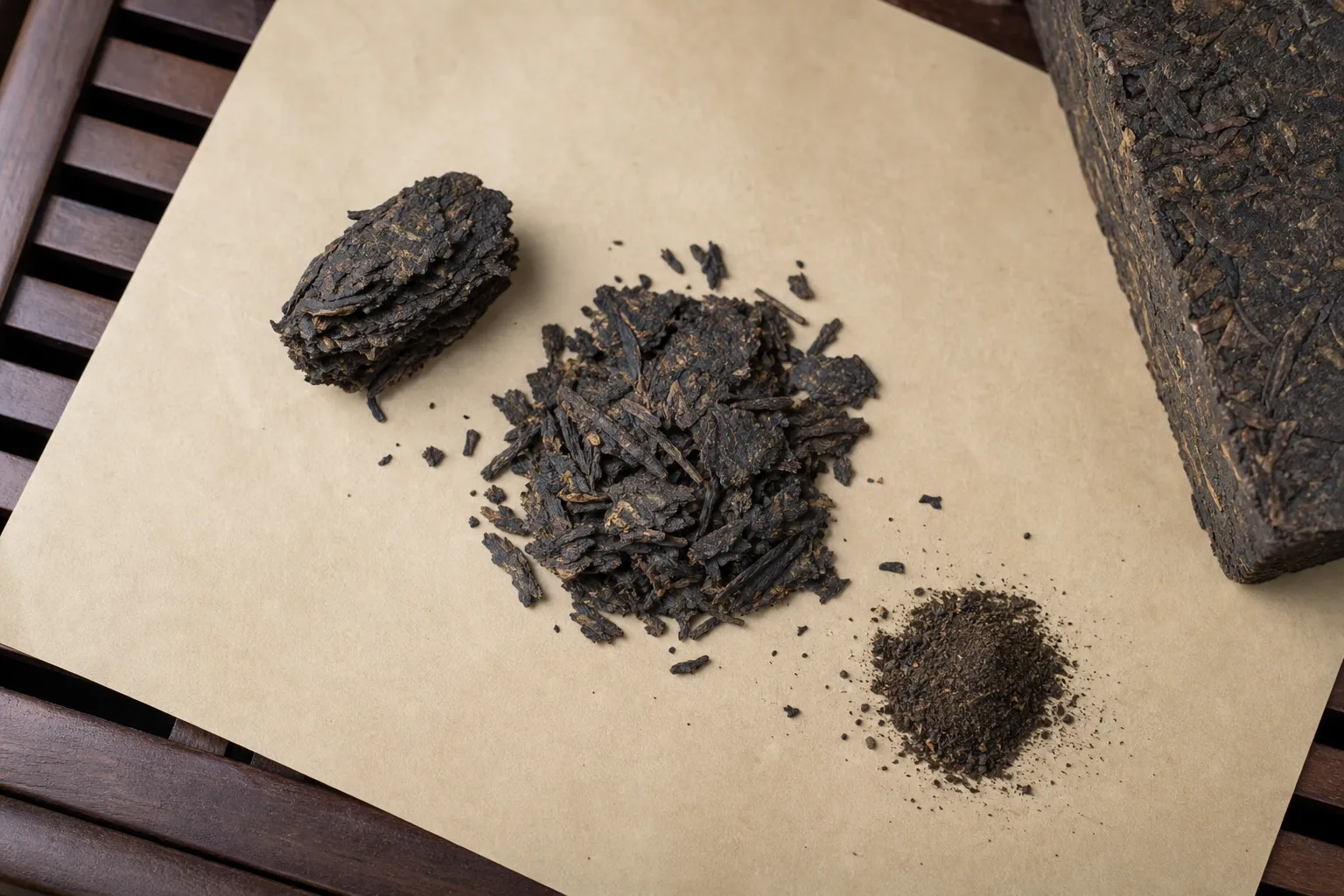
When the prying works well, the tea often comes away as a layered chunk with flakes around it. That is enough. You do not need to turn the whole brick into loose leaf before brewing.
How large should the piece be?
There is no single ideal piece size. It depends on the tea, vessel, water, leaf ratio, and steeping style. For this task, the better question is whether hot water can reach the inner layers during brewing.
A usable piece should be small enough to hydrate evenly in your vessel. If the chunk is thick, hard, and rock-like, split it again along its natural layers. Do not smash it flat. Smashing creates more fine particles than you usually need, and dusty tea can extract quickly.
Fewer crushed particles often make the brew easier to control. In many everyday brewing setups, too much dust can make early infusions taste stronger, sharper, heavier, or murkier than expected. That is not a universal rule. Some teas handle broken material well, and some drinkers like a more forceful first cup. The practical point is simple: a layered piece plus a few flakes gives you more room to adjust than a pile of powder.
What to do with crumbs, flakes, and extra tea
Some crumbs are normal when you loosen a tea brick. Treat them as part of portioning, not as failure. The aim is to break a tea brick without dust as much as reasonably possible, not to produce a perfect display sample.
Sort the loosened tea into three loose groups:
Main chunk
The layered piece you plan to brew.
Flakes
Small sheets and loose leaves that can brew with the main piece.
Fine dust
Tiny particles that may extract faster than the rest.
If your portion has a lot of fine dust, adjust the brew rather than discarding it automatically. You can shorten the first steep, use slightly less total tea, or save the dustier bits for a later casual brew. If a quick rinse is already part of your routine, it may also help clear very fine fragments. Let the cup decide: if it tastes thin, harsh, heavy, flat, or pleasantly strong, adjust from there.
If you loosen more tea than you need, keep the extra dry and protected from odors. A clean paper wrapper, small tin, or dry container can work for short-term holding. Label it if you keep several teas open.
Common points of confusion
Can I just break the brick by hand?
Sometimes a loosely compressed edge can be flaked by hand after it has been opened with a pick. Starting with your hands alone usually crushes the outer layers and sends fragments across the table. Fingers are better for finishing the separation, not forcing the first break.
Is a kitchen knife faster?
It may look faster, but it is usually the wrong kind of force. A knife is made to cut. A tea pick is used to pry. Cutting down through a compressed brick can shear leaves, skid on the hard surface, and put your hand in a poor position. If you use any substitute tool, choose something sturdy, controlled, and not aimed toward your body.
Should I steam a dense brick to loosen it?
Steaming appears in some discussions of extremely stubborn compressed tea, but it is not a normal beginner method. Added moisture raises practical questions about cleanliness, drying, odors, and storage of the remaining brick. For an everyday dark tea brick, start with dry edge-prying, smaller movements, and patience. If a brick feels impossible to portion safely, pause rather than escalating to moisture or heavy tools.
Do I need to loosen the whole brick at once?
No. Loosen only what you need, or a little more if the brick opens cleanly. Keeping the rest intact can make storage simpler and reduces extra handling. If you prefer ready-to-brew portions, separate them gradually and keep them dry.
Quick safety checks
Breaking compressed tea is a small task, but the tool is pointed and the brick can release without warning.
- Work on a stable table, counter, tray, or cutting board.
- Keep your supporting hand behind or beside the tool path, never in front of it.
- Do not aim the pick toward your palm, wrist, lap, or torso.
- Use slow pressure instead of a hard stab.
- Stop if the brick shifts, the tool bends, or your hand position feels awkward.
- Avoid chisels, hammers, vises, saws, and other workshop-style force for ordinary tea preparation.
A dense brick can make a careful person impatient. That is the moment to slow down. Move to another edge, take a smaller bite, and let repeated shallow insertions do the work.
Brick versus cake: the small difference that matters
The same general method applies to many compressed dark teas, but the starting point can differ. A round cake may invite work from the side, rim, or back hollow if it has one. A rectangular brick usually makes the edge or corner the most practical starting point.
This article stays with the brick because its flat faces can tempt people to press straight down. Resist that impulse. With a brick, the edge is your friend: it reveals the layers and gives the tea pick room to slide between them.
A clean break is controlled, not perfect
The clean everyday method is simple: stable surface, dry brick, edge entry, tool nearly parallel to the layers, gentle wiggle, repeated nearby insertions, and a small lifted piece. That approach helps you pry a tea brick safely while limiting unnecessary dust.
Expect a few crumbs. Use them. Adjust the first steep if the portion is dustier than usual. What matters is not flawless separation, but a brewable piece removed without smashing the brick or putting your hand in the path of the pick.
Sources
Sources and further reading
Reference links are limited to sources considered suitable for public citation in this page.