
Dark tea comparison
Does Compressed Dark Tea Taste Different From Loose Leaf Dark Tea
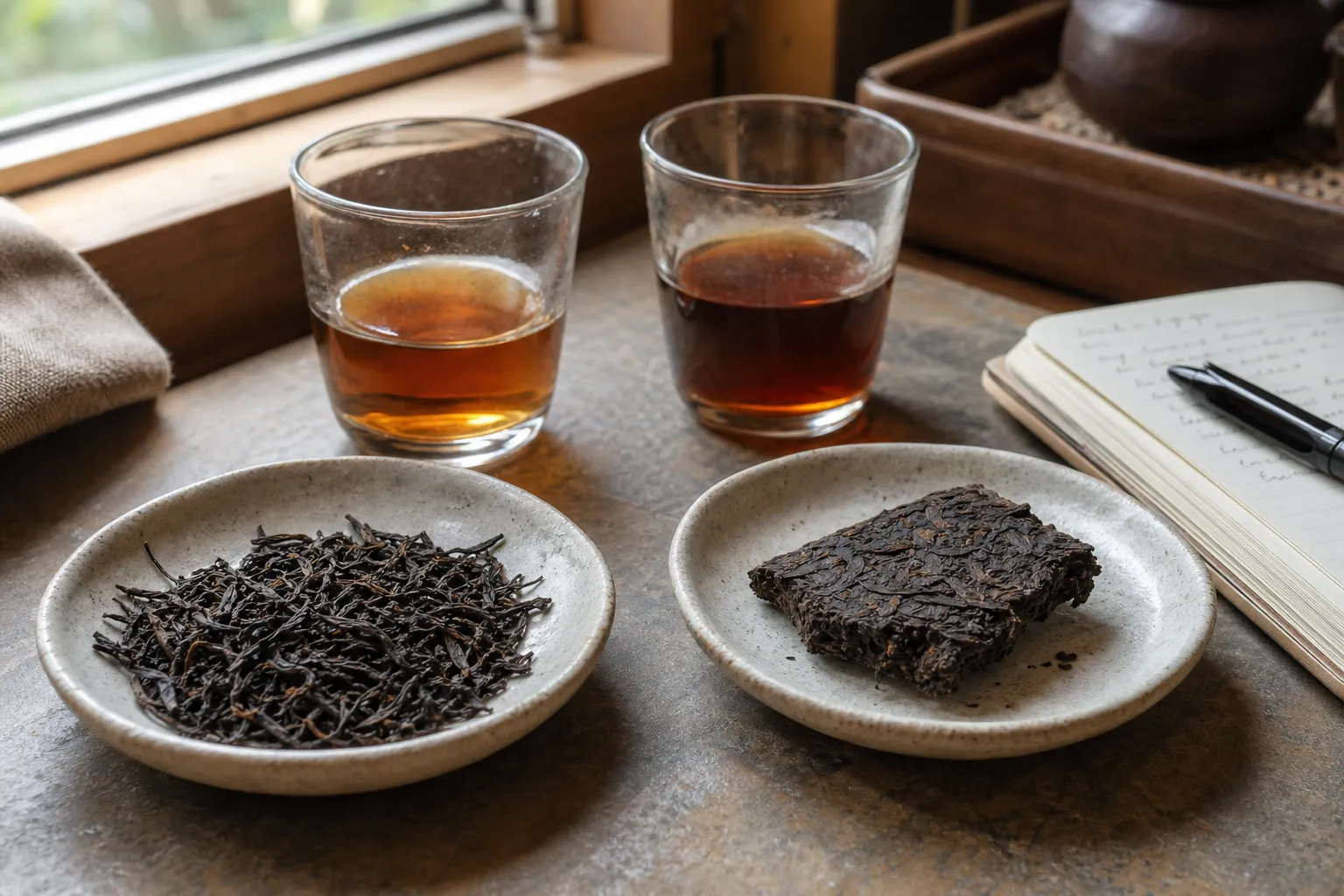
Yes, compressed dark tea can taste different from loose leaf dark tea, but not because every brick has one fixed “brick flavor.” In the cup, the most common difference is pace. Loose leaf dark tea often hydrates quickly and gives a more even first infusion. A dense piece from a brick, cake, or tile may open slowly, taste quiet at first, then become fuller in later steeps.
There are exceptions. A crumbly edge or dusty broken piece from compressed tea can extract very fast, giving dark color, heavy body, and possible bitterness before the aroma has caught up. So the useful answer to compressed dark tea taste is conditional: form matters, but chunk size, storage, processing, water, vessel, and steeping time can matter just as much.
upward
Start with the broader guide
Use the broader guide first if you need the full scope before this page.
The difference usually begins with how the leaf opens
Loose leaf dark tea has more immediate contact with water. The leaves are already separated, so hot water can move around them with less resistance. In many everyday brewing setups, the first infusion shows aroma, color, and body more evenly. The cup is easier to read early: woody, earthy, sweet, mellow, sharp, thin, or flat notes tend to appear without waiting for a dense center to loosen.
Compressed tea is less uniform. A brick or cake piece has an outer surface and a tighter inner core. The outside extracts first. The center may stay partly dry through the first steep, especially if the piece is thick or tightly pressed.
That is why compressed tea extraction can feel staged:
- The first steep may be pale, woody, or quiet.
- The second or third steep may gain body suddenly.
- Later steeps may become rounder or sweeter once the piece opens.
- A dense chunk may keep giving flavor after a loose-leaf portion has faded.
This does not mean compressed tea is always stronger. A tight piece can taste weaker at first. A broken edge with many exposed surfaces can taste stronger. Compression changes the path of extraction; it does not automatically improve the tea.
A simple way to frame it: loose leaf often gives a clearer early picture, while compressed tea may need a few steeps before it shows its balance.
Pressing can matter, but the evidence should stay narrow
There is direct research support for the idea that pressing can be associated with sensory and chemical differences in dark tea. One open-access study compared Fu brick tea and Fu loose tea made from the same raw dark tea material and reported measurable sensory and metabolomic differences between the pressed and loose forms. In that study, the loose Fu tea was described as having a longer-lasting fungal flower aroma and a mellower taste than the brick version.
That is useful, but it should not be stretched into a rule for every dark tea. Fu tea has its own processing sequence, microbial context, and pressing method. Other dark teas may differ by raw material, region, fermentation style, storage age, and compression tightness.
The practical takeaway is modest: dark tea compression is not just a shape for storage. In at least one dark tea context, pressing interacted with sensory properties. For the drinker, that means it is reasonable to expect possible differences between compressed and loose forms, but not reasonable to rank one as always richer, cleaner, stronger, or more authentic.
The cup gives better evidence than the label. Watch whether the compressed piece:
- Opens slowly or quickly.
- Gives color before aroma.
- Becomes fuller in later steeps.
- Releases bitterness from small fragments.
- Carries a storage aroma that dominates the tea’s own character.
Those cues tell you more than the word “brick” by itself.
Chunk size can change the cup more than compression itself
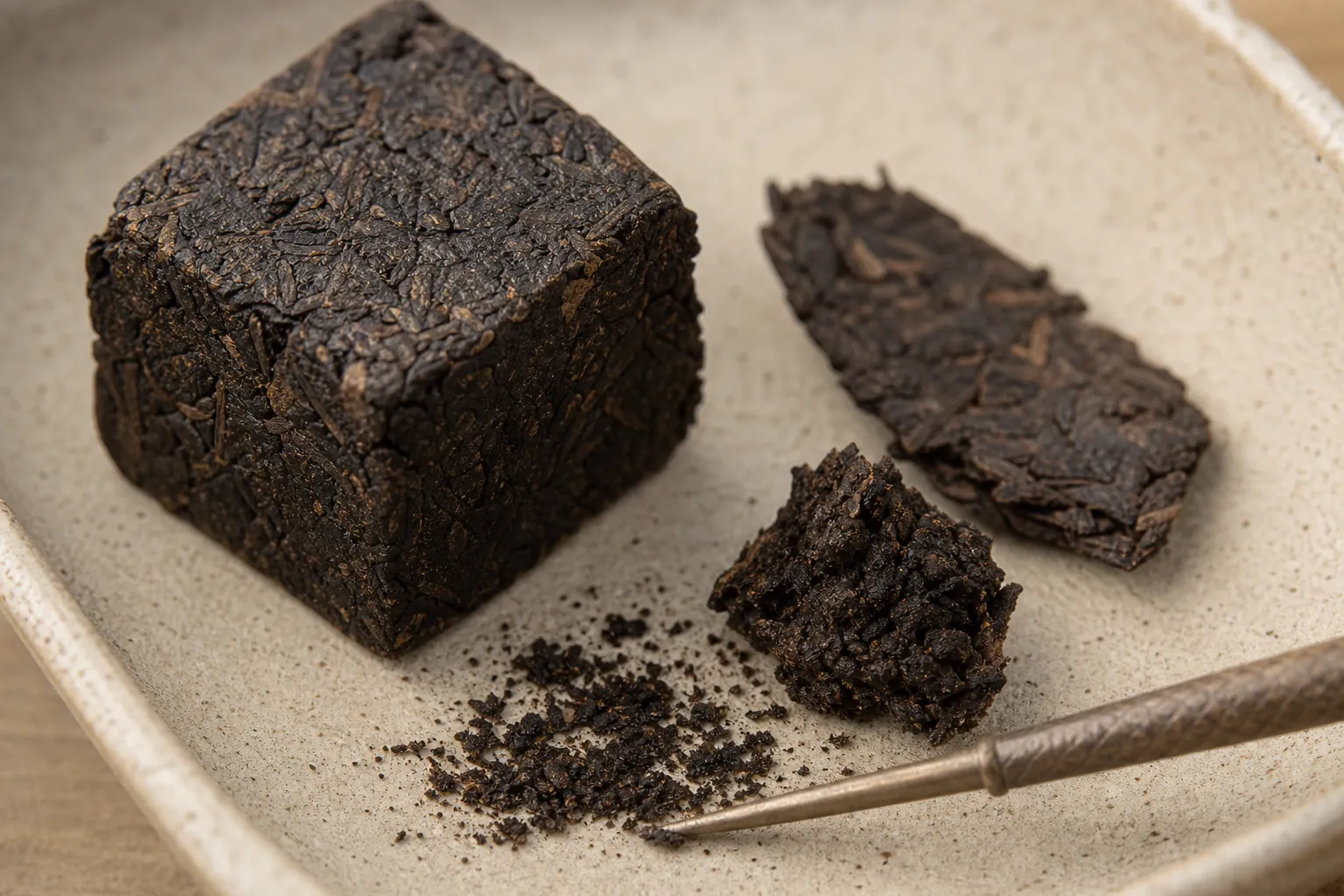
Two pieces from the same compressed tea can brew differently. A dense cube from the middle of a brick behaves differently from a thin flake, a loose corner, or powder from the wrapper. This is one reason drinkers disagree about tea brick flavor: they may be brewing different physical forms, even when the tea is technically the same.
A dense compressed piece often tastes slow because water access is limited. If the first cup is thin, the tea may not lack flavor. It may simply be closed. Try small adjustments before judging it:
- Use a brief rinse to warm and loosen the piece.
- Extend the first drinkable steep by 10 to 20 seconds.
- Use hotter water if the tea seems flat and closed.
- Gently separate the piece after it softens, rather than forcing it apart dry.
- Give the tea one more infusion before deciding it is weak.
Broken compressed tea edges create the opposite problem. Fine fragments and dust expose more surface area, so they extract quickly. A cup can turn dark before the aroma feels complete. It may taste heavy, drying, bitter, or muddy if brewed with the same timing used for an intact chunk.
If compressed dark tea bitterness appears early and sharply, check the leaf before blaming compression. Too much dust, aggressive prying, a long first steep, or strong agitation can push the cup toward harshness. Remove excess powder, shorten the first steep, or use a slightly larger intact piece with fewer broken bits.
Loose leaf dark tea varies too, but it is usually easier to dose. A scale gives the cleanest comparison. Even without one, spoon dosing tends to be more consistent with loose leaves than with uneven chunks from a brick. That consistency is one reason loose leaf dark tea flavor can feel more predictable for daily brewing.
Do not confuse storage aroma with compression flavor
Storage can blur the comparison between compressed versus loose dark tea. Dark tea is often appreciated for woody, earthy, mellow, sweet, fermented, or aged aromas. But a cardboard-like, smoky, damp, stale, wrapper-heavy, or basement-like note may come from where and how the tea was kept, not from compression itself.
Loose leaf has more exposed surface area, so it can pick up surrounding odors if stored carelessly. Compressed tea is more compact, but it is not sealed away from its environment. Wrappers, boxes, shelves, humidity, airflow, nearby foods, smoke, and containers can all affect aroma.
A quick check helps:
- Smell the dry leaf.
- Smell the warmed wet leaf after a rinse or first steep.
- Notice whether the same dull note grows stronger with heat.
- See whether it fades by the second or third infusion.
If a storage note becomes stronger with heat and covers the tea’s sweetness, woodiness, or fermented aroma, you may be tasting storage impact more than format. If the note fades and later steeps become cleaner, the first cup may have carried surface aroma from the wrapper or outer layer.
This is why “brick taste” is too vague to be a reliable tasting conclusion. Sometimes people mean pleasant depth, slow-opening sweetness, or compact earthy body. Sometimes they mean dust, stale aroma, or a dense piece that has not opened yet.
A fair side-by-side tasting keeps the variables small
If you want to know whether a specific compressed dark tea tastes different from a specific loose version, compare them with as few moving parts as possible. The goal is not a laboratory test. It is to avoid mistaking uneven brewing for a real flavor difference.
Use the same setup for both teas:
For compressed tea, choose a representative piece. Avoid using only wrapper dust, but also avoid a huge dense chunk that cannot hydrate in the same time as loose leaf. If the compressed tea is very tight, a brief rinse is fair, as long as the loose tea is treated the same way.
When tasting, do not judge only by liquor color. Dark liquor can arrive before aroma, texture, or aftertaste. Compare:
- Dry-leaf aroma.
- Wet-leaf aroma after first contact with water.
- How quickly body appears.
- Whether bitterness arrives early or late.
- Whether sweetness builds after swallowing.
- Whether the finish is clean, flat, drying, or lingering.
- How the tea changes from steep one to steep four.
This usually shows the real difference: loose leaf extraction and compressed tea extraction often follow different curves, not simple better-or-worse categories.
Quick troubleshooting for common cup results
Compressed tea tastes thin in the first steep
Likely cause: dense piece has not opened.
What to try next: rinse, extend the first steep slightly, or let the softened piece loosen.
Liquor is dark but aroma feels dull
Likely cause: fine fragments extracted fast, or storage aroma is covering the tea.
What to try next: reduce dust, shorten timing, and smell the wet leaf.
Compressed tea turns bitter quickly
Likely cause: too many broken edges, long steep, strong agitation, or a very extractive piece.
What to try next: use fewer crumbs, pour sooner, or keep the piece more intact.
Loose leaf tastes flatter than expected
Likely cause: low dose, tired tea, cooler water, or short steep.
What to try next: increase dose slightly or extend timing in small steps.
Later compressed steeps taste better than the first
Likely cause: the piece opened gradually.
What to try next: judge after the tea has hydrated, not only from the first cup.
Small changes work better than dramatic ones. If the cup is thin, add time before adding much more leaf. If it is harsh, reduce dust or shorten the steep before dropping the water temperature too far. Dark tea can lose clarity when too many variables move at once.
So which form should you choose?
Choose loose leaf dark tea if you want easy dosing, quick daily brewing, and a more even early infusion. It is useful when you are learning a tea’s basic aroma and flavor because the leaves open with less negotiation.
Choose compressed dark tea if you enjoy compact storage, breaking pieces from a brick or cake, and slower opening steeps. It can be satisfying when you want a session that changes gradually instead of giving everything at once.
Neither form is automatically more flavorful. Compressed dark tea can taste different from loose leaf dark tea because pressing, density, chunk size, and water access can change extraction, and in some dark tea contexts pressing is associated with measurable sensory differences. But the final cup still depends on the individual tea, how it was processed, how it was stored, and how you brew it.
The best answer is sensory rather than ideological: compare the same weight, watch how the leaves open, taste beyond color, and adjust for the piece in front of you.
FAQ
Is compressed dark tea stronger than loose leaf dark tea?
Not always. A dense compressed piece may taste weaker in the first steep because the center has not opened. A dusty broken piece may taste stronger because it extracts quickly. Strength depends on dose, surface area, steeping time, water temperature, and how tightly the tea is pressed.
Why does my compressed dark tea taste thin at first?
The piece may still be closed. Try a brief rinse, slightly longer first steep, or let the softened piece loosen before judging the tea. If later steeps become fuller, the issue was probably extraction pace rather than lack of flavor.
Why does my tea brick taste bitter?
Early bitterness often comes from small fragments, dust, long steeping, or strong agitation. Remove excess powder, use a more intact piece, and shorten the first steep. If the bitterness remains across several careful brews, it may be part of that tea’s material or processing.
Is “brick taste” a real flavor note?
It is not precise enough on its own. People use it to mean different things: slow-opening body, earthy depth, dusty edges, wrapper aroma, stale storage notes, or a dense chunk that has not fully hydrated. Describe what you actually taste instead: woody, sweet, damp, sharp, flat, bitter, mellow, or lingering.
Sources
Sources and further reading
Reference links are limited to sources considered suitable for public citation in this page.