
Chinese dark tea meaning
What Hei Cha Means in Chinese Tea Culture
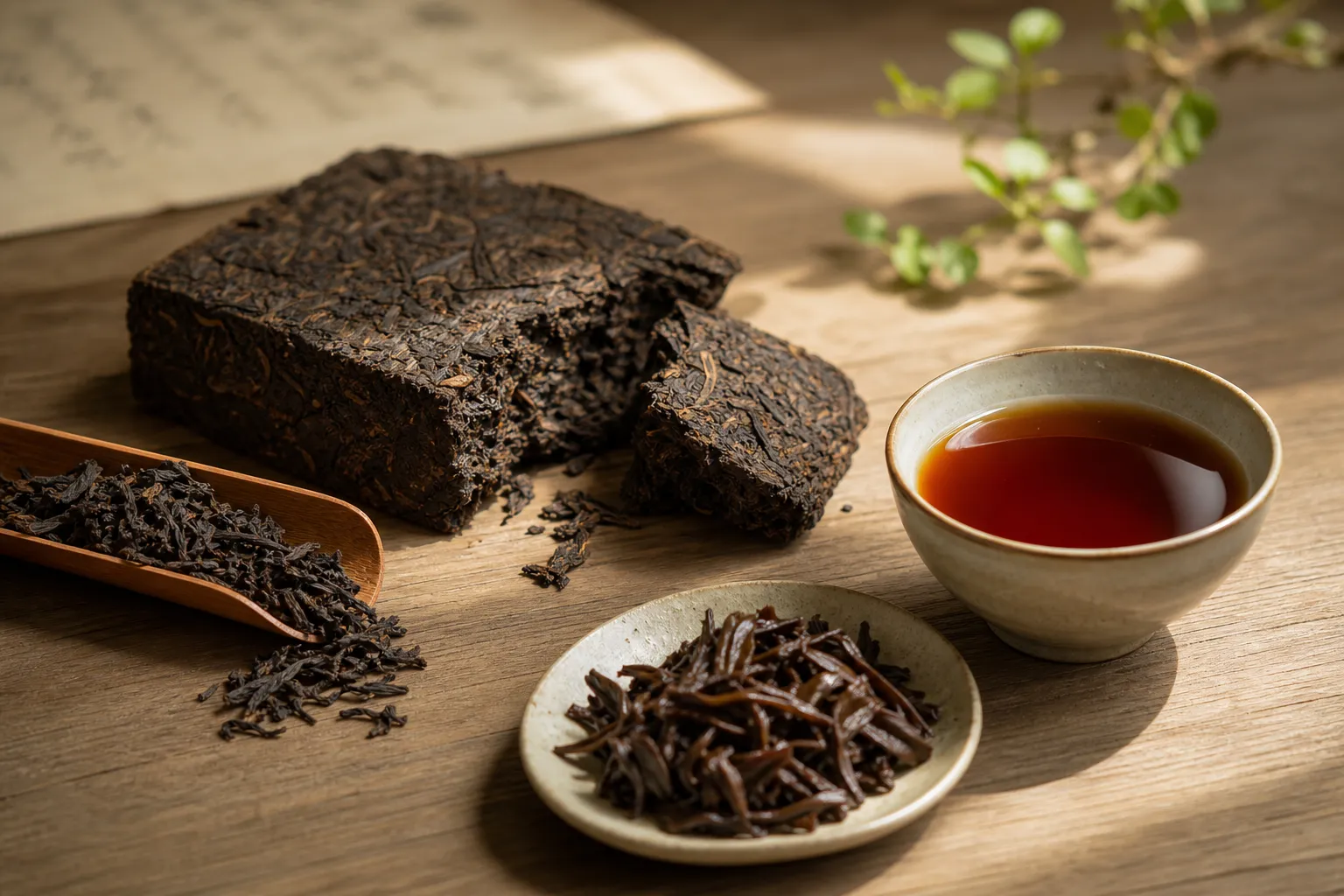
A compressed brick, a dark loose-leaf scoop, or a small broken piece from a cake can all lead to the same question: what does hei cha mean?
In practical English, hei cha means the Chinese dark tea category. It points to a family of fermented teas understood through form, storage, brewing behavior, and cup character, not through one fixed flavor. In hei cha culture, the term is most useful as a reading tool: it tells you to look at compression, aroma, liquor color, storage condition, and how the leaf opens in water.
That does not make every hei cha old, rare, valuable, or better than another tea. It simply gives you the right shelf of questions to ask before you brew.
upward
Read the full overview first
Use the broader guide first if you need the full scope before this page.
Hei Cha Is a Category, Not One Taste
The most useful Chinese dark tea meaning is categorical. Hei cha names a type of tea, not one aroma, one ceremony, or one universal brewing method. For an English-language drinker, that matters because the label can appear on very different forms: loose leaf, pressed cakes, bricks, small chunks, or broken pieces prepared for daily brewing.
Better first questions
- What form is this tea in?
- Does the dry leaf smell clean, heavy, sweet, stale, or damp?
- Does the first cup open quickly or slowly?
- Does the next steep need more time, less leaf, or a cleaner comparison sample?
Because this page does not have public reference sources to support detailed historical, regional, or technical claims, it keeps the answer narrow. Hei cha is treated here as a Chinese dark tea category whose meaning becomes practical when you connect the label to the leaf in front of you.
For the cup, start with what you can see and control: loose or compressed form, dry aroma, liquor color, steeping time, vessel size, and whether the taste feels thin, harsh, flat, earthy, sweet, or too heavy.
What the Term Changes at the Tea Table
When a tea is described as hei cha, it changes your expectations before it changes your recipe. You are not treating the leaf like a delicate green tea or a bright black tea in the English supermarket sense. You are reading a dark tea label that often invites hotter water, closer attention to storage aroma, and a patient look at the liquor over several infusions.
Form
Loose-leaf dark tea usually gives up flavor more quickly because water reaches more surface area. A compressed brick or cake piece may need a rinse or a slightly longer opening steep because the leaves are packed together. A broken chunk sits between those two behaviors: easier to open than a tight cake, slower than loose strands.
Aroma
Smell the dry tea, then the warmed leaf if you use a warmed vessel. Look for woody, earthy, mellow, sweet, stale, sharp, or damp notes. These words do not prove origin, age, or quality. They help you decide what to do next.
Rhythm
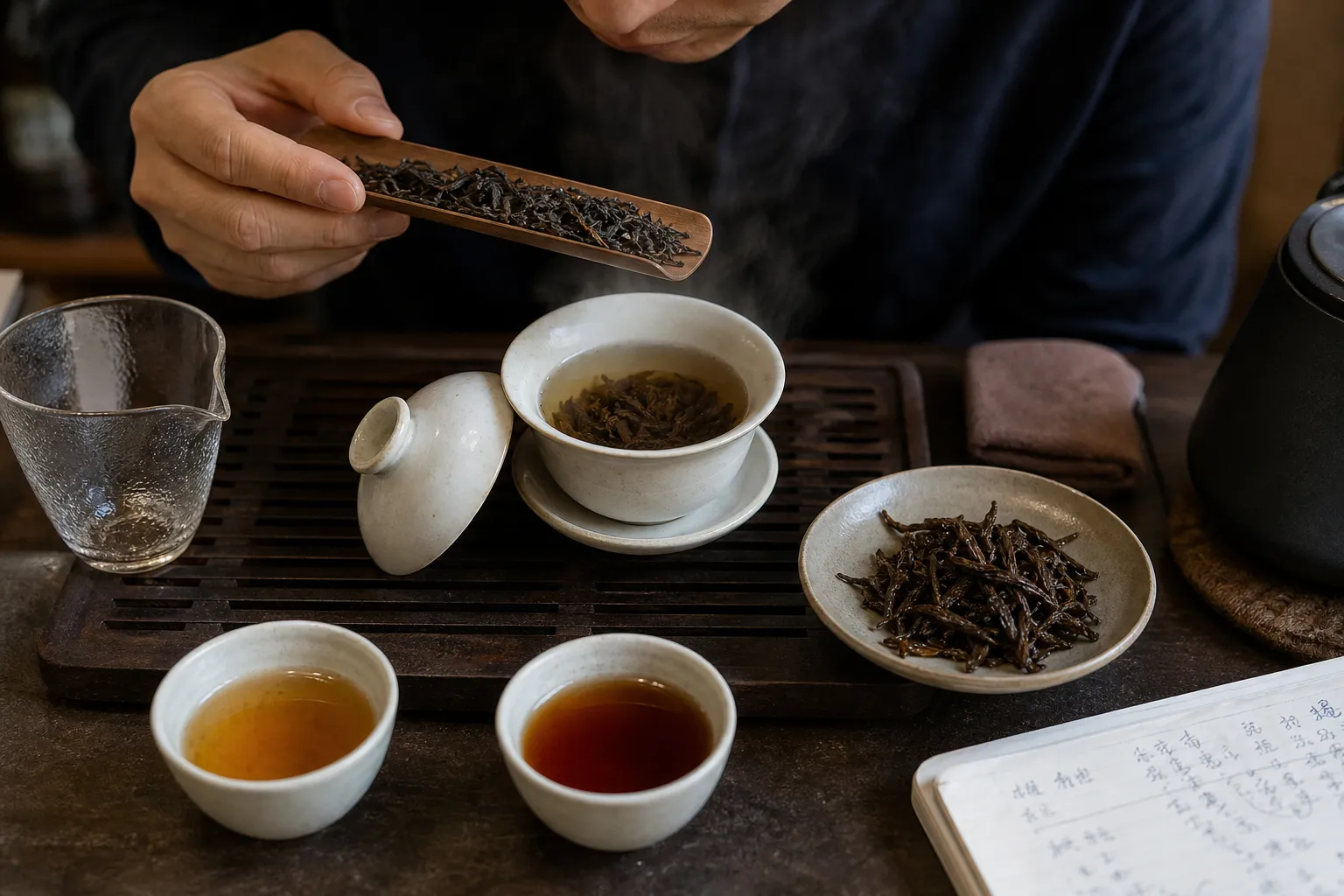
Many everyday hei cha brewing setups can begin with hot water, a brief rinse if the form is compressed or dusty, and short early steeps that lengthen as the leaves open. Exact timing depends on vessel size, leaf amount, compression, water, and taste preference.
A clean but tight aroma may benefit from a rinse. A flat aroma may not improve much with longer steeping. An unpleasantly damp aroma makes storage the first question.
A small gaiwan with more leaf asks for shorter steeps; a mug with less leaf can handle a slower infusion.
Hei cha brewing is not one method. The label tells you where to begin; the cup tells you how to adjust.
How Hei Cha Culture Stays Practical
Hei cha traditions are easy to flatten into vague words: ancient, rare, powerful, mysterious. Those words may sound attractive, but they do not help you read a brick, brew a cup, or choose a storage place.
A more useful view of hei cha culture stays close to ordinary tea practice: compressed tea that can be broken and shared, dark tea labels that need interpretation, storage that changes aroma, and brewing habits that respond to the material.
Culture here is not only a story behind the tea. It is also the set of practical expectations around it. A drinker may treat a brick differently from loose leaf. A host may rinse a compact piece before serving. A buyer may ask whether the tea smells clean instead of relying on a grand label. A daily drinker may prefer a heavier brew in a larger pot, while another may use short gaiwan infusions to watch how the liquor changes.
That is where fermented tea meaning becomes concrete. At a reader level, the term points toward teas that may show darker liquor, deeper aroma, and storage-sensitive character. Without stronger source support, it would be wrong to turn that into a technical process claim or a promise about how every tea will age. As a practical category marker, it tells you to pay attention to time, storage, and the way the leaf opens under water.
This keeps cultural respect grounded. Hei cha is not a decorative word for any dark-looking tea. It is a Chinese tea category label, and it should be read with care, especially when seller language is broad or promotional. Let the tea’s form, aroma, liquor, and storage condition do more work than the sales copy.
Common Confusion Around Dark Tea Labels
Flavor promise
One common confusion is treating hei cha as a flavor promise. It is not. Some cups may seem mellow, woody, earthy, sweet, mineral, or heavy. Others may be thinner, sharper, or dominated by storage. Those outcomes can shift with origin, processing, compression, storage, age, water, and brewing style.
Compressed form
Another confusion is treating compressed form as proof of age or value. A brick or cake is a form, not a final judgment. Compression affects how the tea breaks, stores, and brews. It can make the first steep slower and the later steeps more gradual. It does not settle whether the tea will taste good to you.
Storage story
A third confusion is turning storage into a simple upgrade story. Storage matters because aroma matters. Light, heat, humidity, airflow, nearby odors, and packaging can all affect how tea presents itself when opened. But storage is not a magic improvement.
Broad promises
The fourth confusion is reading broad wellness-style marketing as part of the meaning. This page does not support health-outcome claims. For a dark tea drinker, the better use of hei cha culture is practical and sensory: identify the category, check the form, brew with attention, and avoid letting broad promises replace cup evidence.
A tea that smells clean and stable is easier to approach; a tea that smells stale, perfumed by its surroundings, or unpleasantly damp asks for caution.
A Practical Way to Read Hei Cha Before Brewing
Use the label as a starting point, then verify it with the tea in front of you.
This table is not a grading system. It is a way to move from the Chinese dark tea category to a brewing decision without pretending that the label explains everything. The same tea can feel different in a small pot, gaiwan, mug, or thermos-style setup. Water temperature, vessel size, leaf amount, and personal preference all change the result.
If you are new to hei cha tasting, keep the first session simple. Break or measure a modest amount, smell the dry leaf, warm the vessel if that is part of your routine, rinse if the form seems compact or dusty, then brew short. Watch the liquor color, smell the wet leaf, and decide whether the next infusion needs more time or less.
That sequence teaches more than memorizing a fixed rule.
What This Page Can and Cannot Say
This page can say that hei cha is best understood by English-language readers as the Chinese dark tea category, and that its meaning becomes useful when tied to form, brewing choices, storage cues, and flavor observation. It can also say that dark tea labels should be read carefully, because category language does not settle questions of taste, age, condition, or value.
This page cannot responsibly supply detailed origin stories, named historical timelines, regional production claims, technical fermentation explanations, or broad market conclusions from the current material. Rather than filling those gaps with confident-sounding claims, the answer stays close to the cup.
So if your question is “what hei cha means,” the first useful answer is not a long cultural performance. Hei cha means Chinese dark tea, approached as a fermented tea category whose practical meaning appears in the leaf form, storage aroma, brewing response, and flavor cues you notice over several steeps.
The next time you see hei cha on a label, do not stop at the name. Look at whether it is loose leaf, cake, or brick; smell before you brew; start gently enough to hear the tea; and let the next steep tell you whether this dark tea wants more time, less leaf, or a cleaner storage comparison.