
Everyday dark tea
Why Dark Tea Is Often Treated as an Everyday Tea in China
Dark tea is often treated as an everyday tea in some Chinese drinking settings because it fits ordinary routines. It can be brewed light or strong, many forms tolerate repeated steeping, and loose or compressed formats can be kept for regular household use. That is the useful answer behind dark tea everyday drinking: not that every tea drinker in China drinks dark tea daily, and not that the category has one fixed cultural meaning, but that its preparation rhythm and sensory weight can suit repeated, practical drinking.
A daily tea has to be forgiving. It should work on a busy morning, sit comfortably beside food, and allow the drinker to adjust the next cup without turning every session into a formal tasting.
upward
Read the full overview first
Use the broader guide first if you need the full scope before this page.
Everyday Tea Means Usable, Not Ordinary
When people call a tea “everyday,” they usually do not mean dull or low quality. They mean it can be used without making the whole moment complicated.
In many everyday brewing setups, the tea needs to answer simple questions:
- Can it be brewed without exact measuring every time?
- Can the cup be adjusted if it tastes too strong or too thin?
- Can the same leaves give more than one infusion?
- Does the flavor sit well beside food or after a meal?
- Is the tea easy enough to store and return to later?
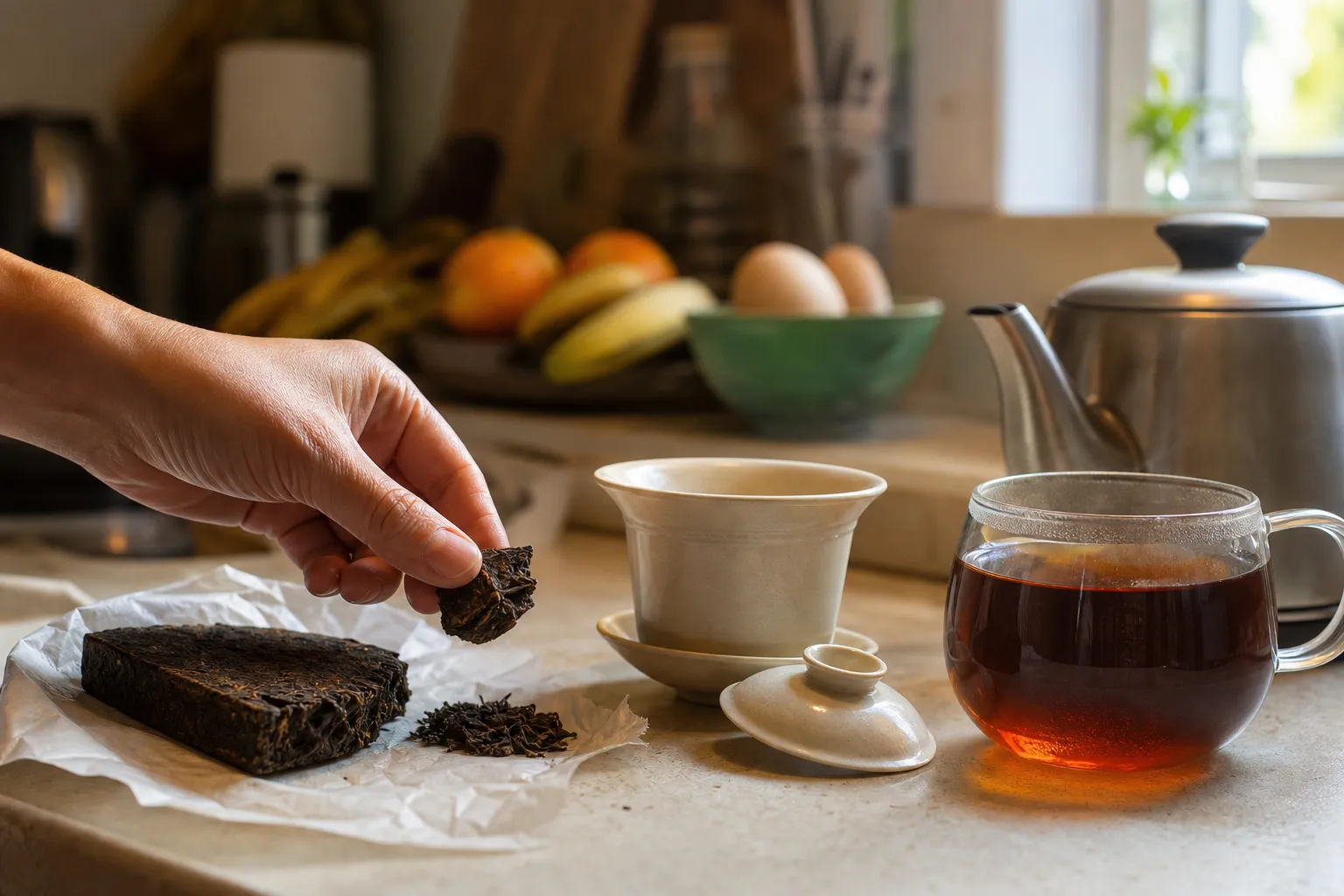
Dark tea can often meet those needs, depending on the tea type, storage condition, compression, water, vessel, and personal taste. A small piece from a brick, a portion of loose dark tea, or a measured bit from a cake or basket can be brewed in a practical way. The drinker can rinse if desired, steep briefly, extend the next infusion, or dilute a heavy cup with more water.
That adaptability matters. Some teas have a narrow brewing window: a little too long and the cup turns sharp, a little too short and it feels empty. Dark tea can still become harsh, flat, muddy, or unpleasant when overbrewed or poorly stored, but in ordinary use it often gives the drinker room to adjust. A stronger cup may lean deeper, woodier, earthier, or more roasted. A lighter cup may feel smoother, thinner, and easier to drink over a longer sitting.
So daily dark tea is not only a cultural label. It is also a handling pattern: break or measure, brew, taste, and adjust.
The Preparation Rhythm Fits Daily Use
A tea becomes daily when its preparation rhythm matches the setting. Dark tea can work in a small pot, a gaiwan, a thermos, a mug with a strainer, or a larger shared vessel. Each method changes the cup, but the practical idea stays the same: use a controllable amount of leaf, keep the water hot enough to draw flavor, and adjust time by taste.
For a simple everyday hei cha session, start with a moderate amount of leaf rather than trying to make the strongest possible brew. If the liquor tastes thin, let the next infusion run longer or use slightly more leaf next time. If the cup tastes too heavy, bitter, or muddy, shorten the steep, reduce the leaf, or use a larger vessel.
This is not one rule for all dark tea. A tightly compressed piece may need more time to open. A looser tea may release flavor quickly. A tea stored in a clean, dry, stable place may smell more settled than one exposed to odors or damp conditions. The everyday quality comes from being able to respond to those cues without treating every brew as a technical exam.
Why the Cup Can Feel Suited to Regular Drinking
Dark tea is often described in everyday terms because its flavor can be broad, warm, and food-friendly. Depending on the tea and storage, the cup may show notes that drinkers describe as woody, mellow, earthy, grain-like, date-like, mineral, lightly sweet, or roasted. Those notes are not guaranteed in every leaf, but they help explain why some people reach for dark tea when they want a steady cup rather than a highly fragrant or delicate one.
For daily drinking, sensory fit is about balance. A tea that is too sharp may feel tiring. A tea that is too faint may disappear beside food. A tea that is too heavy may work for one small cup but not for repeated drinking. Many dark teas, when brewed with restraint, sit somewhere in the middle: enough body to be present, enough softness to drink slowly, and enough range to become lighter or deeper through steeping choices.
This is especially relevant around meals. Some drinkers prefer darker, warmer-tasting teas with savory or rich foods because the cup does not compete the way a highly floral tea might. That is best understood as a drinking preference and sensory context, not as a claim about bodily effects. The practical point is simple: the liquor can feel rounded, steady, and compatible with ordinary food.
When judging whether a dark tea suits daily use, look for these cues:
- The dry leaf smells clean rather than stale, sour, or musty.
- The first drinkable infusion has enough body without feeling harsh.
- Later infusions remain pleasant instead of collapsing immediately.
- The aftertaste feels comfortable enough for repeated cups.
- The tea can be brewed lighter without becoming empty.
If a tea only tastes acceptable in one narrow brew, it may still be interesting, but it may not feel like an everyday drinking tea.
Form and Storage Affect the Routine
Dark tea appears in different forms, and form changes how practical it feels. Loose tea is easy to portion. Bricks and cakes are compact, but they require breaking or prying. Small compressed pieces can be convenient if the portion size suits the vessel. None of these forms is automatically better for daily drinking; each one changes how the tea fits into a routine.
Compressed tea can be useful because it keeps a large amount of tea in a compact shape. It also encourages gradual use: break off a small amount, return the rest, and continue over time. The tradeoff is handling. Poor prying can create dust, uneven chunks, or damaged leaves, and a very tight piece may brew unevenly if it is not given time to loosen.
Loose dark tea removes that step. It is easier to measure and may brew more quickly. The tradeoff is exposure: depending on the container, it may pick up air, odors, or handling changes more readily. For daily use, the better choice is the one the drinker can store cleanly and portion consistently.
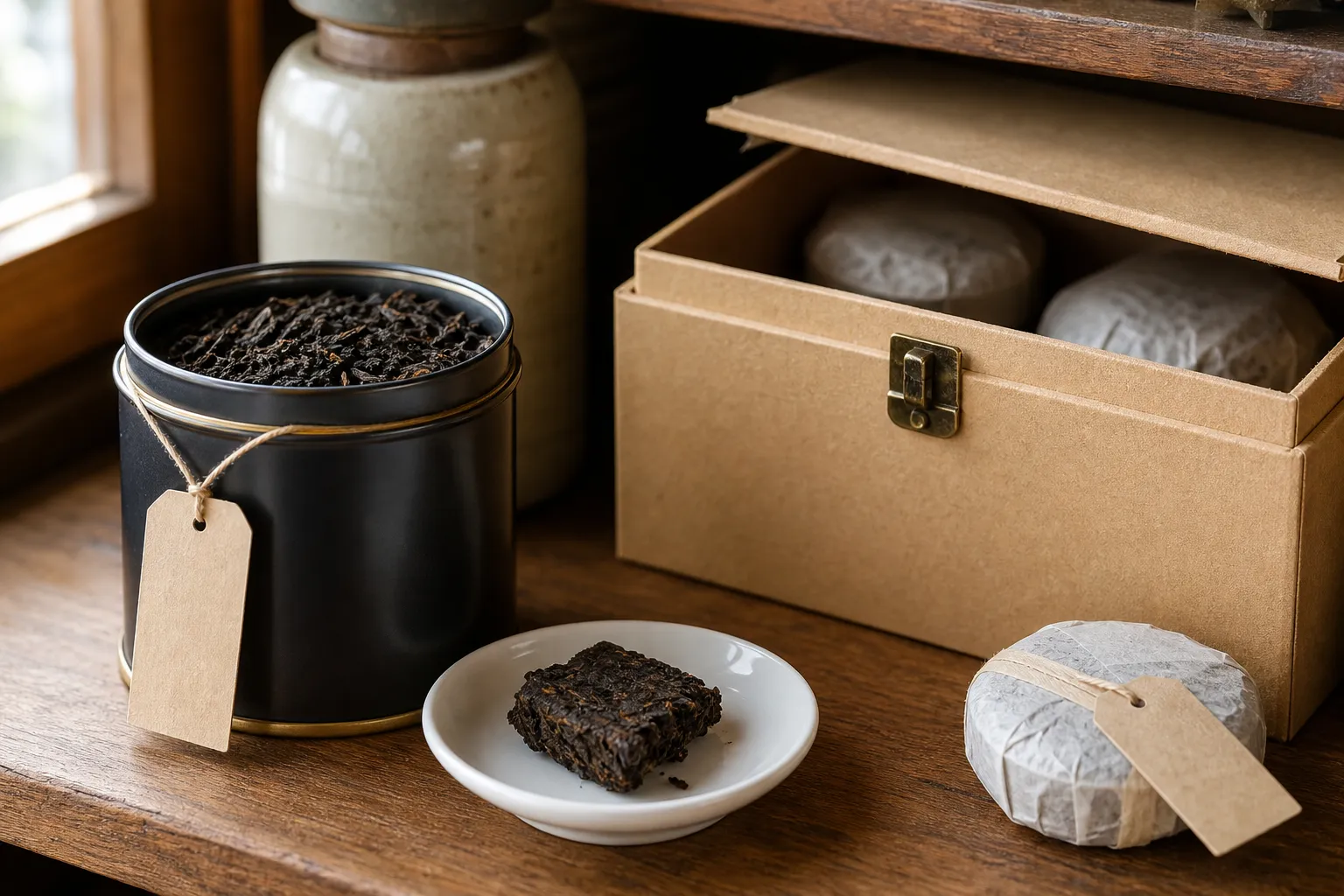
Storage tolerance also needs careful wording. Dark tea is often discussed as a tea category that can be kept over time, but “can be stored” does not mean “can be ignored.” A practical setup still needs protection from strong odors, direct light, excessive dampness, and unstable conditions. For everyday use, the most useful check is simple: does the dry tea still smell clean when you return to it?
If the aroma suggests basement dampness, sourness, smoke contamination, perfume, kitchen grease, or cardboard-like flatness, brewing technique may not solve the problem. Everyday tea should make the routine easier, not force the drinker to fight the material every time.
Common Misunderstandings
Too broad a cultural claim
The phrase “dark tea in China” can sound too broad if handled carelessly. China has many tea habits, many regions, and many household preferences. Dark tea is not the daily tea of every person, province, or table. Green tea, oolong, black tea, jasmine tea, white tea, and other teas also appear in ordinary drinking contexts. Dark tea is one everyday pattern among many, not a national rule.
Health-outcome shortcuts
Another misunderstanding is to explain everyday dark tea mainly through health-outcome language. Some market descriptions make daily use sound as if the tea must be chosen for a guaranteed effect. That is not the careful explanation here. For this page, the stronger answer is practical and sensory: dark tea can be repeatable, adjustable, meal-compatible, and easy to keep in usable forms.
Careless brewing
A third confusion is assuming that “everyday” means careless brewing. Daily tea still benefits from small adjustments. If the liquor is too dense, shorten the steep. If it tastes hollow, use more leaf or extend the time. If the aroma is unpleasant before water touches the leaf, check storage before blaming the brewing method.
One tea standing for all dark tea
Finally, one dark tea should not stand in for the whole category. A mild loose tea, a tightly compressed brick, an older stored piece, and a fresher, more assertive tea can behave very differently. The everyday reputation depends on the specific tea in front of the drinker.
A Practical Way to Test It
If you want to understand why dark tea can become a daily tea, start with one small, repeatable brew.
Use a familiar vessel, a moderate amount of leaf, and hot water. Keep the first drinkable steep short enough that the cup does not become heavy immediately. Taste for aroma, body, finish, and how the tea changes after a second or third infusion. Then ask whether the tea would still make sense on an ordinary day: beside breakfast, after lunch, during work, or in a quiet evening cup.
A dark tea that suits everyday use will usually feel adjustable. It can be made lighter without losing all character. It can be made stronger without becoming unpleasant too quickly. It can sit beside food without feeling distracting. It can be returned to the next day or the next week without storage anxiety, as long as the tea is kept cleanly and sensibly.
That is the real reason dark tea is often treated as an everyday drinking tea in some Chinese contexts. The habit is not explained by one origin story, one region, one brewing rule, or one claim about what the tea does. It is better explained by a cluster of practical qualities: form, storage, strength control, repeated brewing, and a flavor range that many drinkers can fit into ordinary life.
FAQ
Is dark tea an everyday tea for everyone in China?
No. It is an everyday tea in some settings, not a universal habit. China has many local and household tea preferences, and dark tea is only one part of that wider pattern.
Does “everyday” mean low quality?
No. In this context, “everyday” means usable, repeatable, and practical. A tea can be simple to brew often and still be carefully made, well stored, and enjoyable.
What makes dark tea practical for daily drinking?
The main factors are adjustable strength, repeated infusions, food-friendly flavor, compact or easy-to-portion forms, and storage that can fit regular household use when handled sensibly.
Should daily dark tea be brewed strong?
Not necessarily. Many everyday brews work better when started moderate. If the cup tastes thin, extend the next steep. If it tastes heavy or muddy, shorten the steep or use less leaf.