
Production Date vs Pressing Date on Dark Tea Labels
A dark tea production date usually points to the date a producer records the tea product as made, completed, or packed under that label. A tea pressing date is narrower: it points to when loose or prepared tea material was compressed into a cake, brick, tuo, or other pressed form.
Those two dates can be the same, especially for a newly made compressed tea. They can also differ when the leaf material existed before it was pressed.
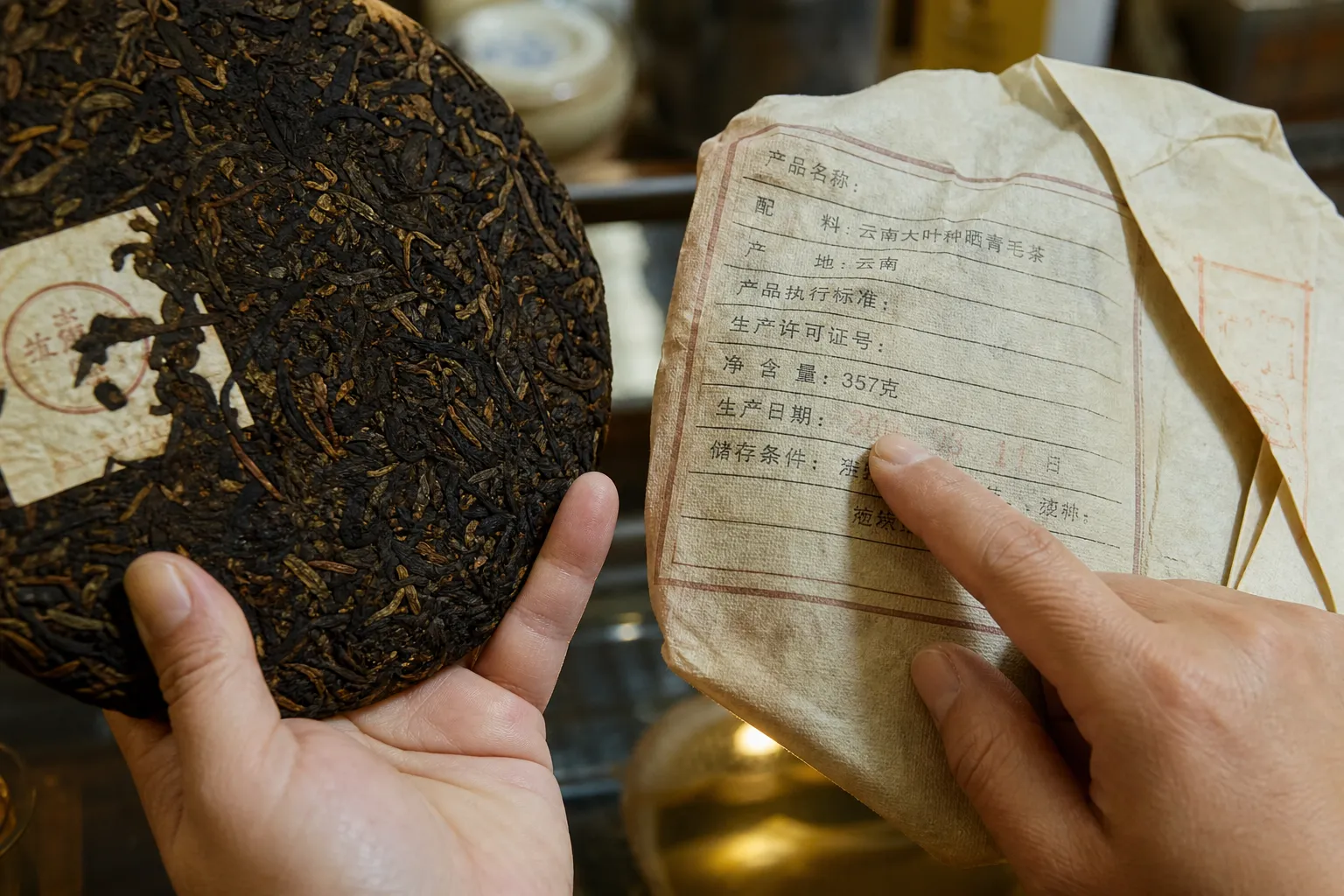
If you are holding a wrapper, do not start with “older date equals older tea.” Start with three smaller questions: what words sit beside the date, where is the date printed, and is the number really a calendar date or part of a code?
upward
Start with the broader guide
Use the broader guide first if you need the full scope before this page.
The quick label-reading difference
On a compressed dark tea package, several moments can matter:
- when the fresh leaves were processed into base material;
- when that material became loose tea or maocha;
- when pile fermentation happened, if the tea uses that process;
- when the tea was pressed into its current shape;
- when it was packaged, labeled, or released for sale.
A production date may refer to the producer’s recorded completion point for the product as sold. A pressing date refers more specifically to the compression stage. In Pu’er and other compressed dark teas, pressing is not just a package shape: prepared material may be steamed or softened, shaped, compressed, dried, and wrapped.
That does not mean every wrapper follows one universal wording rule. Publicly available processing and authentication sources support the broader point that dark tea can pass through distinct stages, but they do not give a single front-of-label rule for every producer’s use of “production date” versus “pressing date.” Treat the date as a clue, not a full age record.
“Production date” near the product information block
The product was recorded as produced, completed, or packed on that date, according to that label’s usage.
“Pressed on,” “pressing date,” or similar wording
The tea material was compressed into its present form on that date.
Seller text saying “old material” or “older maocha”
A claim about material before pressing; ask how that year is recorded.
A number inside a recipe, mark, batch, or lot code
Not necessarily a date. Check the surrounding words.
A standard issue or implementation date
A document-context date, not the age of the tea.
Why compressed dark tea can carry more than one date
Loose tea and pressed tea create different date questions. If you buy loose Liu Bao, loose ripe Pu’er, or another loose dark tea, the production date may be the main printed time cue. If you buy a cake, brick, tuo, square, or other compressed form, there may be another question: when was this material pressed?
This matters because dark tea material can exist before compression. In Pu’er market language, maocha commonly refers to unpressed or semi-finished tea material before it becomes a cake or brick. A seller may say that a cake was pressed in one year from older maocha. That can describe a real production path, but the wrapper alone may not establish the older material year.
For example, if a cake is described as “pressed in 2022 from 2018 material,” there are two separate claims:
-
The pressing date
The cake took its current compressed form in 2022.
-
The material-age claim
The underlying tea material is said to come from 2018.
Those are not the same claim. If the older year affects the price, ask for clarification before treating it as the full age of the tea in your hand.
Useful seller questions include:
- Does the printed date refer to production, pressing, packaging, or batch release?
- Was the tea stored as maocha or loose tea before pressing?
- If the material is said to be older than the pressed cake date, how is that recorded?
- Is there a separate packaging date?
- Is the year part of a recipe code rather than the product date?
This is especially helpful with Pu’er, where raw tea, ripe tea, loose tea, and pressed tea all appear in the same market, and date language is not always written with English-language buyers in mind.
Date-like numbers that are not production dates
The most common mistake is reading every year-like number as a Pu’er production date. Wrappers and seller pages can contain several number systems, and only some of them are calendar dates for the actual tea.
Recipe or formula year
Some Pu’er mark numbers and recipe codes include digits that look like a year. In market use, early digits may refer to a formula or recipe year rather than the year this individual cake was produced or pressed. That kind of code can help identify a style or production lineage, but it should not be treated automatically as the cake’s age.
A simple test: if the number is compact, printed as a product code, and not placed beside wording such as “production date,” “pressed,” or “packaged,” slow down. It may be a recipe code, not a production date.
Batch or lot code
A batch lot code on tea may include dates, factory references, internal batch numbers, or mixed letter-number sequences. It can help identify a production run, but it is not always written in a way that tells a consumer the leaf age. If a seller uses a batch code as age evidence, ask what each part of the code means.
Packaging date
A packaging date can be later than production or pressing. This may happen if tea was stored, rewrapped, boxed, or prepared for a particular sale channel after it was made. A packaging date tells you about the package event, not necessarily the harvest, fermentation, pressing, or storage history.
Standard dates
A standards reference can carry issue or implementation dates. Those dates belong to the document context, not to the cake, brick, or tuo you are holding. Do not read a standard date as a dark tea age label.
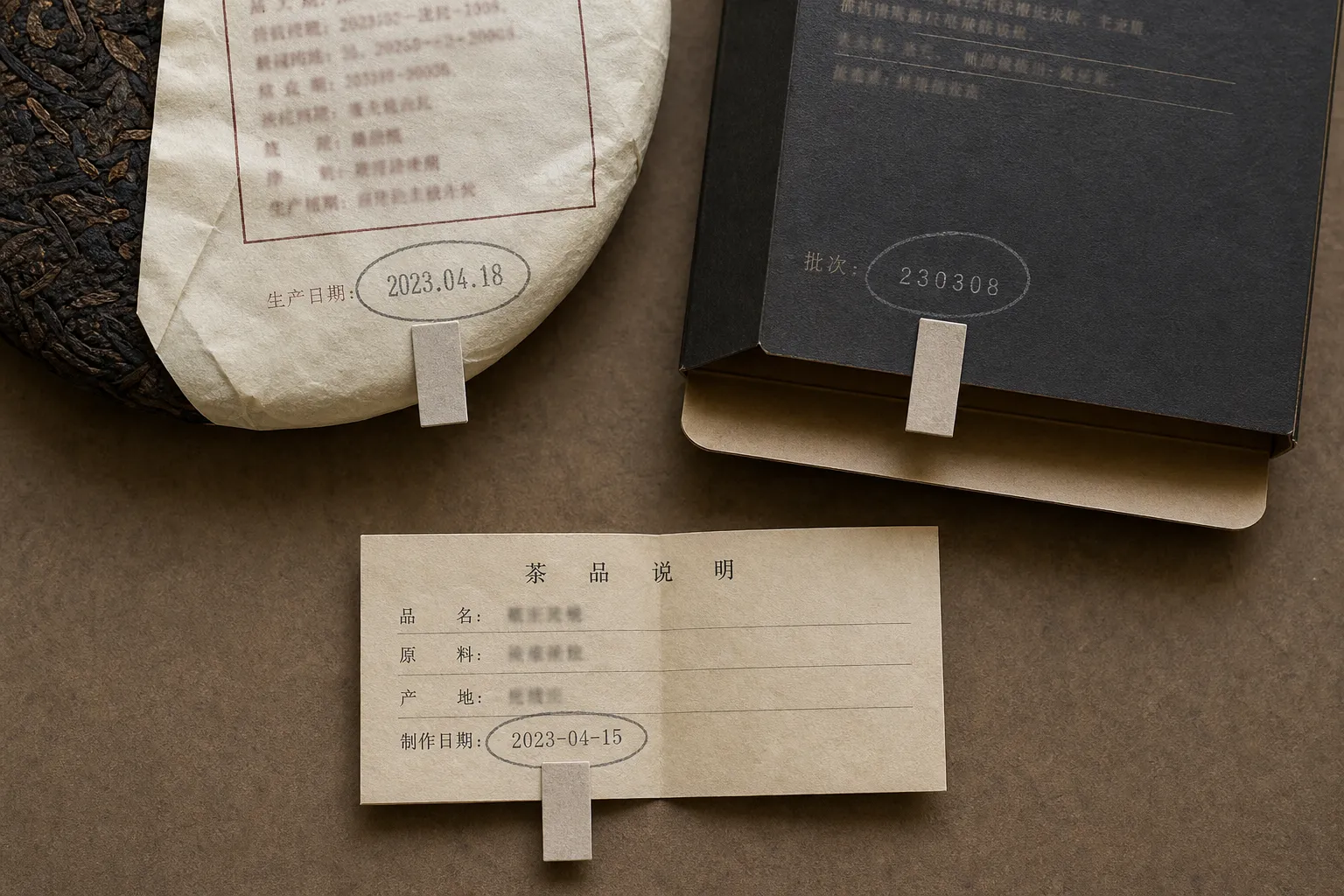
Where to look before asking the seller
The best tea wrapper date cues are not the digits alone. They are the words and placement around the digits.
Start with the nearest wording. A date beside “production date” should be read differently from a date in a recipe story, a batch code, a brand-history paragraph, or a seller description. If the wrapper has both Chinese and English, compare both when possible; English stickers sometimes summarize rather than fully explain the original package.
Then check the location. Product information fields often sit together with net weight, producer, origin, storage wording, and shelf-life or storage statements. A recipe mark or cake name may appear on the front design. A batch code may be printed, stamped, or stickered in a more mechanical position. None of these placements is proof by itself, but placement helps you avoid reading a decorative or coded number as a date.
Also notice whether the date is a full calendar date or only a year. A full year-month-day date is more likely to be a product, packaging, or pressing record. A two-digit or four-digit year embedded in a longer number needs more caution.
Use this quick check:
- Is the number a full date or part of a longer code?
- What exact words sit beside it?
- Is it near product information, batch information, or a recipe mark?
- Does the seller describe older material than the pressing date?
- Is there a separate packaging date?
- Is a standard date being mistaken for product age?
- If price depends on age, has the seller explained which date they mean?
What the label cannot tell you by itself
A label date can help you ask better questions, but it cannot carry every claim people attach to dark tea. An early production date, later pressing date, traditional wrapper design, or standards reference does not by itself establish taste, storage condition, product identity, safety status, or market value.
This boundary matters because age language is powerful in dark tea. Research on Pu’er and other dark teas discusses processing, aging, fermentation, storage, and lab-based authentication methods. Those methods exist partly because wrapper information and sensory judgment can be limited. For an everyday buyer, that does not mean you need lab analysis to enjoy tea. It simply means the printed date should not be stretched beyond what it actually says.
Storage is a separate question too. A tea pressed earlier may have been stored cleanly, poorly, dry, humid, steadily, or inconsistently. The date does not tell you the aroma of the dry leaf, the condition of the wrapper, the way the cake opens in water, or the character of the liquor. Those are inspected through the tea itself, not through the date field alone.
If the tea smells heavily damp, sour in an unpleasant way, stale, or visibly compromised, do not let an attractive year override what you can observe. If a seller uses lab-report or compliance language, keep that separate from age reading unless the document is clearly tied to the exact tea and the exact claim being made.
A practical way to ask about production date versus pressing date
When a label is unclear, use plain questions. The goal is to make the seller define the date.
Try asking:
- “Does this date mean production, pressing, or packaging?”
- “Was the tea material stored as maocha or loose tea before pressing?”
- “Is the older year a material year, a formula year, or a batch year?”
- “Is this number a recipe code or the actual production date?”
- “If the cake was pressed later, what supports the earlier material-age claim?”
A clear answer should separate the current pressed form from any earlier material claim. If the seller cannot explain the date language, read the label conservatively. The tea may still be enjoyable, but the age claim should not be the main reason you pay more.
Bottom line
Production date versus pressing date is a simple distinction with messy real-world packaging around it. The production date usually refers to the producer’s recorded product date. The pressing date refers to when the tea was compressed into its present cake, brick, tuo, or similar form. They can match, but they can also differ when maocha or loose material existed before compression.
Read the nearby wording, placement, code format, seller description, and any separate packaging or batch information. If the year affects the price, ask what the date refers to before assuming the wrapper tells the tea’s full age.
Sources
Sources and further reading
Reference links are limited to sources considered suitable for public citation in this page.