
Label reading
What Leaf Grade Words on Dark Tea Labels Can and Cannot Tell You
A dark tea leaf grade word is a clue, not a verdict. On a label, terms such as “1st Grade,” “Large-leaf,” “Regular,” “coarse leaf,” or “broken leaf” may point to leaf size, sorting, tenderness, or a producer’s own naming habit. They cannot tell you, by themselves, whether the tea was processed well, stored well, enjoyable in the cup, or better than another dark tea with a plainer label.
Dark tea labels often pack style, origin, form, year, processing language, storage notes, and sales tasting words into one crowded line. Read the grade-like word only after you know what kind of dark tea you are holding.
upward
Start with the broader guide
Use the broader guide first if you need the full scope before this page.
Separate the label before judging the grade word
The first mistake is treating every impressive label word as part of one ranking system. The available sources support style-specific differences in raw material, processing, fermentation, and form. They do not support one universal dark tea grade ladder that works the same way across Liubao, Fu Zhuan, Qing Zhuan, Tian Jian, Liu’An, shou Pu-erh, and other post-fermented teas.
A dark tea label may contain several kinds of information at once:
Liubao, Fu Zhuan, Qing Zhuan, shou Pu-erh
Tea style or regional category. Start here before judging grade words.
Guangxi, Hunan, Yunnan, Hubei, Sichuan
Origin or regional context. Useful context, not a quality result by itself.
Brick, cake, basket, beeng cha, loose leaf
Form. Not the same as leaf grade.
2010, 2012, production year, release year
Date information. Does not prove storage outcome or flavor.
Wo dui, post-fermented, pile-fermented
Processing language. Helps explain the tea type, not leaf size.
Golden Flower Brick
Style, form, and appearance or process language in some Fu Zhuan-related teas. Do not read it as a health-outcome claim.
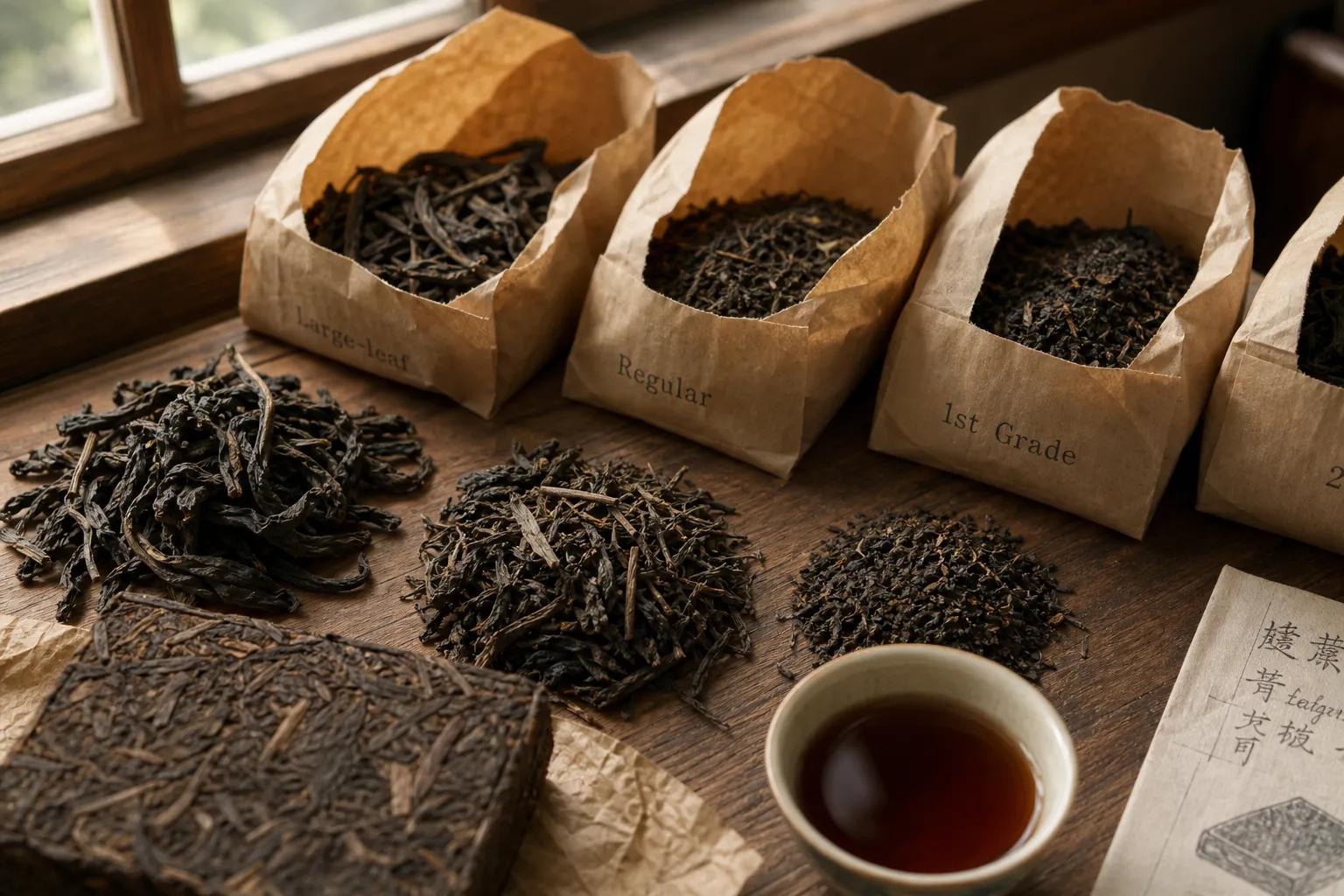
1st Grade, Regular, Large-leaf, coarse leaf
Grade-like or leaf-size language. Compare with style, visible leaf, aroma, and cup behavior.
Mellow, earthy, woody, smooth, robust
Sales tasting language. Treat as expectation-setting, not a result you can rely on.
This separation matters. Liubao 1st Grade is not the same kind of information as Liubao Large-leaf, and neither works the same way as Golden Flower Brick. One may sound like a grade, one may describe material size, and one may point to a style-linked feature and compressed form. If you read all of them as “higher or lower quality,” the label becomes less useful.
What leaf grade words can suggest
A leaf-grade or leaf-size descriptor can still help. It gives you a first question to test before you open the bag, pry the brick, or brew a small cup.
In many dark tea labels, grade-like words may suggest one or more of these things:
- Leaf size: smaller sorted leaf, larger leaf, coarse material, broken pieces, or mixed leaf.
- Tenderness of raw material: in some production contexts, younger material may be separated from more mature leaf.
- Sorting convention: the maker or seller may be distinguishing batches by appearance, size, or product line.
- Style expectation: some dark teas commonly use mature, coarse, large-leaf, or stem-including material.
- Brewing behavior: smaller broken material can release flavor faster, while larger or more compressed material may need more time to open.
Research on Fu brick tea gives a useful boundary: raw material grade can matter under controlled processing conditions. In one study, different grades of raw dark tea were processed under comparable conditions, and the resulting teas showed differences in sensory quality, chemical composition, and fungal community. That does not mean every retail “1st Grade” label means the same thing. It supports the narrower point that raw material grade can be one real variable in some dark tea production.
Studies on large-leaf dark tea and Liupao/Liubao processing point in the same practical direction: raw material, pile-fermentation duration, moisture, heat, microbial activity, and processing technique can all shape the finished cup. For a buyer, the takeaway is simple: leaf material matters, but it works together with processing. The grade word alone is not enough.
What those words cannot tell you
A dark tea grade term cannot carry the whole buying decision. It may look precise, but it leaves too much unknown.
A grade-like word cannot tell you:
- whether the tea was stored in a suitable environment;
- whether the compression preserved the tea well or held unwanted odors;
- whether pile fermentation was handled skillfully;
- whether the tea will taste sweet, earthy, woody, thick, thin, bright, flat, or harsh in your water;
- whether the year on the label reflects favorable storage conditions;
- whether the tea is more typical of its style than a plainer-labeled tea;
- whether the tea suits your preferred brewing style;
- whether “large-leaf” is a strength, a neutral style trait, or simply a sorting description for that product.
This is especially important with compressed dark tea. A compressed tea leaf grade does not become clearer just because the tea is in a brick, cake, basket, or beeng cha. Compression is a form. It has a practical connection with transport, storage, and regional tea styles, but it is not the same as grade. A brick can contain coarse material, carefully sorted material, stem-inclusive material, or blended material. The shape does not decode the leaf grade for you.
The same caution applies to age words. A label that includes a production year or release year gives date context. It does not show that the tea has become smoother, more valuable, or more enjoyable. Storage conditions, airflow, humidity, odor exposure, compression, and the original material all matter.
Read the grade word in this order
When you are looking at dark tea labels online or in a shop, use the grade word late in the reading process, not first.
1. Identify the tea style
Ask whether the tea is Liubao, Fu Zhuan, Qing Zhuan, Tian Jian, Liu’An, shou Pu-erh, or another dark tea. Dark tea, also called Hei Cha in Chinese tea contexts, is often described in English as post-fermented tea. That helps distinguish it from Western “black tea,” though the color terms can be confusing.
The style matters because “large leaf,” “regular,” “brick,” or “basket” does not carry the same practical meaning in every dark tea family.
2. Check origin or region if given
Origin words such as Guangxi, Hunan, Yunnan, Hubei, Sichuan, or a more specific place name can help you understand the label’s context. They do not settle quality by themselves, but they help you avoid comparing unlike teas as if they were the same product.
A Liubao label and a Fu Zhuan label may use different material expectations, processing language, and form traditions. The grade word has to be read inside that style context.
3. Separate form from grade
Loose leaf dark tea is not automatically higher or lower than compressed dark tea. Brick, cake, beeng cha, basket, and loose leaf are form words. They tell you how the tea is presented and may affect how you handle, store, and brew it. They do not replace a look at the actual leaf material.
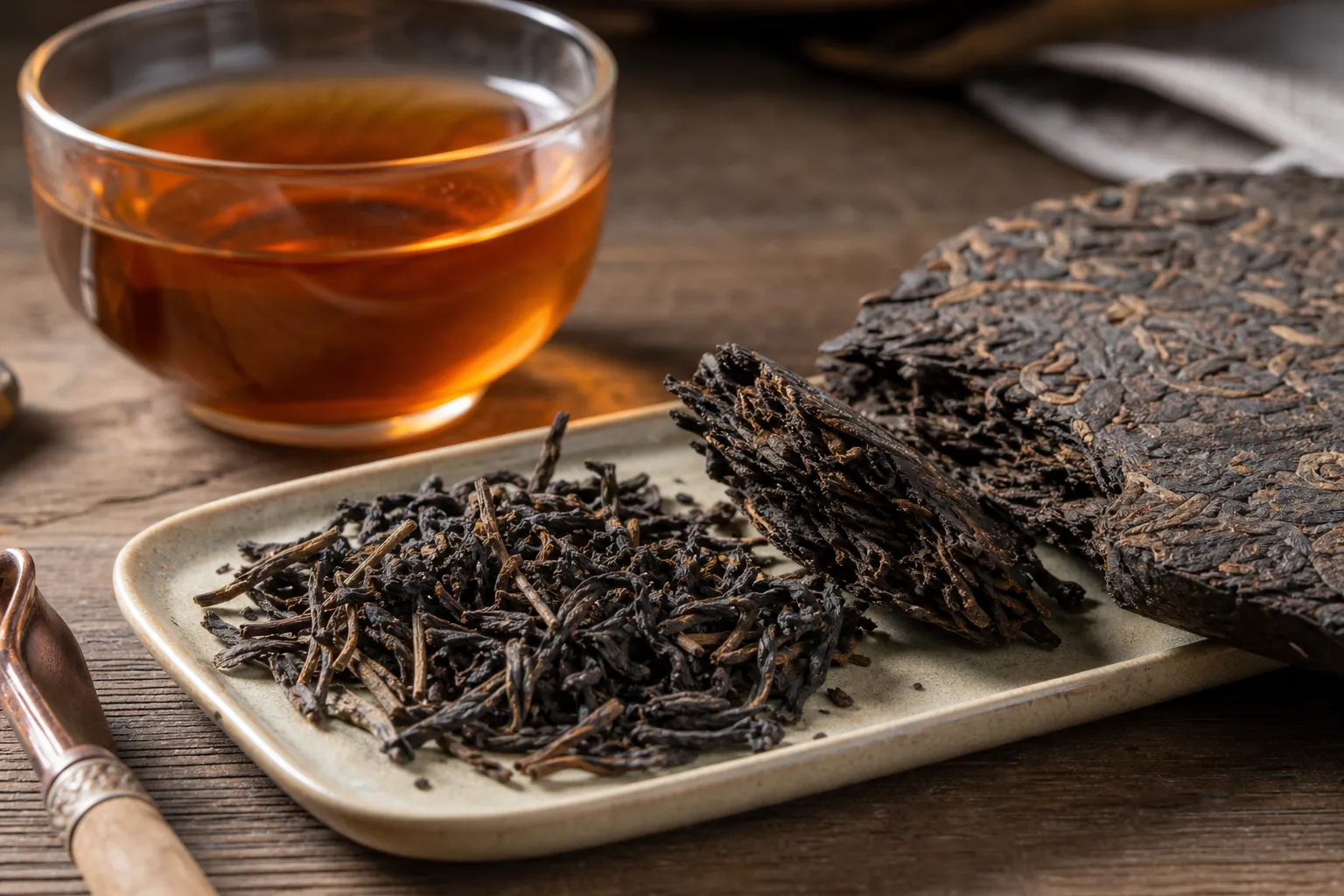
With compressed tea, the outside surface may show only part of the story. Edges, broken flakes, pry marks, and inner layers can reveal whether the material is more leafy, stemmy, broken, dusty, or mixed.
4. Notice processing words without turning them into quality scores
Dark tea processing terms such as post-fermented, pile-fermented, wet-piled, wo dui, flowering, or Golden Flower can explain why the tea belongs to a certain style. They can also help set brewing expectations. They should not be read as automatic proof of flavor, value, or suitability.
For example, Golden Flower Brick can be read as a Fu Zhuan-related style and form clue, especially where visible golden fungal growth is part of the product identity. For this page, that term belongs to processing and appearance. It should not be treated as a body-effect claim.
5. Then read the leaf grade or leaf-size word
Now the grade-like word has context. “Liubao Large-leaf” is no longer just “large equals good or bad.” It becomes a question: is large-leaf material normal for this tea, and does the dry leaf and brewed cup support the way the label is presenting it?
Likewise, “Liubao Regular” may be a product-line term rather than a universal rank. “Liubao 1st Grade” may suggest a sorting or grade claim from the seller or producer, but without a verified standard attached to that exact product, it should not be treated as a universal definition.
What to check with your eyes, nose, and cup
After reading the label, look for evidence the label cannot provide.
For dry leaf, check:
- Is the material mostly whole, broken, chopped, stemmy, flaky, or mixed?
- Does the leaf size match the label’s wording?
- If compressed, does the brick or cake look evenly pressed, very tight, loose, crumbly, or dusty?
- Are there obvious foreign odors before brewing?
- Does the tea smell well kept, or does it carry a dull, stale, sour, smoky, musty, or perfumed note?
For the rinse or first steep, notice:
- Does the leaf open quickly or slowly?
- Does the liquor look clear, cloudy, reddish-brown, dark brown, or muddy?
- Does the aroma settle after a rinse, or does an unwanted odor remain?
- Does the cup taste thin, sharp, flat, heavy, sweet, woody, earthy, or drying?
- Does a shorter steep improve the tea, or does it need more time to show body?
These observations do not turn your cup into a grading office. They simply bring the label back to the tea in front of you. A rough-looking dark tea may still brew pleasantly in some styles. A tidy-looking grade label may still disappoint if storage or processing was poor. Your cup is not a universal judgment either, because water, vessel size, leaf amount, and steep time can change the result. But it is more useful than trusting a single label word.
Common confusions around dark tea grade terms
Borrowing black tea grading too easily
One common confusion is importing black tea leaf grading into dark tea. English-speaking buyers may know terms from black tea labels and assume every tea category uses a similar leaf-size hierarchy. Dark tea needs a more cautious reading. Its processing, compression, regional styles, and use of mature material can make “smaller leaf is better” or “higher number is better” unreliable.
Rejecting coarse or stemmy material too quickly
Another confusion is treating coarse or stemmy material as an automatic defect. Some dark teas intentionally include mature leaf, thicker leaf, stems, or larger material. That does not make every coarse tea good, but it means rough appearance alone is not enough to reject it.
Over-reading sensory marketing
A third confusion is over-reading sensory marketing. Words such as mellow, earthy, woody, mushroomy, sweet, smooth, robust, or bright may describe what a seller wants you to expect. They are not the same as leaf grade, and they are not something the label can ensure in your own brewing setup.
A practical label-reading rule
Use the grade word as a question mark, not a conclusion.
If a dark tea label says 1st Grade, ask what style it belongs to and whether the seller explains what that grade means for that tea. If it says Large-leaf, ask whether large-leaf material fits the style and whether the visible leaf supports the claim. If it says Regular, treat it as a product descriptor until more context is given. If it says Golden Flower Brick, separate the visible or processing-related term from the compressed form and from any flavor promise nearby.
The most useful reading order is:
style first, region second, form third, year and processing fourth, leaf grade fifth, visible leaf and cup behavior last.
That order keeps the label useful without letting one attractive grade word do more work than it can support. A dark tea leaf grade can help you decide what to inspect next. It cannot replace inspection, aroma, brewing, and your own taste preference.
Sources
Sources and further reading
Reference links are limited to sources considered suitable for public citation in this page.