
Thermos brewing
How to Choose Dark Tea for a Thermos Without It Getting Too Strong
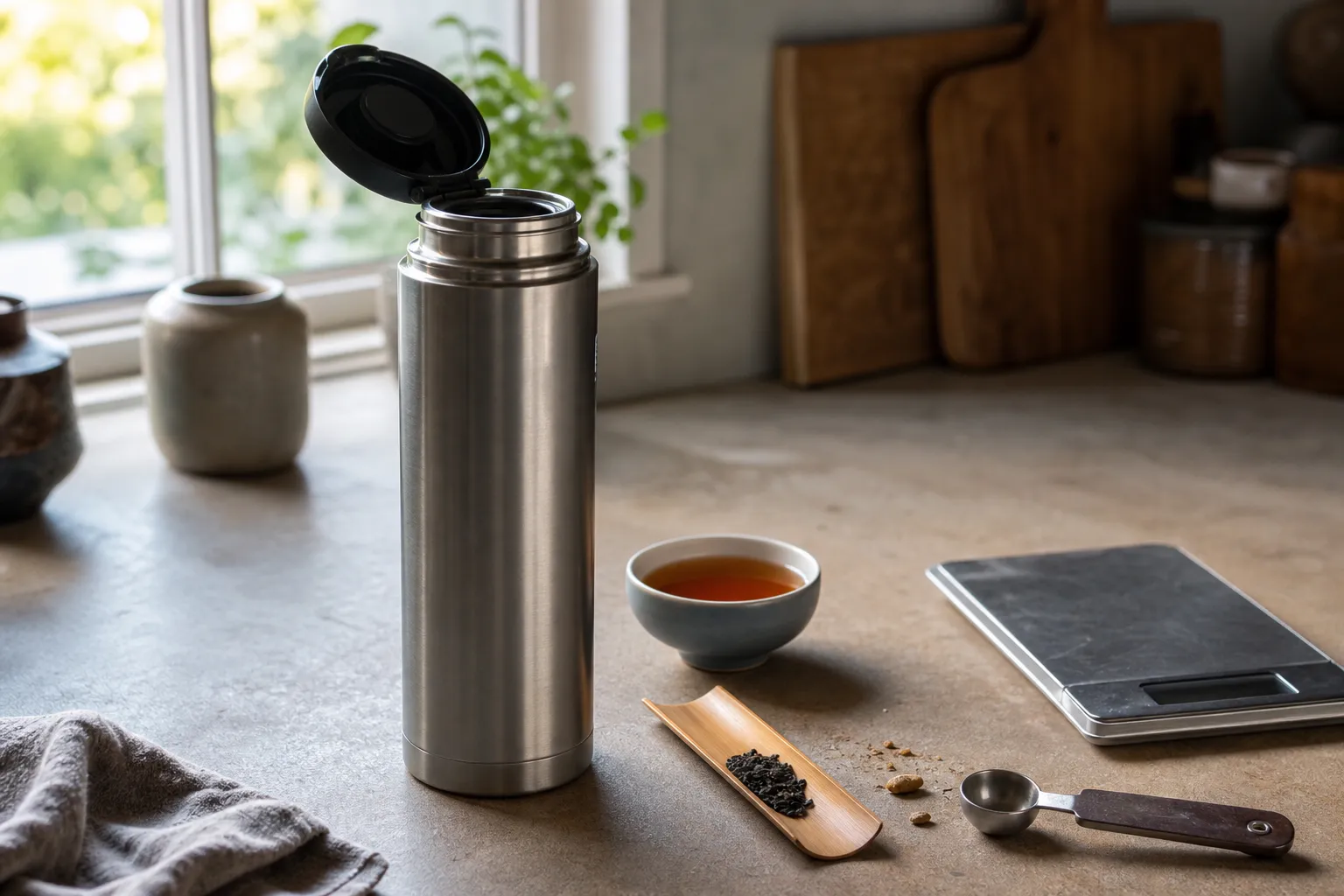
Choose dark tea for thermos brewing by using a forgiving tea and less leaf than you would use for short infusions. For a 500 ml travel flask, start around 3–5 g of dark tea, then adjust after the first bottle. Fu Brick, Liu Bao, other mature dark teas, and some ripe Pu-erh often handle long hot contact better than delicate, high-aroma teas.
The main mistake is dosing a thermos like a gongfu session. In a flask, the leaves keep sitting in hot water while the vessel holds heat, so the liquor can move from smooth to heavy, bitter, muddy, or flat before you notice.
A good first setup is simple: a small dose, a tea form that is not too dusty, a clean thermos, and one clear adjustment for next time.
upward
Read the full overview first
Use the broader guide first if you need the full scope before this page.
Start with a forgiving dark tea
For a travel flask, choose a dark tea that already tastes rounded, earthy, woody, mellow, or lightly sweet when brewed normally. Those profiles often survive long contact better than teas built around fresh, bright, delicate aroma.
Fu Brick
Why it can work: Often gives a mellow, woody, thick, or fungal-floral cup, depending on the brick and storage.
What to watch: Dusty crumbs can make the liquor dense or muddy.
Liu Bao
Why it can work: Often suits long warm drinking, with earthy, woody, aged, or betel-like notes.
What to watch: Some examples become heavy when overdosed.
Other mature dark teas
Why they can work: Post-fermentation and age can give a steadier cup under long heat.
What to watch: Storage aroma can become more obvious in a sealed flask.
Ripe Pu-erh
Why it can work: A nearby option that often works for long steeping.
What to watch: Too much leaf can make it thick, earthy, or dull.
The category name is only a starting point. Research on Chinese dark teas and Fu Brick teas shows wide variation in processing, storage, volatile compounds, taste characteristics, and microbial or metabolite profiles. In brewing terms, two teas with the same name on the wrapper can behave differently in a thermos.
Use delicate green tea, yellow tea, greener oolong, and young raw Pu-erh only as contrast points here. Long heat can push them toward stewed, sharp, or astringent flavors. That is why “any tea works in a thermos” is not a useful rule.
Use less leaf than you think
The usual cause of bitter thermos tea is not a bad tea by itself. It is too much leaf for a long, hot steep.
Use these as practical starting points, not fixed rules:
350 ml thermos
2–3.5 g
500 ml thermos
3–5 g
750 ml thermos
5–7 g
If the tea is not very dusty or broken.
If you normally brew gongfu style, these amounts may look light. That is intentional. Gongfu brewing uses more leaf because each infusion is short. Thermos brewing uses less leaf because extraction continues while you carry the flask.
If the first bottle is too strong, reduce the leaf by 0.5–1 g next time before changing everything else.
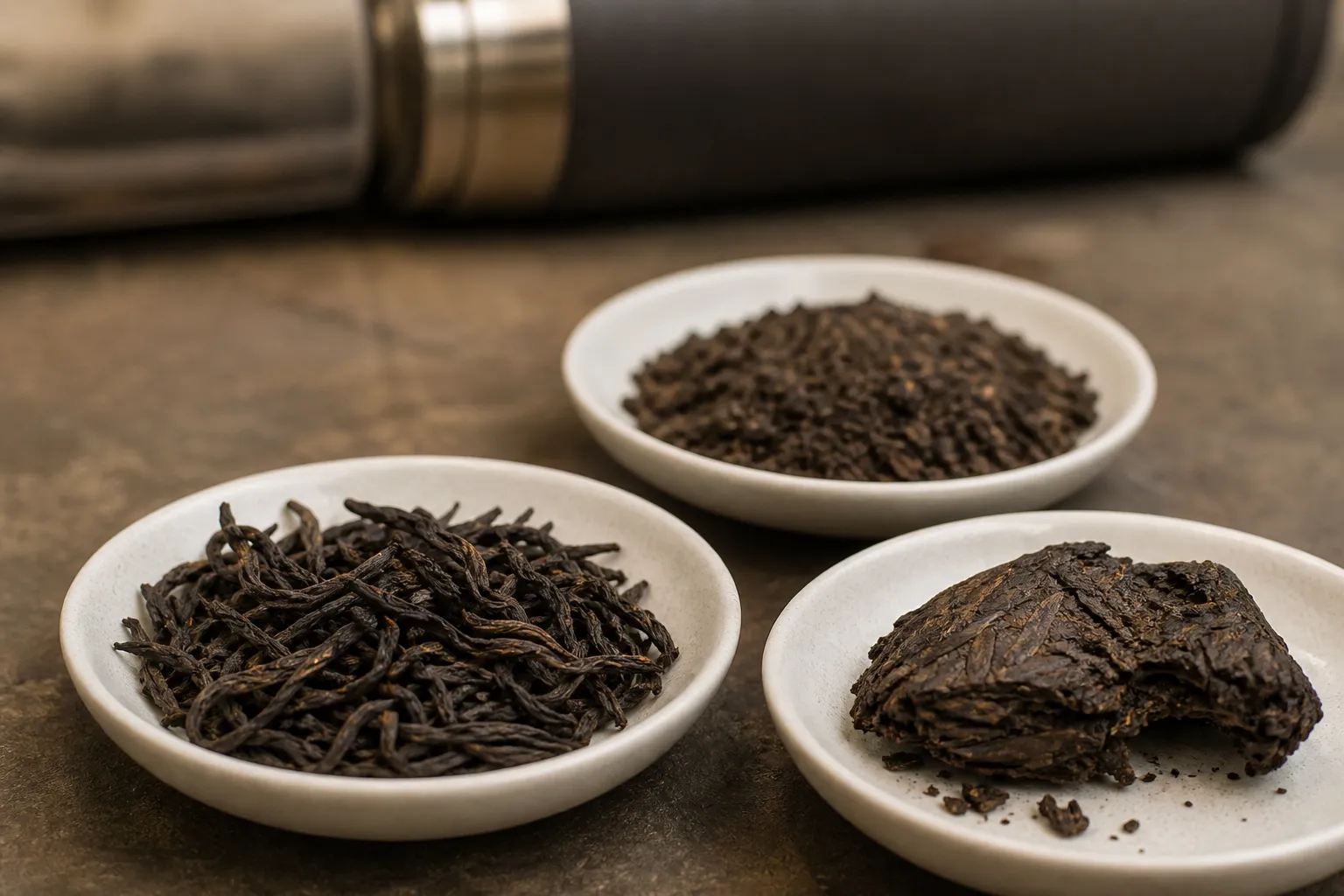
Leaf form matters as much as weight:
- Loose, intact leaves usually release more gradually.
- Broken leaves and dust extract faster and can make the liquor cloudy.
- Compressed chunks may start slowly, then open and strengthen later.
- Thin flakes from a brick or cake can taste stronger than they look because of the broken edges.
For compressed tea, a quick rinse can help. Pour hot water over the piece for about 10–15 seconds, discard that water, then place the tea in the thermos. This is not a quality claim. It simply loosens the piece and removes some loose dust before a long steep.
A simple thermos setup
You do not need a complicated method. The goal is to reduce surprises.
- 1. Clean the thermos well. Old coffee, old tea, or trapped aroma can make dark tea taste stale or metallic.
- 2. Preheat if the brew often tastes thin. Fill the flask with hot water for 1–2 minutes, then discard it.
- 3. Add a small amount of dark tea. For 500 ml, begin around 3–5 g.
- 4. Rinse compressed pieces if they are dusty or tightly packed.
- 5. Fill with hot water. Robust dark tea is commonly brewed hot, but if a tea turns harsh, try slightly cooler water next time.
- 6. Taste after 30–60 minutes if you can. This is a flavor check, not a required drinking time.
- 7. Change one variable on the next flask. Leaf amount first, then water temperature, preheating, or tea choice.
Thermos-style brewing overlaps with the Chinese term Mēn Pào, a covered or long steep. In daily use, it often means leaves and hot water staying together in an enclosed vessel. The term is useful, but it is not one strict recipe.
The vessel itself matters. Studies on tea utensils and heat-retained containers support the broader point that vessel choice, temperature, and steeping time can affect aroma and sensory quality. They do not give one exact dark-tea thermos formula, so the practical method stays adjustable: start low, taste, then correct.
How to read the first flask
Treat the first thermos as a test. The first sip may not tell the whole story because the leaves keep extracting.
Too strong, heavy, or drying
Likely cause: Too much leaf for long contact.
Next adjustment: Reduce leaf by 0.5–1 g.
Bitter or astringent
Likely cause: Overdosing, many broken fragments, a less forgiving tea, or too much heat for that tea.
Next adjustment: Use less leaf first; then consider smoother tea or slightly cooler water.
Muddy or cloudy
Likely cause: Dust, broken leaf, small fragments, or compressed tea opening quickly.
Next adjustment: Rinse the tea; use a cleaner chunk or less leaf.
Weak, flat, or watery
Likely cause: Too little leaf, cool thermos, underheated water, or tight compression.
Next adjustment: Preheat the flask, use hotter water, or add a little leaf.
Metallic or stale
Likely cause: Vessel carryover, old residue, or storage notes becoming stronger.
Next adjustment: Clean the thermos; smell the dry leaf and the rinsed leaf.
A thermos dark tea may taste less bright than the same tea brewed in a gaiwan or small pot. That is normal. Gongfu brewing highlights short infusions, aroma shifts, and separate layers. A thermos gives warmth, convenience, and a more blended cup. The tradeoff is only a problem if you expect both methods to taste the same.
Fu Brick, Liu Bao, or ripe Pu-erh?
If you are choosing tea for a travel flask, think by texture and risk rather than by prestige.
Choose Fu Brick if you like mellow body, woody notes, and a rounded cup. Some Fu Brick teas show visible “golden flowers,” which are connected with the tea’s processing. Treat them as a processing and visual feature, not as a promise of taste or quality. For a thermos, break off a small clean piece instead of using a pile of crumbs.
Choose Liu Bao if you like earthy, aged, woody, or slightly betel-like profiles. Liu Bao can be pleasant for long warm drinking, but storage character matters. If the dry leaf smells stale, damp, or unpleasant to you, a sealed hot flask may make that note more noticeable.
Choose ripe Pu-erh if you want a familiar rounded, earthy option. Ripe Pu-erh thermos brewing can work well, but it can become thick and dull when overdosed. Start at the low end, especially with broken pieces.
The label is not enough. A loose Liu Bao with many small fragments may brew stronger than a compact Fu Brick chunk. A clean ripe Pu-erh cake piece may behave better than a dusty sample bag. Look at the actual leaf before deciding the dose.
What not to copy from ordinary tea charts
General tea charts often discuss “black tea” temperature. That is a different question. In English tea naming, black tea usually means fully oxidized red tea, while dark tea refers to post-fermented teas such as Fu Brick, Liu Bao, and related categories. The names are easy to confuse, but their brewing behavior is not identical.
For dark tea for thermos brewing, the important variables are:
- how much leaf is in the flask;
- how broken or compressed the tea is;
- how long it stays in hot water;
- how well the thermos retains heat;
- whether the vessel carries old flavors;
- whether the tea becomes pleasant or harsh under long contact.
Do not use a high-leaf gongfu ratio in a thermos. Do not assume a stronger dose makes a better cup. And do not expect a sealed flask to preserve every bright aroma the way a short infusion can.
First-flask checklist
Before leaving with the tea, check five things:
- Tea choice: Fu Brick, Liu Bao, mature dark tea, or ripe Pu-erh rather than a delicate tea.
- Leaf amount: about 3–5 g for 500 ml as a first test.
- Leaf condition: avoid too much dust or broken fragment.
- Thermos condition: clean, odor-free, and preheated if your brews run thin.
- Adjustment plan: if too strong, reduce leaf first; if too weak, preheat or add a little leaf next time.
The right dark tea for long steeping is not the strongest or most expensive one. It is the one that stays drinkable while heat, time, and contact are all working together. Start small, let the first flask teach you, and adjust one variable at a time.
Sources
Sources and further reading
Reference links are limited to sources considered suitable for public citation in this page.