
Which Dark Teas Are Usually Compressed Into Bricks
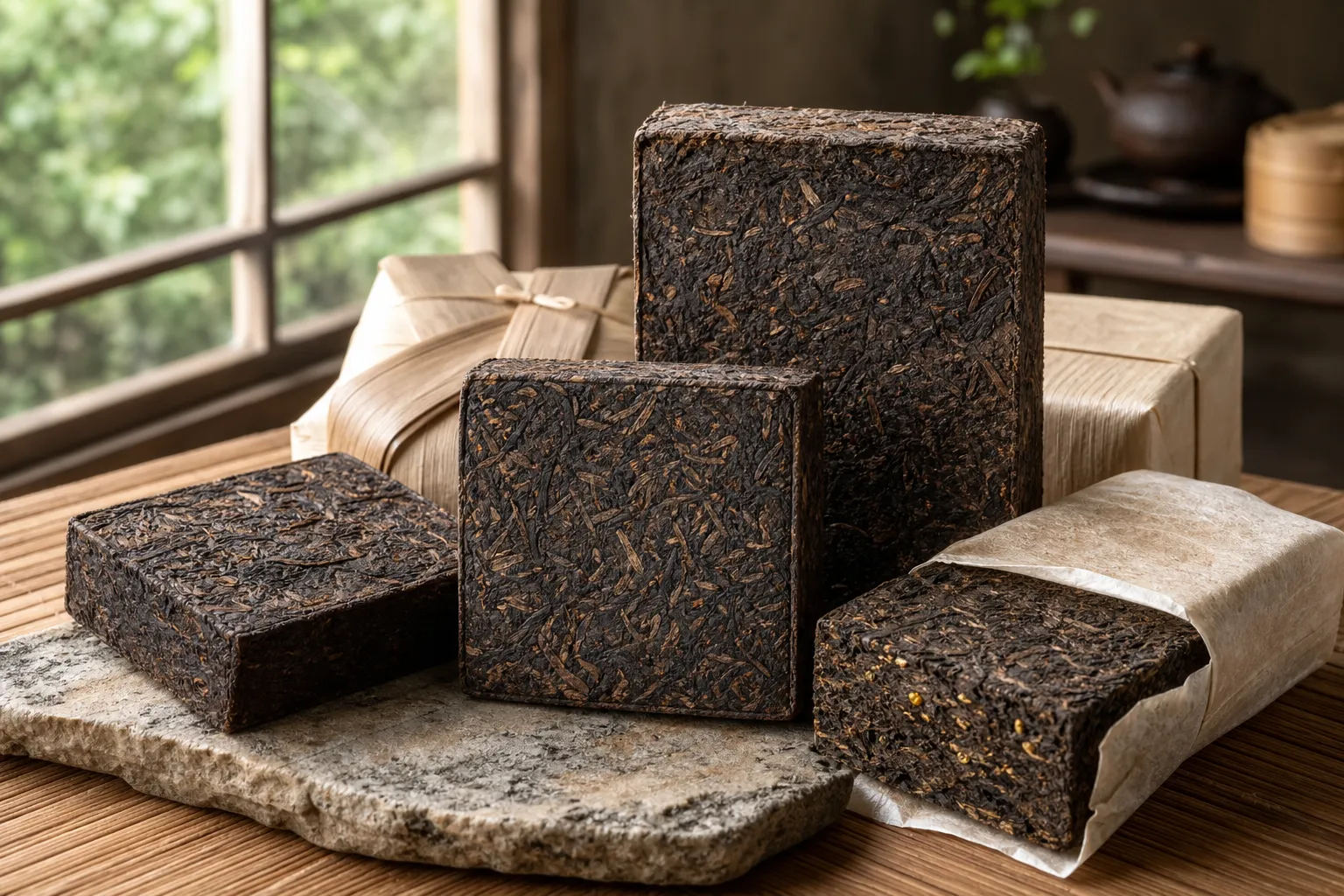
The dark tea brick types most often found as rectangular or brick-like blocks include Fu Zhuan brick tea, Hei Zhuan brick tea, Hua Zhuan brick tea, Qingzhuan green brick tea, several Sichuan border-tea products such as Kangzhuan, Jinjian, and Fangbao, and Pu’er brick tea when Pu’er is pressed into a rectangular form.
The useful distinction is simple: many dark teas are compressed, but not every compressed dark tea is a brick. Pu’er cakes, Pu’er tuo, Qianliang tea cylinders, Hua Juan rolls, basket-packed Hunan teas, and many Liubao teas belong near this conversation, but they are not ordinary rectangular tea bricks unless the physical shape says so.
upward
Start with the broader guide
Use the broader guide first if you need the full scope before this page.
The dark teas most likely to be true bricks
When you are holding a block of Chinese dark tea, check the form before reading too much into flavor notes or wrapper language. A brick is usually flat-sided, rectangular, square, or cuboid enough to look stackable. Weight, thickness, surface pattern, and tightness can vary by maker, so “brick” is more useful as a shape category than as a fixed size.
Fu Zhuan / Fuzhuan brick tea
Usual form cue: rectangular or cuboid brick.
What to watch for: often associated with visible yellow-gold “golden flowers” inside the brick.
Hei Zhuan / Heizhuan brick tea
Usual form cue: compact dark rectangular brick.
What to watch for: a Hunan dark tea brick name; sometimes awkwardly translated as “black tea brick.”
Hua Zhuan / Huazhuan brick tea
Usual form cue: brick-like compressed block.
What to watch for: related in name to Hua Juan traditions, but not the same shape as a long roll.
Qingzhuan / green brick tea
Usual form cue: rectangular brick.
What to watch for: commonly described as a Hubei dark tea brick type.
Kangzhuan
Usual form cue: brick form.
What to watch for: often grouped with Sichuan border-tea brick products.
Jinjian
Usual form cue: brick or compact block form.
What to watch for: usually treated as a compressed Sichuan dark tea product rather than a cake.
Fangbao
Usual form cue: square or brick-like compressed form.
What to watch for: the name points toward a square-bundle style.
Pu’er brick tea
Usual form cue: rectangular Pu’er block.
What to watch for: a brick only when the Pu’er is actually pressed into a brick shape.
Fu Zhuan is often the easiest example for newer buyers because the English name commonly includes “brick.” It is also the tea most often linked with visible golden specks or patches inside the compressed leaf, usually called golden flowers. For this page, that is only an appearance and production clue. It should not be treated as a promise about taste, storage quality, or value.
Hei Zhuan and Hua Zhuan are useful Hunan examples. Their spellings vary in English, including Heizhuan and Huazhuan, so a label may look slightly different while still pointing to the same broad product name. Qingzhuan, often translated as green brick tea or Qing brick tea, is another common brick term. Here, “green” is part of the product name; it does not mean green tea in the usual English tea-category sense.
Kangzhuan, Jinjian, and Fangbao may be less familiar to many English-language drinkers, but they belong in a practical list of dark tea brick types because they are commonly handled as compact Sichuan dark tea products. If you see one of these names on a dark tea menu or wrapper, expect a brick-like or block-like presentation unless the seller clearly shows another shape.
Compressed dark tea that is not usually a brick
The common mistake is to use “compressed dark tea” and “brick tea” as if they mean the same thing. They overlap, but they are not identical.
Pu’er causes much of the confusion. Pu’er can be sold as a brick, but it is also very commonly pressed into cakes and tuo shapes. A Pu’er cake is usually round and flat, so it is compressed but not a brick. A Pu’er tuo is usually bowl-like, nest-like, or dome-shaped. Some Pu’er also appears as small squares, mini cakes, large rounds, or loose tea. The safest wording is: Pu’er may be brick tea, but Pu’er is not automatically brick tea.
Qianliang tea is another important near-miss. It belongs to the world of compressed Hunan dark tea, but it is usually described as a large cylindrical roll or column rather than a rectangular brick. The related term Hua Juan is better understood as a rolled or columnar compressed form. It may sit near Hunan dark tea bricks in a shop or catalog, but its shape and handling are different.
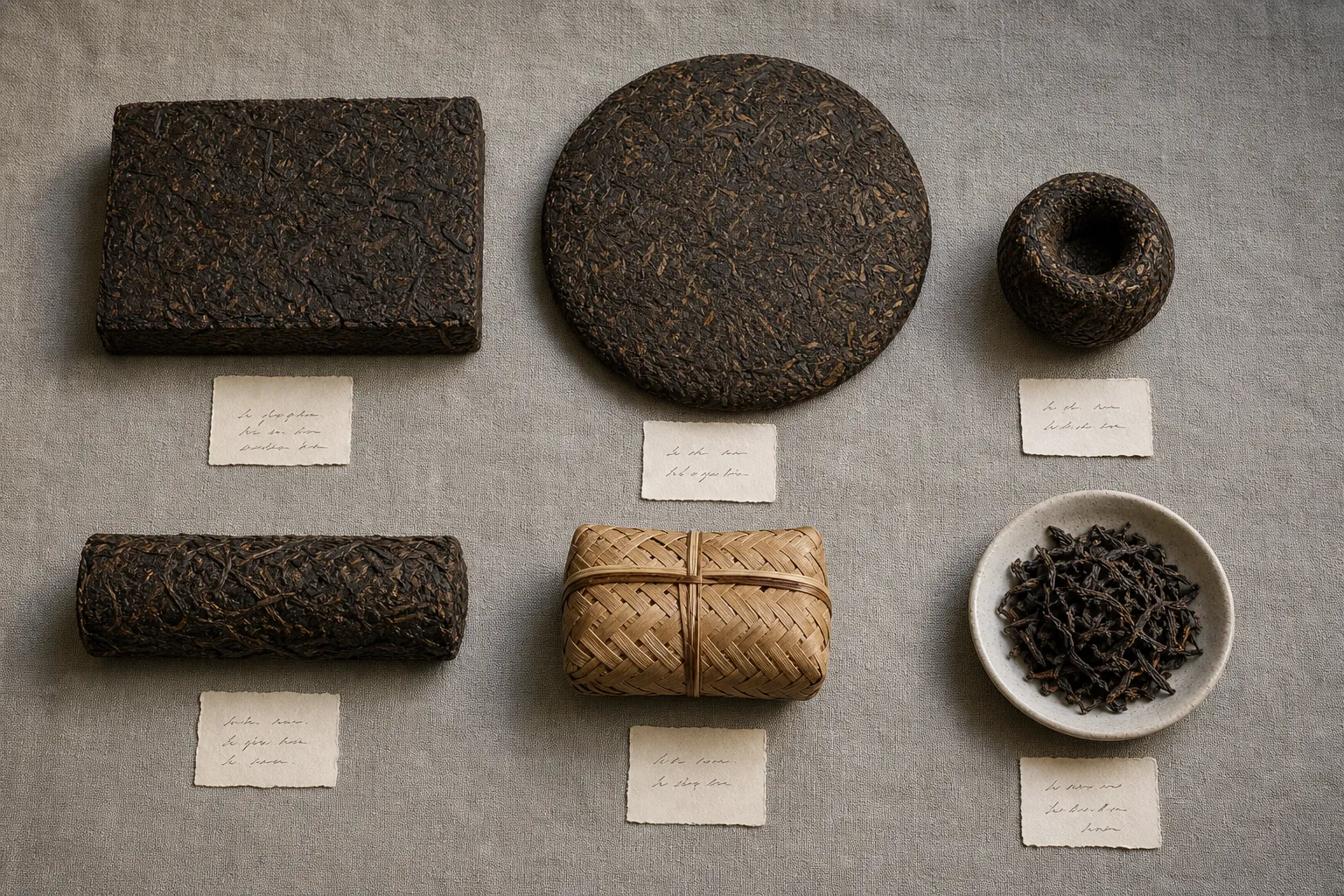
A quick shape check helps
- Brick: rectangular, square, or cuboid block, with clear edges and corners.
- Cake: round, flat disc, especially common with Pu’er.
- Tuo: bowl, nest, or dome-like compressed tea.
- Cylinder or roll: long column form, as with Qianliang or Hua Juan.
- Basket-packed: tea packed into bamboo or woven containers, not molded as a clean rectangular block.
- Loose or bulk: dark tea not pressed into a fixed shape.
This is more than vocabulary. Shape affects how you break and measure the tea. A dense brick is usually worked from an edge or corner. A cake may flake from the rim or face. A tuo can resist the pick because of its curved form and tight compression. A cylinder may need more deliberate breaking because of its size and structure. Knowing the form helps you avoid crushing good leaf into dusty fragments before brewing.
Dark tea that may be basket-packed, loose, or sold in other forms
Not all dark tea is made for the brick shelf. Some Chinese dark teas are commonly seen as basket-packed, loose, or bulk tea, and some appear in more than one market form.
Xiangjian-style Hunan dark teas are a good example. Names such as Tianjian, Gongjian, and Shengjian are often associated with basket-packed products rather than standard rectangular bricks. A basket-packed tea may become compacted by its container and storage, but it is still not the same object as a molded brick. If the tea arrives in a bamboo basket or basket-shaped package, call it basket-packed first.
Liubao, sometimes written as Liupu in older or alternate English renderings, also needs care. It belongs within the broader dark tea family, but it is often encountered in basketed or loose presentations. Some sellers may portion or compress it in other ways, so check the actual form instead of assuming it is a brick.
Loose ripe Pu’er creates the same issue. Ripe Pu’er is often discussed within dark tea classification, and Pu’er can be compressed into many shapes, but loose ripe Pu’er is not brick tea. If the label says “Pu’er brick,” that is a shape claim. If it only says “ripe Pu’er,” “shou Pu’er,” or “loose Pu’er,” do not infer a brick.
How to read common label words
If the label says: Fu Brick, Fu Zhuan, Fuzhuan
Likely reading: usually a true brick.
If the label says: Hei Zhuan, Hua Zhuan, Qingzhuan
Likely reading: usually brick-like dark tea.
If the label says: Kangzhuan, Jinjian, Fangbao
Likely reading: often compact brick or block-style dark tea.
If the label says: Pu’er brick
Likely reading: Pu’er in brick form.
If the label says: Pu’er cake, Qizibing, round cake
Likely reading: compressed, but not a brick.
If the label says: Pu’er tuo
Likely reading: compressed, but not a brick.
If the label says: Qianliang, Hua Juan
Likely reading: compressed cylinder or roll, not a normal brick.
If the label says: Tianjian, Gongjian, Shengjian
Likely reading: often basket-packed rather than brick.
If the label says: Liubao / Liupu
Likely reading: often basketed or loose; check the actual form.
Why the shape matters when you brew
Compression fits many dark teas because processed leaf material can be sorted, steamed or moistened, weighed, pressed, cooled, dried, and wrapped. That does not mean every dark tea must be compressed. It only helps explain why bricks, cakes, tuo, rolls, and basketed forms are so common around this category.
For the drinker, the practical result matters most. A brick usually asks for a tea pick, a stable surface, and patience at the edge. Try to loosen a piece that keeps some leaf structure rather than grinding it into powder. If the brick is very tight, work from a corner or natural seam. If it flakes easily, use lighter pressure and adjust your brewing amount by weight or by the visual density of the broken piece.
Two chunks that look similar can behave differently in the cup. A tight inner piece may open slowly. A loose outer flake may release color and flavor faster. In many everyday brewing setups, it helps to briefly wet or rinse the broken tea first, then watch the first drinkable infusion. If the cup tastes thin, extend the next steep or use a little more leaf. If it turns heavy, harsh, or muddy, shorten the steep or reduce the amount. Those adjustments come from the density of the piece as much as from the tea name.
How to check a tea brick without over-reading the label
A label can help, but the object in front of you gives the clearest answer.
- Look at the outline. Is it rectangular, square, or cuboid? If yes, “brick” is plausible.
- Read the product name. Fu Zhuan, Hei Zhuan, Hua Zhuan, Qingzhuan, Kangzhuan, Jinjian, Fangbao, and Pu’er brick are strong brick signals.
- Separate category from shape. “Dark tea,” “Pu’er,” or “compressed tea” alone does not mean brick.
- Watch for non-brick words. Cake, tuo, Qianliang, Hua Juan, basket, and loose all point away from a normal brick.
- Do not let decoration decide. Wrapper style, surface pattern, age wording, or pressing marks do not override the basic shape.
One language caution: in English, “black tea brick” can be misleading. Chinese dark tea is often called hei cha, and “hei” literally means black or dark, but dark tea is not the same category as the red-brown oxidized tea usually called black tea in English. For Chinese fermented tea bricks, “dark tea brick” or the specific product name is clearer.
The available classification material for this narrow question is uneven, and much public writing around tea bricks drifts into sales language, storage talk, or broad cultural history. For a buyer or brewer, the cautious method is enough: name the tea if you can, identify the shape you can actually see, and avoid turning every compressed dark tea into a brick.
Short answer to remember
The usual Chinese dark tea bricks are Fu Zhuan, Hei Zhuan, Hua Zhuan, Qingzhuan, Kangzhuan, Jinjian, Fangbao, and Pu’er when it is specifically pressed as a brick.
The main near-misses are Pu’er cakes, Pu’er tuo, and Qianliang/Hua Juan cylinders. They are compressed, but they are not ordinary rectangular bricks. Basket-packed Hunan teas and many Liubao presentations belong to dark tea culture too, but they should not be counted as brick tea unless the physical form actually matches.
Sources
Sources and further reading
Reference links are limited to sources considered suitable for public citation in this page.