
Dark tea comparison guide
Major Types of Dark Tea and How They Differ
If you are comparing the types of dark tea, the hard part is rarely the word “dark.” The confusion usually comes from overlap: region names, brick shapes, post-fermentation methods, storage language, and seller shorthand all get mixed together.
Pu-erh is not the whole category. Fu Brick is not every Hunan dark tea. Golden Flowers do not appear in every dark tea. An old cake, basket, or brick does not automatically taste better because it has more years behind it.
A useful way to compare dark tea is to ask five questions:
- Where is it mainly associated with?
- What processing cue defines it?
- What form does it usually take?
- What does the cup tend to do?
- What brewing or storage habit does it ask from you?
That frame is more reliable than trying to memorize one fixed flavor for each name.
upward
Read the full overview first
Use the broader guide first if you need the full scope before this page.
Hei Cha, dark tea, and the first distinction to get right
In Chinese tea classification, Hei Cha is commonly translated as dark tea. It refers to a family of post-fermented teas made from Camellia sinensis, where microbial activity is part of processing or later transformation.
That is different from the “fermentation” language often used for black tea or oolong tea, where oxidation by tea-leaf enzymes is the main idea.
For a drinker, this matters because dark tea often behaves less like a bright, aromatic green or black tea and more like a stored, transformed tea: deeper liquor, softer bitterness, woody or earthy tones, sometimes a thicker body, and flavors shaped by compression, humidity, airflow, age, and storage setting.
Still, dark tea is not one taste. A ripe Pu-erh cake, a Fu Brick with Golden Flowers, a Liu Bao basket tea, a Hubei Qingzhuan brick, and a Sichuan/Tibetan-style border tea can all belong in the dark tea conversation while feeling quite different in the cup.
Major Chinese dark tea types at a glance
This table is a practical map, not a strict legal taxonomy. Use it to separate the main Chinese dark tea types by origin, processing cue, form, and drinking behavior.
| Dark tea type | Common region association | Processing cue | Common form | Typical cup direction | What to watch when buying or brewing |
|---|---|---|---|---|---|
| Ripe Pu-erh / Shou Pu-erh | Yunnan | Wet-piling process, often called wo dui | Cakes, bricks, tuocha, loose leaf | Earthy, woody, smooth, dark red-brown liquor; can be damp or heavy if young or poorly aired | Rinse if needed; use shorter steeps if the cup turns muddy or too dense |
| Fu Brick / Fu Zhuan / Fuzhuan | Hunan and Shaanxi are often discussed; also made elsewhere | Pressing and a controlled “flowering” stage associated with Golden Flowers and Eurotium cristatum | Brick | Mellow, sweet-leaning, bready, date-like, thick; sometimes described with fungal-flower aroma | Golden Flowers are a Fu Brick cue, not a universal marker for all dark tea |
| Liu Bao tea / Liubao | Guangxi | Regional post-fermented style; often discussed with aging and basket storage | Baskets, loose tea, compressed forms | Aged wood, clean earth, mellow depth; market language often mentions betel-nut aroma | Betel-nut aroma is a known descriptor, not a pass-fail test for every Liu Bao |
| Anhua dark tea | Hunan, especially Anhua | Regional dark tea family; may include Fu Brick, Hei Zhuan, Hua Zhuan, and other forms | Bricks, logs, compressed pieces, loose material | Can be rustic, woody, smoky, pine-like, strong, or mellow depending on subtype and storage | Do not assume all Anhua dark tea is Fu Brick |
| Qingzhuan tea / Hubei green brick tea | Hubei | Brick-style dark tea, historically linked with compact transportable forms | Dense brick | Sturdy, straightforward, often less perfumed than some Fu Brick examples | Compression can slow extraction; break carefully and give leaves room to open |
| Tibetan dark tea / Zang Cha / Ya’an tea | Sichuan and border-tea contexts | Robust dark tea made for regional preparation habits | Bricks and compressed blocks | Strong, steady, sometimes coarse-leaf; less delicate than fragrance-led teas | May be brewed stronger or boiled in some settings; for plain drinking, start lighter |
| Kang Brick tea | Often discussed in Sichuan/Tibetan tea contexts | Border-tea brick style | Brick | Firm, dark, functional, robust | Compare with Fu Brick by processing cue and use, not only by shape |
For a first decision: choose ripe Pu-erh for a familiar earthy reference point, Fu Brick for Golden Flowers and mellow brick sweetness, Liu Bao for aged wood and betel-nut aroma language, and Qingzhuan, Kang Brick, or Tibetan dark tea for denser, stronger brick styles.
How the main types differ in the cup
Ripe Pu-erh: dark, earthy, and often the easiest reference point
Ripe Pu-erh is the dark tea many English-language drinkers meet first. It is associated with Yunnan and often appears as cakes, bricks, small tuocha, or loose tea. Its key processing cue is wo dui, usually translated as wet piling, which encourages post-fermentation and gives ripe Pu-erh its dark liquor and familiar earthy direction.
Good examples are often smooth, woody, mellow, and deep. Less settled examples can taste damp, muddy, overly earthy, or flat. A brief rinse is common, especially when the tea is tightly compressed or carries a heavy storage smell.
Ripe Pu-erh usually handles hot water well. In a small vessel, start with a quick rinse, then short steeps. If the liquor becomes opaque, sour-heavy, or too thick, use less leaf or shorten the next infusion. If it tastes thin and hollow, add leaf or extend the steep.
Fu Brick tea: Golden Flowers, mellow body, and a different aroma path
Fu Brick tea, also written Fu Zhuan or Fuzhuan, is one of the most recognizable dark tea brick types because of its “flowering” step, often called Fahua. In this context, Golden Flowers refers to visible yellow-gold fungal growth associated with Eurotium cristatum in Fu Brick production.
The boundary is important: Golden Flowers are especially linked with Fu Brick language. They are not something to expect in every dark tea, and more visible flowers should not be treated as a simple ranking system across unrelated teas.
In the cup, Fu Brick is often described as mellow, sweet-leaning, bready, date-like, or thick. Some sources and market descriptions use “fungal flower aroma” for its characteristic smell. That does not mean every brick will taste sweet or fragrant in the same way. Region, storage, leaf material, compression, age, and brewing ratio all change the result.
Fu Brick usually rewards patience. Break off a clean piece rather than crushing the brick into dust. Use hot water. If the first cup seems too light, the brick may need a rinse and a slightly longer first drinkable steep. If it becomes rough or sour, reduce leaf or shorten the infusion.
Liu Bao tea: aged wood, clean depth, and the betel-nut aroma question
Liu Bao tea from Guangxi is another major name in Chinese dark tea types. English-language drinkers often meet it as basket-stored tea, aged loose tea, or compressed material. Descriptions commonly mention aged wood, cellar, clean earth, and the well-known betel-nut aroma.
That aroma term is useful, but easy to overread. It should not become a pass-fail test for every Liu Bao. Some examples show it clearly; others lean more toward wood, mineral, dry earth, camphor-like coolness, or mellow sweetness. Storage has a strong influence on how Liu Bao presents itself.
Compared with Fu Brick, Liu Bao often feels less bready and less centered on Golden Flowers. Compared with ripe Pu-erh, it may feel cleaner, drier, or more woody, though this depends heavily on the tea. If you are comparing Liu Bao vs Fu Brick, start with aroma and texture: Liu Bao may suggest aged wood and basket-stored depth, while Fu Brick may point toward mellow brick sweetness and fungal-flower language.
Anhua dark tea: a regional family, not one flavor
Anhua dark tea is a Hunan regional family, not a single cup profile. This is where many buyers get tangled. Fu Brick may be discussed within the Anhua dark tea world, but Anhua also includes other forms such as Hei Zhuan and Hua Zhuan. These can differ in compression, leaf material, aroma, and brewing behavior.
Some Anhua bricks are described as stronger, smokier, pine-like, or rustic. Others can be rounder and more mellow. Read the specific subtype and form before assuming that “Anhua” tells you the whole story.
If you are comparing Hunan dark tea vs Liu Bao, the better starting question is not “which is better?” but “what kind of darkness do you want?” Hunan styles may bring brick structure, roasted or smoky suggestions, or Fu Brick’s flowering language. Liu Bao more often points toward Guangxi regional identity, aged-wood descriptors, and basket-aging vocabulary.
Qingzhuan tea: Hubei green brick tea and dense compression
Qingzhuan tea, often translated as Hubei green brick tea, can confuse readers because “green” in the English name does not mean it drinks like green tea. It is usually discussed as a Hubei dark tea brick, compact and practical in form.
The main drinking issue is extraction. Dense bricks can give a pale first cup if the leaves have not separated, then a very strong later cup when the chunk opens suddenly. Use a tea pick carefully, avoid crushing too much leaf, and give the broken pieces a rinse or short awakening steep. If the tea tastes blunt, reduce the chunk size rather than forcing long steeps from a dense piece.
Tibetan dark tea, Zang Cha, Ya’an tea, and Kang Brick
Tibetan dark tea, Zang Cha, Ya’an tea, and Kang Brick appear in conversations about border tea and robust compressed tea. These teas are often discussed in relation to strong preparation contexts, including butter-and-salt tea in some cultural settings. That context is useful, but it should not take over the comparison.
For plain drinking, these teas can be strong, steady, and less delicate than a fragrant loose-leaf tea. They may use coarser material and can be boiled or brewed longer in some preparations. If you are tasting one for the first time without milk, butter, or salt, start gentler than the strong-use image suggests: less leaf, hot water, and a short first steep. You can build strength after the first cup.
When comparing Kang Brick vs Fu Brick, shape alone is not enough. Both may be bricks, but Fu Brick is usually identified by its flowering and Golden Flowers language, while Kang Brick belongs more naturally to the robust border-tea comparison.
Variables that change how any dark tea tastes
The type name helps, but it does not finish the judgment. The same category can produce very different cups when form, material, storage, and brewing change.
Form: loose, cake, brick, basket, or compressed chunk
Loose dark tea extracts quickly and can become strong fast. Cakes and bricks need more time to open. Basket-stored teas, especially Liu Bao, may carry storage aromas that shift after airing and rinsing.
A tightly compressed Fu Brick or Qingzhuan brick may taste quiet in the first steep and powerful later. A loose ripe Pu-erh may give color and body almost immediately. When comparing fermented tea varieties, do not blame the category for what is really a form issue.
Leaf material
Many dark teas use more mature leaves than delicate green or white teas. Mature leaves can support deeper, steadier brews, but they can also taste coarse if over-extracted or poorly stored. Bud-heavy delicacy is not the normal standard for many dark tea bricks.
Storage
Dark tea is storage-sensitive. It can change over time, but change is not automatically improvement. Clean, dry-enough, odor-free storage may preserve and gradually shift aroma. Poor storage can create flatness, harshness, stale smells, or unpleasant damp notes.
If a tea smells sharply musty, sour in an unpleasant way, perfumed by its surroundings, or visibly questionable beyond the expected appearance of its type, brewing technique is unlikely to fix the problem.
Brewing ratio and vessel
Small-vessel brewing with more leaf and short steeps emphasizes texture and layered aroma. A mug or larger pot with less leaf makes a calmer daily cup. Neither method is the one “true” version of dark tea.
For a first comparison session:
- Use water near boiling for most dark teas.
- Rinse compressed or storage-heavy teas briefly if the aroma feels closed.
- Start with short steeps in a small vessel.
- Lengthen only when the cup becomes thin.
- Reduce leaf if the liquor turns muddy, sour-heavy, or overly forceful.
Common mix-ups when comparing dark tea
Pu-erh is not the same as dark tea
Pu-erh is one major dark tea family, especially in its ripe form, but it does not cover Fu Brick, Liu Bao, Qingzhuan, Tibetan tea, or all Anhua bricks. If a shop uses Pu-erh language for every dark tea, read carefully.
Black tea and dark tea are not the same category in English tea shopping
In Chinese tea classification, what English speakers call black tea is usually a different category from Hei Cha. Dark tea refers to post-fermented tea. This distinction matters because someone searching for “dark black tea” may mean either oxidized black tea or post-fermented dark tea. They are not interchangeable.
Golden Flowers belong mainly to the Fu Brick conversation
Golden Flowers are important for understanding Fu Brick tea, but they should not be expected in Liu Bao, ripe Pu-erh, Qingzhuan, or every Anhua brick. Their presence is a processing and type cue, not a universal dark tea rule.
A brick shape does not identify the tea
Many dark teas are compressed into bricks: Fu Brick, Qingzhuan, Kang Brick, Hei Zhuan, Hua Zhuan, and other regional forms. The brick tells you about form and extraction. It does not, by itself, tell you the region, processing cue, or flavor.
Age depends on storage
Some dark teas can become smoother or more integrated with time, but age alone does not make a better cup. Storage conditions, original material, compression, and handling matter. A younger clean tea may be more enjoyable than an older poorly stored one.
A practical choosing path
If you are choosing your first few dark teas, do not try to cover every regional subtype at once. Choose by the experience you want to compare.
Start with ripe Pu-erh if you want the most common dark, earthy reference point. It is widely available and helps you learn how post-fermented smoothness, woodiness, and storage aroma behave.
Choose Fu Brick tea if you want to understand Golden Flowers, brick fermentation language, and a mellow, sweet-leaning profile that may feel bready or thick.
Choose Liu Bao tea if aged wood, basket-stored depth, and the betel-nut aroma conversation interest you. Look for clean aroma more than dramatic sales language.
Choose Anhua dark tea if you want to explore Hunan brick diversity beyond Fu Brick. Pay attention to whether the tea is Fu Zhuan, Hei Zhuan, Hua Zhuan, or another named form.
Choose Qingzhuan, Kang Brick, or Tibetan dark tea if you are curious about dense, robust brick teas and traditional strong-use contexts. Brew gently at first, then increase strength.
A useful tasting comparison is one ripe Pu-erh, one Fu Brick, and one Liu Bao brewed with the same vessel and similar leaf ratio. Notice more than flavor words: how fast each tea darkens, how the aroma opens after a rinse, whether the texture feels thick or dry, and how the aftertaste sits. That comparison teaches more than memorizing a list.
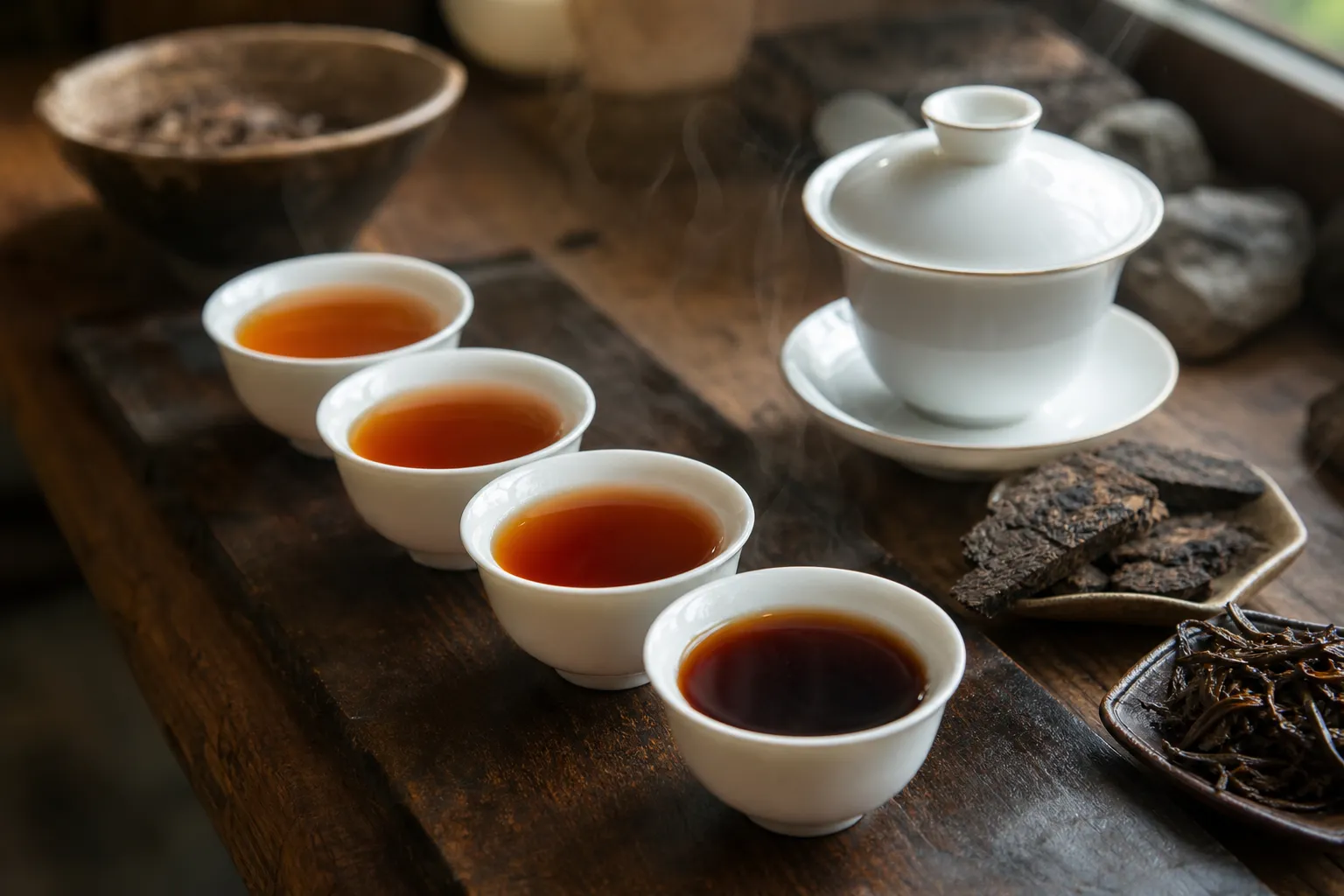
How to tell major dark tea types apart by leaf, liquor, and aroma
When labels are unclear, visible and sensory clues can help you ask better questions. They do not replace trustworthy sourcing, but they make the label easier to interpret.
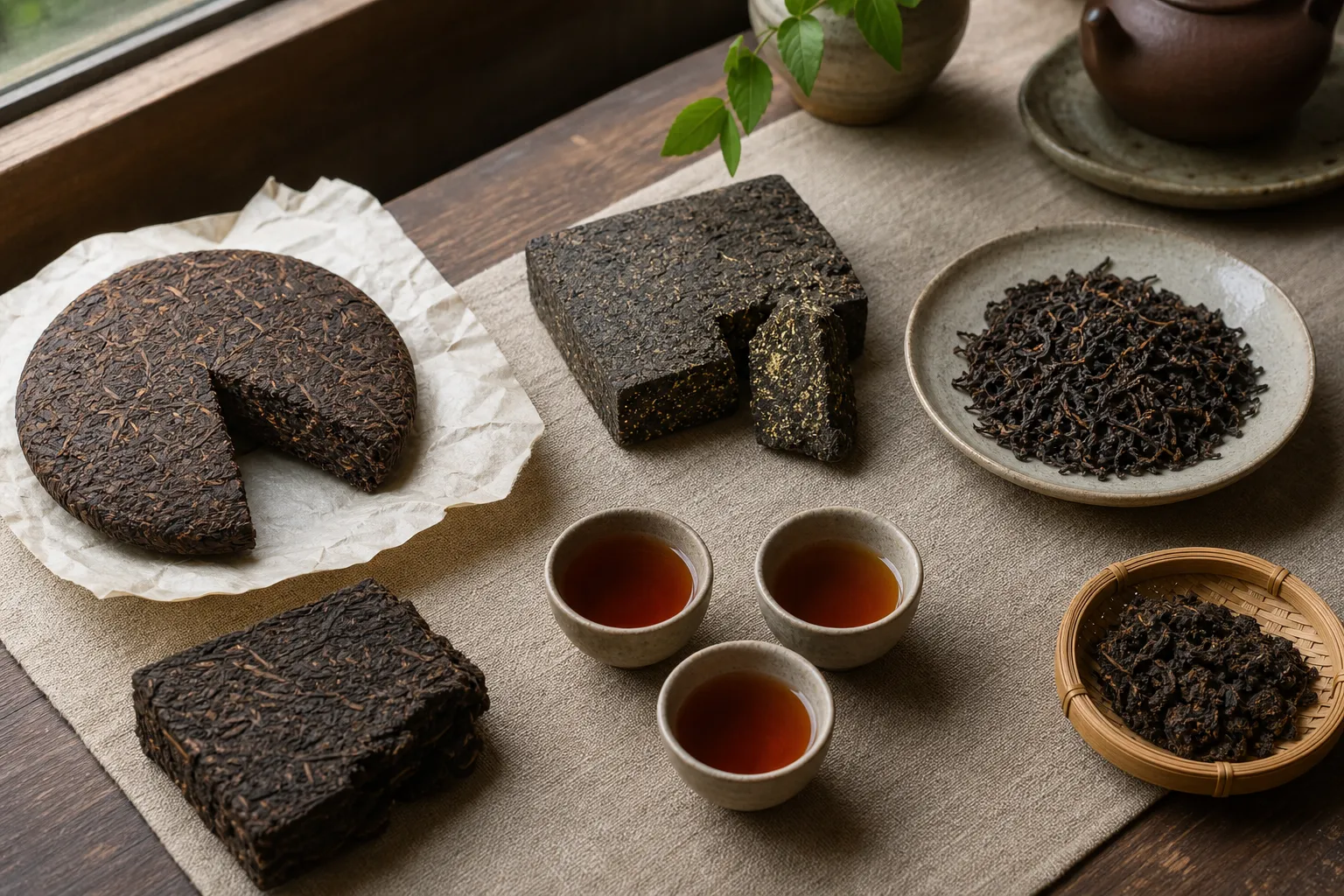
Look at the form first. Is it a cake, brick, basket tea, loose leaf, tuocha, or compressed block? A cake often points buyers toward Pu-erh, while dense rectangular bricks may suggest Fu Brick, Qingzhuan, Kang Brick, or other brick teas. Basket presentation often appears in Liu Bao conversations.
Notice the inside of the brick. If you see yellow-gold specks in a Fu Brick context, that may be the Golden Flowers associated with Fuzhuan tea. Do not apply that expectation to every dark tea.
Watch the liquor color. Ripe Pu-erh often brews dark red-brown to nearly opaque when strong. Fu Brick can produce a clear amber to reddish-brown liquor depending on age and strength. Liu Bao may range from reddish-brown to darker brown. Color alone is not enough, but it helps when paired with aroma.
Smell for the aroma direction. Earthy and woody may point toward ripe Pu-erh, though many dark teas can be woody. Bready, sweet, or fungal-flower language often appears with Fu Brick. Aged wood and betel-nut aroma language often appears with Liu Bao. Smoky, pine-like, or rustic notes may appear in some Anhua brick discussions. Strong and functional rather than delicate may fit Tibetan tea or Kang Brick contexts.
Finally, taste the extraction pattern. Loose or loosely compressed tea gives itself quickly. Dense bricks unfold slowly. If a tea seems weak, it may need time to open. If it becomes rough, you may be using too much leaf or steeping too long.
FAQ
What does Hei Cha mean compared with dark tea?
Hei Cha is the Chinese term commonly translated as dark tea. In English tea writing, dark tea usually means post-fermented tea, not simply tea with dark-colored leaves.
Which dark teas are usually compressed into bricks?
Fu Brick, Qingzhuan, Kang Brick, Hei Zhuan, Hua Zhuan, and some Tibetan dark teas are commonly encountered as bricks or compressed blocks. Ripe Pu-erh can also be compressed, though cakes and tuocha are common too.
Is ripe Pu-erh a dark tea?
Ripe Pu-erh is commonly discussed as a major dark tea type because it is post-fermented. Raw Pu-erh has its own aging and classification debates, so for beginner-friendly comparisons, ripe Pu-erh is the clearer reference point.
Is Fu Brick better than Liu Bao?
Not as a general rule. Fu Brick and Liu Bao differ by region, processing language, form, aroma, and storage behavior. Fu Brick is often discussed through Golden Flowers and mellow brick sweetness; Liu Bao through Guangxi identity, aged wood, and betel-nut aroma language. The better choice depends on the cup you want and the condition of the specific tea.
Sources
Sources and further reading
Reference links are limited to sources considered suitable for public citation in this page.