
Regional comparison
Dark Tea Types by Region: Hunan, Guangxi, Hubei, Sichuan, and Yunnan
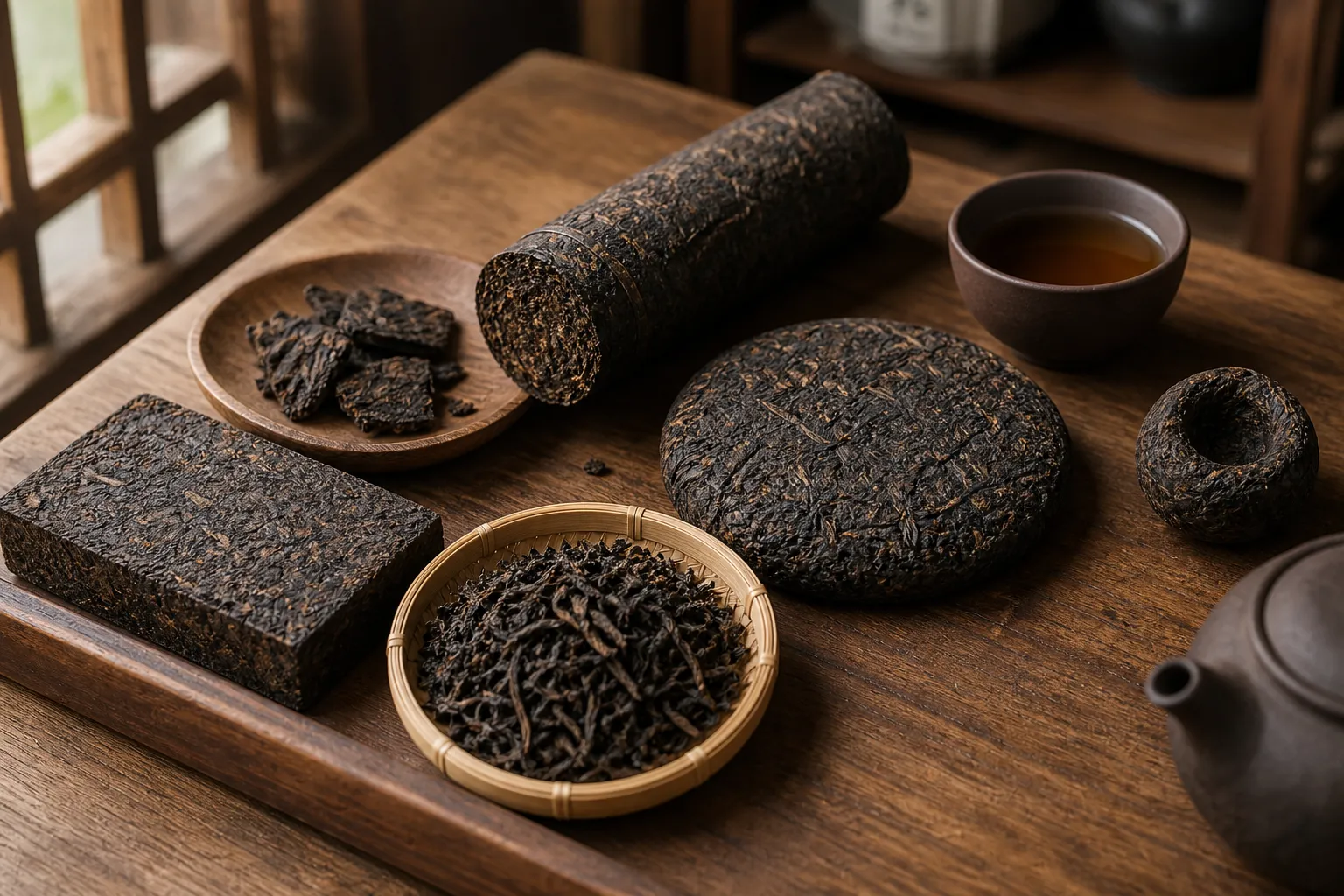
If you are comparing dark tea types by region, use the region as a map, not as proof of quality. Hunan points to Fu Zhuan, Hei Zhuan, Hua Zhuan, Xiangjian, and Qianliang forms. Guangxi points most clearly to Liubao. Hubei is usually represented by Qingzhuan, often translated as green brick tea. Sichuan is associated with Kangzhuan, Jinjian, Fangbao, and other packed border-sale styles. Yunnan is the home region of Pu’er, which appears as loose tea, cakes, bricks, tuo shapes, and small compressed portions.
For the drinker, the useful differences are practical: what the label says, how the tea is shaped, how hard it is to dose, what kind of post-fermentation language is used, how clean the storage aroma feels, and whether the cup brews light, mellow, thick, earthy, woody, brisk, or heavy.
upward
Read the full overview first
Use the broader guide first if you need the full scope before this page.
A quick regional map for Chinese dark tea
Dark tea is a post-fermented tea category. Many regional styles begin with broad steps such as heat-fixing, rolling, moisture heaping or pile fermentation, and drying, then diverge through local processing, compression, packing, and storage habits.
Use this table when a wrapper or seller description gives you a regional name but not much practical detail.
| Region | Names you may see | Common form | Processing or form cue | What to notice as a drinker |
|---|---|---|---|---|
| Hunan | Fu Zhuan, Hei Zhuan, Hua Zhuan, Xiangjian, Tianjian, Gongjian, Shengjian, Hua Juan, Qianliang | Bricks, baskets, large compressed cylinders | Strongly shaped or packed forms; Fu Zhuan is associated with “golden flowers” | Compression, aroma clarity, orange-yellow to red-yellow liquor, mellow body, possible brisk edge |
| Guangxi | Liubao tea | Loose tea, basket-packed tea, some compressed forms | Guangxi’s main dark tea name in most English contexts | Red-brown liquor, woody or aged notes, body thickness, clean storage aroma |
| Hubei | Qingzhuan, green brick tea | Brick | A recognized Hubei dark tea brick style | Brick hardness, dosing effort, steady dark-tea body rather than delicate leaf aroma |
| Sichuan | Kangzhuan, Jinjian, Fangbao, Tibetan tea in some English contexts | Bricks and packed forms | Often discussed with border-sale tea history | Compression, clean aroma, whether the cup turns thin, heavy, or rough |
| Yunnan | Pu’er, raw Pu’er, ripe Pu’er, Pu’er cake, tuo, brick, loose Pu’er | Loose tea, cakes, tuo, bricks | The best-known dark tea branch for many English readers | Very wide range depending on raw or ripe processing, age, storage, and form |
This map also corrects a common shortcut: Pu’er is not the whole dark tea category. It is one major Yunnan branch inside a wider group of regional dark tea styles.
Hunan: the widest set of recognizable forms
Hunan gives readers the clearest form-based comparison because several names lead to very different handling experiences.
Fu Zhuan, often called Fu brick tea, is a compressed brick style. Its most recognizable cue is the presence of small yellow-golden specks commonly called “golden flowers,” associated in tea literature with Eurotium cristatum. In a Fu Zhuan context, these specks are a known feature of the style and are tied to its fermentation identity and aroma formation.
Still, visual recognition should not replace basic smell judgment. Clean golden specks in a Fu Zhuan brick are different from fuzzy, damp, sour, or unpleasantly musty growth. If a brick smells sharp, dirty, wet-cardboard-like, or stale in an off-putting way, treat that as a storage warning rather than normal regional character.
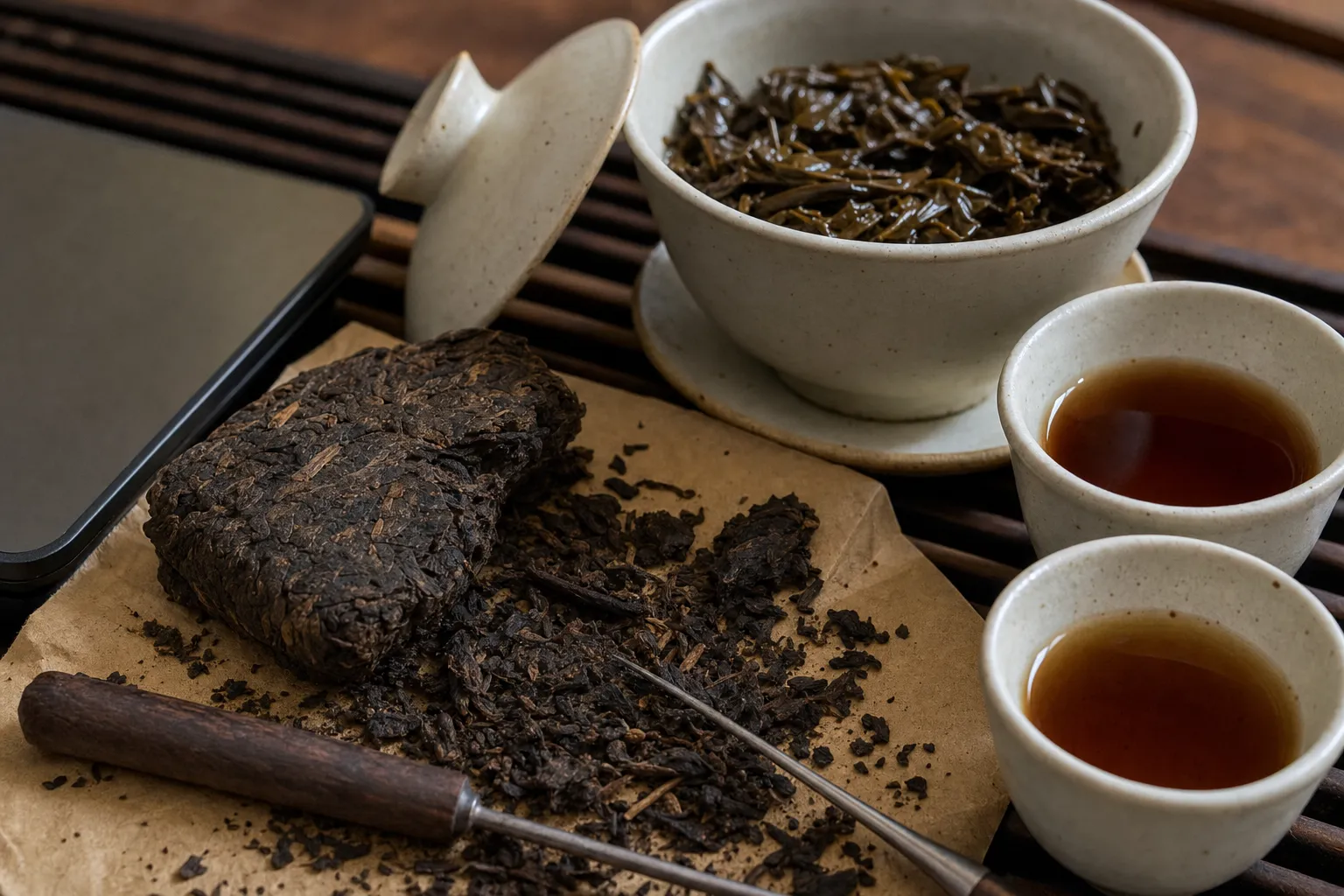
Hei Zhuan and Hua Zhuan are also Hunan brick styles. Product details vary, so the practical question is simple: how compressed is the brick, and how cleanly can you remove a portion? A tighter brick may need a tea pick and slower preparation. A looser brick may be easier to dose but can produce more broken leaf and dust.
Xiangjian is a basket-packed Hunan group that includes names such as Tianjian, Gongjian, and Shengjian. Some older descriptions connect these names with raw-material distinctions, but that should not be turned into a simple modern buying ladder without product-specific information. For everyday brewing, the main cue is that Xiangjian is not the same handling experience as a hard brick. Basket-packed tea may separate more easily and can feel closer to loose dark tea in the pot.
Hua Juan and Qianliang are the most physically distinctive Hunan forms. Qianliang is known as a large, tightly compressed cylindrical tea. In real brewing terms, that matters more than the drama of the shape. Most drinkers encounter slices, chunks, or smaller portions rather than a full cylinder. If you buy a dense Qianliang piece, use a tea pick carefully and expect the first rinse or steep to help the compressed layers open.
In the cup, Hunan dark teas can show orange-yellow, red-yellow, or deeper reddish liquor depending on style, age, storage, and brewing strength. Some cups feel mellow and settled; others keep a firmer, slightly astringent edge if brewed strong or made from more robust material. Treat these as cues to watch, not fixed outcomes.
Guangxi: Liubao as the main regional name
For Guangxi, the name to recognize is Liubao tea. In English-language tea markets, Liubao is sometimes compared with Pu’er because both are post-fermented dark teas and both can show aged, woody, earthy, or red-brown cup qualities. The comparison can be helpful, but it can also blur the tea’s identity.
Liubao is not simply “Pu’er from Guangxi.” It belongs to the Guangxi dark tea tradition and has its own raw-material, processing, and storage context. Academic summaries often describe Liubao around sensory ideas such as redness, thickness, aged aroma, and a clean impression. In the cup, translate that into questions you can actually answer:
- Does the liquor lean reddish-brown rather than pale orange?
- Does the body feel rounded or thick enough for the amount of leaf used?
- Is the aged aroma woody, mellow, or settled rather than damp and unpleasant?
- Does the aftertaste feel clean, or does the storage note take over?
Liubao may appear loose, basket-packed, or compressed. Loose Liubao is usually easier for daily dosing than a tight brick. If you are new to regional dark tea styles, that ease of use can make Liubao less intimidating than a hard Hubei, Sichuan, or Hunan brick.
Hubei: Qingzhuan and the brick-tea question
Hubei dark tea is most often represented by Qingzhuan tea, also called green brick tea in some English descriptions. The available source coverage for Hubei is thinner than for Hunan, Guangxi, and Yunnan, so it is better to keep the claim modest: Qingzhuan is a recognized Hubei dark tea brick style within the broader Chinese dark tea taxonomy.
For the drinker, the key issue is compression. A brick tea asks different questions than loose tea:
- Can you remove a piece without creating too much dust?
- Is the piece mostly layered leaf, stems, and compressed material, or is it very powdery?
- Does the tea need a rinse or a longer first steep to open up?
- Do broken fragments make the cup too strong too quickly?
Qingzhuan may not give the immediate aromatic lift of a loose tea. Its appeal is more likely to sit in body, steadiness, and a darker post-fermented profile. Region alone does not tell you how thick, sweet, brisk, or earthy a particular brick will be.
Sichuan: Kangzhuan, Jinjian, and packed border-sale forms
Sichuan dark tea is commonly associated with Kangzhuan, Jinjian, Fangbao, and related packed or brick forms. These teas are often discussed in the context of border-sale tea history and the movement of compressed tea into western regions. That history helps explain why form matters: dense bricks and packed teas travel, break, and brew differently from loose leaves.
The curated evidence supports the naming and regional placement, but not a detailed modern flavor map for every Sichuan style. A careful comparison should focus on what a buyer can verify:
- Is the tea sold as a brick, a packed bundle, or broken pieces?
- Does the dry tea smell clean, woody, mellow, smoky, or damp?
- Is the compression tight enough that you need tools?
- Does the liquor feel thin at first, suggesting more leaf or time may help?
- Does it turn heavy or rough when pushed too hard?
With a new Sichuan brick, start modestly: use hot water, a reasonable leaf amount, and short steeps, then increase time if the liquor feels too light. This gives the inner layers time to open before you judge the tea.
Yunnan: Pu’er forms and why they do not all taste alike
Yunnan’s dark tea identity is Pu’er. For many English-language drinkers, Pu’er is the first dark tea they meet, which is why it is often mistaken for the whole category. It is better to think of Pu’er as one large regional family with many forms and processing distinctions.
You may see Pu’er as:
- Loose tea
- Compressed cakes
- Tuo shapes
- Bricks
- Small compressed portions
Pu’er may also be described as raw or ripe, and storage age changes how people discuss it. Research commonly frames Pu’er as a Yunnan post-fermented tea made from sun-dried large-leaf tea material, with microbial transformation playing an important role in ripe Pu’er processing. For this page, the practical point is simpler: “Yunnan” on the label does not predict one flavor.
A young compressed raw Pu’er, a loose ripe Pu’er, and an aged cake from different storage conditions can behave like very different teas. Some may brew bright and brisk; others may be dark, smooth, earthy, woody, or thick. If a seller only says “Yunnan dark tea” or “Pu’er” without form, age, raw-versus-ripe context, or storage description, you still do not know enough to predict the cup.
What changes the answer besides region
Form changes extraction
Loose Liubao or loose Pu’er may release quickly. A tight Qingzhuan brick, Fu Zhuan brick, or Qianliang chunk may need a rinse and more time for the leaf to separate. Broken crumbs can brew stronger and rougher than intact chunks from the same tea.
Storage changes aroma
Aged, woody, mellow, and settled notes can be part of dark tea enjoyment. Damp, fuzzy, sour, or unpleasantly musty notes are different. Do not excuse every storage smell as “aged character.”
Processing changes the family resemblance
Dark teas share post-fermentation as a broad category, but Fu Zhuan’s golden-flower feature, Liubao’s Guangxi identity, Pu’er’s Yunnan processing language, and brick-based Hubei or Sichuan forms are not interchangeable.
Brewing changes the impression
Hotter water, more leaf, longer steeps, and smaller vessels can make a dark tea feel thicker and stronger. Too much broken material may make the same tea seem harsh. If the first cup is thin, lengthen the steep or use slightly more leaf. If it is heavy or drying, reduce leaf, shorten the steep, or separate out some dust.
Common confusions when reading regional dark tea labels
The first confusion is treating region as a ranking. Hunan, Guangxi, Hubei, Sichuan, and Yunnan are useful origin markers, but none of them proves that a tea was well stored, well processed, or right for your taste.
The second confusion is treating all dark tea as Pu’er. Pu’er is important, but Liubao, Fu Zhuan, Qingzhuan, Kangzhuan, and Qianliang are not minor versions of Pu’er. They are regional dark tea styles with different forms and processing cues.
The third confusion is visual panic around Fu Zhuan. Golden flowers in Fu Zhuan are a recognized feature of that tea style. Still, golden specks should not make you ignore bad storage smells or fuzzy growth. Look, smell, and brew cautiously.
The fourth confusion is assuming darker liquor means better tea. Darker liquor may come from more leaf, longer steeping, broken material, ripe processing, age, or storage. It is an observation, not a grade.
A simple way to choose by region and form
If you want an easy everyday starting point, choose a form you can dose cleanly. Loose Liubao or loose Pu’er is simpler than a very hard brick. If you want to explore Hunan, Fu Zhuan is useful for learning the golden-flower vocabulary, while Xiangjian or smaller brick portions may be easier than a large Qianliang piece. If you are curious about Hubei or Sichuan, pay close attention to compression and storage aroma because the regional label may give less sensory detail on its own.
The practical question is not “Which region is best?” It is: what name is on the label, what shape is in your hand, how clean does it smell, and how should you adjust the brew? That approach keeps regional dark tea styles useful without forcing every tea from a province into the same cup.
Sources
Sources and further reading
Reference links are limited to sources considered suitable for public citation in this page.