
Brewing compressed dark tea
How to Brew a Newly Broken Piece of Compressed Dark Tea
A newly broken piece of compressed dark tea needs a little more attention than loose leaf. To brew newly broken compressed dark tea, inspect the broken face first, shake away excess dust, wet the leaves with hot water, and let the first pour do the right job: a quick rinse if the piece is dusty or storage-heavy, a short opening steep if the chunk is dense, or a drinkable first infusion if the leaves are clean and already loose. If the center stays tight after wetting, cover the vessel and let the damp leaves rest for a few minutes before the next steep.
The working rule is simple: dust, flakes, and a dense core do not extract at the same speed.
upward
Read the full overview first
Use the broader guide first if you need the full scope before this page.
Start With the Broken Piece in Front of You
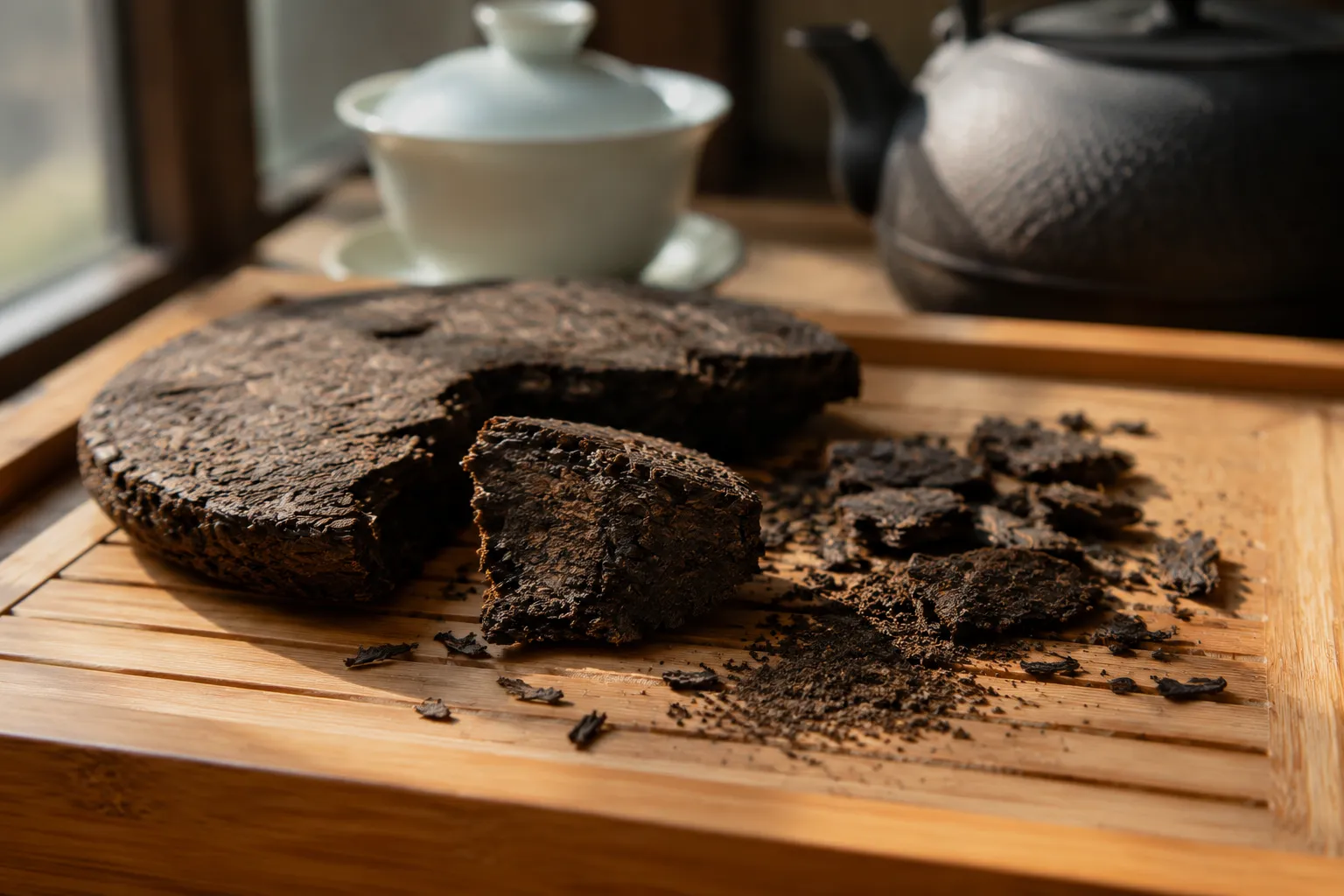
After breaking a cake, brick, tuo cha, or other compressed form, one scoop may hold three different materials: a hard inner chunk, loose edge flakes, and fine dust from prying. They may come from the same tea, but water reaches them differently.
Small flakes and dust often give color and bitterness quickly. A dense tea chunk may stay closed through the first wetting. That is why the first steep of a freshly broken tea cake piece can taste uneven: the loose material rushes ahead while the compressed center is still waking up.
Mostly one dense chunk
Needs a hot opening pour or slightly longer early steep.
Many loose flakes
Can brew quickly; keep early steeps short.
Heavy tea dust
May make the liquor rough, cloudy, or heavy.
Chunk, flakes, and dust together
Brew cautiously and adjust after the first cup.
Work with the piece rather than crushing it smaller. If it has visible layers, loosen along those layers with a tea needle, tea pick, or similar narrow tool, keeping fingers out of the tool path. The goal is not perfect whole leaves. The goal is a portion that wets predictably without turning into powder.
If the piece is already broken, do not keep prying just because it looks compact. Hot water can open compressed tea more gently than force.
Inspect Before Brewing
A quick inspection matters because a fresh break exposes the inside of the cake or brick. You are not trying to judge origin, age, or market value. You are checking whether the piece is fit for the cup in front of you.
Stop before brewing when the piece looks or smells wrong
Do not brew it if you see fuzzy growth, active dampness, wet patches, pest signs, sour rot, a harsh mildew smell, a garbage-like odor, or a damp, moldy texture. Do not taste questionable tea to decide whether it should be used. General food-safety guidance on visible mold supports a conservative home rule here: when the tea shows clear contamination or active damp-storage signs, stop before brewing.
That does not make every earthy aroma a fault. Many dark teas, especially fermented styles, can carry wood, cellar, dried leaf, old paper, earth, or pile-like notes depending on type and storage. The warning signs are more specific: wet, sour, fuzzy, rotten, sharply mildewed, or pest-damaged.
If the broken surface smells clean but closed, continue. If it smells stale or flat without the stop signs above, the first pour can help you decide whether the tea needs opening or simply has weak storage character.
Manage Dust Before the First Wetting
Tea flakes and dust are normal after breaking compressed tea. The problem is proportion.
If the portion has only a light dusting, brew it and keep the first steep short. If the bottom of the scoop is mostly powder, remove some of it before brewing. Tap the portion over a tray, lift out the larger pieces, or use less of the dusty material. A powder-heavy portion can turn rough before the dense chunk has opened.
The broad extraction principle is enough for this task: time, water temperature, and particle size can affect what moves from tea into the cup. Fine particles extract fast; a hard center lags behind. Newly broken compressed tea needs observation, not one fixed steeping rule.
First moves by fragment mix
- Dense chunk with few flakes: hot first wetting, then a short opening steep.
- Loose flakes with little dust: short first steep; taste before extending.
- Dense chunk plus many flakes: quick wetting or rinse, then watch color closely.
- Dust-heavy portion: remove some dust or reduce the leaf amount.
If the first cup is rough, muddy, or too heavy, the tea itself may not be the problem. You may have brewed the dust as if it were a solid chunk.
Choose a Rinse, Opening Steep, or Drinkable First Pour
The first pour after breaking compressed tea has three possible jobs.
Quick rinse
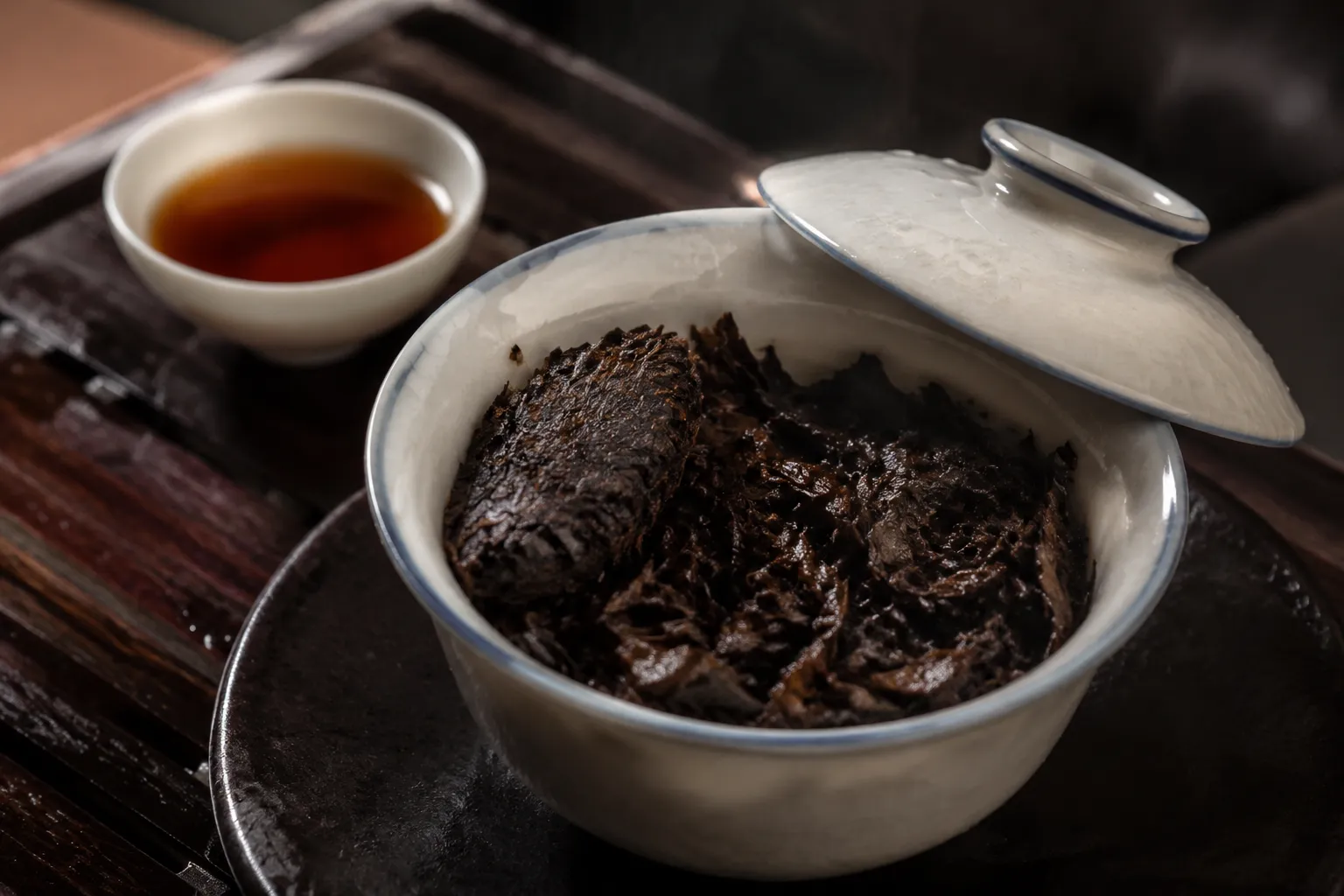
Use a quick rinse when the piece is dusty, tightly compressed, or carrying a storage aroma you want to clear before tasting. Keep it brief: wet the leaves fully, pour off, and smell the warmed leaf. This is common in many small-vessel setups, but it is not required for every tea.
Opening steep
Use an opening steep when the piece is dense but clean-smelling. Pour hot water, steep briefly, and check the liquor. If the cup is thin but aromatic, the next infusion may improve as the piece opens. If it is already dark, heavy, or sharp, shorten the next pour.
Drinkable first pour
Treat the first pour as drinkable when the portion is mostly flakes, smells clean, and opens quickly. Some broken compressed tea gives a pleasant first cup without a discarded rinse, especially when the piece is not dusty and the storage note is settled.
After the first wetting, check the leaf:
- Has the dense chunk loosened at the edges?
- Are flakes floating free while the center remains hard?
- Does the warmed leaf smell clean, musty, sour, sweet, woody, or flat?
- Is the liquor pale and thin, or already dark and heavy?
That information is more useful than deciding in advance that every first pour must be kept or discarded.
Let Dense Tea Chunks Rest Only When They Need It
A dense tea chunk first steep can be frustrating. The surface darkens, but the center remains a hard knot. If that happens, a short covered rest can help.
After a rinse or very short first steep, leave the wet leaves covered in the gaiwan, small pot, or brewing vessel for a few minutes. Treat this as troubleshooting, not a standard schedule. The useful rest time depends on chunk size, compression, water heat, vessel, and leaf amount.
When resting makes sense
- Chunk stays hard after hot water: yes, briefly.
- Leaves are already loose and open: usually no.
- Cup is already harsh or muddy: no; shorten and reduce dust instead.
- Tea has suspicious storage signs: no; do not brew it.
Covered resting is not meant to cook the tea into strength. It lets moisture soften the compressed layers so the next steep extracts more evenly. If the leaf opens enough to separate with gentle movement, continue brewing. If it remains hard, use shorter repeated hot steeps rather than one long extraction that pulls roughness from the loose fragments.
Adjust the Next Steeps by the Cup
Once the first wetting is done, stop treating the portion as a fixed recipe. Read the liquor, aroma, and mouthfeel.
If the cup is thin, pale, or watery, the dense center may not have opened. Extend the next steep slightly, use hotter water if suitable for the tea, or let the wetted piece sit covered a little longer. Thinness with a closed aroma often means the tea needs opening, not more leaf immediately.
If the cup is harsh, gritty, muddy, or too heavy, the fine material may be extracting too fast. Shorten the next steep, reduce loose dust in the next session, or use a little less leaf. If the liquor darkens very quickly, keep the next infusions short until the early rush settles.
If the cup is flat, check three variables before blaming the tea: water heat, storage aroma, and compression. Water that is not hot enough can leave a dense piece dull. A tired or poorly stored piece can smell flat even after opening. A chunk that has not separated may give little aroma until the inner layers wet through.
For many everyday brewing setups, the first two or three infusions are the adjustment zone. Once the compressed tea opens, later steeps usually become easier to read.
Common Confusion With Newly Broken Compressed Tea
Newly broken compressed tea does not always behave like settled loose leaf. The fresh break creates an uneven particle mix, so the first infusion may show the break more than the tea’s full character.
Harder prying does not usually make better brewing. Careful separation is more useful than force. Crushing creates dust, and dust changes timing. A few imperfect flakes are fine; a scoop full of powder is harder to control.
The first rinse is a choice, not a rule. Some drinkers rinse compressed dark tea by habit, while others drink the first pour when the tea is clean and open. For this situation, decide from the piece: dust, density, and storage aroma. A quick rinse helps when the portion is dusty or closed; it matters less when the leaves are already loose and clean-smelling.
Storage language can also confuse the issue. Aged-tea market talk should not make you ignore obvious warning signs. For home brewing, keep the rule plain: do not brew a piece with fuzzy growth, active dampness, pests, rotten odor, harsh mildew, or moldy texture. Do not try to classify growth at the tea table.
A Compact Brewing Sequence
Use this when the broken piece is already in your hand:
- Inspect the dry piece. Stop if you see fuzzy growth, damp patches, pests, rotten odor, harsh mildew, or moldy texture.
- Sort the fragment mix. Notice whether you have a dense chunk, flakes, dust, or all three.
- Remove excess dust if the portion is powder-heavy.
- Wet with hot water suited to the tea and vessel.
- Choose the first pour. Rinse if dusty or storage-heavy; drink or test if clean and open; use an opening steep if dense.
- Rest only if the chunk stays tight after wetting.
- Adjust the next steep. Shorter for harsh, muddy, or heavy liquor; longer for thin, pale, or closed liquor.
This is the narrow answer for brewing compressed dark tea after breaking: inspect, wet, observe, and adjust. The newly broken surface tells you how cautious the first steep should be; the cup tells you what to change next.
Sources
Sources and further reading
Reference links are limited to sources considered suitable for public citation in this page.